★ LATEST REVIEWS

Our Rating: ★★★★☆ 8/10
A great city film finds a single place that can contain the whole society, and then it refuses to leave. The Yacoubian Building does exactly that with a faded, once-grand apartment block in downtown Cairo, filling its flats, offices and rooftop shacks with aristocrats and doormen’s sons, pious businessmen and gay editors, corrupt fixers and desperate young women — and then watching every one of them bargain with the same decaying system. This The Yacoubian Building review comes nearly twenty years after the film’s release, yet the uncomfortable truth is that its portrait of corruption, hypocrisy and squeezed hope in Mubarak-era Egypt has not dated the way its makers probably wished it would.
Directed by Marwan Hamed — astonishingly, this was his first feature — and adapted by his father, the celebrated screenwriter Wahid Hamed, from Alaa Al Aswany’s bestselling 2002 novel, the film was reported at the time as the most expensive production in Egyptian cinema history. It became a national event: record-breaking at home, debated in parliament, submitted as Egypt’s entry for the Academy Award for Best Foreign Language Film, and argued about everywhere Egyptians talked about films. It is not a flawless film. It is long, crowded and occasionally melodramatic. But as a panoramic act of national self-examination smuggled inside a glossy popular drama, very few Arab films of its decade can stand beside it.
| Detail | Information |
|---|---|
| Release date | 21 June 2006 (Egypt) |
| Director | Marwan Hamed |
| Writers | Wahid Hamed (screenplay), based on the novel by Alaa Al Aswany |
| Genre | Drama |
| Language | Arabic |
| Runtime | 165 minutes |
| Budget | Approx. $3.5 million (reported) |
| Lead cast | Adel Emam, Nour El-Sherif, Yousra, Hend Sabri, Khaled El Sawy |
| Our rating | 8/10 |
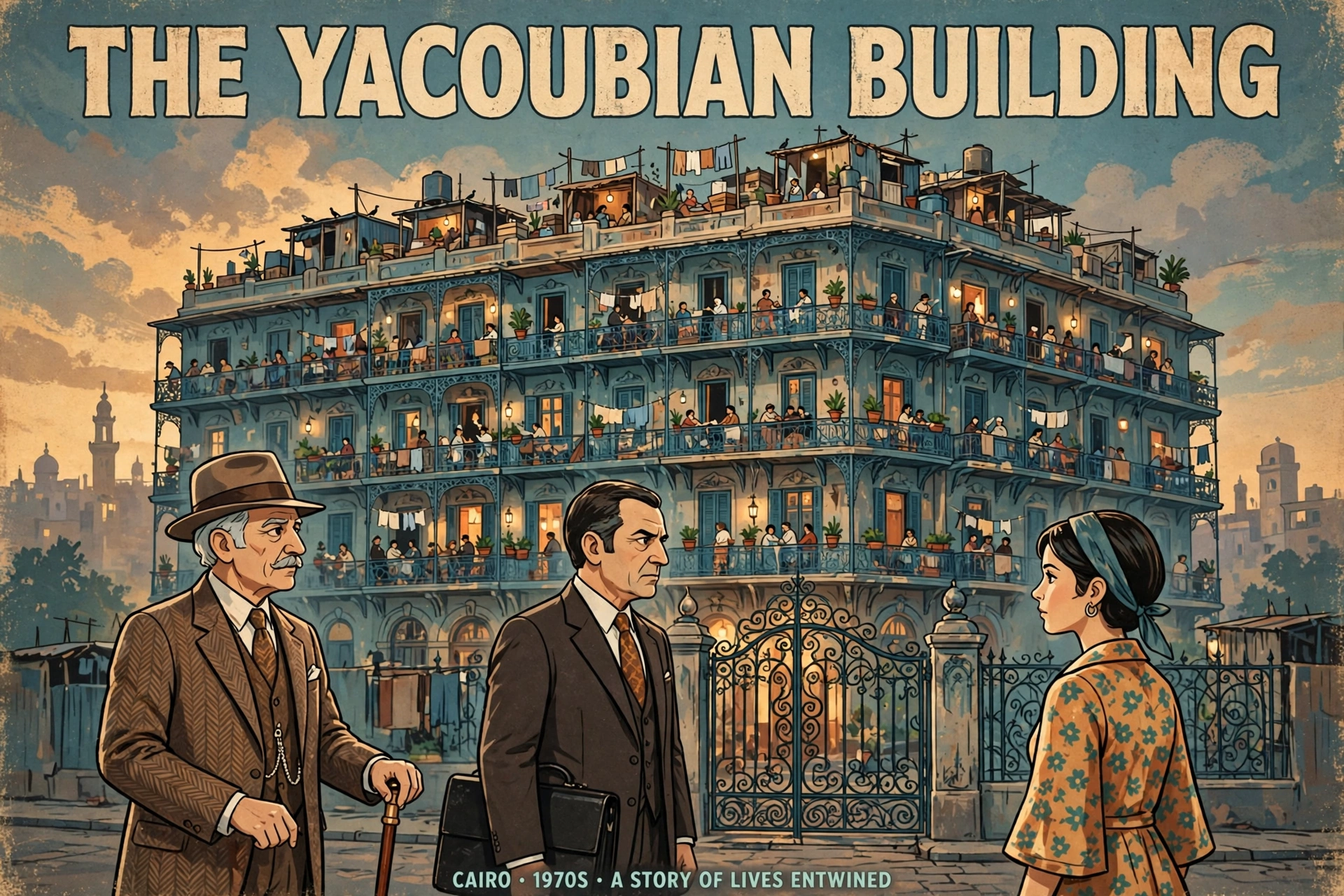
The building itself, standing on a downtown Cairo street in high classical European style, opens the film’s story before any character does: built in an age of cosmopolitan confidence, subdivided and patched ever since, its grand apartments now sit above — literally — a rooftop community of iron shacks housing the families who service the building. Hamed uses that architecture as his map of Egypt, and then walks us through it, story by story.
Zaki Pasha, an ageing, French-educated aristocrat and cheerful womaniser, clings to his office in the building and to a vanished Cairo of elegance, feuding bitterly with his sister Dawlat while finding unexpected late companionship closer to the street than to his class. Haj Azzam, a self-made, outwardly devout businessman who rose from shining shoes to owning dealerships and dreams of a seat in parliament, discovers exactly what political ambition costs in a system where everything and everyone has a broker. Taha, the bright son of the building’s doorman, earns the grades for the police academy and learns, in one humiliating interview, that his father’s job outweighs his own merit — a rejection that sets him searching for belonging in increasingly dangerous company. Busayna, Taha’s girlfriend, navigates a city where holding down a job means enduring the wandering hands of employers, and where economic pressure quietly reprices every principle she was raised with. And Hatem Rasheed, a cultured newspaper editor leading a double life as a gay man in a society that criminalises his existence, tests the limits of money as protection.
These threads, along with fixers, deputies, second wives and rooftop dreamers, cross and comment on one another rather than merging into a single plot. That is the design: no one in the building is the whole story, because no one in Egypt is. We will not reveal where each thread ends — several of them end hard — except to say that the film’s final movement returns, as it must, to the building itself.
Adel Emam as Zaki Pasha is the film’s warm centre, and the casting is itself a statement. Egypt’s defining comedy superstar for decades, Emam here plays charm as a form of melancholy: Zaki’s flirtations, French phrases and old-world manners are a performance the character gives to convince himself his Cairo still exists. Emam lets the act slip in small, unguarded moments — a look at a changed street, a pause before a joke — and the result is one of his finest dramatic performances, funny and quietly desolate at once.
Nour El-Sherif as Haj Azzam matches him with a study in compartmentalised piety. El-Sherif, one of the great serious actors of Egyptian cinema, plays Azzam’s public devotion and private appetite as two complete sincerities that never meet, which is far more unsettling than simple hypocrisy. Hend Sabri as Busayna (credited in some listings as Bothayna) gives the film its most grounded modern performance — Tunisian-born Sabri plays an Egyptian working woman’s compromises without a trace of self-pity, making Busayna’s hard calculations feel like survival, not sin. Khaled El Sawy as Hatem Rasheed took the film’s most dangerous role for an Egyptian actor of the period and plays it with dignity and restraint; whatever reservations one may have about how the storyline is framed by the standards of today, El Sawy never allows Hatem to become a caricature.
The ensemble depth is extraordinary. Yousra as Christine, the singer who shares Zaki’s past and his evenings, brings glamour with real weariness underneath it. Essad Younis as Dawlat makes Zaki’s sister’s bitterness specific rather than shrill. Mohamed Emam as Taha — Adel Emam’s son, in one of his earliest major roles — carries the film’s most political arc with earnest vulnerability, and Somaya El Khashab as Soad, Bassem Samra, Khaled Saleh and Ahmed Bedeir as Malak fill even brief parts with the kind of lived-in assurance that a national cinema with deep bench strength can offer. If there is a complaint, it is that a cast this rich inevitably leaves some performers — Yousra above all — wanting one more scene than the structure can give them.
For a debut director still in his twenties, Marwan Hamed’s control of scale is the film’s quiet marvel. Ensemble dramas of this size usually sprawl; Hamed, working from his father’s tightly carpentered screenplay, keeps each storyline visually and tonally distinct while making the whole film feel like one building breathing. He is helped enormously by the production design and period recreation: set around 1990, at the time of the first Gulf War, the film rebuilds a downtown Cairo suspended between eras — colonial-era facades and marble staircases against satellite dishes and rooftop iron rooms, period cars and shopfronts handled with a care that Egyptian productions of the time rarely afforded. The building’s interiors tell the class story by themselves, from Zaki’s wood-panelled, book-lined office to the cramped rooftop cells a few metres above it.
Sameh Selim’s cinematography gives that world a rich, slightly burnished glow — the famous golden-age sheen of Egyptian studio filmmaking, updated. It flatters the stars, as it is meant to, but it also lingers on decay: peeling paint, crowded landings, streets that no longer match Zaki’s memories. Editor Khaled Marei faces the film’s hardest technical problem, the rotation of five-plus storylines across 165 minutes, and solves most of it with clean, patient cross-cutting that trusts the audience to hold the threads. Not all of it: the middle section undeniably sags, a couple of transitions feel like chapter breaks in search of momentum, and the film’s melodramatic instincts — inherited proudly from classic Egyptian cinema — occasionally push scenes a beat past their natural end. A long ensemble drama must be judged on pacing honestly, and this one asks real patience. It rewards that patience more often than it wastes it, but viewers raised on faster cutting should know what they are committing to: this is a novel on screen, with a novel’s appetite for breadth over speed.
The score is by Khaled Hammad, and it works in the grand, emotional register of classic Egyptian film music — strings-forward, theme-driven, unafraid of sentiment. Hammad gives the building and its city a recurring musical identity that helps unify storylines the plot keeps separate, and he knows when the melodrama needs the orchestra and when a scene of humiliation or tenderness plays stronger with the music pulled back. The film also uses song performance diegetically through Christine’s world of nightclubs and private evenings, where music is part of the old Cairo Zaki refuses to surrender — an elegant touch that lets the soundtrack argue the film’s theme about a culture caught between memory and money. If the score has a fault, it is the same as the film’s: a tendency, at the biggest emotional peaks, to underline what the actors have already achieved. But in the final movement, when threads resolve and the music is allowed its full sweep, the effect is genuinely moving rather than merely loud.
What we loved:
What could be better:
Egyptian box-office reporting of this period comes from press compilations rather than a single audited source, so the honest way to present these figures is in Egyptian pounds, as ranges, with the warning that reports differ. Contemporary reporting in Al Ahram recorded an opening of more than LE 6 million in the film’s first week — at the time the biggest theatrical debut ever reported in Egypt. Totals for the initial theatrical run are reported at around LE 20 million, while other compilations and later retrospectives put the eventual domestic total higher, at over LE 25 million, and describe it as the top local earner of its year. In United States dollar terms those pound figures converted, at 2006 exchange rates, to only a few million dollars — USD equivalents quoted in different sources are approximate and should not be treated as precise. What is not in dispute is the shape of the achievement: on a reported budget of about $3.5 million, then described as the largest in Egyptian cinema history, the film was a major commercial success at home, toured festivals including Berlin and Tribeca — where it won a Best New Narrative Director prize for Hamed — and served as Egypt’s official submission to the 79th Academy Awards.
Yes, if you want to understand modern Egyptian cinema — and modern Egypt as its filmmakers dared to show it — there are few better places to start. The Yacoubian Building is a big, star-filled, unapologetically emotional popular drama that smuggles a fierce social critique inside its gloss, carried by performances from a generation of Egyptian actors at or near their peak. Go in prepared for its length and its novelistic sprawl, and for a middle hour that tests patience before the threads tighten. International viewers should seek a subtitled version and a little patience with unfamiliar rhythms; the reward is a film that treats its audience like adults and its country like a subject worth arguing about.
Our rating: 8/10 — a flawed, sprawling, essential panorama of a society, anchored by great performances.
Is The Yacoubian Building based on a true story?
No, but it is adapted from Alaa Al Aswany’s bestselling 2002 novel of the same name, which drew on recognisable realities of life in downtown Cairo. A real Yacoubian Building does stand in central Cairo, though the film’s characters and events are fictional.
Why was The Yacoubian Building controversial in Egypt?
Its frank treatment of subjects rarely shown in mainstream Egyptian cinema — political corruption, police torture, religious extremism, homosexuality and sexual harassment — drew both praise and protest, including calls by some parliamentarians for the film to be banned or cut. It was released for adult audiences.
Is The Yacoubian Building suitable for family viewing?
No. It is an adult drama containing sexual themes, violence including a torture storyline, and sustained mature subject matter. It is intended for adult viewers.
Do I need to read the novel first?
No. Wahid Hamed’s screenplay stands on its own, though readers of Alaa Al Aswany’s novel will notice compressed and rearranged material — inevitable in adapting a book of this breadth into a single film.
Where can I watch The Yacoubian Building?
It circulates on regional streaming and satellite services in the Arab world and appears periodically on international platforms and festival programmes with subtitles. Availability changes by region, so check your local services.