★ LATEST REVIEWS

★★★★★ Our Rating: 9/10
Some action films want you to admire how efficiently their hero kills. This Léon: The Professional review starts from a different place: what stays with you, thirty years later, is not the gunfire but the milk, the houseplant, and a man who has learned how to disappear so completely that he has almost disappeared from his own life. Luc Besson’s 1994 French, English-language thriller remains one of the most imitated films of its decade, and also one of the most argued about — tender and troubling in the same breath, stylish to a fault, and carried by three performances that pull in completely different directions and somehow hold.
That tension is the film. A professional killer who lives by rules, a twelve-year-old who has never really been allowed to be a child, and a corrupt lawman who behaves like a force of nature rather than a person — put them in the same few blocks of New York and something has to break. Besson does not rush the breaking. He lets quiet domestic scenes sit next to sudden violence, and trusts the audience to feel the discomfort of caring about people in a situation that should not be sentimentalised. It does not always get that balance right, which we will come to, but when it works, it works completely.
| Detail | Information |
|---|---|
| Release date | 14 September 1994 |
| Director | Luc Besson |
| Writers | Luc Besson |
| Genre | Action, Crime, Drama, Thriller |
| Language | English |
| Runtime | 110 minutes |
| Budget | $16 million |
| Lead cast | Jean Reno, Natalie Portman, Gary Oldman, Danny Aiello |
| Our rating | 9/10 |
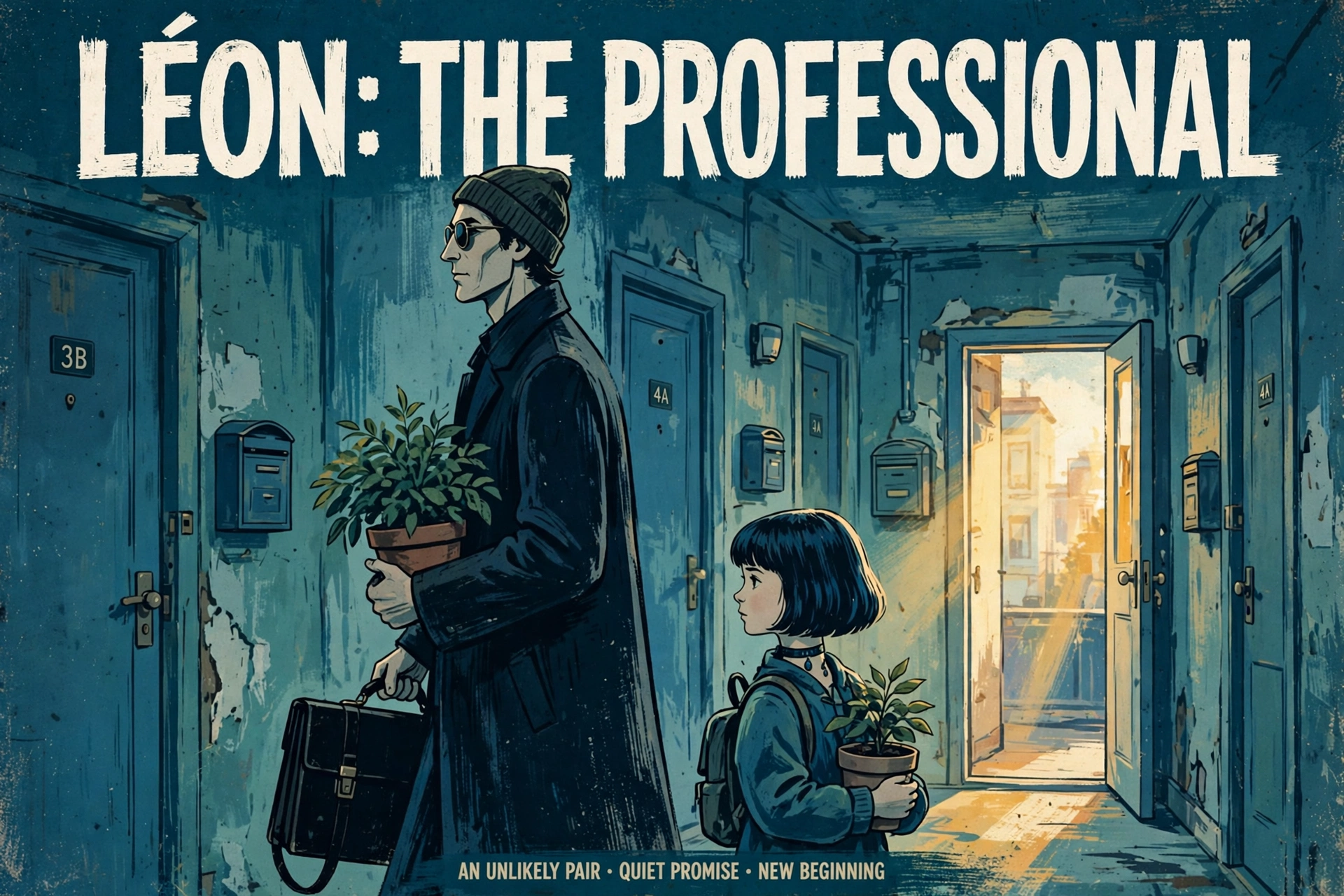
Léon Montana (Jean Reno) works in Little Italy, New York, as what he calls a cleaner. His employer, Tony (Danny Aiello), hands him assignments, holds his earnings, and gives his rootless existence just enough structure to function. Léon lives alone in a small apartment, sleeps sitting up in a chair, drinks milk, tends a single houseplant he treats as his closest companion, and follows a strict personal code — most famously, no women, no children.
Down the same hallway lives Mathilda Lando (Natalie Portman), a twelve-year-old in a chaotic, neglectful household. Her father is storing drugs for corrupt Drug Enforcement Administration officers, a decision that puts the whole family in danger. When Mathilda returns from an errand to find that danger has erupted, she makes a split-second decision at Léon’s door that binds their lives together.
What follows is built from that premise and we will not carry it further here. Mathilda wants revenge. Léon wants to return to his invisible routine. Neither gets what they planned. Through training, arguments, small acts of care and escalating risk, an unlikely household forms — one that draws the attention of Norman Stansfield (Gary Oldman), the pill-popping, Beethoven-loving DEA agent whose volatility drives the film’s threat. The shape of the story is a thriller, but its engine is really a question: can two people who have only known violence and neglect teach each other something gentler before the world outside the apartment catches up with them?
A note on versions is honest and necessary: the 110-minute theatrical cut is the version most audiences first saw. Longer international and director’s versions, running roughly 133 to 136 minutes, restore additional material centred on Léon and Mathilda’s time together. This review is based on the theatrical cut, and viewers choosing a longer version should know the emphasis shifts noticeably.
Jean Reno as Léon gives the performance the whole film leans on, and he does it with stillness. Reno plays Léon as a man of limited words and careful rituals, someone emotionally far younger than his years because his life has allowed him almost no ordinary human experience. That could have become a caricature — the simple killer with a pure heart — but Reno keeps finding small, specific details: the pride in the plant, the shy pleasure at an old musical on television, the bewilderment when Mathilda cries and he has no script for comfort. His action work is clean and unshowy, which makes the character’s competence believable, but it is the hesitations that make him memorable.
Natalie Portman as Mathilda, in her feature film debut, is extraordinary and, at times, difficult to watch in exactly the way the role intends. Mathilda is precocious not because the film finds it cute, but because neglect has forced her to perform adulthood early. Portman holds anger, bravado, grief and childish need in the same scenes without smoothing them into one note. Her scenes mourning her younger brother are the film’s emotional centre, and they keep the story honest: whatever else Mathilda asks for, she is a bereaved child first. Critics at the time and since have debated how Besson frames some of Mathilda’s behaviour — that debate is legitimate, and we return to it below — but Portman’s talent itself has never been the question.
Gary Oldman as Norman Stansfield chooses the opposite of Reno’s restraint and launches himself at the ceiling. Stansfield sniffs, twitches, lectures on classical music and erupts without warning; the famous demand for “everyone” has become shorthand for the performance, but the quieter menace is just as effective, the moments when Oldman goes soft-voiced and reasonable seconds before violence. Some viewers will find it too much. In context, the excess has a purpose: Stansfield is what power without any code looks like, set against Léon’s narrow but real one.
Danny Aiello as Tony supplies warmth with an edge. His restaurant scenes with Léon feel affectionate, almost fatherly, yet Aiello lets a hint of exploitation sit underneath — Tony benefits from Léon’s isolation, and the film knows it, even if it never fully interrogates it.
Besson directs New York as a French visitor in love with American genre cinema might see it: heightened, compressed and slightly unreal. Hallways become theatres, stairwells become traps, and an ordinary apartment building is filmed with the reverence other directors reserve for palaces. Thierry Arbogast’s cinematography favours strong contrasts and restless framing, using tight close-ups to trap characters in doorways and mirrors. The opening assignment, in which Léon seems to materialise out of darkness itself, announces the film’s visual grammar in minutes — this is realism abandoned in favour of myth, deliberately.
Sylvie Landra’s editing is crucial to that effect. Besson cuts domestic calm and sudden violence against each other without warning, and Landra keeps the transitions legible even when they are shocking. The final act’s cross-cutting, as pressure closes in from several directions at once, is a model of escalating clarity: you always know who is where, which is precisely why the dread builds instead of dissolving into noise.
The production design works on suggestion rather than scale. Léon’s bare apartment, Tony’s old-world restaurant, Stansfield’s stark institutional spaces — each location tells you how its occupant lives. If the craft has a weakness, it is that Besson’s love of the striking image occasionally outruns plausibility: police and tactical sequences obey the needs of spectacle more than any recognisable procedure. The film asks you to accept its heightened world early, and rewards you if you do, but viewers who need procedural credibility will bump against it throughout.
Éric Serra, Besson’s long-time collaborator, provides a score that moves between cold electronic pulses for the professional world and warmer, more melodic material for the apartment scenes. The contrast does real narrative work: Léon’s life literally sounds different once Mathilda is in it. Serra avoids scoring every action beat for maximum impact, which was unusual for a 1990s thriller, and lets silence and room tone carry several of the tensest exchanges.
The film’s closing use of Sting’s “Shape of My Heart” has become inseparable from its reputation. Used over the final movement, the song’s reflections on masks, luck and profession land with a directness that could have felt obvious and instead feels earned, because the film has spent two hours showing you a man who never learned to take his mask off. Classical music also matters inside the story itself — Stansfield’s reverence for Beethoven is presented as both genuine taste and grotesque self-image, culture used as a costume for cruelty, and the juxtaposition remains one of the film’s sharpest ideas.
What we loved:
What could be better:
Léon was made for a reported $16 million, a modest sum even in 1994 for a film with this much action. Its original theatrical run earned around $45.3 million worldwide — most databases agree on that figure, though some French sources list a slightly higher total of about $46.1 million, so reports differ a little depending on the source and what later reissues are counted. By the standards of a blockbuster that is respectable rather than spectacular, and it undersells the film’s real commercial story.
The real story happened afterwards. On video, then DVD, then streaming, Léon became one of those rare titles that each new generation seems to discover for itself. Its imagery — the plant, the milk, the long coat, the bob haircut — entered popular culture far beyond what its theatrical gross would predict, and Portman’s debut and Oldman’s villain became reference points for an entire era of thrillers. Judged purely on its first run it was a solid hit; judged on thirty years of cultural presence, it is one of the most successful French films ever made in the English language.
Yes — with clear eyes. Watch it for Reno and Portman, for Besson’s visual confidence, and for a thriller that understands silence can be more affecting than gunfire. Go in knowing that its central relationship has been debated since the day it opened, that the debate is part of the film’s history, and that the theatrical cut is the most balanced place to start. If heightened, operatic crime stories are your taste, few films of the 1990s deliver this combination of style and feeling.
Our rating: 9/10 — a stylish, moving and morally complicated classic whose performances outshine its controversies and its implausibilities alike.
Is Léon: The Professional a French film or an American film?
It is a French production, written and directed by Luc Besson and produced by Gaumont, filmed largely in New York and performed in English. That combination — French authorship, American setting — is a big part of its distinctive flavour.
What is the difference between the theatrical cut and the director’s cut of Léon?
The theatrical cut runs about 110 minutes. Longer versions run roughly 133 to 136 minutes and restore extended sequences of Léon training Mathilda and of their life together. The longer material changes the film’s emphasis, so many first-time viewers prefer to start with the theatrical version.
Was Léon Natalie Portman’s first film?
Yes. She was cast at eleven and the film, released when she was thirteen, was her feature debut. Her performance was widely praised and it launched one of the most notable acting careers of her generation.
Is Léon: The Professional suitable for children?
No. Despite a child being one of its leads, this is an adult film with strong violence, drug references and mature themes throughout. It is intended for older teens and adults.
Where can I watch Léon: The Professional?
It is widely available on streaming, rental and disc in most regions, in both theatrical and extended versions. Availability rotates between services, so check your local platforms and confirm which cut is listed before watching.