★ LATEST REVIEWS

★★★★☆ Our Rating: 7/10
Of all the films in director Lokesh Kanagaraj’s crime universe, Leo, released on 19 October 2023, arrived with the heaviest baggage: a superstar in Vijay who rarely plays this dark, a beloved source premise about a peaceful man with a violent history, and the expectation that it would expand the Lokesh Cinematic Universe built by Kaithi and Vikram. This Leo review reaches a divided verdict, because the film itself is divided. Its first half is some of the finest sustained work of Lokesh’s career — tense, stylish and powered by a superbly restrained Vijay. Its second half, built around a flashback the film never quite earns, is noticeably weaker, and the universe connections feel bolted on rather than grown. The result is a good action thriller that should have been a great one.
That judgement still leaves plenty to recommend. Leo is technically formidable, its action choreography is inventive, its score is a phenomenon in its own right, and Vijay gives what many consider one of his two or three best performances. The film was also a major commercial success despite mixed word of mouth, which tells its own story about the draw of this actor-director combination. The task here is to separate the craft from the clutter.
| Detail | Information |
|---|---|
| Release date | 19 October 2023 |
| Director | Lokesh Kanagaraj |
| Writers | Lokesh Kanagaraj, Rathna Kumar, Deeraj Vaidy |
| Genre | Action, Thriller |
| Language | Tamil |
| Runtime | 164 minutes |
| Budget | Approx. ₹250–400 crore (reports vary widely) |
| Lead cast | Vijay, Trisha, Sanjay Dutt, Arjun Sarja |
| Our rating | 7/10 |
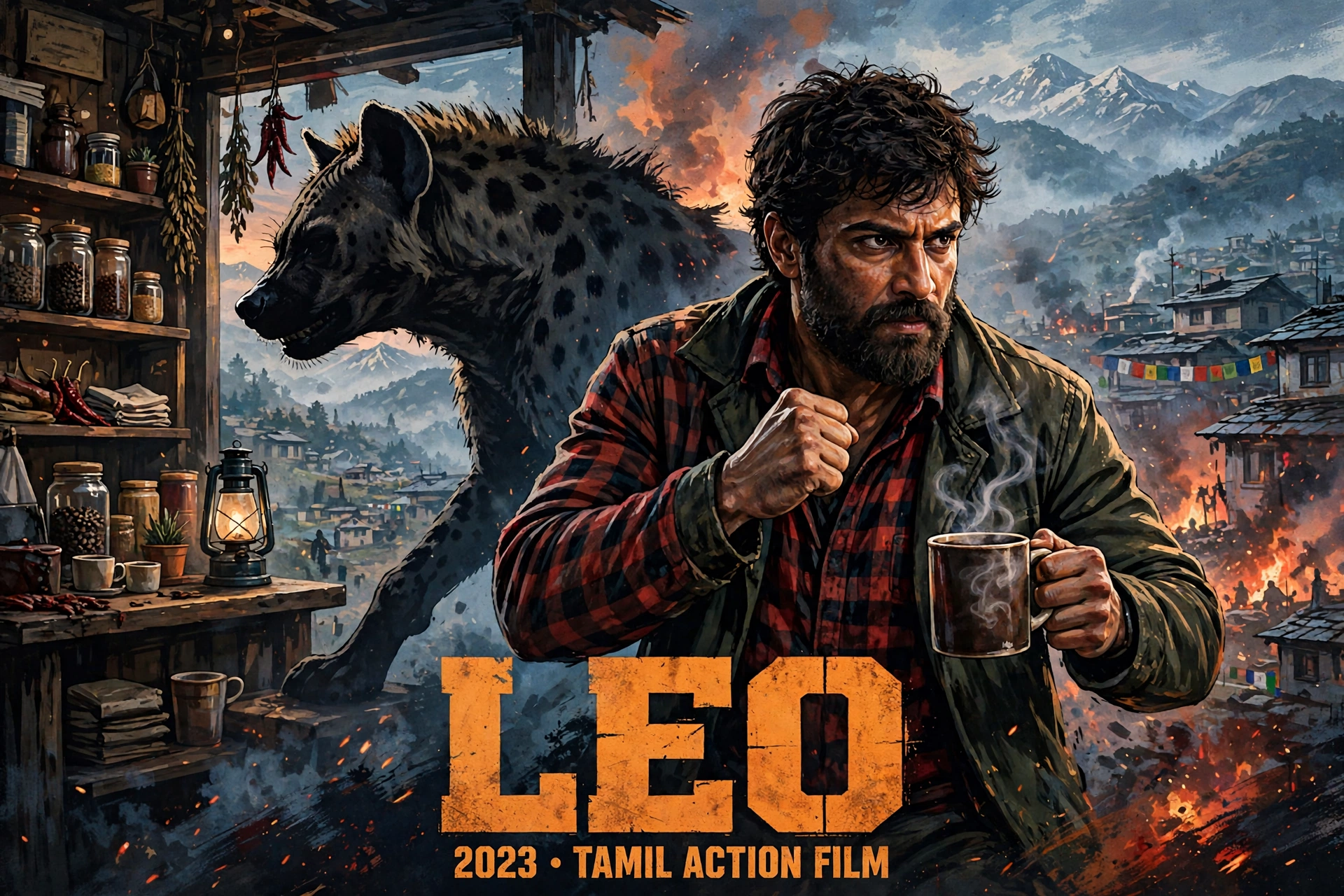
Parthiban, called Parthi (Vijay), runs a café in Theog, a small town in Himachal Pradesh, where he lives with his wife Sathya (Trisha) and their two children. He is gentle, respected and known locally for helping the forest department deal with wild animals — the film opens with a striking episode involving a hyena loose in the town, which establishes both his courage and his reluctance to use it. Parthi’s life is ordinary in the best way, and the film takes care to make that ordinariness warm and specific before destroying it.
The destruction arrives in stages. When armed robbers attack his café, Parthi is forced to defend his staff and family, and the skill with which he does so becomes a local news story. The story travels. Soon men from a powerful drug cartel in Tamil Nadu, run by the brothers Antony Das (Sanjay Dutt) and Harold Das (Arjun Sarja), come looking — because the face in the news resembles someone they believe is dead: Leo Das, a name spoken in their world with a mixture of pride and dread. Parthi insists, again and again, that they have the wrong man. The cartel refuses to accept it, a forest officer who knows more than he says watches from the sidelines, and the pressure on Parthi’s family escalates from threats to something far worse.
Whether Parthi is Leo is the question the entire film is built on, so we will not answer it here. What can be said is that the film takes its broad inspiration — acknowledged by the director — from the premise of a man whose hidden past returns to claim him, and that its answer arrives through a flashback whose execution divided audiences sharply. The present-day story, of a family man cornered by his own legend, is consistently the stronger material.
Vijay as Parthiban is the reason to watch Leo. Lokesh asks him to suppress almost everything his stardom usually sells — there is no swagger for long stretches, no punch-dialogue comfort — and Vijay responds with a performance of fear, guilt and barely contained violence. His Parthi is a man physically recoiling from his own capabilities, and the scenes in which that control cracks are electric. When the film does let him unleash, the release feels earned rather than routine. It ranks among the most committed work of his career, and it carries the film across its weakest passages.
Trisha as Sathya reunites with Vijay to warm audience memory, but the role is more than nostalgia casting. Sathya’s growing suspicion — her dawning sense that the man she married has a locked room inside him — gives the film its emotional stakes, and Trisha plays doubt and devotion in the same breath. Their domestic scenes are the film’s most human writing.
Sanjay Dutt as Antony Das and Arjun Sarja as Harold Das present the review’s hardest honesty: both actors have the presence the roles require, and both are underwritten. Antony is introduced as a figure of dread but the flashback material gives him more exposition than menace, while Harold, despite a stylish entry and Arjun’s physical authority, is given surprisingly little consequential action until late. The failure is in the writing, not the casting. In the supporting ranks, Gautham Vasudev Menon as Joshy Andrews brings quiet intelligence to the investigating officer, George Maryan as Napoleon — a character carried across from the universe’s earlier films — is affecting in a small role, and Mysskin and Mathew Thomas contribute solidly in their parts.
Lokesh Kanagaraj’s direction of action and atmosphere remains elite. Manoj Paramahamsa’s cinematography gives Theog a cold, blue-grey beauty that contrasts sharply with the warmer, dustier tones of the Tamil Nadu cartel passages, and the night photography in the café sequences is genuinely handsome. The action design is the film’s signature: a café fight, a market chase and a large-scale highway pursuit are staged with geography you can follow and impacts you can feel, and Philomin Raj’s editing keeps the first half moving like a held breath. Lokesh’s use of the camera in long, roaming takes during confrontations shows a director still evolving his craft.
The problems are in the screenplay, credited to Lokesh with Rathna Kumar and Deeraj Vaidy. The flashback at the film’s centre is brief, generic and oddly weightless for material meant to explain a legend; characters the present-day story has built carefully are sidelined while it runs. The much-discussed connection to the wider Lokesh Cinematic Universe is handled through references and a late development that many viewers found forced — the film works noticeably better as Parthi’s standalone story than as a universe chapter, and its most contrived moments all serve the franchise rather than the family at its heart. A subplot involving a serial killer in Theog feels imported from another film entirely. Lokesh has since been candid that this is not his most satisfied work, and the film itself shows why: the director’s gifts are everywhere except in the connective tissue of his own script.
If one department can be called an unqualified triumph, it is Anirudh Ravichander’s music. The background score is the film’s second lead performance: the “Badass” theme material turns Vijay’s eruptions into events, while quieter motifs keep Parthi’s dread humming under domestic scenes. The score was so central to the film’s marketing and theatrical experience that audiences arrived already knowing its signatures — a rare case of a composer functioning as a box-office draw in his own right. The songs are more uneven: “Naa Ready” is a full-blooded star number staged with flair, while “Ordinary Person” and the gentler tracks serve the family passages pleasantly without lingering. Anirudh’s work papers over the second half’s cracks so effectively that the film plays better than it reads — high praise and a warning in one.
What we loved:
What could be better:
The commercial story of Leo is one of a gigantic launch followed by a faster-than-hoped cooling, and its final figures are reported as estimates rather than a single settled number: most sources place the worldwide gross between roughly ₹595 crore and ₹615 crore. The budget is even less settled, with reports ranging from about ₹250 crore to as high as ₹400 crore — an unusually wide spread that we report as a range rather than pretend to resolve. What is not in dispute is the opening: the film registered one of the biggest first days ever for an Indian film, set opening records for a Tamil film in several overseas markets, and became the highest-grossing Tamil film of 2023 despite reviews that were clearly mixed. The lesson of its run is that the Lokesh–Vijay combination opened like a phenomenon, and that stronger second-half writing might have carried it considerably further.
Yes, with expectations set correctly. Watch Leo as a star performance wrapped in a stylish thriller, not as the universe-expanding event it was sold as, and its first half alone justifies the evening. Fans of Kaithi and Vikram should know this is the loosest of the three films, but also the one with the most interesting acting at its centre. If you have never seen Vijay play against his image, this is the film that proves what he can do when a director asks him to.
Our rating: 7/10 — a gripping first half and a superb Vijay, held back by a weak flashback and franchise obligations.
Is Leo part of the Lokesh Cinematic Universe (LCU)?
Yes, it is positioned as the third entry in Lokesh Kanagaraj’s universe after Kaithi and Vikram, with characters and references linking it to both — though many viewers felt the connection was less organic than in the earlier films.
Is Leo a remake of A History of Violence?
Not a remake, but Lokesh Kanagaraj has acknowledged the David Cronenberg film’s premise — a quiet family man whose violent past resurfaces — as an inspiration, and the debt is openly credited in the film.
How violent is Leo?
It is a violent action thriller with intense fight sequences and dark subject matter including drug cartels. It is aimed at adult audiences and older teens, not young children.
Do I need to watch Kaithi and Vikram before Leo?
The main story stands on its own, but a few characters and references will mean more if you have seen the earlier films. Watching Vikram first gives the most context for the universe links.
Where can I watch Leo?
The film moved to streaming after its theatrical run, in Tamil and dubbed versions. Regional availability varies, so check your local platforms.