
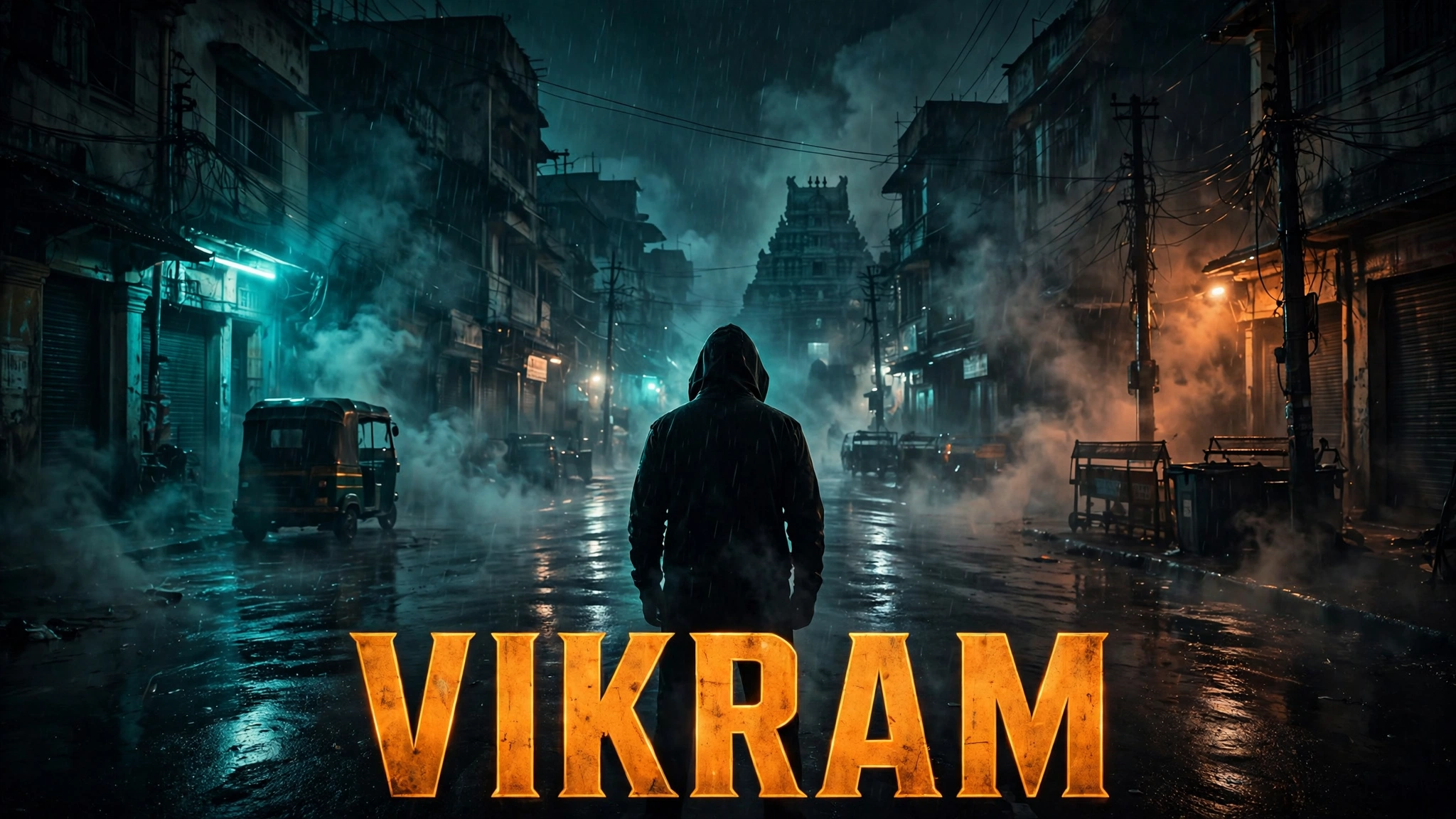

Vikram (2022) Review – Once Upon a Time, There Lived a Ghost
There is a moment, deep into Vikram, when Kamal Haasan’s character finally stops hiding and the film exhales — you can feel an entire theatre lean forward. Released on 3 June 2022, Lokesh Kanagaraj’s Tamil action thriller was engineered as both a comeback vehicle for a legend and the cornerstone of an ambitious shared universe. It succeeded at both, becoming one of the biggest Tamil hits of its year.
But Vikram is also a film with a divided personality: a grounded police procedural in its first half and a full-throttle mass action spectacle in its second. Does the split work? In this review we examine the story, the three powerhouse performances at its centre, the craft, the music and the money — honestly, including where the film overreaches.
Quick Facts: Vikram at a Glance
| Detail | Information |
|---|---|
| Release date | 3 June 2022 |
| Director | Lokesh Kanagaraj |
| Writers | Lokesh Kanagaraj, Rathna Kumar |
| Genre | Action, Thriller |
| Language | Tamil (dubbed in Hindi, Telugu, Malayalam, Kannada) |
| Runtime | 174 minutes |
| Budget | Approx. ₹120 crore (estimates range up to ₹150 crore) |
| Lead cast | Kamal Haasan, Vijay Sethupathi, Fahadh Faasil |
| Our rating | 8/10 |
The Story: A Drug Empire, a Dead Officer and a Man Who Should Not Exist (Spoiler-Free)
Chennai is drowning in a new wave of narcotics, and the police are losing. When a series of masked murders claims senior officers — including a young anti-drug cop named Prabhanjan — the department hands the case to Amar (Fahadh Faasil), the meticulous head of a black-ops unit that officially does not exist. Amar’s investigation keeps circling one strange figure: Karnan, the cheerful, hard-drinking foster father of Prabhanjan’s orphaned baby, a man whose grief seems genuine and whose past seems carefully, almost professionally, empty.
On the other side of the law stands Sandhanam (Vijay Sethupathi), a swaggering drug lord building an empire on a mountain of contraband, desperate to impress a shadowy syndicate known only through its enforcer — a name whispered in the underworld: Rolex. Sandhanam’s hunger for a missing shipment of raw drugs and Amar’s hunt for the masked killers pull both men towards the same impossible conclusion: that a legendary agent named Vikram, leader of a black-ops squad wiped out decades ago, may not be as dead as the records claim.
That is the setup, and you should learn no more before watching. Vikram is a spiritual successor to Kamal Haasan’s 1986 film of the same name and a follow-up to Lokesh Kanagaraj’s Kaithi (2019), and it weaves its drug-war plot around grief — nearly every major character is fighting for a child, a family or a memory.
Performances: Three Aces, One Table
Kamal Haasan as Vikram / Karnan delivers a masterclass in delayed gratification. For much of the first half he plays an ordinary, eccentric older man — funny, warm, slightly drunk — while the film lets you sense the machinery underneath. When the mask drops, the transformation is electrifying rather than camp: this is a veteran who has thought carefully about how a 60-something agent would actually fight, all economy and cruelty. It is his finest screen turn in years, and the rare comeback that respects the actor’s age instead of hiding it.
Fahadh Faasil as Amar effectively carries the film’s first half, and he is superb — precise, unsentimental, and quietly funny in his domestic scenes. Amar’s investigation gives the audience its eyes, and Fahadh makes procedural legwork feel like a thriller in itself. The disappointment, widely noted, is that once Vikram takes centre stage, Amar is pushed towards the margins of his own movie.
Vijay Sethupathi as Sandhanam is gleefully unhinged: gold-toothed, drug-fuelled, forever chewing through scenes with his brood of wives and children in tow. It is a performance on the edge of caricature that Sethupathi keeps human through sheer unpredictability. The extended ensemble supports them well — Narain as Bejoy, Arjun Das as Anbu (imported from Kaithi), Kalidas Jayaram as Prabhanjan — and then there is the late-arriving cameo by Suriya as Rolex, barely a few minutes long, which detonates the theatre and sets up the universe’s future. Few cameos have ever done more with less.
Direction and Technical Brilliance
Lokesh Kanagaraj directs with a fan’s love and a technician’s discipline. His action grammar, developed with stunt duo Anbariv, favours long, readable takes and inventive use of space: a fight staged inside a house during a child’s birthday, an interval block that turns a mansion siege into a crescendo, a climactic assault involving weaponry the film has been quietly seeding for an hour. Girish Gangadharan’s cinematography keeps Chennai rain-slicked and shadowy, and Philomin Raj’s editing is at its best in the investigation stretches, cross-cutting between Amar’s deductions and the truths the audience is slowly allowed to see.
The flaws are structural. At 174 minutes, the film’s middle sags under exposition, with the universe-building material — returning characters, syndicate mythology, sequel hooks — occasionally crowding out the emotional story of a grandfather avenging his son. Some viewers will also find the second half’s escalation into near-invincible heroics a betrayal of the first half’s grounded tension. Both halves are well made; they simply belong to slightly different films.
Music and Background Score
Anirudh Ravichander’s score is half the reason Vikram works as a theatre experience. His main theme — built around a menacing chant of the title — has become one of the most recognised motifs in modern Tamil cinema, and he deploys it with restraint early and abandon late, so the interval and climax genuinely feel earned. The songs are used sparingly: “Pathala Pathala,” performed by Kamal Haasan himself, is a rowdy celebration track, while “Porkanda Singam” carries the emotional charge of the backstory. If anything, the score occasionally shouts over scenes that silence would have served better — but as mass-cinema scoring goes, this is top-tier work.
What Works and What Doesn’t
What we loved:
- Kamal Haasan’s layered, age-honest star performance
- Fahadh Faasil’s gripping investigative first half
- Inventive, clearly staged action with real escalation
- Anirudh’s score and a finale cameo that breaks the internet-era record for impact per minute
What could be better:
- Amar’s character is sidelined in the second half
- At 174 minutes, the middle stretch is exposition-heavy
- The tone shifts from grounded thriller to superhero spectacle, which will not suit everyone
Box Office: The Legend, Vindicated
Produced by Kamal Haasan’s own Raaj Kamal Films International on a budget most sources place around ₹120 crore (some reports go up to ₹150 crore), Vikram needed to be a hit — and became a phenomenon. Reported worldwide grosses vary between roughly ₹424 crore and ₹500 crore depending on the source, making it one of the highest-grossing Tamil films of all time at its release and the biggest hit of Kamal Haasan’s long career. Just as importantly for its makers, it established the “Lokesh Cinematic Universe” as a commercially real proposition, linking Kaithi and setting up future chapters.
A Note on the Universe Building
Because Vikram doubles as a franchise foundation, it is worth judging how gracefully it does that job. On the credit side, the connections to Kaithi are mostly woven into the drug-war plot rather than pasted on top of it: the missing consignment, the syndicate structure and returning faces all serve this film’s own story before they serve any sequel. On the debit side, viewers who arrive without Kaithi will feel a few scenes playing to knowledge they do not have, and the final stretch spends real screen time introducing future players at the expense of closing this film’s own emotional arcs. It is a better-than-average example of universe building — impatient viewers should simply treat the homework as worthwhile, because Kaithi is an excellent film in its own right.
Verdict: Should You Watch It?
Yes — especially if you enjoy action thrillers built around investigation rather than noise. Vikram is overlong and its two halves do not perfectly agree with each other, but its highs — Haasan’s return, Fahadh’s procedural grip, the action design, that cameo — are very high indeed. Watch Kaithi first for the full effect.
Our rating: 8/10 — a smart, muscular thriller that launches a universe without forgetting to be a film.
Frequently Asked Questions
Is Vikram connected to Kaithi?
Yes. Vikram is set in the same world as Lokesh Kanagaraj’s Kaithi (2019), shares characters such as Anbu and Bejoy, and continues its drug-war storyline. It is also a spiritual sequel to Kamal Haasan’s 1986 film Vikram.
Who plays Rolex in Vikram?
Suriya appears as Rolex in a brief but pivotal cameo near the end. The character is positioned as a major figure for future films in the universe.
Is Vikram suitable for family viewing?
It is a violent action thriller with drug-related themes and intense sequences, certified U/A in India. It is best suited to older teens and adults.
Will there be a Vikram sequel?
The film ends by expanding its universe rather than closing it, and Lokesh Kanagaraj has spoken of further films connecting these characters. Watch Kaithi and future LCU entries for the continuing thread.
Where can I watch Vikram?
The film has streamed on major platforms in Tamil and dubbed versions after its theatrical run. Availability varies by region, so check your local service.