★ LATEST REVIEWS

★★★★★ Our Rating: 9/10
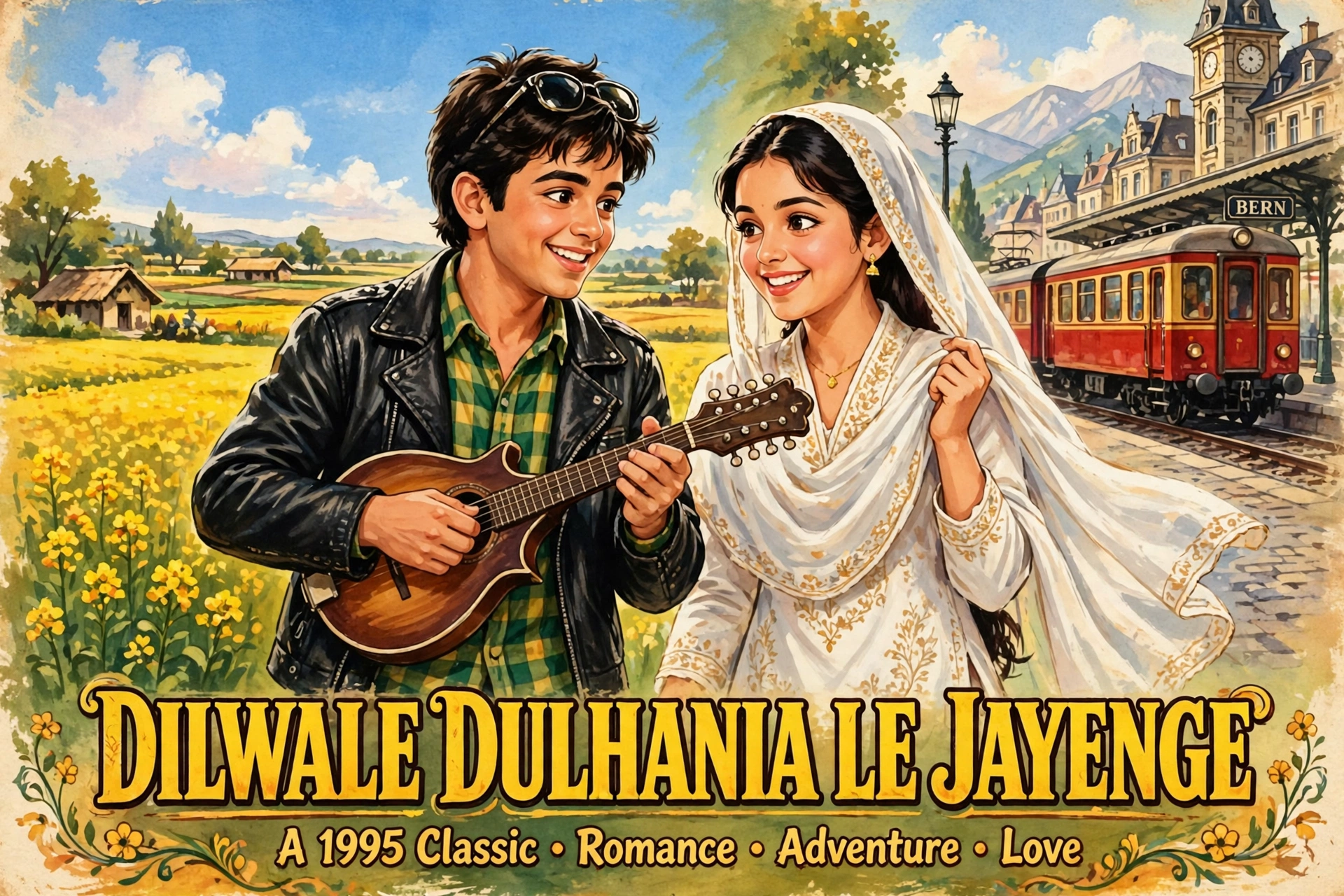
Some films are released. Dilwale Dulhania Le Jayenge was installed — in cinemas, in wedding playlists, in the muscle memory of a generation. Released on 20 October 1995, Aditya Chopra’s directorial debut ran at Mumbai’s Maratha Mandir theatre for over a thousand weeks, becoming the longest-running film in Indian cinema history. Its hero’s name became a byword for romance; its climax is re-enacted at railway stations by couples to this day; and its central bargain — win the girl by winning her father — quietly rewired what a Bollywood love story was allowed to be.
This Dilwale Dulhania Le Jayenge review tries to do what thirty years of devotion makes difficult: judge the film, not the phenomenon. The verdict upfront: the phenomenon is earned. Shah Rukh Khan and Kajol share the most electric chemistry in Hindi film history, the second half in Punjab is close to perfect popular filmmaking, and the film’s flaws — a padded first hour, comedy that has dated, ideas about women that belong firmly to 1995 — are real but cannot sink it. Here is the full argument.
| Detail | Information |
|---|---|
| Release date | 20 October 1995 |
| Director | Aditya Chopra |
| Writers | Aditya Chopra (story and screenplay); Javed Siddiqui (dialogues) |
| Genre | Romance, Drama, Comedy |
| Language | Hindi |
| Runtime | 189 minutes |
| Budget | ₹4 crore |
| Lead cast | Shah Rukh Khan, Kajol, Amrish Puri, Farida Jalal, Anupam Kher |
| Our rating | 9/10 |
Raj Malhotra (Shah Rukh Khan) and Simran Singh (Kajol) are both London-raised children of Indian immigrants, and they could not be built more differently. Raj is the spoiled, flunking, piano-playing son of a rich and doting father (Anupam Kher) — a boy who has failed at everything except enjoying himself. Simran is the dutiful elder daughter of Chaudhary Baldev Singh (Amrish Puri), a stern shopkeeper who has lived in London for decades without letting London live in him, and who has already promised Simran’s hand to the son of his old friend back in Punjab.
Fate, in the form of a missed connection and a month-long European rail trip with friends, throws the two together. The first half of the film is their sparring courtship across Switzerland and beyond — missed trains, forced detours, a drunken night neither fully remembers, and a slow, reluctant warming that both refuse to name until the trip ends and the naming is suddenly urgent. Then the film executes its famous turn: instead of eloping, Raj follows Simran to Punjab and sets out to win her the hard way — by becoming indispensable to the very household that has promised her to another man, and by earning the blessing of the one person determined never to give it. Whether he succeeds, and at what cost, is a climax so beloved that describing it feels unnecessary — and we will not spoil its mechanics here for the few who somehow do not know.
Shah Rukh Khan as Raj gives the star-making performance of the decade. The early Raj should be insufferable — a rich brat who treats Europe as his playground — and it is a measure of Khan’s charm offensive that he is delightful instead: the raised eyebrow, the stammer of mock-innocence, the grin that admits he is lying before the words arrive. But the performance deepens in Punjab, where Raj’s comedy acquires patience and even dignity; watch how Khan plays a young man choosing, scene after scene, not to take what he could simply take. The role made him the defining romantic hero of his generation, and it is not hard to see why.
Kajol as Simran is his perfect counterweight — and “counterweight” is the operative word, because Simran is nobody’s prize. Kajol plays her as bright, romantic and quietly furious at the cage of obedience she was raised in; her Simran dreams in secret, writes poetry, and falls in love with her eyes open. The famous scene in which she begs to be allowed one month of freedom before her arranged marriage, and the trembling control of her Punjab scenes opposite Amrish Puri, show an actress holding a big commercial film’s emotional centre without ever raising her voice. Together, Khan and Kajol produce the thing casting directors dream about and cannot buy: an ease with each other that makes every other romance of the era look rehearsed.
Amrish Puri as Chaudhary Baldev Singh is the film’s third lead in everything but billing. Puri, fresh from years of screen villainy, finds the steel and the sorrow in a man whose rigidity is not cruelty but terror — terror that exile will dissolve everything he is. His final scenes carry the film’s entire thesis, and Puri plays them with a granite restraint that makes the resolution land as grace rather than surrender. Farida Jalal as Lajjo, Simran’s mother, gets the film’s most quietly revolutionary speech — a mother’s confession about the sacrifices women are asked to call love — and delivers it heartbreakingly. Anupam Kher as Dharamvir Malhotra supplies warmth and the film’s best comic relief as the father Raj deserves less than he gets, and Parmeet Sethi makes an effective, entitled Kuljeet, the fiancé standing in the way.
Aditya Chopra was twenty-three when he directed this, and the confidence is startling. Working with cinematographer Manmohan Singh, he shoots Europe not as a postcard backdrop but as freedom itself — open roads, green valleys, the famous mustard-yellow of a Swiss summer standing in for everything Simran has never been allowed. Then he brings the film home to Punjab and shoots India as warmth: golden fields, courtyard bustle, wedding colour, food, family, noise. The contrast is the argument. Keshav Naidu’s editing keeps a three-hour-plus film breathing, though the first half’s European caper — for all its charm — runs long, with comedy detours and a subplot or two that exist to delay the inevitable.
The craft landmark here is really the screenplay’s architecture. Chopra’s script takes the oldest Bollywood conflict — love versus parental authority — and refuses the genre’s usual endings: no elopement, no villainised father, no deathbed conversion. Raj’s entire Punjab strategy — win the family, respect the house, refuse to elope even when eloping is offered — was a genuine ideological novelty in 1995, and it is why the film converted even conservative audiences who would have rejected a runaway romance. The film’s treatment of its heroine, though, belongs to its era: for all Simran’s inner life, the story ultimately hands the deciding vote to the men around her, and a modern viewer will feel that limit even while surrendering to the film’s emotion.
Jatin–Lalit’s soundtrack, with lyrics by Anand Bakshi, became one of the best-selling and most enduring Hindi film albums of the 1990s, and it is not hard to hear why. “Tujhe Dekha To” — shot in the mustard fields with Khan’s arms spread wide in the pose that defined a superstar — is arguably the most recognised romantic song in Hindi cinema. “Mehndi Laga Ke Rakhna” became a permanent fixture of actual weddings; “Mere Khwabon Mein” gives Simran her dreaming interiority; “Ruk Ja O Dil Deewane” powers the first half’s teasing courtship; and “Ghar Aaja Pardesi” carries the diaspora’s homesickness in a single refrain. The background score leans on the mandolin-and-strings signature that became the film’s audio logo — hum a few notes of it to any fan and watch them smile. Few soundtracks have ever been so completely fused with a film’s identity.
What we loved:
What could be better:
The production numbers are unusually well documented for a 1990s Hindi film: made for about ₹4 crore and produced by Yash Chopra under the Yash Raj Films banner, DDLJ was the highest-grossing Indian film of 1995. Its total worldwide gross is where honest reporting must note disagreement: the widely cited figure is ₹102.5 crore (roughly ₹89 crore in India and ₹13.5 crore overseas), while some other trackers place the total higher, in the region of ₹122–130 crore. Either way, it returned its budget many times over and became one of the most successful Indian films of its decade, especially overseas, where it helped open the modern diaspora market to Bollywood.
The film’s true box-office legend, though, is longevity. At Mumbai’s Maratha Mandir theatre, DDLJ screened continuously for years as a daily matinee, crossing 600, 700 and eventually 1,000 weeks in December 2014 — an unbroken run without parallel in Indian cinema, briefly interrupted only by later theatre closures and special circumstances. It won ten Filmfare Awards — a record for a single film at the time — including Best Film, Best Director, Best Actor and Best Actress, plus the National Film Award for Best Popular Film Providing Wholesome Entertainment. Many films earn more money. None has ever earned a permanent slot in a cinema’s daily schedule.
If you love Hindi cinema and have somehow never seen it, this is not optional viewing — it is the source code. If you are new to Bollywood, there is no warmer door in: three hours that explain the diaspora, the family drama, the songs, the superstar era, and why a train platform can make a billion people emotional. Go in aware of its era — the gender politics are 1995’s, the first hour wanders, and this review has not hidden either. But the central performances, the music and that final act are the real thing: popular art built to last, and still lasting.
Our rating: 9/10 — the definitive Bollywood romance, whose flaws are footnotes to its immortality.
Why is DDLJ called the longest-running Indian film?
Because of its run at Mumbai’s Maratha Mandir theatre, where it played continuously for years after its 1995 release and crossed 1,000 weeks in 2014 — a record unmatched in Indian cinema history.
Was Dilwale Dulhania Le Jayenge Aditya Chopra’s first film?
Yes. It was the directorial debut of Aditya Chopra, made when he was in his early twenties and produced by his father, Yash Chopra, for Yash Raj Films. It is frequently ranked among the greatest directorial debuts in Hindi cinema.
What does the title Dilwale Dulhania Le Jayenge mean?
It translates roughly as “The Brave-Hearted Will Take the Bride” — a line borrowed from an earlier Hindi film song, and a statement of the film’s theme: that real courage wins love honestly rather than stealing it.
Did DDLJ really win ten Filmfare Awards?
Yes — at the 1996 Filmfare Awards it won ten trophies, including Best Film, Best Director for Aditya Chopra, Best Actor for Shah Rukh Khan and Best Actress for Kajol, a record haul for a single film at that time. It also won the National Film Award for Best Popular Film Providing Wholesome Entertainment.
Where can I watch Dilwale Dulhania Le Jayenge?
It is available on major streaming platforms in many regions and in restored home-video editions. Availability changes over time, so check your local services.