★ LATEST REVIEWS

★★★★☆ Our Rating: 7.5/10
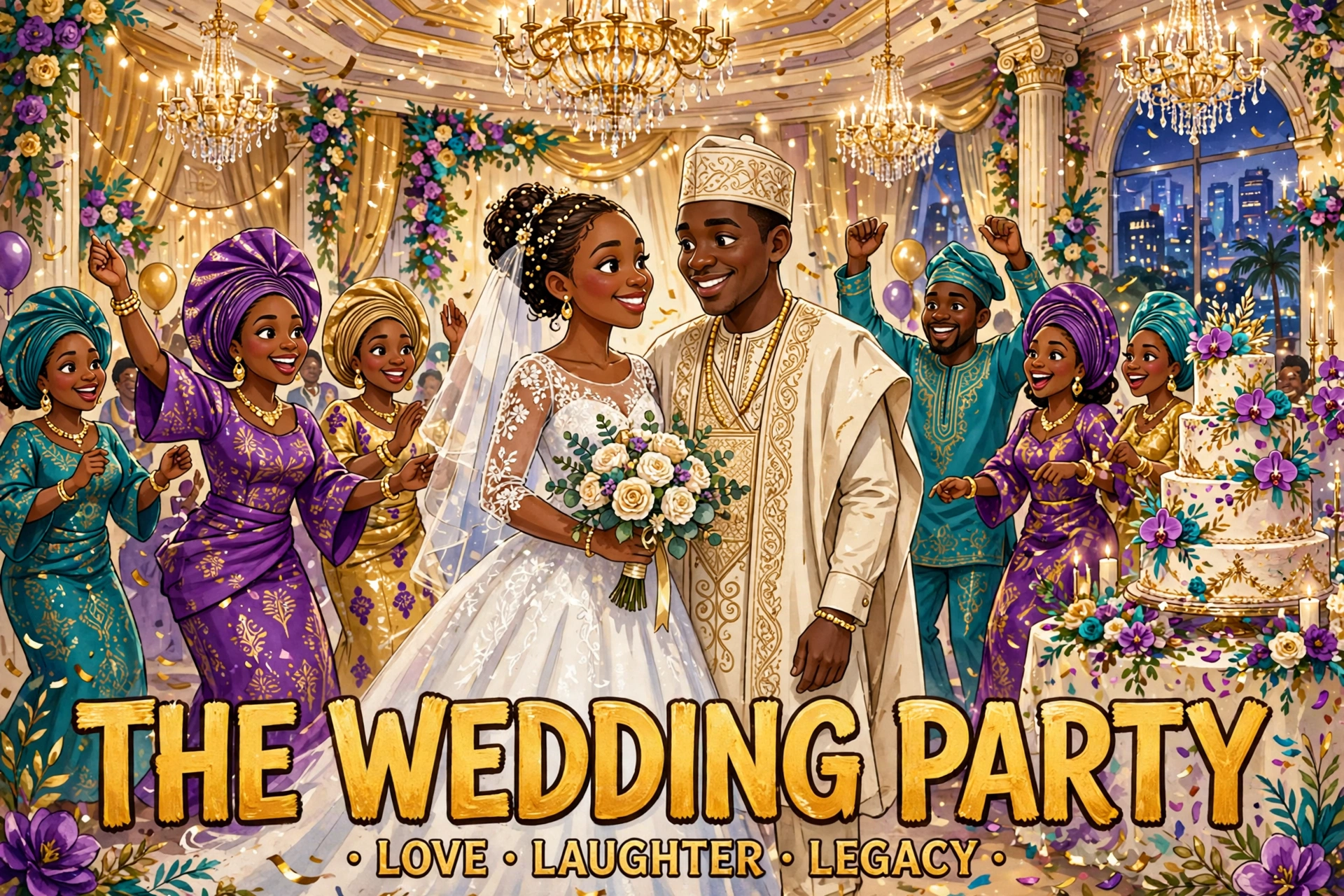
Every Nigerian knows the truth this film is built on: a big Lagos wedding is not really about the couple. It is about two families, two reputations, several hundred guests, and the delicate art of showing the world that your side did it better. The Wedding Party, directed by Kemi Adetiba, turned that truth into the most successful Nigerian film of its era. It premiered at the Toronto International Film Festival on 8 September 2016, opened across Nigeria on 16 December 2016, and went on to become the highest-grossing Nollywood film of all time at that point — a record it held for years.
But a record-breaking film is not automatically a great one. So how does The Wedding Party hold up as a comedy, away from the headlines? In this review we break down the story, the performances, the direction, the music and the famous box office numbers, and tell you honestly what works, what creaks, and whether it still deserves a place on your watchlist.
| Detail | Information |
|---|---|
| Release date | 16 December 2016 (Nigeria); premiered 8 September 2016 (Toronto) |
| Director | Kemi Adetiba |
| Writers | Tosin Otudeko, Kemi Adetiba |
| Genre | Romantic Comedy, Drama |
| Language | English, Yoruba, Igbo |
| Runtime | 110 minutes |
| Budget | ₦60 million (reported) |
| Lead cast | Adesua Etomi, Banky Wellington, Richard Mofe-Damijo, Sola Sobowale, Iretiola Doyle, Alibaba Akporobome |
| Our rating | 7.5/10 |
Dunni Coker, a young art gallery owner, is marrying Dozie Onwuka, the handsome son of a wealthy business family. On paper it is a dream match. In practice, the wedding day begins with two families who approach the event from completely different directions. Dunni’s parents, Bamidele and Tinuade Coker, are newly rich and determined to throw a celebration Lagos will talk about for years — their daughter, their money, their glory. Dozie’s parents, Felix and Obianuju Onwuka, are old money, quietly snobbish, and not entirely convinced their son is marrying into the right family. Tradition says the bride’s family hosts, so the Onwukas must smile, attend, and endure a party they consider far too loud.
Adetiba wisely keeps the structure simple: almost everything unfolds across the single wedding day, from the church service to the vast reception. Around the couple, small disasters accumulate. There are uninvited guests and gatecrashers, a best man with his own agenda, family members nursing old scores, a wedding planner fighting to hold the day together, and one discovery by the bride about something belonging to the groom that threatens to blow up the marriage before it has properly started. Underneath the jokes sits a real theme — class. New money versus old money, Yoruba versus Igbo expectations, and parents using a wedding to fight battles that have nothing to do with the two people actually getting married.
We will not spoil how the day ends. What we can say is that the film understands something many wedding comedies miss: the couple’s romance is the least interesting part. The parents are the real show.
Adesua Etomi as Dunni Coker gives the film its emotional centre. Etomi plays Dunni as sweet-natured and romantic but not foolish; she wants her perfect day and slowly realises how much of it is out of her control. It was a star-making performance, natural and likeable, and her scenes of doubt give the comedy something real to hold onto.
Banky Wellington as Dozie Onwuka was better known as the singer Banky W when the film was made, and his acting debut is better than it needed to be. He is charming and relaxed as the groom, though the script gives Dozie less to do than Dunni — he reacts to chaos more than he causes it, and his character’s past is more talked about than shown.
The film truly ignites, however, whenever the parents are on screen. Sola Sobowale as Tinuade Coker is a force of nature — loud, joyful, fiercely proud, dancing and spending and defending her daughter with her whole chest. Sobowale’s energy is so big it could have swallowed the film, and in the best scenes it nearly does. Opposite her, Iretiola Doyle as Obianuju Onwuka plays the ice to Sobowale’s fire: controlled, cutting, and devastating with a single look. Their rivalry is the film’s best material. Richard Mofe-Damijo as Felix Onwuka brings smooth, amused authority to the groom’s father, while Alibaba Akporobome as Bamidele Coker — a comedy legend playing the bride’s father — grounds the Cokers’ flashiness with genuine warmth. Around them, a deep bench including Zainab Balogun, Beverly Naya, Somkele Iyamah and Enyinna Nwigwe keeps the reception scenes buzzing.
This was Kemi Adetiba’s feature directorial debut, arriving from a celebrated career in music videos, and that background is visible in every frame — in a good way. The film is glossy, colourful and confident. The aso-ebi outfits, the decorated hall, the food, the dancing: The Wedding Party treats a Lagos wedding as the spectacular social theatre it really is, and the camera loves it. Adetiba also handles a large ensemble well, cutting between storylines in the reception without losing the audience, which is harder than it looks.
The weaknesses are mostly in the script’s construction rather than the direction. At 110 minutes the film is a touch long for its material; a few comic subplots are stretched past their best joke, and the pacing dips in the middle before recovering for a strong final act. Some storylines resolve very conveniently, and one or two gags rely on broad stereotypes that have aged less gracefully than the rest. But as a piece of crowd-pleasing commercial filmmaking — clear storytelling, big performances, high production value — it set a standard Nigerian producers openly chased for years afterwards.
Music is not decoration at a Nigerian wedding; it is the event. The film understands this completely. The reception sequences are powered by live-party energy — highlife and contemporary Nigerian pop flavours, drumming, praise-singing and the glorious chaos of the money-spraying tradition, where guests shower the dancing couple with banknotes. The original score, credited to Dr. Bayo Adepetun and Michael “Truth” Ogunlade, keeps the lighter dramatic scenes moving without smothering them. If the soundtrack occasionally leans on atmosphere rather than memorable original songs, that is a fair trade: the party itself is the musical set piece, and it works.
What we loved:
What could be better:
The numbers here are well documented for a Nollywood release of this period. Made on a reported budget of around ₦60 million — large by Nigerian standards of the time — The Wedding Party earned roughly ₦203 million in its first two weeks in Nigerian cinemas, already enough to top the 2016 box office, and continued climbing through 2017 to a total of about ₦452–453 million. Distributor FilmOne later named it the highest-grossing Nollywood film of the decade, and it held the all-time Nigerian record until it was overtaken in 2021 by Omo Ghetto: The Saga.
Context matters more than the raw figure. In 2016 it was still common to assume Nigerian audiences would only fill cinemas for Hollywood films. The Wedding Party disproved that decisively, outgrossing imported blockbusters on its home turf and showing investors that a well-marketed local film could return many times its budget in cinemas alone. Its success directly powered a sequel, The Wedding Party 2: Destination Dubai (2017), which itself grossed over ₦430 million, and it remains the reference point for every Nigerian producer promising a “Wedding Party-sized” hit.
Yes. The Wedding Party is not a subtle film and it does not try to be; it is a big, bright, generously performed comedy that delivers exactly the celebration it promises. Come for the mothers, stay for the party. Its length and its fondness for easy resolutions keep it from greatness, but as an introduction to modern Nollywood — and as pure entertainment — it earns its reputation honestly.
Our rating: 7.5/10 — a joyful, star-powered crowd-pleaser and a genuine piece of Nigerian box office history.
Is The Wedding Party based on a true story?
No. The Cokers and Onwukas are fictional, but the film draws heavily on the real culture of lavish Lagos weddings — the family rivalry, the aso-ebi matching outfits, the money spraying and the social one-upmanship are all drawn from life.
Is The Wedding Party the highest-grossing Nollywood film ever?
It was at the time. It became Nollywood’s highest-grossing film on release and held the record until 2021, when Omo Ghetto: The Saga passed it. It remains one of the biggest Nigerian hits of all time.
Do I need to watch The Wedding Party before the sequel?
It helps. The Wedding Party 2: Destination Dubai (2017) continues with the same families, and the jokes about the parents land better if you know them from the first film — but each film’s plot stands on its own.
What language is The Wedding Party in?
Mostly English, with Yoruba and Igbo dialogue woven through the family scenes — itself a joke about the couple’s mixed heritage. Subtitled versions are widely available on streaming.
Where can I watch The Wedding Party?
The film has circulated on major streaming platforms and digital stores in many regions since its cinema run. Availability changes by country, so check your local services.