★ LATEST REVIEWS

★★★☆☆ Our Rating: 6.5/10
Every Pakistani knows the face on the currency notes. Fewer films have dared to build an entire story around what that face would think of us. Quaid-e-Azam Zindabad, released for Eid-ul-Adha in July 2022, does exactly that. Director Nabeel Qureshi and writer-producer Fizza Ali Meerza, the team behind crowd-pleasers such as Na Maloom Afraad and Actor in Law, returned with an action comedy about corruption, conscience, and a policeman who treats bribery as a birthright.
The ingredients looked unbeatable on paper: Fahad Mustafa in full commercial-hero mode, Mahira Khan returning to a big mainstream film, veteran Javed Sheikh for comedy and heart, plus songs, chases and a patriotic hook built right into the title. The film became a major commercial success and even won Best Film (Viewers’ Choice) at the Lux Style Awards. Yet critics were divided, and audiences argued about it all through the Eid holidays.
So which side is right? Is this a sharp satire wrapped in a masala entertainer, or a loud film whose message gets lost in its own noise? In this review, we break down the story, performances, direction, music and box office honestly, so you know exactly what you are getting before you press play.
| Detail | Information |
|---|---|
| Release date | 8 July 2022 (worldwide); 10 July 2022 in Pakistan for Eid-ul-Adha |
| Director | Nabeel Qureshi |
| Writers | Nabeel Qureshi, Fizza Ali Meerza |
| Genre | Action, Comedy |
| Language | Urdu |
| Runtime | 142 minutes |
| Budget | Rs. 15 crore |
| Lead cast | Fahad Mustafa, Mahira Khan, Javed Sheikh, Nayyar Ejaz, Mehmood Aslam |
| Our rating | 6.5/10 |
Inspector Gulab Mughal is an SHO in Karachi who has turned his police station into a business. Bribes are not a temptation for Gulab; they are the system, the salary top-up and the family tradition all rolled into one. His father, Munir Mughal, was by contrast an honest retired inspector, and the shame of that difference sits quietly in the background of Gulab’s life, even if Gulab himself is too busy enjoying his perks to notice.
Gulab’s world is colourful and chaotic. He is assisted by the loyal, long-suffering constable Ronaq Ali, he answers to senior officers who are part of the same game, and he crosses paths with Jia, a passionate veterinarian and animal-rights activist whose compassion is the exact opposite of his cynicism. Jia’s love for voiceless creatures — and her refusal to look the other way — begins to irritate, challenge and slowly attract him.
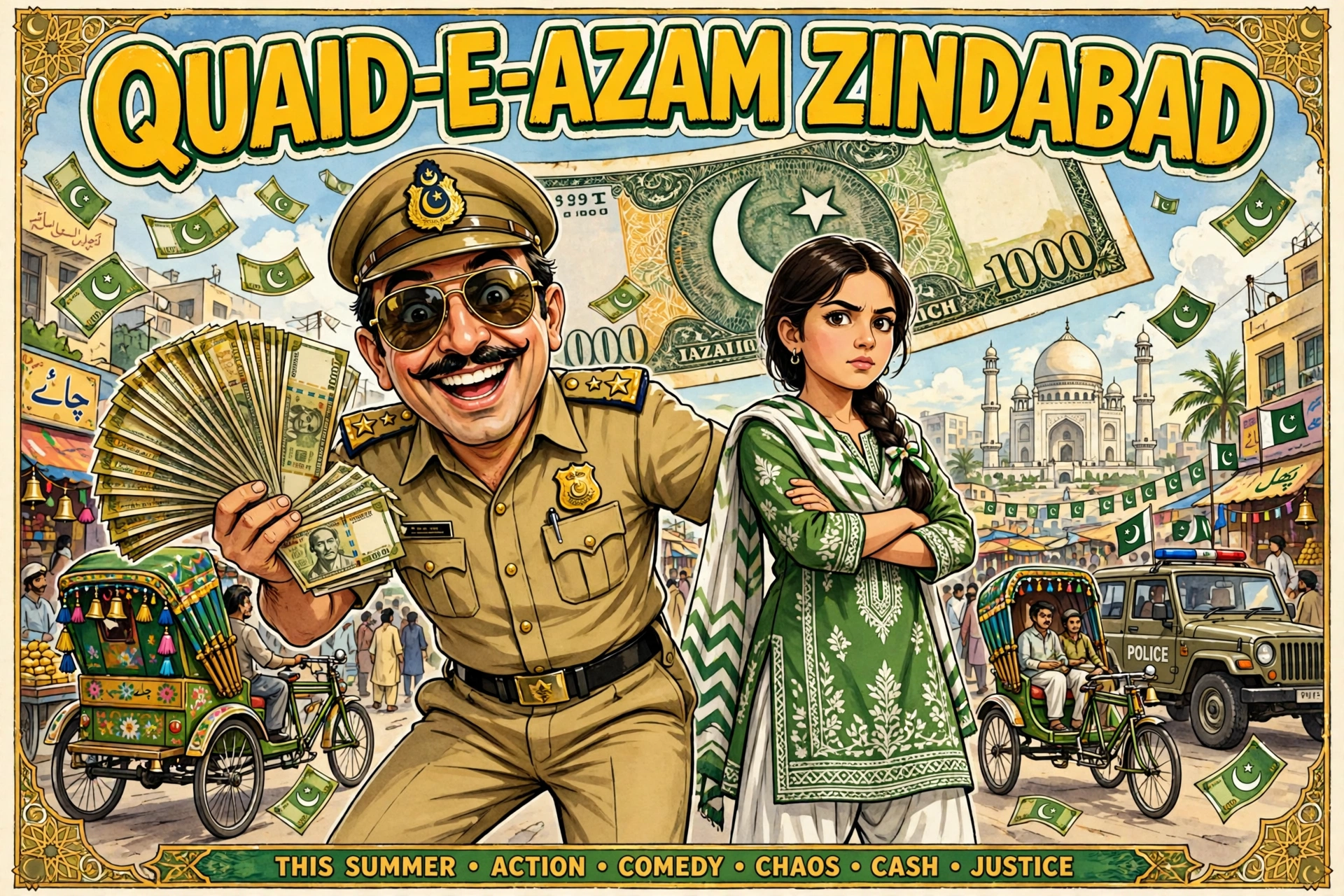
Then the film’s central idea arrives, and it is a genuinely clever one. After a personal loss shakes Gulab’s life, the banknotes he has spent years collecting begin to behave strangely: the portrait of Quaid-e-Azam Muhammad Ali Jinnah on the currency seems to be watching him, judging him, refusing to let him enjoy his dirty money in peace. Whether you read this as guilt, conscience or something more magical, it turns an ordinary corrupt-cop story into a fable. Gulab is forced to confront not just the law he has been mocking, but the founding ideals of the country whose uniform he wears — while corrupt politicians and his own past close in around him.
We will stop there. The film mixes this moral fable with romance, comic set pieces, action and social commentary about everything from animal cruelty to everyday bribery, and not every thread gets equal care. But the premise itself is one of the most original hooks Pakistani commercial cinema has produced in years.
Fahad Mustafa as Inspector Gulab Mughal is the engine of the film, and he knows it. Mustafa plays Gulab with swagger, comic timing and a gift for physical humour, sliding between arrogance and panic in the same scene. His transformation arc needs him to become vulnerable later on, and he handles the quieter beats better than the script sometimes deserves. The limitation is familiarity: this is very much the star persona audiences already know, polished and energetic but rarely surprising. If you enjoy Fahad Mustafa, you will enjoy this. If you wanted him stretched, you may leave wanting more.
Mahira Khan as Jia brings warmth and sincerity to a role that is thinner on paper than it should be. Jia’s animal activism gives the film some of its sweetest and funniest material, and Khan plays her with an earnestness that stops the character becoming a lecture. Her chemistry with Mustafa is pleasant, particularly in the lighter first half. The problem is structural: after a strong introduction, Jia is too often reduced to a moral prompt for the hero’s journey rather than a person with her own complete arc. Khan does everything asked of her; the writing simply asks less than she can give.
Javed Sheikh as Ronaq Ali is, minute for minute, the most enjoyable performer in the film. As Gulab’s Sindhi constable assistant, Sheikh lands jokes with the ease of a man who has been stealing scenes for decades, and he gives the film much of its heart as well. His loyalty to Gulab feels lived-in rather than written. In a film that often shouts, Sheikh’s relaxed timing is a lesson in how much comedy improves when an actor underplays.
The supporting cast is stacked with familiar faces. Nayyar Ejaz is reliably slimy as the corrupt politician Rana Kamran, Mehmood Aslam brings authority as Gulab’s senior officer, and the late Qavi Khan adds real emotional weight in his scenes as Gulab’s father — his presence gives the conscience theme a human face, not just a printed one. Saleem Mairaj and others pop up in enjoyable cameos, though some supporting tracks feel like sketches that wandered in from another film.
Nabeel Qureshi directs with pace and confidence in individual sequences. He has a genuine talent for staging chaos — a crowded street, a police station in uproar, a chase that doubles as a joke — and cinematographer Rana Kamran gives Karachi a bright, glossy, larger-than-life look that suits the Eid entertainer brief. The film also deserves credit for a much-discussed hand-drawn animated passage in a song sequence, a first-of-its-kind experiment for a Pakistani feature, which shows real ambition from the makers.
Where the direction is less successful is in discipline. At 142 minutes, the film carries subplots it does not need, and the tone swings hard between slapstick, social lecture, patriotic sentiment and action. Some swings work — Pakistani masala cinema has always mixed flavours — but here the joins are visible. Scenes run long after their point is made, and the second half in particular keeps returning to the same message in different costumes. The action is energetic but edited for noise rather than clarity, and the visual effects supporting the film’s central gimmick are uneven: charming in concept, occasionally rough in execution.
Editor Asif Mumtaz keeps the first half moving briskly, but a trimmer cut — fifteen minutes shorter would not have hurt — could have turned a good entertainer into a tight one. None of this is fatal. It is the difference between a film that impresses in moments and one that impresses as a whole.
Shani Arshad’s music fulfils the commercial brief. “Loota Rey”, performed by Asrar and Aima Baig, is the breakout track — a high-energy number built for trailers, weddings and repeat plays, and the one most viewers will hum on the way out. Ali Zafar’s “Dil Karay” is the romantic centrepiece, presented with that inventive animated treatment, while the soundtrack also includes more reflective material that supports the film’s patriotic and emotional turns.
As an album, it is effective rather than exceptional. The songs are well produced and well sung, and they are integrated into the film with more thought than the average item-number approach. But only “Loota Rey” has truly stayed in the public memory, and a couple of musical moments arrive because the formula expects them, not because the story needs them. Solid work, not a classic soundtrack.
What we loved:
What could be better:
Commercially, there is no argument: Quaid-e-Azam Zindabad was a hit. Released over the Eid-ul-Adha holidays in July 2022 after a long pandemic delay — filming had finished before lockdown, with post-production completed in 2020 — it drew families in large numbers at home and in overseas markets. Reported worldwide collections stand at around Rs. 50 crore against a reported budget of Rs. 15 crore, making it one of the most profitable Pakistani releases of its year and a clear blockbuster by local standards. Its audience award at the Lux Style Awards confirmed that the popularity was not just an opening-weekend spike. Whatever critics debated, the paying public had clearly enjoyed the ride.
If you want a polished, star-led Pakistani entertainer with a good heart, Quaid-e-Azam Zindabad is an easy recommendation for a family movie night. Its central idea is clever, its best scenes are genuinely funny, and its message — however loudly delivered — is one worth hearing. Just go in expecting a masala film, not a sharp satire: the script explains what a smarter film would simply show, and the running time tests patience. Enjoy it for its stars, its heart and its highlights, and forgive the bloat around them.
Our rating: 6.5/10 — an entertaining, big-hearted Eid blockbuster whose great idea deserved a tighter script.
Is Quaid-e-Azam Zindabad based on a true story?
No. It is an original fictional story by Nabeel Qureshi and Fizza Ali Meerza. It uses the image of Quaid-e-Azam Muhammad Ali Jinnah on Pakistan’s currency as a symbol of conscience, but Gulab and the events around him are invented.
Will there be a sequel to Quaid-e-Azam Zindabad?
No sequel has been officially released or dated. Given the film’s commercial success, speculation appears from time to time, but treat any circulating date as rumour until the makers announce otherwise.
What language is the film in, and are subtitles available?
The film is in Urdu. International cinema releases were presented with English subtitles, and subtitled versions are the norm for its home and digital releases.
Where can I watch Quaid-e-Azam Zindabad?
Availability varies by country and changes over time. The film has circulated through cinemas, television and digital platforms after its theatrical run, so check your local streaming services and digital stores for current options.
How long is the film, and is it family-friendly?
It runs about 142 minutes. It was made as an Eid family entertainer, with mild language and comic action violence, though parents should note some scenes involve animal cruelty themes and intense moments that younger children may find upsetting.