★ LATEST REVIEWS

★★★★☆ Our Rating: 8/10
Few films in recent memory arrived with as much noise, colour and expectation as Barbie did in the summer of 2023. The trailers promised a candy-coated comedy. The posters promised nostalgia. What very few people expected was a film that would make grown adults laugh out loud in one scene and then sit quietly reflecting on their own lives in the next. That surprise is the film’s greatest achievement.
Director Greta Gerwig took on a task that looked impossible on paper: satisfy a major toy company, honour a doll that has meant different things to different generations, and still say something meaningful to adults. For the most part she pulls it off with real style. This is neither a children’s cartoon stretched to feature length nor a lecture in disguise. It is a bright, musical, often very funny adventure that keeps opening doors into bigger questions about identity and purpose.
Does it stumble in places? Yes. Is the final act a little crowded? Also yes. But its heart is in the right place. Here is our honest breakdown of what works, what does not, and whether it deserves your time.
| Detail | Information |
|---|---|
| Release date | 21 July 2023 |
| Director | Greta Gerwig |
| Writers | Greta Gerwig, Noah Baumbach |
| Genre | Fantasy, Comedy |
| Language | English |
| Runtime | 114 minutes |
| Budget | $128–145 million |
| Lead cast | Margot Robbie, Ryan Gosling, America Ferrera, Kate McKinnon, Issa Rae, Rhea Perlman, Will Ferrell |
| Our rating | 8/10 |
Life in Barbieland runs like a perfect clock. Every morning begins the same way, every home is spotless, every outfit is flawless, and every day ends with music and dancing. In this world, different versions of Barbie hold every important job imaginable, from president to doctor to Nobel Prize winner, while the Kens exist mainly to admire them and compete gently for attention at the beach.
Our central Barbie, played by Margot Robbie, is the classic version: cheerful, kind and completely certain that her world has solved every problem. That certainty begins to wobble when ordinary things start going wrong. Her shower turns cold. Her breakfast burns. Her feet, famously shaped for high heels, suddenly go flat. Most unsettling of all, thoughts about ageing and mortality begin popping into her head during a party, silencing the music around her.
Seeking answers, she visits the one resident who lives on the edge of town and sees the world differently. She learns that a connection has opened between Barbieland and the real human world, and that someone out there who once played with her is going through a difficult time. The emotions of that person are bleeding through into her life. To set things right, Barbie must travel to the real world, find that person, and understand what has gone wrong.
Ken, unwilling to be left behind, hides himself away and joins the journey. What the two of them discover in Los Angeles could not be more different. For Barbie, the real world is confusing, sometimes unkind and far less fair than she expected. For Ken, it is a revelation of a completely different social order, one that he decides to bring back home with him. That clash sets up the film’s second half, where Barbieland itself begins to change in ways nobody anticipated.
We will stop there, because the fun of the film lies in watching those discoveries play out. The premise sounds simple, but Gerwig uses it to ask a gentle, persistent question: what happens when the story you were given about yourself no longer fits?
Margot Robbie as Barbie carries the entire film on her shoulders, and she does it without ever making the role feel like a gimmick. Playing a doll could easily have become a one-note joke about smiling too much. Instead Robbie finds layers: the early confidence, the embarrassment when things go wrong, the sadness of realising the real world does not adore her, and the quiet curiosity that grows as she watches ordinary human life. Her most affecting moments are the smallest ones, a look, a pause, a tear she does not understand. She also produced the film, and her belief in the project shows in every frame.
Ryan Gosling as Ken delivers the comic performance of the year. He plays Ken’s devotion as completely sincere, which is why it is so funny. His hurt feelings, his rivalry with other Kens, his discovery of horses and guitars and big coats, and his desperate need to be noticed are all played straight, and that sincerity turns silliness into something oddly touching. His big musical number is staged like an old Hollywood dream sequence, and he throws himself into it with total commitment. It would be easy to call this a scene-stealing role, but Gosling never unbalances the film; he deepens its central joke and then, surprisingly, its central sadness.
America Ferrera as Gloria provides the human heartbeat. She plays an ordinary working mother who feels invisible in her own life, and her warmth gives the film the emotional ground it needs. One speech she delivers late in the film, about the impossible expectations placed on women, became the most quoted moment of the movie for good reason. Ferrera delivers it simply, without theatrics, and it lands hard.
Kate McKinnon as Weird Barbie is perfectly cast as the wise outsider who has seen too much and cares too little about appearances. Issa Rae brings authority and dry humour as President Barbie. Rhea Perlman appears in a small but crucial role filled with tenderness, and her scenes give the ending its emotional weight. Will Ferrell as the toy company chief executive is funny in bursts, though his storyline is the thinnest of the major threads. Michael Cera, in a supporting turn, quietly gets some of the best laughs simply by being earnest while everyone else poses.
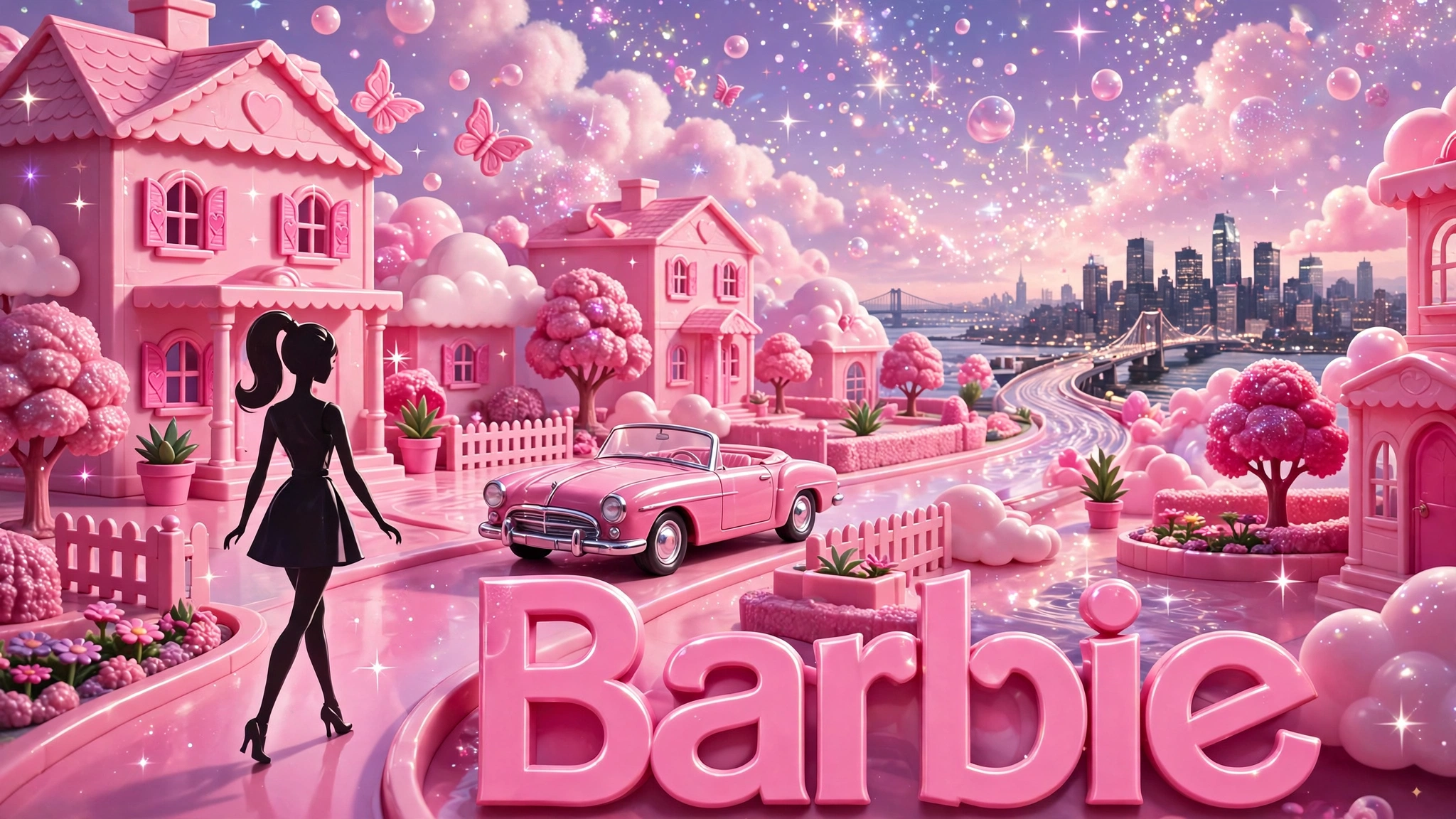
Greta Gerwig directs with the confidence of someone who loves old musicals, classic comedies and playfully artificial sets. Barbieland is not meant to look real, and that is the point. Production designer Sarah Greenwood and costume designer Jacqueline Durran built a world of painted skies, plastic waves, open-plan dream houses with no walls for privacy, and wardrobes that change with a twirl. Everything looks handmade and theatrical, which suits a world built from toys and imagination.
Cinematographer Rodrigo Prieto keeps the colours luminous without turning the film into a blur of pink. The contrast between Barbieland and Los Angeles is handled visually as much as in dialogue: one is bright, flat and perfectly lit, while the other is messy, golden and full of shadows. The journey between the two worlds, told through a playful montage of different vehicles, is a lovely nod to stagecraft over digital trickery.
Editor Nick Houy keeps the pace brisk. At 114 minutes the film rarely drags, and comic timing in the cutting helps several jokes land harder. The dance sequences are shot wide enough to appreciate the choreography rather than hiding it in quick cuts, which is refreshing. If there is a technical complaint, it is that a few real-world scenes feel visually plain compared with the invention on display elsewhere, though that contrast is partly intentional.
Music is not decoration in this film; it is part of the storytelling. Mark Ronson and Andrew Wyatt shaped both the score and the soundtrack album, working closely with Gerwig so that songs arrive at specific emotional moments rather than simply filling silence.
The album plays like a pop event in its own right. Lizzo opens the world with a playful introduction to Barbieland. Dua Lipa provides the big disco centrepiece for the house party sequence, a song built for the choreographed dance that opens the story. Billie Eilish contributes the film’s quiet soul with a soft, questioning ballad that returns at the most emotional moments and deservedly won major awards. Nicki Minaj and Ice Spice rework a famous nineties pop hook into something fresher and more self-aware.
The standout, of course, is Ken’s power ballad. Written as an over-the-top rock confession, it manages to be funny, catchy and genuinely sad at the same time. Gosling performs it without winking at the camera, and the staging turns it into a full dream ballet of rival Kens. It is the sequence audiences talked about most on the way home.
Not every track is equally memorable, but as a whole the soundtrack extends the film’s personality rather than just marketing it.
What we loved:
What could be better:
Nobody in the industry predicted quite how large this film would become. Made on a reported budget of $128–145 million, Barbie went on to earn $1.448 billion worldwide, becoming the highest-grossing film of 2023 and one of the biggest hits in Warner Bros. history. Its opening weekend turned into a cultural event, with audiences dressing in pink and cinemas reporting group bookings and repeat visits.
Timing helped: it opened on the same day as a much more serious historical drama, and the playful double-bill contrast helped both films. But word of mouth did the heavy lifting. It also proved an original, female-led, director-driven comedy could dominate a summer usually reserved for sequels and superheroes.
Barbie is that rare blockbuster that respects your intelligence while never forgetting to entertain you. It is colourful without being empty, funny without being cruel, and emotional without being manipulative. Its flaws are real but minor: a thin corporate subplot and a busy ending cannot undo the charm, craft and performances at its centre. Whether you played with the doll or never thought about it for a second, the questions the film asks about who you are versus who you were told to be will stay with you.
Watch it with family, watch it with friends, or watch it alone on a quiet evening. You will laugh, you may tear up, and you will almost certainly hum at least one song afterwards.
Our rating: 8/10 — A joyful, beautifully crafted comedy with genuine heart and two outstanding lead performances.
Is Barbie suitable for young children?
It is rated PG-13 for suggestive references and brief language. Younger children will enjoy the colours, songs and slapstick, but many jokes and themes are aimed at older viewers, so parental guidance is sensible.
Is Barbie based on a true story?
No. It is an original fictional story inspired by the Barbie doll line created by Mattel. One character is inspired by the doll’s real creator, Ruth Handler, but the events are invented for the film.
Do I need to know Barbie toys or lore before watching?
Not at all. Long-time fans will spot extra references and familiar outfits, but the film explains its world clearly and works completely as a standalone comedy.
How long is Barbie and where can I watch it?
The runtime is 114 minutes. Availability changes by country and over time, so check your local cinema listings and major streaming and rental services for the current options.
Will there be a Barbie sequel?
As of now there is no officially confirmed sequel in release. The film’s huge success has led to plenty of discussion, but any follow-up would need the same creative team to agree on a story worth telling.