★ LATEST REVIEWS

★★★☆☆ Our Rating: 5.5/10
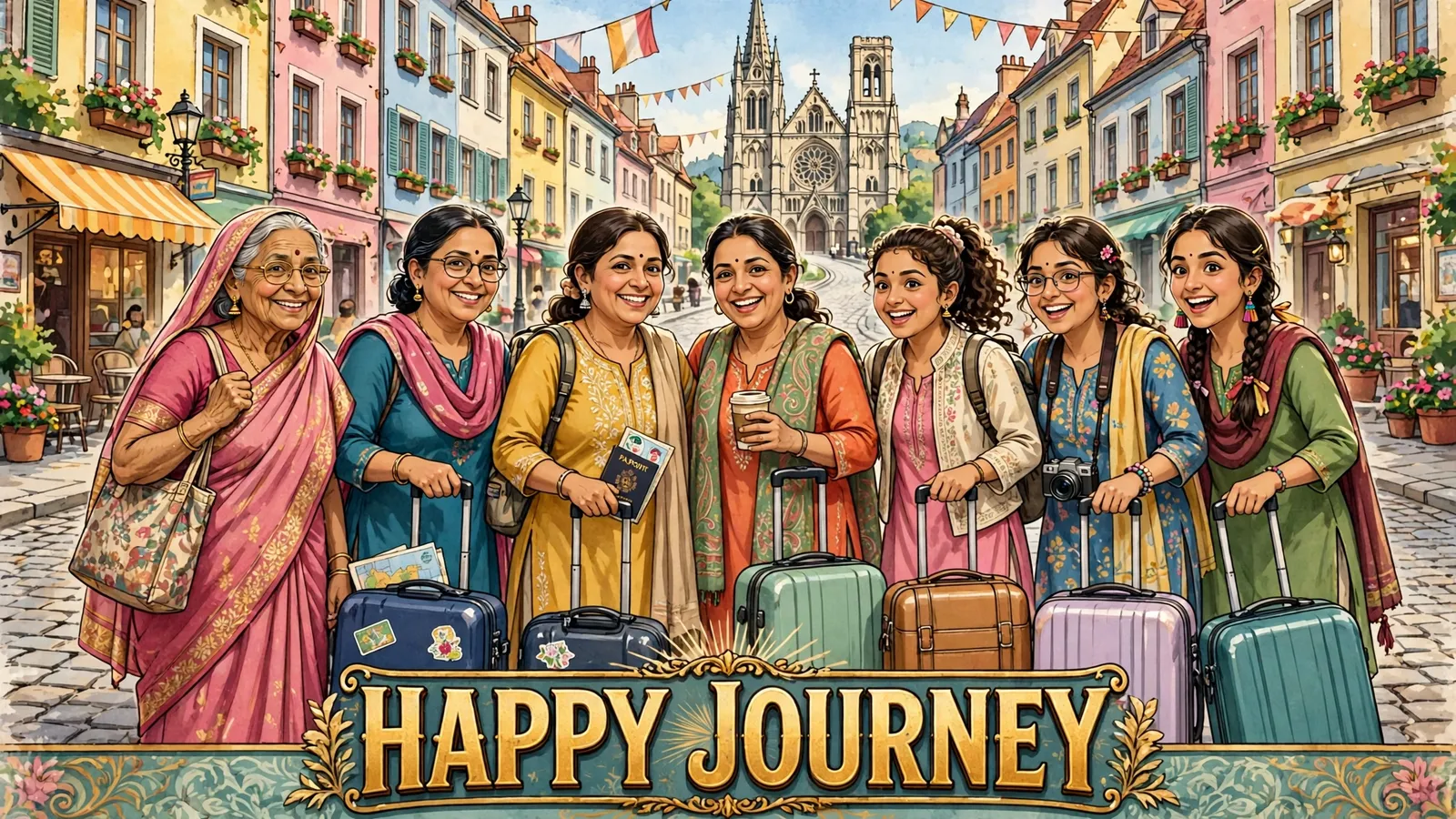
There is a simple, generous idea at the heart of Happy Journey: seven women who have spent their lives looking after everyone else are handed a holiday they never asked for and never thought they deserved. The Telugu travel comedy drama, directed by Abhiramm Naidu and written from a story by Hemant Dhome, opened in cinemas on 18 September 2026 and arrived on SunNXT on 13 November 2026, also in other South Indian languages. It follows seven women from different generations and backgrounds who win an all-expenses-paid trip to Europe through a lucky draw run by Greatandhra Travels, and it asks what happens when women who have always been the ones holding the family together are finally given a week to themselves. The premise is warm, the cast is full of experienced performers, and the European locations look lovely. The trouble is that a good premise is not the same thing as a good film, and Happy Journey is an uneven ride that works in parts and wanders in others.
This review is spoiler-free. A note on the numbers before we begin: the film’s promotional artwork carries claims of a BookMyShow score of 9.5 out of 10 and an IMDb score of 9.7 out of 10. Those figures are unverified promotional claims, and this review does not cite them as ratings. The verified critical scores are far more modest — 123telugu rated it 2.75 out of 5, TeluguNow rated it 2.8 out of 5, and tenvow rated it 5 out of 10. No verified box-office figures and no verified budget are available at the time of writing.
| Detail | Information |
|---|---|
| Theatrical release | 18 September 2026 |
| OTT premiere | 13 November 2026 on SunNXT (also in other South Indian languages) |
| Director | Abhiramm Naidu |
| Story by | Hemant Dhome |
| Genre | Women-centric travel comedy drama |
| Language | Telugu |
| Runtime | 125 minutes |
| Certification | U/A 13+ |
| Starring | Annapurnamma (Savitri), Aamani (Chamundeswari), Jinisha Alishetty (Nayana), Jhansi (Srilatha), Payal Radhakrishna (Tanvi), Sunaina Badam (Divya), Roopa Srinivas (Vihaana), Vamshidhar Goud (Govind), Ravi Siva Teja (Apparao) |
| Cinematography | Subramaniyan Manigandan |
| Budget | Not publicly disclosed |
| Box office | No verified figures available |
| Our rating | 5.5/10 |
The film opens with a premise that does a lot of the emotional work on its own. Seven women — Savitri, Chamundeswari, Nayana, Srilatha, Tanvi, Divya and Vihaana — come from different generations and very different walks of life. What they share is the sense that their lives have been lived for other people: for husbands, children, parents, in-laws and workplaces that take their care for granted. Then luck intervenes. All seven win an all-expenses-paid trip to Europe through a lucky draw run by Greatandhra Travels, and suddenly they are on a plane to a continent most of them have only seen in films.
The film is at its best when it stays close to that simple contrast — women who have never travelled, travelling. The group is shepherded by two guides, Govind and Apparao, whose job is to keep the itinerary moving and whose comic relief mostly comes from trying, and failing, to keep seven strong-willed women on schedule. The journey takes them through European streets, squares and scenic spots that cinematographer Subramaniyan Manigandan films with evident pleasure, and the film lets its characters react to new places in ways that feel true to who they are: the older women marvelling at things the younger ones take in their stride, the younger women learning that the older women have lives and histories of their own.
What the film does not do, and what a stronger film would have done, is give that journey a shape. The seven women each arrive with a backstory and a burden, but the film introduces them in a hurry and then spreads its attention so thinly across the group that none of the individual arcs gets the time it needs. Episodes come and go — a misunderstanding here, a sightseeing stop there, a heart-to-heart that arrives too quickly to land — and the emotional beats that should carry the second half feel sketched rather than earned. The screenplay has good intentions, and the film’s heart is clearly in the right place, but good intentions do not organise a story. By the final stretch, the film is relying on the audience’s goodwill towards its characters rather than on anything it has actually built.
The strongest reason to watch Happy Journey is its ensemble, and it is also the film’s quiet tragedy that the writing does not serve them better. Annapurnamma, as Savitri, brings the kind of grounded dignity that only decades of screen experience can give. She does not need big speeches to hold the frame; a look, a pause, a small adjustment of a shawl tells the audience everything about a woman who has spent a lifetime putting others first. Aamani, as Chamundeswari, is warm and watchable, and her scenes with Annapurnamma carry the film’s most honest emotional weight — two women of an older generation recognising something in each other that neither has said out loud at home.
Jhansi, as Srilatha, is the film’s most reliable source of energy. She has always had a gift for playing women who are funny without being foolish, and here she brings a practical, no-nonsense warmth that keeps the group scenes moving. Roopa Srinivas, as Vihaana, and the younger performers — Jinisha Alishetty as Nayana, Payal Radhakrishna as Tanvi and Sunaina Badam as Divya — represent the film’s other generations, and each of them gets moments that work: a flash of independence here, a quiet admission there. The trouble is that those moments stay moments. With seven leads to service in 125 minutes, nobody gets a full arc, and the younger characters in particular feel like sketches of people rather than people.
Vamshidhar Goud as Govind and Ravi Siva Teja as Apparao, the two guides, do the comic heavy lifting. Their job is to be the straight men to seven unpredictable travellers, and they play it with commitment, but the comedy written for them is uneven — some of it lands, some of it feels like filler designed to pad the journey between emotional beats. The film’s humour works best when it comes from the women’s personalities clashing and connecting, and less well when it comes from contrived situations.
Abhiramm Naidu directs with clear affection for his characters and for the idea behind the film, and that affection shows in the film’s best passages. The scenes where the women simply experience Europe — walking a street together, sitting in a square, laughing at something small — have a relaxed, observational quality that suits the material. Naidu is less sure-footed when the film needs structure: the transitions between episodes are abrupt, the pacing sags in the middle, and the film’s emotional climax is set up in a way that makes its resolution feel inevitable rather than earned.
The technical standout is the cinematography. Subramaniyan Manigandan’s European visuals have been widely praised, and rightly so. The film looks bright, open and inviting, and the locations are filmed with the kind of care that makes the audience understand why these women would be changed by seeing them. The contrast between the women’s everyday lives and the world they are suddenly walking through is told in images as much as in dialogue, and that is the film’s most consistent achievement. The editing, by contrast, does the film few favours: scenes end before they have landed, and the film’s rhythm lurches between brisk travelogue and slow emotional beats without quite finding a middle gear.
The production design deserves a mention too. The film understands that a travel film lives or dies on its sense of place, and the European streets, cafes and landmarks feel lived-in rather than merely photographed. The costumes do quiet character work as well, distinguishing seven women of different generations and backgrounds at a glance — something that matters a great deal in a film where the audience has to keep seven stories straight.
No single musical moment dominates Happy Journey, and that is both a strength and a weakness. The score supports the film’s light, warm tone without ever drawing attention to itself, and the songs fit the travelogue mood — the kind of music that plays while a group of women walks through a new city, happy and a little overwhelmed. But a film about a journey this emotional could have used music that did more: a theme that grew with the characters, a song that marked the moment the trip stopped being a holiday and started being a turning point. As it stands, the music is pleasant and forgettable, which is a fair description of a film that is often pleasant and too often forgettable.
What we loved:
What could be better:
The critical response to Happy Journey has been consistent: a film with a good heart and an uneven execution. 123telugu rated it 2.75 out of 5, TeluguNow rated it 2.8 out of 5, and tenvow rated it 5 out of 10 — all three landing in the same middling range, and all three praising the premise and the performances while pointing to the screenplay as the problem. The shared verdict, in different words, is that this is an uneven ride that works in parts.
There are no verified box-office figures for the film, and no publicly disclosed budget, so any report claiming either should be treated with caution. What matters more for most viewers now is the streaming release: the film premiered on SunNXT on 13 November 2026, also in other South Indian languages, which is where most of its audience will now find it. On streaming, as a relaxed weekend watch with the family, the film’s warmth and its cast may matter more than its structural flaws did in cinemas.
Yes — with the right expectations. Happy Journey is not a great film, and it is not the film its premise deserved. But it is a kind-hearted, family-friendly travel drama with a strong ensemble, lovely European locations and a premise that will resonate with anyone who has watched the women in their family put themselves last. Watch it for Annapurnamma, Aamani and Jhansi, watch it for the scenery, and watch it for the scenes where the seven women simply enjoy each other’s company. Do not expect a tightly told story or a deeply developed character arc, and the film’s 125 minutes will pass pleasantly enough. Our rating: 5.5 out of 10 — good intentions, a fine cast and beautiful locations, held back by an uneven screenplay that never gives its seven women the film they deserved.
When did Happy Journey release in theatres?
Happy Journey released in cinemas on 18 September 2026.
Where can I watch Happy Journey online?
The film premiered on SunNXT on 13 November 2026, and it is also available in other South Indian languages on the platform.
Who directed Happy Journey?
Abhiramm Naidu directed the film, from a story by Hemant Dhome.
Who stars in Happy Journey?
The film stars Annapurnamma as Savitri, Aamani as Chamundeswari, Jinisha Alishetty as Nayana, Jhansi as Srilatha, Payal Radhakrishna as Tanvi, Sunaina Badam as Divya and Roopa Srinivas as Vihaana. Vamshidhar Goud plays guide Govind and Ravi Siva Teja plays guide Apparao.
What is Happy Journey about?
Seven women from different generations and backgrounds win an all-expenses-paid trip to Europe through a lucky draw run by Greatandhra Travels, and the film follows their journey together.
How long is Happy Journey?
The film runs for 125 minutes and carries a U/A 13+ certification.
What did critics rate Happy Journey?
123telugu rated it 2.75 out of 5, TeluguNow rated it 2.8 out of 5, and tenvow rated it 5 out of 10. Claims of 9.5 out of 10 on BookMyShow and 9.7 out of 10 on IMDb that appear on the film’s promotional artwork are unverified and should not be treated as critic or audience scores.
Is there any verified box-office or budget information for Happy Journey?
No. There are no verified box-office figures and no publicly disclosed budget for the film at the time of writing.