★ LATEST REVIEWS

★★★★☆ Our Rating: 7.5/10
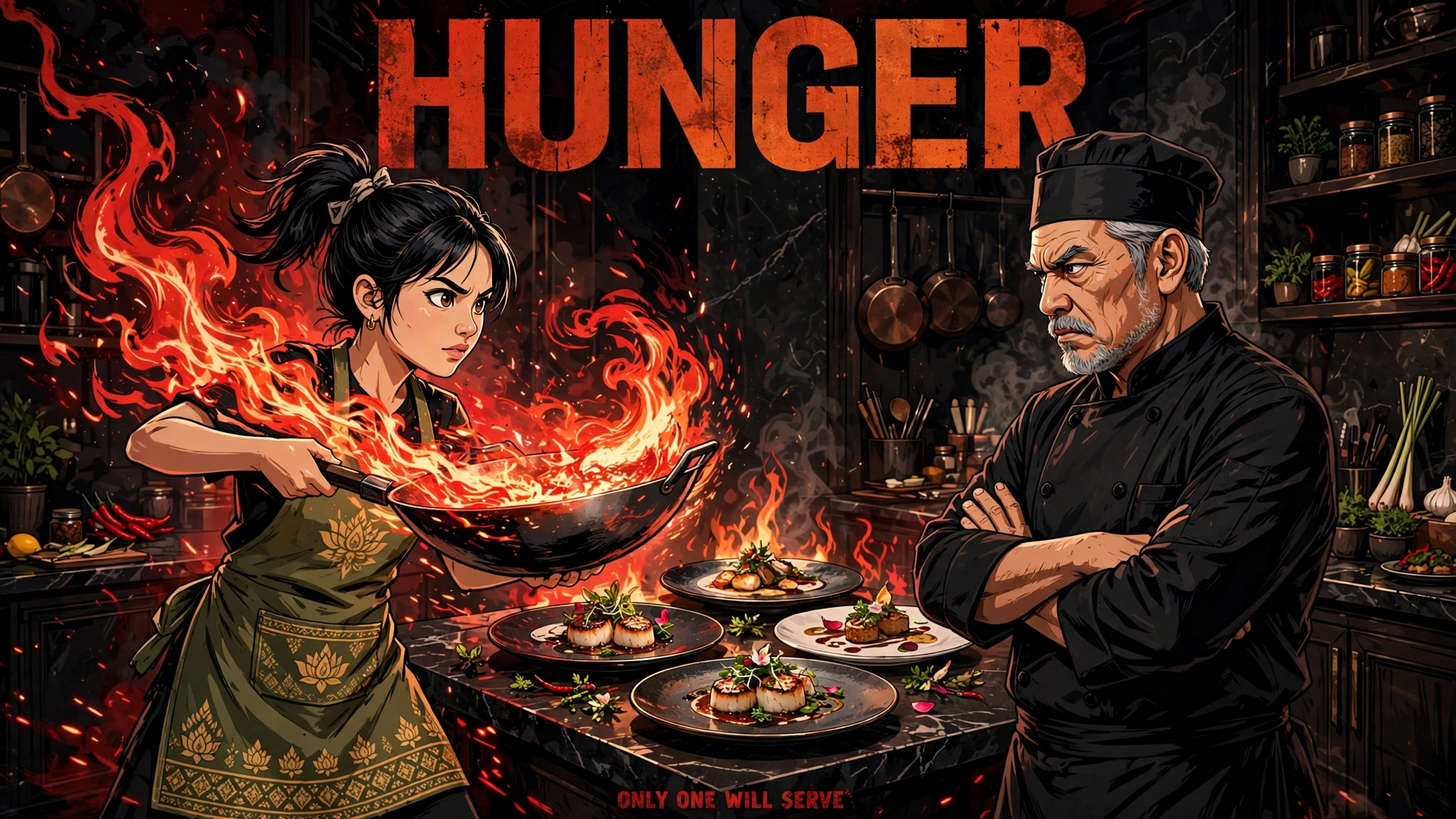
A few months after The Menu served up fine dining as horror, Thailand answered with its own dish. Hunger, directed by Sitisiri Mongkolsiri and written by Kongdej Jaturanrasamee, is a psychological drama about a street-food cook who is invited into the world of luxury cuisine — and discovers that the price of ambition is paid in identity. It is one of the most visually ravishing Thai films of recent years, carried by a superb central performance, and it has a sharper point about class than its famous inspiration: in Bangkok, what you eat does not just define who you are, it decides who gets to be seen.
| Detail | Information |
|---|---|
| Release date | 6 April 2023 (Netflix) |
| Director | Sitisiri Mongkolsiri |
| Writer | Kongdej Jaturanrasamee |
| Genre | Psychological drama, thriller |
| Language | Thai |
| Runtime | 145 minutes |
| Lead cast | Chutimon Chuengcharoensukying, Nopachai Chaiyanam, Gunn Svasti |
| Our rating | 7.5/10 |
Aoy (Chutimon Chuengcharoensukying) is a young woman in her twenties who runs her family’s stir-fried noodle restaurant in the old quarter of Bangkok. Her life is ordinary, hard-working and, in its own way, content — until she receives an invitation to leave the family business and join “Hunger,” Thailand’s number one luxury chef’s table team, led by the famously ingenious and infamously nasty Chef Paul (Nopachai Chaiyanam).
This review will not spoil the film’s later turns, because its pleasures are in watching Aoy climb and then question the ladder. Her first days in Paul’s kitchen are a nightmare designed to break her: brutal hours, impossible standards, humiliations served cold. But Aoy is a fast learner with a palate and a will of her own, and before long she is rising — toward a rivalry with Paul himself, toward her own restaurant, and toward a question the film keeps asking with increasing force: if you succeed in a world built for the rich, do you change it, or does it change you? The final act, in which Aoy must decide whether to pander to the wealthy like Paul did or to keep something of herself, is the film’s most satisfying passage.
Chutimon Chuengcharoensukying as Aoy — Known to fans as Aokbab, Chutimon is a class act here, and the film belongs to her. She plays Aoy’s whole journey — the street cook’s confidence, the novice’s terror, the rising star’s hunger, the successful woman’s doubt — with remarkable understatement, never pushing a moment further than it needs to go. Her performance is the reason the film’s class critique lands: you believe in Aoy’s talent and her decency in equal measure, and so her compromises cost you something too.
Nopachai Chaiyanam as Chef Paul — Chaiyanam brings a quiet menace to Paul that never lets up. He is not a shouting tyrant but a cold, precise, almost priestly figure — the “high priest of fine dining,” as one review memorably called him — whose cruelty is delivered as professional standards. That restraint makes him more frightening than any tantrum, and his scenes with Chutimon are the film’s crackling centre.
Gunn Svasti as Tone — Svasti, as Tone, the sous chef who spots Aoy and brings her into the team, is the film’s warmest presence: a supportive, decent man caught between loyalty to Paul and belief in Aoy. He gives the audience someone to breathe with in a kitchen that otherwise never exhales.
Mongkolsiri directs with an attention to atmosphere that elevates the film above its familiar premise. The contrast between Aoy’s two worlds is rendered in every frame: the steam, noise and warmth of the noodle stall against the dark, silent, almost ritualistic precision of Paul’s kitchen, where dishes are composed like art objects and served to people who photograph them more than eat them. The camera lingers on food — its preparation, its plating, its consumption — until food itself becomes the film’s language for class.
The screenplay by Jaturanrasamee (the writer behind The Girl from Nowhere) is ambitious and mostly successful, though it is fair to say the film spells out its social critique more bluntly than it needs to. Where a subtler film would trust the audience to join the dots, Hunger sometimes delivers its points in dialogue that states the obvious — the rich are hungry for status, not food — and a few scenes in the final act feel slightly rushed, as if a scene or two went missing in the edit. The film also runs long at 145 minutes, and a small number of passages could have been trimmed without loss.
What saves the film from being merely a lecture is its attention to craft as character. The way Aoy chops, plates and tastes tells you who she is at every stage of her journey: the confident, unpretentious cook of the noodle stall, the terrified novice copying Paul’s techniques, the rising star imposing her own vision on a plate. Mongkolsiri films cooking as a language, and Aoy’s evolving relationship with food becomes the most honest record of what ambition is doing to her. When she finally cooks for herself rather than for approval, the scene lands without a word of dialogue — proof that the film is at its best when it shows rather than tells.
The sound design is one of the film’s quiet triumphs: the sizzle of the wok, the clatter of the noodle stall, the knife work and the silence of the luxury kitchen are all rendered with a tactile precision that makes you feel the two worlds. The score is restrained, letting the kitchens’ own sounds carry the tension, and it swells only at the moments of decision — when Aoy chooses, and when she refuses. It is a film best watched with good sound, because so much of its meaning is in what you hear.
What we loved:
What could be better:
As a Netflix original, Hunger has no theatrical box-office gross to report, so this review omits the box-office row rather than invent one: streaming viewership figures are not published in comparable form. Its success is measured differently — it was announced by Netflix in 2022 as one of six upcoming Thai original productions, released globally on the platform in April 2023, and received mostly positive reviews from international critics, with particular praise for its performances and its visual craft.
One dating note for readers: while the film’s reference entry gives 6 April 2023 as its Netflix release date, some contemporary coverage listed 10 April 2023. This review uses 6 April, the date given in the film’s standard reference entry, and notes the discrepancy rather than silently picking one.
Yes — especially if you liked The Menu but wanted something with more heart and a sharper sense of place. Hunger is not a perfect film, but it is a rich one: a character drama, a class satire and a love letter to Thai food, all served on the same plate. Watch it hungry, and watch it for Chutimon’s performance, which is worth the whole meal.
Our rating: 7.5/10 — A ravishing, fierce Thai drama about appetite, ambition and who gets to eat.
What is Hunger about?
A Bangkok street-food cook, Aoy, is invited to join Thailand’s top luxury chef’s table team and must decide what success in the world of the rich will cost her.
Who directed Hunger?
Sitisiri Mongkolsiri, from a screenplay by Kongdej Jaturanrasamee.
Who stars in Hunger?
Chutimon Chuengcharoensukying as Aoy, Nopachai Chaiyanam as Chef Paul, and Gunn Svasti as Tone.
Is Hunger based on a true story?
No. It is an original fictional drama, though its portrait of Bangkok’s fine-dining world is grounded in real culinary culture.
Is Hunger suitable for family viewing?
It is an adult drama with strong language, mature themes and some disturbing scenes, best suited to older teenagers and adults.