★ LATEST REVIEWS

★★★★☆ Our Rating: 8.5/10
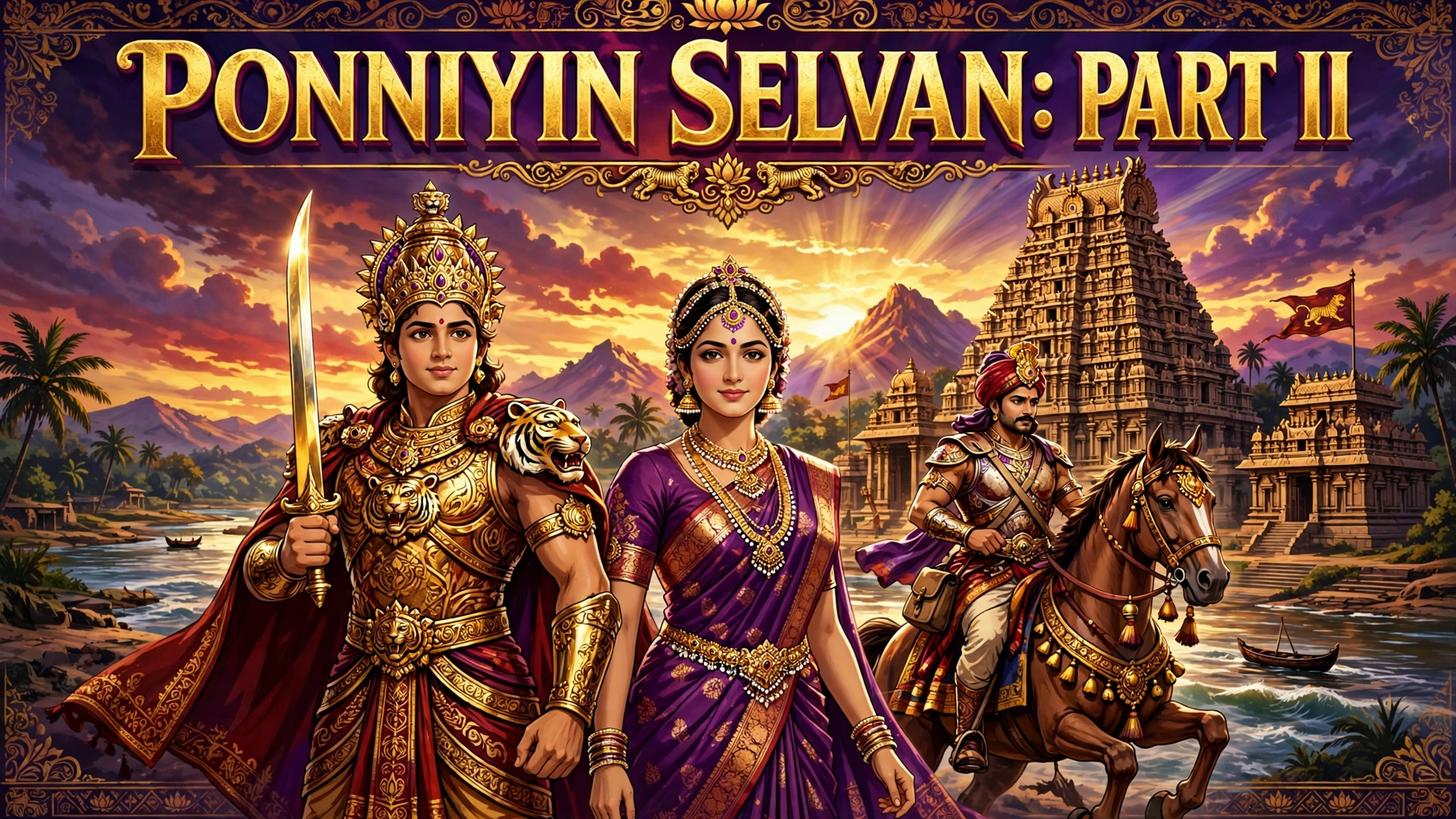
Few adaptations carry as much weight as this one. Kalki Krishnamurthy’s Ponniyin Selvan, serialised in the 1950s, is not just a beloved Tamil novel — it is a cultural inheritance, quoted, debated and re-read across generations. Mani Ratnam’s two-part film version, shot together as one of the most ambitious productions in Tamil cinema history, concludes with Part II: a film that trades some of the first part’s sweep for intimacy, tragedy and a devastating central love story. It earned over ₹340 crore worldwide, becoming one of the highest-grossing Tamil films of 2023.
| Detail | Information |
|---|---|
| Release date | 28 April 2023 |
| Director | Mani Ratnam |
| Writers | Mani Ratnam, Elango Kumaravel, B. Jeyamohan, based on the novel by Kalki Krishnamurthy |
| Genre | Historical epic drama |
| Language | Tamil |
| Runtime | 165 minutes |
| Budget | About ₹250 crore for this part (₹500 crore for both parts together; see box office note) |
| Lead cast | Vikram, Aishwarya Rai Bachchan, Jayam Ravi, Karthi, Trisha Krishnan, Sobhita Dhulipala, Prakash Raj |
| Our rating | 8.5/10 |
Part II picks up directly from the first film’s cliffhanger. Prince Arulmozhi Varman (Jayam Ravi), the future Rajaraja Chola I, has survived an assassination attempt at sea, while the Chola empire trembles under plots from within: the Pazhuvettaraiyar chieftains scheme for the throne, the Pandyas nurse an old vengeance, and the brilliant, dangerous Nandini (Aishwarya Rai Bachchan) moves through the court like a beautiful storm.
At the story’s heart is the relationship between Nandini and the crown prince Aditha Karikalan (Vikram) — former lovers whose shared past holds a secret that explains much of the empire’s pain. Meanwhile the loyal, witty Vandiyathevan (Karthi) races between loyalties, and Princess Kundavai (Trisha Krishnan) works her own quiet statecraft to protect her brother and her dynasty.
This review will not spoil the film’s revelations — including the truth about Nandini’s identity and the fate of the princes — because Part II is built on secrets paying off. What can be said is that this is a more emotional film than its predecessor: less about battles and more about what ambition, revenge and love cost the people who carry them.
Vikram as Aditha Karikalan — Vikram gives the film’s defining performance: a warrior prince haunted by guilt and tenderness in equal measure, by turns terrifying in battle and heartbreakingly vulnerable in Nandini’s presence. His scenes with Aishwarya Rai Bachchan are the film’s peak — two great screen presences playing a love that curdled into tragedy years before the story begins.
Aishwarya Rai Bachchan as Nandini (and Mandakini) — Playing a dual role, Aishwarya Rai Bachchan is magnetic as Nandini: regal, calculating and wounded, a woman using the only weapons her world has given her. It is a performance of great control — every smile measured, every silence loaded — and it anchors the film’s moral complexity, since Nandini is neither simple villain nor simple victim.
Karthi, Jayam Ravi, Trisha and the ensemble — Karthi’s Vandiyathevan remains the audience’s way into the story: brave, funny and romantic, and his chemistry with Trisha’s sharp, intelligent Kundavai is a delight. Jayam Ravi grows into Arulmozhi’s destiny with quiet authority, and the vast supporting cast — Prakash Raj, Jayaram, Prabhu, Sarath Kumar, Sobhita Dhulipala, Aishwarya Lekshmi, Vikram Prabhu — gives the court its depth and texture.
Ratnam directs the second part with the confidence of a master returning to familiar ground. Where Part I had to introduce a world, Part II can linger: Ravi Varman’s cinematography turns rivers, temples and torch-lit chambers into paintings, A. Sreekar Prasad’s editing keeps a famously complicated novel’s threads legible, and Thota Tharani’s production design makes the Chola court feel both opulent and real. The war sequences are staged with scale but never at the expense of character — Ratnam is always more interested in the face before the battle than in the battle itself.
One honest caveat, and it matters for newcomers: this film assumes you have seen Part I, or know the novel. Viewers arriving cold will struggle with the number of characters and the speed of the court intrigue, and a few passages in the middle act feel compressed, as if a longer story is being hurried to its conclusion. Readers of the novel will also notice changes and compressions — inevitable in adaptation, but worth knowing. None of this sinks the film; it simply means Part II rewards preparation.
A. R. Rahman’s score is among his finest recent work: grand without being bombastic, with melodies that carry the film’s emotional weight — the love themes for Aditha and Nandini, the martial swell of the Chola marches, the quiet sorrow underneath the court scenes. The songs, picturised with Ratnam’s characteristic elegance, became popular across Tamil Nadu and beyond, and the background score does much of the work in the film’s wordless passages. The sound design, from temple bells to battlefield chaos, is immaculate.
What we loved:
What could be better:
The figures here need one clarification, because the budget is often quoted in two ways. The two parts of Ponniyin Selvan were shot together at a combined reported cost of about ₹500 crore, which is commonly split as roughly ₹250 crore per part; some reports quote the full ₹500 crore against Part II alone, which misstates the accounting. Against that investment, Part II grossed approximately ₹342–346 crore worldwide according to the most complete trackers (some trackers round it to about ₹340 crore), making it one of the highest-grossing Tamil films of 2023 and a commercial success, though — fairly noted — it did not match Part I’s even larger total.
Critically, it was widely praised for its performances, visuals and emotional depth, with particular acclaim for Vikram and Aishwarya Rai Bachchan. It confirmed Ratnam’s adaptation as a landmark of modern Tamil cinema, whatever one’s view of individual changes from the novel.
The two Ponniyin Selvan films together represent something rare in Indian cinema: a literary adaptation treated as a cultural event rather than a commercial gamble. For Tamil audiences, seeing Kalki’s beloved characters on screen — after decades of failed attempts to film the novel — was itself historic, and Part II’s emotional payoff rewarded years of anticipation. The films also demonstrated that a big-budget Indian epic could succeed on craft and restraint rather than noise, influencing how subsequent historical productions approached scale. Whatever debates continue about changes from the novel, Ratnam’s version has earned its place as the definitive screen Ponniyin Selvan for a generation.
Yes — but watch Part I first. Seen as the second half of a single great story, Part II is a moving, majestic conclusion: less a war film than a tragedy about love, revenge and the price of power, played by two of Indian cinema’s finest at the top of their form.
Our rating: 8.5/10 — A majestic, moving conclusion to one of Tamil cinema’s great undertakings.
Is Ponniyin Selvan Part II based on a novel?
Yes, on Kalki Krishnamurthy’s celebrated Tamil novel Ponniyin Selvan, first serialised in the 1950s.
Do I need to watch Part I first?
Yes, strongly recommended — Part II continues the story directly and assumes knowledge of its characters and cliffhanger.
How much did Ponniyin Selvan Part II earn at the box office?
Approximately ₹342–346 crore worldwide, against a roughly ₹250 crore share of the two films’ combined ₹500 crore budget.
Who plays Nandini in Ponniyin Selvan Part II?
Aishwarya Rai Bachchan, in a dual role as Nandini and Mandakini.
Is Ponniyin Selvan Part II suitable for family viewing?
It is a historical epic with battle violence and complex adult themes, best suited to older children, teenagers and adults.