★ LATEST REVIEWS

Our Rating: ★★★★☆ 8.5/10
Every generation has a moment when the future arrives in a box and nobody quite knows what to do with it. For the village in Vizontele, that box is a television set. Written by Yılmaz Erdoğan and co-directed by Erdoğan and Ömer Faruk Sorak, this 2001 Turkish comedy-drama is based on Erdoğan’s childhood memories of the first television reaching his home region of Hakkâri in the early 1970s. It became one of the most successful Turkish films of its time, won three Golden Orange awards, and remains a beloved classic in Turkey more than two decades later.
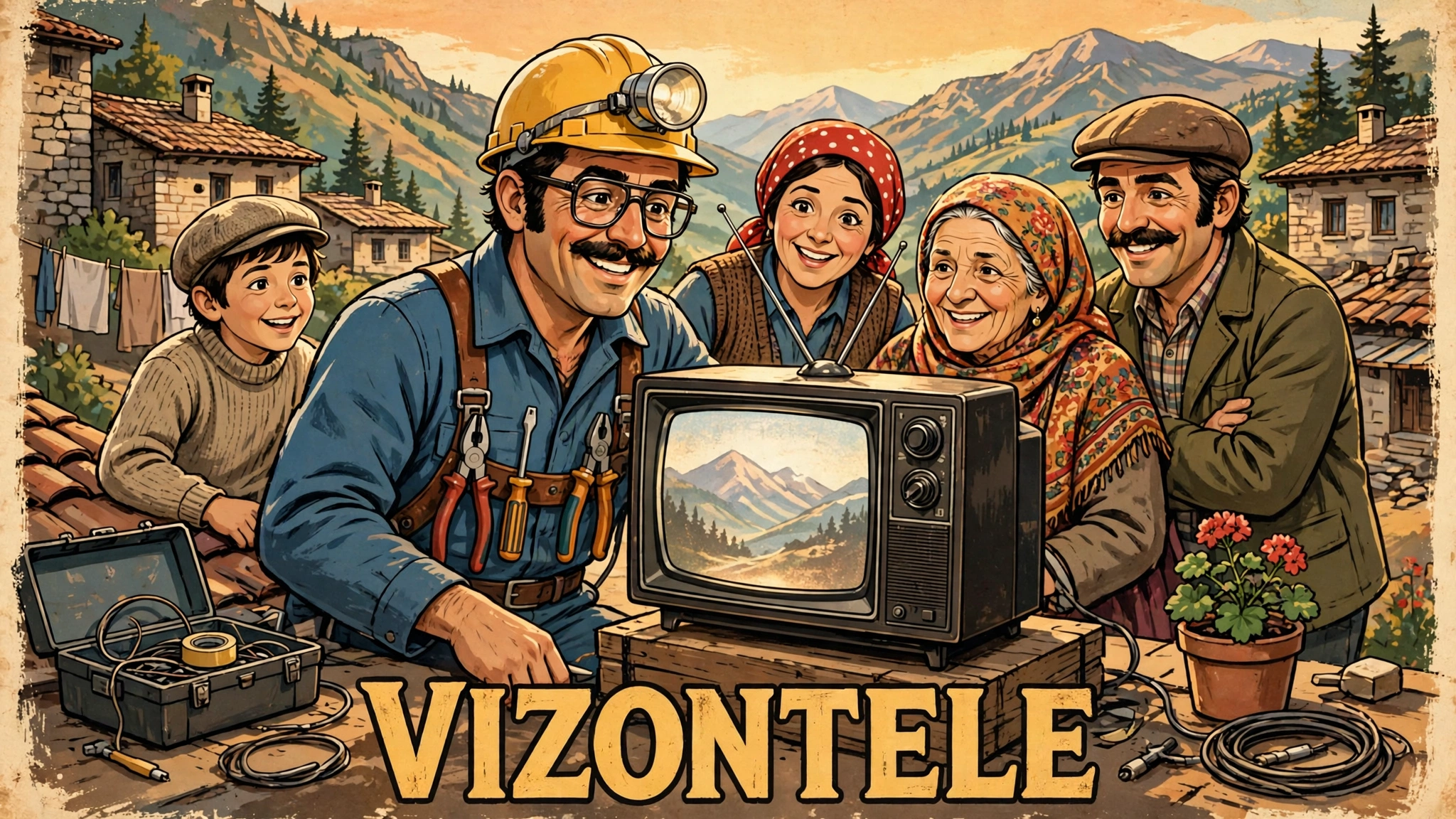
The premise sounds slight, and in a lesser film it would be. A state broadcasting delegation delivers a television transmitter to a remote village in south-eastern Turkey, and the village must work out how to make it function. But Erdoğan understands that a new technology is never just a machine. It is a test of power, faith, pride and curiosity, and every character in the village reacts to it differently. The mayor sees a chance to break a rival’s monopoly on entertainment. The local cinema operator sees the devil’s work. The village electrician, a gentle eccentric known as Crazy Emin, sees a puzzle he alone might solve. Around them, ordinary people gather, gossip, hope and misunderstand in ways that are funny precisely because they are recognisable.
What lifts Vizontele above a simple nostalgia piece is its refusal to treat the villagers as simpletons for the audience to laugh at. The comedy comes from a real clash between worlds, and the film’s emotional final stretch earns its tears because it has spent its first hour making you care about these people.
| Detail | Information |
|---|---|
| Release date | 2 February 2001 (Turkey) |
| Directors | Yılmaz Erdoğan, Ömer Faruk Sorak |
| Writer | Yılmaz Erdoğan |
| Genre | Comedy, Drama |
| Language | Turkish |
| Runtime | 110 minutes |
| Lead cast | Yılmaz Erdoğan, Demet Akbağ, Altan Erkekli, Cem Yılmaz, Cezmi Baskın |
| Our rating | 8.5/10 |
The setting is a small village in south-eastern Turkey in the 1970s, a place where news still travels by word of mouth and the postman reads the newspaper aloud to villagers who cannot read it themselves. Entertainment, such as it is, belongs to Latif, who runs open-air film screenings and guards his little monopoly jealously. The mayor, a well-meaning but proud man, has long resented that monopoly, and he resents Latif’s influence even more.
Then the state arrives with television. A delegation from the national broadcaster TRT delivers a transmitter and a set, and the village is told, in effect, that modernity has come to them. The problem is that nobody knows how to make it work, and the transmitter must be carried up a mountain and installed in the right place before a single picture can appear. The mayor recruits Emin, the village electrician, a man the village regards as half genius and half madman, along with members of his own staff, to get the job done.
Latif, meanwhile, fights back the only way he knows how, denouncing television as the work of the devil and an insult to faith and tradition. Some villagers agree with him, some are simply curious, and some just want to see what all the fuss is about. The film follows the efforts to raise the transmitter, the arguments that break out along the way, and the slow gathering of the whole village for the moment when the screen might finally flicker into life. This review will not reveal whether that moment goes as planned, or what it costs the people who made it happen. The ending is the reason the film is still talked about, and it should be discovered fresh.
Yılmaz Erdoğan as Emin — Erdoğan’s Emin is the film’s heart. He is called crazy by the village, and he is eccentric: he talks to machines, he works by instinct as much as by training, and he lives slightly outside the village’s social order. But Erdoğan never turns him into a caricature. Emin’s genius is practical, his kindness is unforced, and his loneliness is visible underneath the comedy. It is a performance that won him the Sadri Alışık award for best actor, and it is easy to see why: the whole film depends on the audience believing that this odd, gentle man is the only person who can bring the future to his village.
Demet Akbağ as Emin’s wife — Akbağ, Erdoğan’s long-time stage collaborator, gives the film its emotional anchor. As Emin’s wife, she is sceptical of the television project, worried about her husband, and exasperated by the village’s habit of laughing at him. Akbağ won a Golden Orange award for the performance, and her scenes give the comedy its stakes: if Emin fails, it is not just a machine that fails, but a man she loves. Her warmth keeps the film from drifting into pure farce.
Altan Erkekli as the mayor — Erkekli, who also won a Golden Orange award, plays the mayor as a man caught between pride and decency. He wants television partly to defeat Latif, and the film is honest about that pettiness, but he also genuinely wants something better for his village. Erkekli’s gift is to make pomposity funny without making the character contemptible, so that the audience roots for him even when he is being foolish.
Cem Yılmaz and Cezmi Baskın — Yılmaz, already a major comedy star, brings energy and timing to the ensemble, while Baskın as Latif is a superb antagonist: self-interested, sly and funny, but never a cartoon villain. His open-air cinema is a real business and a real part of village life, which is why his fear of television feels understandable rather than merely villainous. Around them, a large supporting cast drawn heavily from Erdoğan’s stage company fills the village with distinct, recognisable faces rather than background extras.
Vizontele was shot on location in Gevaş, in Van Province, and the landscape is one of its greatest assets. The mountains are beautiful and imposing, and the physical effort of hauling equipment up them gives the comedy a real sense of scale. Erdoğan and Sorak, who also shot the film, direct with a warm, unhurried eye: long takes of village life, crowds gathering in squares, children running after anything new. The film looks like a place that exists, not a set built for jokes.
The tonal balance is the directors’ real achievement. For most of its running time, Vizontele is a broad, warm comedy about misunderstanding and ambition. Then, without ever betraying that comedy, it turns serious, and the final stretch lands with a force that surprises first-time viewers. Some critics have argued that the ending is almost too abrupt in its emotional shift, and there is something to that complaint: the film asks the audience to move from laughter to grief very quickly. But the abruptness is also the point. Change, in a village like this, does not arrive gradually and politely. It arrives all at once, and it costs something.
The film’s one structural weakness is that its large ensemble sometimes leaves individual characters underdeveloped. A few villagers are vivid in one scene and then fade into the crowd, and the middle section occasionally repeats its central joke — the village does not understand television — when it could be deepening it. At 110 minutes, though, the film never outstays its welcome, and its economy is part of its charm.
The score by Kardeş Türküler, a group known for drawing on Anatolian and Mesopotamian folk traditions, won a Golden Orange award, and it is central to the film’s feeling. Rather than a conventional comedy score that underlines every joke, the music gives the village a sound: folk instruments, communal rhythms, melodies that feel old even when they accompany something entirely new. That choice matters. It tells the audience that this village has a culture of its own, and that television is arriving in a place that is not empty, but full.
In the film’s most emotional passages, the music does not push the audience toward tears so much as it clears a space for them. It is restrained where a lesser film would be sentimental, and that restraint is why the ending works. The songs and score feel like they belong to the village rather than to a soundtrack album, and they linger after the credits in a way that many comedy scores do not.
What we loved:
What could be better:
Vizontele was one of the most successful Turkish films of its time, selling roughly 3.3 million tickets, a remarkable figure for a domestic comedy-drama in 2001, and it remains a reference point for Turkish popular cinema. Its success was not a flash in the pan: a sequel, Vizontele Tuuba, followed in 2004 with Erdoğan and most of the original cast, and the original film’s lines, characters and ending are still quoted in Turkey today.
No reliable production-budget figure for the film could be verified for this review, so no budget number is given here, and no precise box-office gross in currency is quoted either; the ticket figure, reported in retrospectives on Erdoğan’s career, is the most solid measure of its success. What is not in doubt is the film’s awards record: three Golden Orange awards, including honours for its music and for Akbağ’s and Erkekli’s performances, confirmed that this was not just a popular hit but a film the Turkish industry itself took seriously. For international viewers, it remains the best possible introduction to Erdoğan’s cinema: funny, humane and rooted in a Turkey that many audiences have never seen on screen.
Yes, without hesitation. Vizontele is funny, warm and finally moving, a film about progress that refuses to be simple about it. It does not mock the village for fearing television, and it does not celebrate television as pure progress either. It shows people — proud, funny, frightened, kind — trying to live with a future they did not ask for, and it finds both comedy and tragedy in that effort. If you have ever watched an older relative confront a new technology with a mixture of suspicion and wonder, you will recognise this village immediately.
Our rating: 8.5/10 — A beloved Turkish classic about the day the future arrived in a mountain village.
Is Vizontele based on a true story?
It is based on Yılmaz Erdoğan’s childhood memories of the arrival of the first television in his home region of Hakkâri in the 1970s, dramatised as a fictional village story.
Who directed Vizontele?
Yılmaz Erdoğan co-directed it with Ömer Faruk Sorak, from a script by Erdoğan. Erdoğan also stars as the electrician Emin.
What does Vizontele mean?
It is the villagers’ pronunciation of “vision” and “television” blended together — the local name for the strange new device.
Is there a sequel to Vizontele?
Yes. Vizontele Tuuba followed in 2004, reuniting Erdoğan with most of the original cast.
Where can I watch Vizontele?
It is available on Turkish streaming platforms and in some international editions with English subtitles, though availability varies by country, so check your local platforms.