★ LATEST REVIEWS

Our Rating: ★★★★☆ 7.5/10
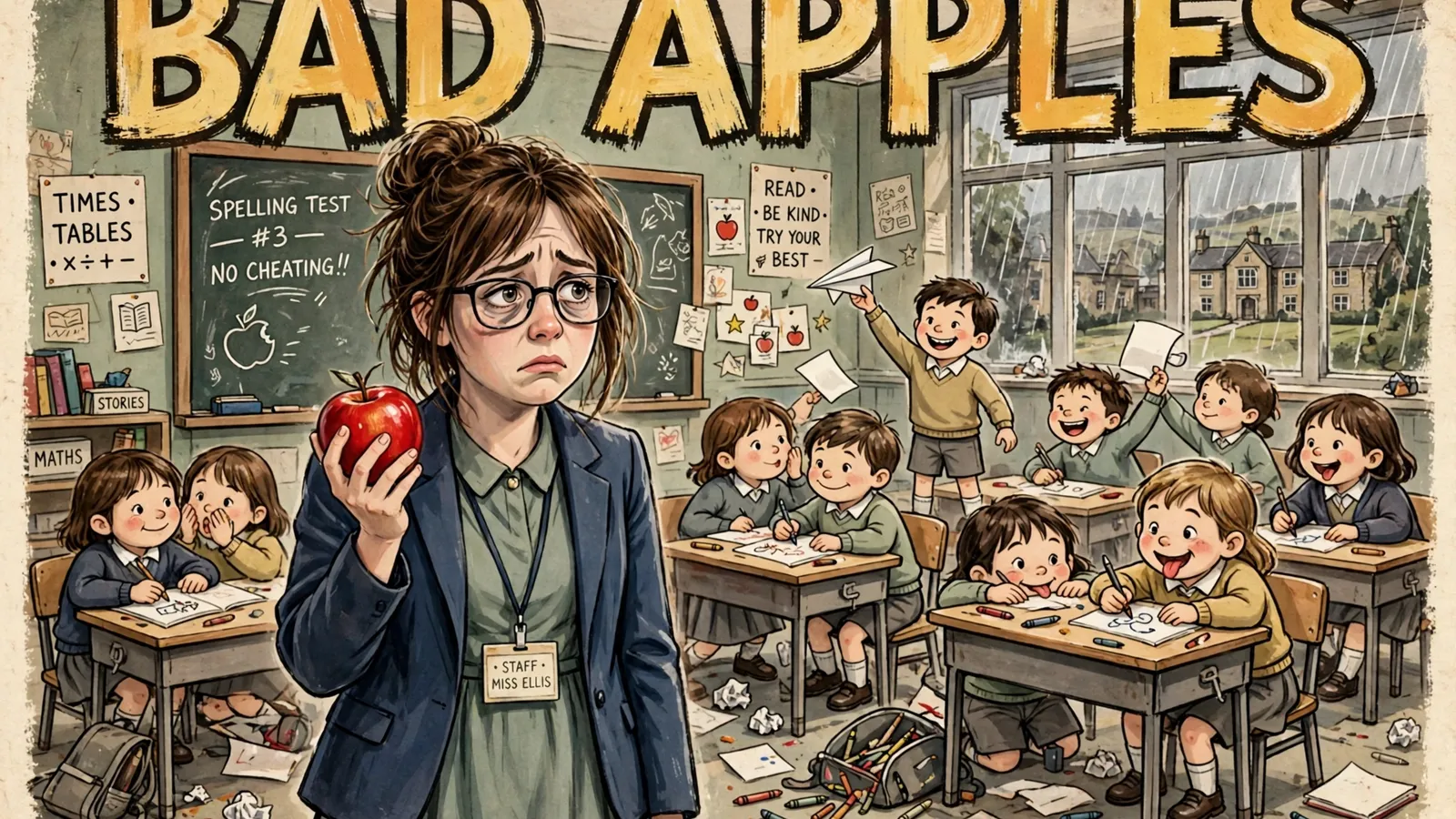
Every teacher has had the fantasy, usually at about 3 p.m. on a Friday: what if the one child who derails every lesson simply was not there on Monday? Bad Apples takes that exhausted daydream and follows it to its darkest, funniest, most uncomfortable conclusion. Saoirse Ronan plays Maria Spencer, a dedicated primary school teacher in Somerset trying to inspire a class of ten-year-olds while one wildly disruptive pupil, Danny Carter, undoes her career lesson by lesson. When a string of bad decisions ends with Maria accidentally locking Danny in her home, something terrible happens: the class starts thriving, the staff and parents are thrilled, and Maria has to decide how far she is willing to go to keep it that way.
This review is spoiler-free on the film’s later twists and ending. The premise itself is the hook; how Maria’s dilemma resolves is best discovered cold.
| Detail | Information |
|---|---|
| Release date | 18 September 2026 (US, UK and Irish cinemas); digital purchase and rental from 3 November 2026 |
| Director | Jonatan Etzler |
| Writer | Jess O’Kane, based on a story by Jonatan Etzler and Jess O’Kane, adapted from Rasmus Lindgren’s novel De Oönskade |
| Genre | Dark comedy, classroom satire, thriller |
| Language | English |
| Runtime | 100 minutes |
| Lead cast | Saoirse Ronan, Eddie Waller, Nia Brown, Jacob Anderson, Rakie Ayola, Robert Emms, Sean Gilder |
| Box office | Over $2.2 million in a limited theatrical release (reported) |
| Our rating | 7.5/10 |
Maria Spencer wants to be a good teacher. That is the film’s first and most important fact, and Ronan plays it without a trace of irony: Maria prepares, she cares, she tries to reach every child in her room. But Danny Carter, played with gleeful chaos by Eddie Waller, is the kind of pupil who can stop a whole class with a single shoe — literally, in the film’s wonderful opening at a cider factory, where Danny’s shoe ends up on the production line and everything grinds to a halt. Danny disrupts lessons, foul-mouths his way through the day, and eventually pushes a classmate, Pauline (Nia Brown), down the stairs and breaks her arm. The school suspends him. Maria’s career, already wobbling, is now in open question.
What happens next is a cascade of terrible choices made by a good person under unbearable pressure. After an encounter outside school leaves Danny hurt, Maria takes him home — and locks him in her basement. She goes back to school the next day while Danny is still downstairs, intending to figure out a way to undo what she has done. And then the film’s devilish engine kicks in: without Danny, her classroom flourishes. The children learn. The staff notice. The parents are delighted. An inspection looms, and the headteacher, Sylvia (Rakie Ayola), wants to see that Maria can manage her class. Suddenly the worst thing Maria has ever done is also the best thing that has ever happened to her career, and every day she does not confess, the trap closes a little tighter.
Director Jonatan Etzler, a Swedish filmmaker working from Jess O’Kane’s screenplay, keeps the tone balanced on a knife edge. This is a comedy that dares the audience to keep laughing, and the laughter keeps catching in the throat — which is exactly the point. The film is a satire of a system that measures teachers by results and then acts surprised when someone games the measurement, and it is also a portrait of a woman discovering that she is capable of things she never imagined, and not in a good way.
Saoirse Ronan as Maria Spencer — Ronan, a four-time Oscar nominee, has called this her darkest role yet, and it is a sharp turn after her recent run of prestige dramas. She is superb as a woman who can speak to a room full of children and sound completely in control while falling apart inside. The performance works because Maria is never a monster and never a victim: she is a professional at the end of her rope making one catastrophic decision and then another, and Ronan lets you see the calculation in her eyes even as you want her to stop. Reviewers singled out her performance and the film’s nerve above everything else, and the film’s 83% Rotten Tomatoes critics’ score reflects that admiration.
Eddie Waller as Danny Carter — Waller is a revelation as Danny, the classroom terror who is also, the film insists, a child — neglected, furious, funny and frightening by turns. The film’s moral force depends on Danny never becoming a caricature, and Waller keeps him human even at his worst. When Danny discovers how much Maria stands to lose if he tells anyone what happened, the power dynamic between teacher and pupil flips in a way that is genuinely chilling.
Nia Brown, Jacob Anderson and the ensemble — Nia Brown is excellent as Pauline, the classmate who wants Maria’s attention and knows how to ask for it in ways adults reward, and Jacob Anderson (best known from Game of Thrones and Interview with the Vampire) plays Sam, the school’s deputy head with a personal history with Maria. Rakie Ayola, Robert Emms and Sean Gilder round out a school that feels like a real workplace, with inspections, politics and petty kindnesses all in play.
Etzler directs with a steady, unshowy hand, which is the right choice for material this combustible. The Somerset school is shot plainly — fluorescent light, small chairs, corridors that feel too narrow — so that the horror of the premise lands in daylight rather than in shadows. The film’s great strength is its refusal to resolve its own joke: it never tells you whether Maria is a villain, a victim of the system, or both, and it trusts the audience to sit with that discomfort. The pacing is tight at 100 minutes, and the classroom scenes have a documentary snap that makes the satire sting.
Where the film wobbles, as several critics noted, is in its later stretch. Once the adults begin to learn why Maria’s class has improved, the film gets less convincing — the machinery of the cover-up starts to creak, and the ending, which some reviewers found weak, resolves the moral question more tidily than the premise deserves. The tone also wobbles by design: this is a comedy about a child locked in a basement, and viewers who want their satire clearly signposted may find the film’s nerve harder to enjoy. But the wobble is part of the film’s honesty — a story this dark should not resolve cleanly, and the fact that it tries to is itself a kind of joke.
The score stays out of the way, which is wise: the film’s tension comes from silence in a classroom, a phone ringing in an empty house, a child’s voice from below. The sound design keeps the school feeling real — bells, chairs, playground noise — so that the unreal thing at the centre of the story feels all the more wrong.
What we loved:
What could be better:
Bad Apples premiered at the Toronto International Film Festival in 2025, reached cinemas in the US, UK and Ireland on 18 September 2026, and earned just over $2.2 million in a limited theatrical release — a small number that understates the film’s footprint, since its festival run and Ronan’s performance made it one of the autumn’s most talked-about dark comedies. It was never distributed theatrically in the US on a wide basis, which makes the digital release on 3 November 2026 from Republic Pictures and Paramount its real moment with audiences. At 83% on Rotten Tomatoes, it arrives at home with its reputation intact.
Yes, if you like your comedy with teeth. Bad Apples is the rare satire that trusts its audience to sit with an unresolvable question — what do we do with a system that rewards the wrong thing? — and Ronan is magnificent in it. Watch it for her, stay for the argument it will start afterwards.
Our rating: 7.5/10 — Deliciously dark and dangerously funny: Ronan magnificent, the premise unforgettable, the ending slightly tidier than the film deserves.
What is Bad Apples about?
It follows Maria Spencer (Saoirse Ronan), a Somerset primary teacher whose career is derailed by one disruptive pupil, Danny — until a terrible decision accidentally removes him from her classroom and her class starts thriving.
Who directed Bad Apples?
Jonatan Etzler, from a screenplay by Jess O’Kane adapted from Rasmus Lindgren’s novel De Oönskade.
Who stars in Bad Apples?
Saoirse Ronan as Maria, Eddie Waller as Danny, Nia Brown as Pauline, Jacob Anderson as Sam, with Rakie Ayola, Robert Emms and Sean Gilder.
When was Bad Apples released?
It premiered at Toronto in 2025, opened in US, UK and Irish cinemas on 18 September 2026, and arrived on digital purchase and rental on 3 November 2026.
How long is Bad Apples?
100 minutes.
Is Bad Apples based on a true story?
No — it is a fictional dark comedy adapted from Rasmus Lindgren’s novel De Oönskade.
Is Bad Apples suitable for younger viewers?
No — it is rated R, with strong language and a disturbing premise, and suits adult viewers.