★ LATEST REVIEWS

Our Rating: ★★★★★ 9/10
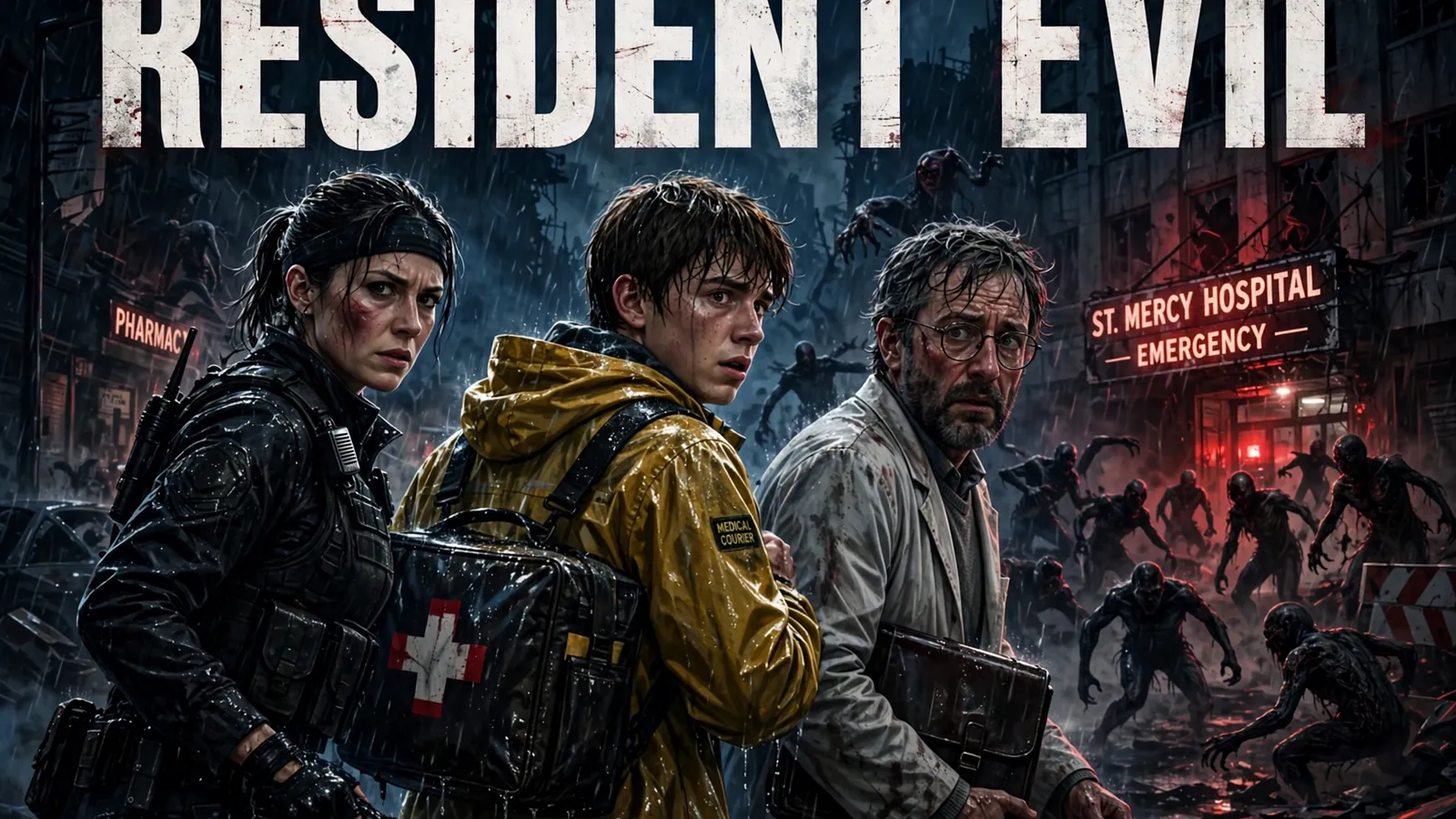
There is a particular feeling that only a great survival-horror game produces: the dread of the next corridor, the relief of a save room, the terrible decision to spend your last bullet now or save it for whatever is behind the next door. Zach Cregger’s Resident Evil is the first film in the franchise’s long screen history to truly bottle that feeling. It does not retell a game’s plot, it does not resurrect the old films’ heroes, and it does not apologise for being a horror film. Instead it drops an ordinary man — Bryan, a medical courier played with crack comic timing by Austin Abrams — into Raccoon City on the worst night of its existence, and then refuses to let him, or you, catch your breath for 94 minutes.
This review is spoiler-free on the film’s set pieces and ending. What matters here is the machine Cregger builds — pace, atmosphere, scares — not the specifics of who survives which corridor.
| Detail | Information |
|---|---|
| Release date | 18 September 2026 (cinemas); digital purchase and rental from 3 November 2026 |
| Director | Zach Cregger |
| Writers | Zach Cregger and Shay Hatten |
| Genre | Survival horror, action horror |
| Language | English |
| Runtime | 94 minutes (some listings give 95 minutes) |
| Lead cast | Austin Abrams, Paul Walter Hauser, Kali Reis, Zach Cherry |
| Budget | About $75 million (reported) |
| Box office | Over $400 million worldwide ($157.4 million domestic, $242.6 million international, as reported in early November 2026) |
| Our rating | 9/10 |
The setup is beautifully simple, and simplicity is the film’s secret weapon. Bryan (Abrams) is a medical courier, not a soldier, not a special agent, not a chosen one. He takes a delivery job that sends him to a remote hospital, and on the way the city around him collapses: an outbreak turns Raccoon City’s streets into a gauntlet of infected monsters, and the hospital becomes less a destination than a trap. Around him orbit the film’s other figures — Umbrella scientists played by Zach Cherry and Paul Walter Hauser, an Umbrella enforcer played by Kali Reis, and an Arklay County sheriff — but the camera stays close to Bryan, an ordinary man whose only real skills are running, hiding, improvising and talking too fast when he is scared.
That ordinariness is the whole point, and it is why the film works where six earlier Resident Evil films did not. The old films gave us superhuman heroines dispatching monsters with balletic ease. Cregger gives us a man who is genuinely out of his depth, and the horror lands harder because of it. Every locked door matters. Every bullet matters. The film understands, as the games always did, that survival horror is not about how powerful the hero is but about how little margin for error he has.
Cregger, who directed Barbarian and Weapons, has said he set out to capture the feeling of playing the games rather than adapting any single title, and the film is full of that philosophy. The camera lingers on corridors the way a game camera lingers on a hallway you do not want to enter. The sound design — drips, distant groans, the hum of a failing hospital — does the work of a game’s ambient dread. And the scares are paced like a well-designed level: quiet, quiet, quiet, then something you will think about for days.
Austin Abrams as Bryan — Abrams is the film’s star-making turn. Critics singled out his performance above everything else, and rightly so: he plays Bryan as scared, resourceful and funny in the same breath, a silly charmer with just enough fight and determination to keep moving. His comic timing provides crucial levity without ever breaking the tension — the jokes come from a man trying not to panic, which is the most human response imaginable to a city full of monsters. The Rotten Tomatoes critics’ consensus says it plainly: his crack comic timing is half of what makes the film work.
Paul Walter Hauser, Kali Reis and Zach Cherry — Hauser brings his usual unsettling warmth to an Umbrella scientist whose corporate calm curdles as the night goes on, Reis is a formidable physical presence as the Umbrella enforcer, and Cherry gives the film its dry, exhausted humour as a fellow traveller in the disaster. None of them is asked to carry exposition for long; Cregger trusts the situation to do that work, and the ensemble benefits.
At 94 minutes, this is the leanest entry in franchise history, and the leanness is a weapon. There is no fat here: no subplot that does not pay off, no action beat that repeats itself, no ten-minute mythology lecture. Cregger shoots the horror with propulsive clarity — you always know where Bryan is, what is between him and safety, and how little time he has — and the film’s mix of humour and scares is calibrated with rare confidence. The gore is strong and bloody, as the R rating promises, but it is never the point; the point is the dread between the shocks.
The film’s one recurring criticism is also fair, and worth stating honestly: the tone swings hard between scary and goofy, and the story underneath the set pieces is thin. A handful of dissenting critics found the plot predictable and the gore gratuitous, and viewers who want dense mythology or a faithful retelling of a specific game will not find it here — Cregger deliberately invented a standalone story with no game heroes, a choice that angered some fans online before release and that the box office has now comprehensively answered. The film is, by design, a ride rather than a novel, and it is the best ride the franchise has ever built.
The score and sound design are the film’s unsung heroes. The hospital’s failing lights, the wet streets, the distant things moving in the dark — all of it builds the sense of a place that was ordinary an hour ago and is now lost. The music never tells you to be scared; the silence does that, and the sudden noise that breaks it is all the worse for the wait.
What we loved:
What could be better:
The numbers are historic. Resident Evil opened in cinemas on 18 September 2026 with a worldwide opening reported at $108.3 million, and by early November it had passed $400 million worldwide — $157.4 million in North America and $242.6 million internationally — on a reported budget of about $75 million, making it the highest-grossing Resident Evil film ever and, by several accounts, the highest-grossing video game movie of its kind. Critically it is the franchise’s peak too: 96% on Rotten Tomatoes from over 300 critics, with a 90% audience Popcornmeter score, a Metacritic score of 79, and a B+ CinemaScore — the best audience grade any Resident Evil film has received. The digital release on 3 November 2026, priced at $24.99 to buy and $19.99 to rent on US storefronts, arrives with the film also returning to IMAX and premium large-format screens — a victory lap for a horror film that outgrossed almost everything in its path.
Yes — and if you skipped it in cinemas because you were burned by the old films, the digital release is your second chance. This is not just the best Resident Evil film; on the evidence of its reviews and its audience, it is the best video game movie ever made, and one of the best horror films of 2026. Watch it with the lights low, the sound up, and someone next to you who will forgive you for grabbing their arm.
Our rating: 9/10 — Lean, terrifying and unexpectedly funny: Cregger’s reboot understands the assignment, and Austin Abrams is magnificent.
What is Resident Evil (2026) about?
It follows Bryan (Austin Abrams), a medical courier whose delivery job traps him in Raccoon City during a horrific outbreak of infected monsters, in a standalone story not based on any single game.
Who directed Resident Evil (2026)?
Zach Cregger, director of Barbarian and Weapons, from a script he co-wrote with Shay Hatten.
Who stars in Resident Evil (2026)?
Austin Abrams as Bryan, with Paul Walter Hauser, Kali Reis and Zach Cherry. It features no heroes from the games — a deliberate, standalone choice.
When was Resident Evil (2026) released?
It opened in cinemas on 18 September 2026 and arrived on digital purchase and rental on 3 November 2026.
How long is Resident Evil (2026)?
94 minutes (some listings give 95 minutes).
How much did Resident Evil (2026) make at the box office?
Over $400 million worldwide on a reported budget of about $75 million, making it the highest-grossing Resident Evil film ever.
Is Resident Evil (2026) connected to the old films?
No — it is a second reboot and a standalone story, separate from the Milla Jovovich films and from Welcome to Raccoon City.