★ LATEST REVIEWS

★★★★★ Our Rating: 9/10
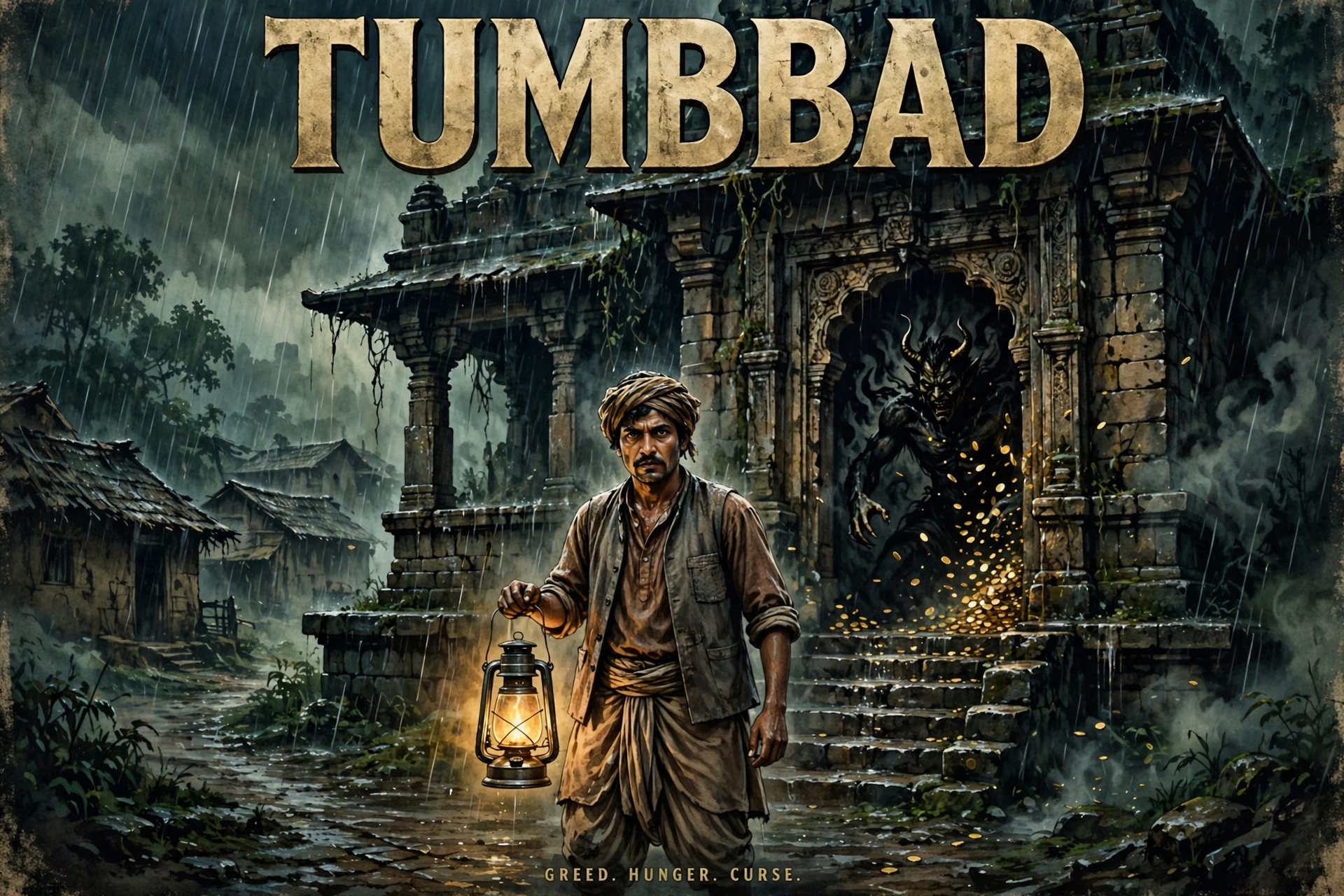
There are films you admire, and there are films that haunt you. Tumbbad does both. Directed by Rahi Anil Barve, shot over six years and four real monsoon seasons, it is a folk horror rooted in Indian mythology, a parable about greed that feels older than cinema itself. It follows Vinayak Rao, a man from the cursed village of Tumbbad, who discovers that a forgotten god will give him gold — if he is willing to descend into darkness again and again to take it. The film was a modest performer on its first release in 2018 and a phenomenon on its re-release in 2024, when audiences finally caught up with it. Today it is rightly regarded as one of the finest Indian films of its decade.
This review is spoiler-free on the film’s secrets. The mystery of what lies in the womb of Tumbbad is the film’s great reveal, and it should be discovered, not described.
| Detail | Information |
|---|---|
| Release date | 12 October 2018 (India) |
| Director | Rahi Anil Barve |
| Writers | Mitesh Shah, Adesh Prasad, Rahi Anil Barve, Anand Gandhi |
| Genre | Folk horror fantasy |
| Language | Hindi |
| Runtime | 104 minutes |
| Budget | Reported figures conflict widely, from around ₹5 crore to around ₹15 crore; no single official figure is settled |
| Box office | Original run around ₹13–14 crore net in India (roughly ₹17 crore worldwide); the 2024 re-release added roughly ₹32–38 crore, taking the combined total past ₹50 crore |
| Lead cast | Sohum Shah, Jyoti Malshe, Dhundiraj Prabhakar Joglekar, Mohammad Samad, Ronjini Chakraborty |
| Our rating | 9/10 |
The film opens with a myth. When the Goddess of Prosperity created the world, her firstborn, Hastar, seized all her gold and grain for himself. The other gods attacked him, and the goddess saved him only on one condition: that he would never be worshipped, and his name would be forgotten. The village of Tumbbad, drenched in endless rain, is where Hastar was imprisoned — and where his gold still waits.
Vinayak Rao grows up in that village, in a household shadowed by the shrine of Hastar. As a boy he learns that the god can be tricked into giving up gold coins, but that every visit to his darkness carries a terrible price. As a man, Vinayak returns again and again, growing rich while the world around him changes — from British-era village life through the decades to a newly independent India. The film is structured in three chapters across thirty years, and each chapter asks the same question with increasing force: how much gold is enough, and what does a man become when he can always have more?
What makes Tumbbad extraordinary is that it never treats its horror as mere spectacle. The fear comes from atmosphere — the rain that never stops, the crumbling wada, the creaking well, the dough dolls and the darkness below — and from a moral idea as old as folklore: greed is not a single sin but a habit, and habits grow. Vinayak is not a monster; he is an ordinary man who learns to live with a terrible bargain, and the film watches, with terrible patience, as the bargain consumes him and then his son.
Sohum Shah as Vinayak Rao — Shah, who also produced the film and shepherded it through its long production, gives a career-defining performance. He plays Vinayak across three decades, from hungry boy to swaggering rich man to a father passing his curse to his son, and he does it mostly through his face: the hunger, the cunning, the fear, the pride. It is a performance of remarkable restraint in a film full of spectacle, and it anchors the mythology in something human. Without Shah’s conviction, the film’s folk tale might feel like a fable; with him, it feels like a biography.
The supporting cast — Jyoti Malshe, as Vinayak’s mother, is heartbreaking in the film’s first chapter: a woman who knows exactly what the shrine costs and tries, desperately, to keep her children from it. Dhundiraj Prabhakar Joglekar brings sly menace to the household’s secrets, and Mohammad Samad, as the young Pandurang, gives the final chapter its emotional sting. The film’s casting is uniformly excellent, with faces that feel like they belong to the rain and the mud of Tumbbad rather than to a film set.
Rahi Anil Barve’s direction is a marvel of patience. The film took six years to shoot, largely because Barve insisted on filming the monsoon scenes in real rain across four monsoon seasons, and that patience is visible in every frame. Pankaj Kumar’s cinematography — which won the Filmfare Award for Best Cinematography — turns rain into a character: grey, silver, relentless, beautiful and oppressive by turns. The production design, also Filmfare-winning, builds a world that feels ancient and rotting at once, from the ancestral wada to the stone well that leads down into darkness.
The creature and effects work deserves special praise. Hastar and his domain are realised with a mixture of practical effects and visual effects that feels tactile rather than digital; the horror is physical, wet, and close. The film’s sound design, another Filmfare winner, is equally crucial — dripping water, creaking wood, whispered chants — building dread from the everyday. And Ajay-Atul’s background score, built around ominous choral and percussive textures, gives the film a ritual, almost religious weight.
If there is a criticism, it is that the film’s final chapter, while emotionally powerful, moves faster than the first two, and some viewers may find its moral spelled out more plainly than the earlier chapters’ ambiguity. But this is a small complaint against a film of such sustained atmosphere and ambition.
Ajay-Atul’s score is one of the film’s great strengths. Rather than conventional horror stings, it uses chanting, deep percussion and unsettling melodic fragments to create a sense of ritual dread, as if the film itself were a prayer gone wrong. The sound design works in tandem: in Tumbbad, rain is never just weather, it is judgement, and the sound of water is present in almost every scene, a reminder that the village’s curse is also its climate.
What we loved:
What could be better:
Tumbbad‘s box-office story is itself a parable about patience. Made on a budget whose reported figures conflict widely — sources cite anything from around ₹5 crore to around ₹15 crore, and this review does not pretend to settle that dispute — the film earned only around ₹13–14 crore net in India on its original 2018 run, roughly ₹17 crore worldwide. Critics loved it; audiences, at first, did not find it. Then came the re-release on 13 September 2024, which became a sensation, adding roughly ₹32–38 crore and taking the film’s combined total past ₹50 crore, outperforming several new releases of that weekend. It is now the benchmark for how a great Indian film can find its audience late, and its success directly fuelled the announcement of Tumbbad 2.
Yes — urgently, if you have not, and again, if you have. Tumbbad is not just the best Indian horror film of recent years; it is one of the best Indian films, full stop. It is a folk tale, a horror film, a period drama and a moral fable at once, made with a patience and craft that Indian cinema rarely attempts. Watch it on the biggest screen you can, with the sound up, and let the rain of Tumbbad get under your skin.
Our rating: 9/10 — A modern classic: India’s finest folk horror, a rain-drenched parable about greed that only grows more powerful with time.
Is Tumbbad based on a real myth?
The story draws on Hindu mythology and folk tradition — the goddess of prosperity and her children — but Hastar and the village of Tumbbad are the filmmakers’ invention, crafted into an original folk tale.
Who directed Tumbbad?
Rahi Anil Barve directed it, with Anand Gandhi as creative director and co-producer, and Adesh Prasad as co-director on some accounts.
How much did Tumbbad earn at the box office?
Around ₹13–14 crore net in India on its original 2018 run, plus roughly ₹32–38 crore from its hugely successful 2024 re-release, taking the combined total past ₹50 crore.
Is Tumbbad 2 coming?
Yes, a sequel has been announced, with Sohum Shah returning and a much larger scale promised, though its story remains under wraps.
Is Tumbbad suitable for family viewing?
It is a horror film with frightening imagery and dark themes, best suited to older teenagers and adults rather than young children.
