★ LATEST REVIEWS

Our Rating: ★★★★☆ 8.5/10
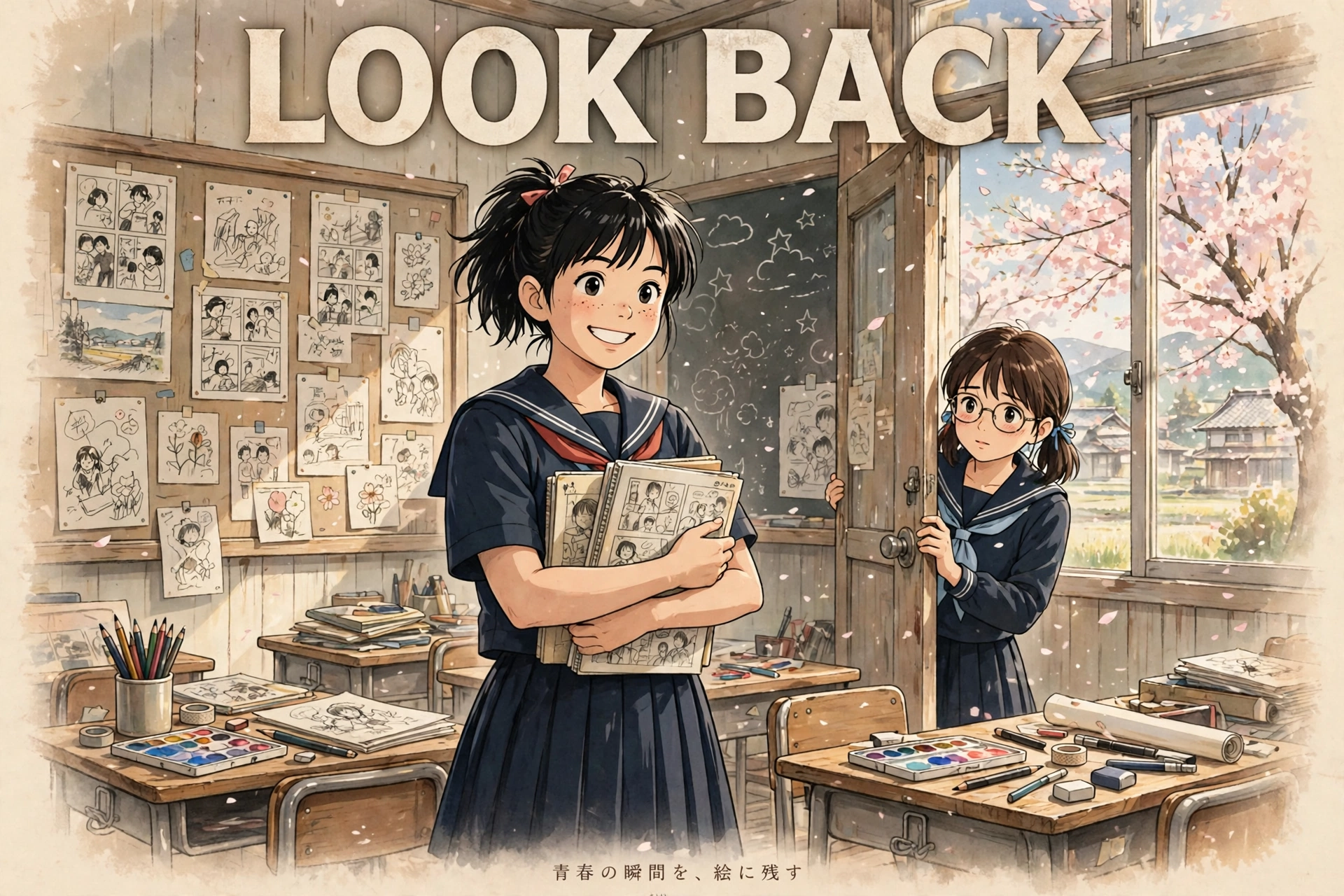
Some stories are small enough to hold in your hand and large enough to contain a life. Tatsuki Fujimoto’s one-shot manga Look Back, published on Shōnen Jump+ in July 2021, is one of them: the story of two girls, Fujino and Kyomoto, who meet through manga and whose friendship carries them from childhood into adulthood, through ambition, rivalry, loss and the strange, stubborn power of making art. It was already adapted once, into a acclaimed 2024 anime film. Now Hirokazu Kore-eda — the Palme d’Or-winning director of Shoplifters, and one of cinema’s great chroniclers of quiet, everyday emotion — has made a live-action version, shot on 35mm film in Fujimoto’s hometown. It premiered in competition at the Venice Film Festival on 6 September 2026 and opened in Japan on 11 September 2026. It is a film of rare gentleness, and it earns its tears honestly.
A release-date note, stated plainly: an earlier internal log for this review series listed a Korea release on 8 October 2026, but no reliable source found during research confirms a Korean release on that date. What is confirmed is the Japanese release (11 September 2026), the Venice premiere (6 September 2026), a Philippines release on 25 November 2026, and a GKIDS theatrical release in the United States, Canada, the United Kingdom and Ireland, with the US date reported as 30 December 2026. Readers in Korea and elsewhere should check local listings rather than relying on the unconfirmed date.
| Detail | Information |
|---|---|
| Release date | 11 September 2026 (Japan; Venice premiere 6 September 2026) |
| Director | Hirokazu Kore-eda |
| Based on | The 2021 one-shot manga by Tatsuki Fujimoto |
| Genre | Coming-of-age drama |
| Language | Japanese |
| Lead cast | Natsuki Deguchi, Aju Makita, Furi Nanase, Rokka Okada, Masaki Suda |
| Music | Yuta Bandoh, with performances by Tōko Miura and Kenshi Yonezu |
| Box office | Over ¥144 million in Japan in its first three days (reported) |
| Our rating | 8.5/10 |
Fujino is the popular, confident girl at school, proud of the manga strips she draws for the school newspaper. Kyomoto is her opposite: a shut-in, crippled by social anxiety, who never leaves her room — but whose art, glimpsed by chance, is startlingly better than Fujino’s. What begins as rivalry becomes friendship, and friendship becomes a creative partnership: the two girls draw together, push each other, dream of becoming professional manga artists, and grow up side by side. And then, as in all stories about growing up, life intervenes — ambition pulls in different directions, and a tragedy changes everything.
This review will not spoil the film’s second half, which is where Fujimoto’s story turns from charming to devastating. What can be said is that Look Back is, at its heart, a story about why people make art at all: for praise, for rivalry, for a friend, for oneself, and finally, after loss, as a way of keeping someone alive. Kore-eda, whose films have always been about families — found, broken, chosen — finds in Fujimoto’s manga a story perfectly suited to his sensibility: small moments, long silences, and emotions that arrive without announcement.
The live-action film expands the manga’s compact story across a longer running time than the 2024 anime, trading that version’s tight punch for a slower, more atmospheric portrait. Filmed across the seasons in Nikaho, Akita — Fujimoto’s hometown — it lets the landscape do emotional work: snow, rain, cherry blossoms and long summer light marking the years as the girls grow.
Natsuki Deguchi and Aju Makita as the older Fujino and Kyomoto — Deguchi plays the older Fujino with a confidence that never quite hides her insecurity, the popular girl grown into a young professional still measuring herself against her friend. Makita, as Kyomoto, gives the film its still centre: a young woman whose shyness is not a quirk but a real, lived condition, and whose art is her truest voice. Their chemistry is the film’s engine, and it works because both actresses understand that this friendship is built on both admiration and envy — the two feelings that, in creative partnerships, are often the same feeling.
Furi Nanase and Rokka Okada as the younger Fujino and Kyomoto — The childhood sections are carried by Nanase and Okada, who are charming without ever being cutesy. The young Fujino’s swagger and the young Kyomoto’s terror of the classroom door are played with a directness that makes the later, adult scenes land harder. Masaki Suda, as Maeda, a Weekly Shōnen Jump manga editor, and the supporting cast of family and teachers, fill out a world that feels observed rather than constructed.
Kore-eda’s decision to shoot on 35mm film, in Fujimoto’s hometown and across the seasons, is the film’s defining craft choice. The image has a warmth and grain that digital rarely achieves, and the seasonal structure gives the story a natural rhythm: the girls’ lives advance the way years do, in weather and light rather than in plot beats. The film premiered in competition at Venice, where it won five collateral awards — a strong festival reception for a film that, on paper, might have seemed too quiet for competition.
The adaptation’s relationship to its source material is worth noting honestly. Fans of the manga and the 2024 anime will recognise the story’s beats, and some may miss the anime’s concision: the live-action film is a slower, more expansive telling, and its patience will not suit every viewer. But Kore-eda’s version finds things the shorter versions could not — the texture of a hometown, the weight of years, the way a room changes when someone stops coming to it — and for viewers willing to slow down to its pace, it is the richer experience.
Yuta Bandoh’s score, with vocal performances by Tōko Miura and Kenshi Yonezu, is restrained and melodic, favouring piano and strings over orchestral swell. It works the way Kore-eda’s films always work: by staying out of the way until the moment when a single musical phrase can break your heart. The sound design — pencil on paper, rain on windows, the quiet of an empty room — is equally deliberate, reminding the audience that this is a film about the small, physical act of drawing.
What we loved:
What could be better:
Look Back grossed over ¥144 million in Japan in its first three days of release — a healthy opening for a quiet, literary drama, and a sign of the manga’s devoted readership and Kore-eda’s reputation. No reliable budget figure has been published, so this review omits one rather than guessing, and international totals will depend on the staggered GKIDS rollout through late 2026. The film’s commercial story, like its artistic one, is one of steady, word-of-mouth growth rather than explosive opening weekends.
Yes — especially if you love stories about creativity, friendship, or growing up. Look Back is a gentle, devastating film, and Kore-eda’s version is a worthy companion to both the manga and the anime: slower, warmer, and quietly heartbreaking. Watch it with someone you make things with, or someone you grew up with. You will want to talk afterwards, and you may want to draw something.
Our rating: 8.5/10 — A tender, luminous adaptation: Kore-eda turns Fujimoto’s small manga into a film about why art matters, and why friends matter more.
Is Look Back (2026) the same as the anime film?
No. The 2024 anime, directed by Kiyotaka Oshiyama, and the 2026 live-action film, directed by Hirokazu Kore-eda, are separate adaptations of the same 2021 manga by Tatsuki Fujimoto.
Who stars in Look Back (2026)?
Natsuki Deguchi and Aju Makita as the older Fujino and Kyomoto, Furi Nanase and Rokka Okada as their younger selves, with Masaki Suda as the manga editor Maeda.
When was Look Back (2026) released?
It premiered at Venice on 6 September 2026 and opened in Japan on 11 September 2026; GKIDS will release it in North America, the UK and Ireland, with the US date reported as 30 December 2026.
Do I need to read the manga first?
No. The film stands on its own, though readers of the manga will recognise its story and appreciate how Kore-eda expands it.
Is Look Back suitable for family viewing?
It is a gentle coming-of-age drama, but its themes of grief and loss make it best suited to older children, teenagers and adults rather than young children.