★ LATEST REVIEWS

★★★★☆ Our Rating: 7/10
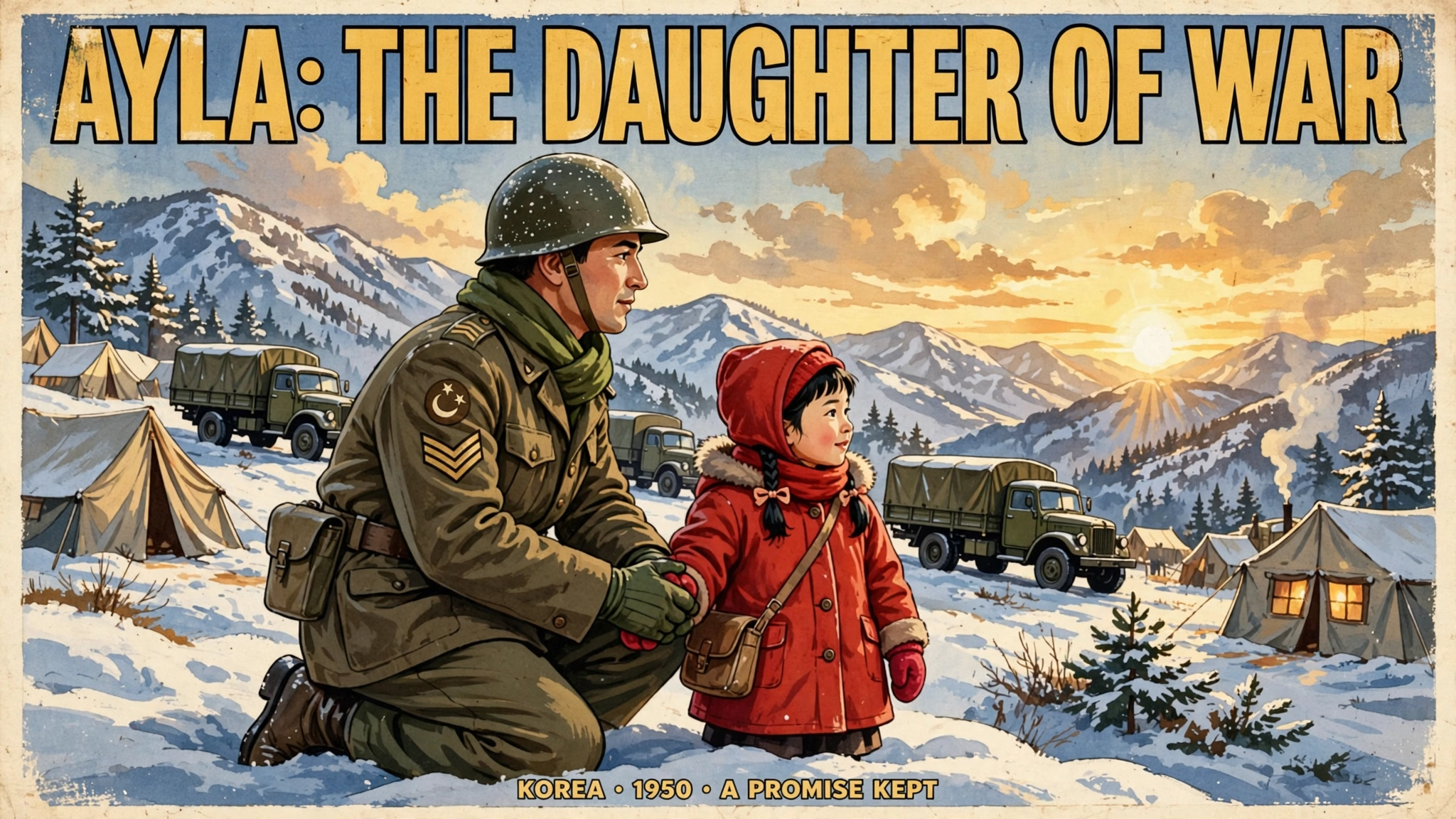
Some war films are about battles. Ayla: The Daughter of War is about what a battle leaves behind: a small child standing alone among the dead, and the young soldier who could not walk past her. Based on the true story of Turkish Sergeant Süleyman Dilbirliği and the Korean orphan he named Ayla, Can Ulkay’s 2017 Turkish–South Korean drama became one of Turkey’s biggest films of its year, was selected as Turkey’s entry for the Best Foreign Language Film Oscar at the 90th Academy Awards, and has been making audiences weep at festivals and on streaming platforms ever since.
True stories carry a special risk — filmmakers lean on “it really happened” instead of making it work as drama. Does Ayla earn its emotion, or borrow it? In this review we look at the story, the performances of İsmail Hacıoğlu and young Kim Seol, the film’s handling of the Korean War, and Fahir Atakoğlu’s score, and give an honest answer.
| Detail | Information |
|---|---|
| Release date | 27 October 2017 (Turkey); 21 June 2018 (South Korea) |
| Director | Can Ulkay |
| Writers | Yiğit Güralp |
| Genre | War, Drama |
| Language | Turkish, Korean, English |
| Runtime | 124 minutes |
| Lead cast | İsmail Hacıoğlu, Çetin Tekindor, Kim Seol, Ali Atay, Damla Sönmez, Murat Yıldırım |
| Our rating | 7/10 |
In 1950, North Korea invades the South, and Turkey answers the United Nations’ call by sending a brigade halfway around the world. Among the soldiers is Süleyman, a young sergeant and mechanic from Istanbul, leaving behind his family and the woman he hopes to marry. The Turkish troops distinguish themselves in some of the war’s hardest fighting, but the moment that will define Süleyman’s life comes not in a famous battle but on a night patrol afterwards, in a landscape of frozen devastation: a little Korean girl, perhaps five years old, alone, half-frozen and unable to speak, her parents killed.
Süleyman carries her back to the base. She has no name anyone knows and no words he understands, so he calls her Ayla — from the halo of light around the moon — because of the moonlit night on which he found her. What begins as an emergency act of mercy becomes something nobody planned: Ayla is unofficially adopted by the entire brigade. She learns Turkish words, the soldiers learn to be fathers, and Süleyman, who hides her, feeds her and teaches her, becomes in every way that matters her parent.
The film’s second movement is built into that happiness from the start: wars end, brigades go home, and military rules about war orphans do not bend for love. As the brigade’s departure approaches, Süleyman must fight a different kind of battle — against regulations, distances and time itself — to keep his promise that he will not abandon her. And framing the whole story, shown in glimpses, is an elderly Süleyman decades later, still carrying Ayla in his heart, and the question of whether fate kept its side of the bargain. We will not spoil the answer here, but audiences familiar with the famous documentary footage of the real story may already know why this film’s final minutes are so powerful.
İsmail Hacıoğlu as the young Süleyman carries the film with warmth and believability. He plays Süleyman first as an ordinary young man — cheeky with his friends, nervous in battle, far from a born hero — which is essential, because the story’s point is that decency, not heroism, saves Ayla. His transformation into a father is gradual and touching: watch the scenes where he teaches her words, or panics at the thought of losing her, and you are watching a man discover the central fact of his life.
Kim Seol as Ayla is a small miracle of casting. Very young at the time of filming, she communicates across a language barrier exactly as the character must — through trust, fear, playfulness and grief that needs no translation. Her chemistry with Hacıoğlu feels entirely unforced, and the film wisely lets many of their scenes play as simple shared moments rather than written set pieces.
Çetin Tekindor as the elderly Süleyman appears for a fraction of the running time and somehow deepens everything. One of Turkish cinema’s most respected actors, he plays the old sergeant’s lifelong love and regret with a quietness that trusts the audience completely; the framing scenes derive much of their force from him. In support, Ali Atay as Ali, Süleyman’s loyal friend, provides humour and heart, Murat Yıldırım brings steadiness as a fellow officer, and Damla Sönmez as Nuran, the woman Süleyman left behind in Turkey, gives the home front a face and a cost of its own.
Director Can Ulkay, working from Yiğit Güralp’s screenplay, balances two films at once: a war movie with large-scale battle sequences, period vehicles, aircraft and hundreds of extras, and an intimate two-hander about a man and a child. The war material is competently and sometimes impressively staged — the chaos, cold and confusion of the Korean winter are convincingly rendered, and the Turkish brigade’s story, little known internationally, is told with evident national pride.
Cinematographer Jean-Paul Seresin’s work moves between the blue-grey misery of the battlefield and the warm interiors of the base where Ayla is safe, making the emotional geography of the film visual. The production, a Turkish–South Korean co-production shot across both countries, recreates 1950s Korea with care, and the integration of languages — Turkish, Korean and English flowing through scenes — gives the film an authenticity many war dramas lack. The pacing is the main technical quibble: at 124 minutes, the middle act repeats its emotional situation — happiness shadowed by inevitable separation — a few times more than necessary before the story moves forward.
Fahir Atakoğlu, one of Turkey’s best-known film composers, provides a full, traditional orchestral score: strings, piano and gentle folk colouring that underlines both the war’s scale and the central relationship’s tenderness. It is effective and often beautiful, and the main themes linger. It is also, in places, insistent — the music occasionally arrives a beat before the emotion does, instructing the audience to cry rather than letting the scene do the work. Used a touch more sparingly, the same score would have hit even harder.
What we loved:
What could be better:
Released in Turkey on 27 October 2017, Ayla became the second-biggest film of the Turkish box office year, earning around $13 million domestically, with its worldwide total reported at roughly $16–17 million once its South Korean release in June 2018 and other markets are included. For a period war drama in Turkish and Korean, that is a substantial result. Its life after cinemas was equally notable: festival audiences honoured it with awards including the Audience Award at the Asian World Film Festival in Los Angeles and Best Editing at the Cape Town International Film Festival, and as Turkey’s official Oscar submission it carried the real Süleyman and Ayla’s story — first told in the 2010 documentary Kore Ayşe / Ayla — to a global audience.
Yes, if you respond to true stories told with an open heart. Ayla: The Daughter of War is not a subtle film, and it does not try to be: it wants you to love these two people and to grieve at the machinery of war and bureaucracy that separates them, and for most viewers it will succeed completely. Its flaws — sentimentality applied with a heavy hand, a sagging middle, a score that sometimes over-instructs — are the flaws of earnestness rather than cynicism. Anchored by Hacıoğlu’s warmth, a wonderful child performance and the sheer human weight of the real story behind it, Ayla is a moving tribute to a soldier who kept a promise for sixty years.
Our rating: 7/10 — a big-hearted, handsomely made true-story drama that earns most of its tears.
Is Ayla: The Daughter of War based on a true story?
Yes. It is based on the real story of Sergeant Süleyman Dilbirliği of the Turkish brigade in the Korean War and the orphaned girl he rescued and named Ayla, whose real name was Kim Eun-ja. Their story was first widely told in a 2010 documentary marking the war’s 60th anniversary.
What does the name Ayla mean in the film?
Süleyman names the girl Ayla after the ring of light around the moon — in Turkish, “ay” means moon — because he found her by moonlight and she brought light into the darkness of the war.
Is Ayla suitable for family viewing?
It contains realistic war violence and battle scenes, so it is best for teenagers and adults rather than young children. Its emotional themes of separation are intense but handled with warmth.
What languages is Ayla in?
The film moves between Turkish, Korean and English, reflecting its story and its Turkish–South Korean co-production. Subtitled versions are widely available.
Where can I watch Ayla: The Daughter of War?
The film is available on various streaming platforms and digital rental services depending on country, and has circulated widely on platforms specialising in Turkish cinema; check your local services.