★ LATEST REVIEWS

★★★★★ Our Rating: 9/10
Some debut films arrive quietly. Mustang arrived at the Cannes Film Festival in May 2015 and simply refused to leave the conversation. Directed by Turkish-French filmmaker Deniz Gamze Ergüven, it premiered in the Directors’ Fortnight, won the Europa Cinemas Label award, and then kept travelling — through the Toronto festival, through a Golden Globe nomination, all the way to the Academy Awards, where it was nominated for Best Foreign Language Film as France’s official submission. A small, Turkish-language story about five orphaned sisters in a remote Black Sea village had become one of the most decorated first films of its decade.
A note on filing before we begin: Mustang is an international co-production of France, Germany and Turkey, shot in Turkey, performed in Turkish, and drawn from its director’s own Turkish childhood memories. We review it here under Turkish Cinema, where its story, language and subject belong, while being honest that French money and a French Oscar submission helped carry it around the world. That dual identity is part of the film’s history — and part of the argument it provoked at home, where some Turkish commentators embraced it as a brave mirror and others accused it of looking at Turkey through foreign eyes.
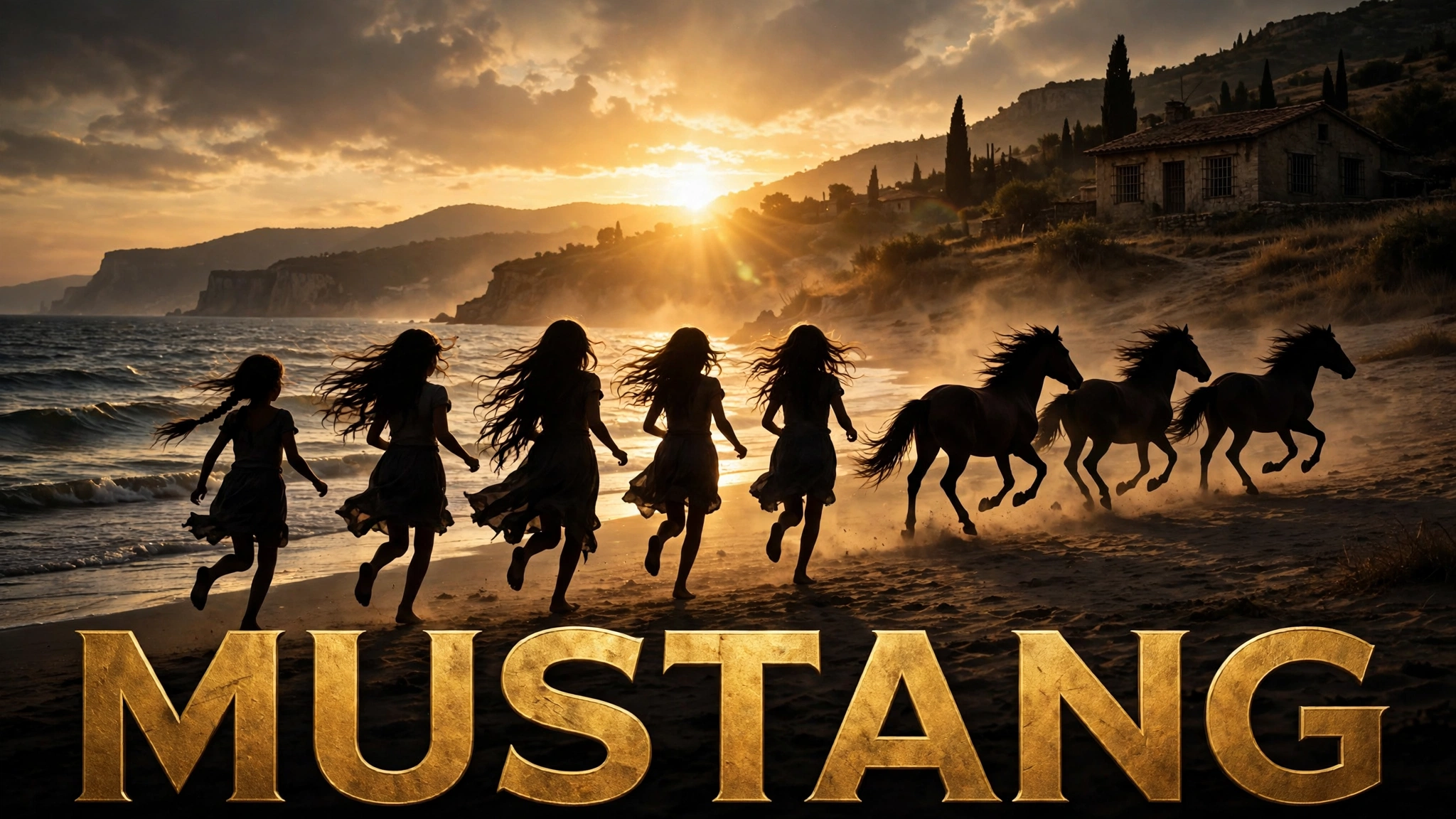
What nobody seriously disputed was the filmmaking. In 97 minutes, Ergüven tells a story that begins in sunshine — five sisters splashing in the sea with classmates on the last day of school — and darkens, step by reasonable-sounding step, into a tale of confinement, forced marriage and escape. It is a fairy tale built out of real fences. This is our spoiler-free Mustang review: the story, the remarkable young cast, Warren Ellis’s award-winning score, and an honest verdict on a film that still sparks arguments a decade later.
| Detail | Information |
|---|---|
| Release date | 19 May 2015 (Cannes premiere); 17 June 2015 (France) |
| Director | Deniz Gamze Ergüven |
| Writers | Deniz Gamze Ergüven, Alice Winocour |
| Genre | Drama, Coming-of-Age |
| Language | Turkish |
| Runtime | 97 minutes |
| Budget | $1.3 million (reported) |
| Lead cast | Güneş Nezihe Şensoy, Doğa Zeynep Doğuşlu, Tuğba Sunguroğlu, Elit İşcan, İlayda Akdoğan, Nihal Koldaş, Ayberk Pekcan |
| Our rating | 9/10 |
It is the last day of school in a village on Turkey’s Black Sea coast, roughly a thousand kilometres from Istanbul. Lale (Güneş Nezihe Şensoy), the youngest of five sisters, says an emotional goodbye to a teacher who is leaving for the city. Walking home, the sisters — Lale, Nur, Ece, Selma and Sonay — stop at the beach and play in the water with boys from their class, climbing on shoulders, shrieking, entirely innocent. A neighbour sees them, and reports what she considers scandalous behaviour to the girls’ grandmother (Nihal Koldaş) and their uncle Erol (Ayberk Pekcan), who have raised the sisters since their parents died.
The punishment is total, and it escalates like a ratchet. The girls are beaten, then confined to the house. Phones, computers and anything considered corrupting are removed. School ends; in its place come lessons in cooking, cleaning and sewing from the women of the family, shapeless brown dresses, and bars on the windows. The house, in the film’s most quoted line of narration, turns into a wife factory. One by one, suitors begin to arrive, and the older sisters face marriages arranged with a speed that shocks precisely because of how ordinary everyone around them treats it.
Ergüven has said the triggering incident came from her own youth, when a harmless game was treated as a scandal, and the film never loses that sense of disproportion: everything that follows grows out of adults choosing control and calling it protection. The sisters respond as a single organism — joking, scheming, sneaking out, and slowly, heartbreakingly, being separated. We will not describe the fates the film reserves for its middle act, or the escape plan around which the final stretch is built. It is enough to say the ending is earned, costly, and very far from a simple triumph.
Güneş Nezihe Şensoy as Lale narrates the film and carries its point of view, and it is one of the great child performances of the 2010s. Lale is the sisters’ strategist: the one who watches, learns the house’s weaknesses, and refuses every stage of surrender. Şensoy plays her without a trace of precocious polish — she is stubborn, funny, furious and frightened in proportions that feel entirely real, and the film’s hope rests on her face.
The four older sisters work as a true ensemble, most of them first-time performers discovered through auditions — one, Tuğba Sunguroğlu, was famously spotted by the director on a flight. İlayda Akdoğan’s Sonay has a secret boyfriend and a pragmatist’s approach to the marriage market; Tuğba Sunguroğlu’s Selma is dry, deadpan and quietly desperate; Elit İşcan, the one experienced actor of the five, gives Ece a stillness that becomes more worrying the longer the film runs; and Doğa Zeynep Doğuşlu’s Nur, closest to Lale, carries the story’s final movement. Their physical ease together — limbs tangled on beds, hair everywhere, finishing each other’s mischief — is the film’s warmth and its argument: this is what is being locked away.
Nihal Koldaş as the grandmother refuses every easy villainy. She administers the regime and enforces its cruelties, yet she is also a woman who believes, sincerely, that she is saving her granddaughters from ruin, and who shields them, in her own way, from worse. Ayberk Pekcan as Uncle Erol is the colder presence: respectable, aggrieved, and increasingly frightening, a man whose authority the film examines without ever turning him into a cartoon.
Ergüven directs confinement from the inside out. Cinematographers David Chizallet and Ersin Gok shoot the house as a place of golden light, fruit trees and tangled bodies — the camera loves this home even as the script turns it into a prison — and that beauty is a deliberate strategy. The horror of the film is not gothic; it happens in sunshine, over meals, in front of television football matches. Handheld camerawork keeps the sisters’ scenes loose and alive, while windows, gates and locks quietly accumulate in the frame. The editing, by Mathilde Van de Moortel, won a César Award, and you can see why: the film moves between idyll and dread on a cut, sometimes within a single sequence, most famously when a stolen trip to a football match — women-only crowd, confetti, pure joy — detonates consequences at home.
Comparisons with Sofia Coppola’s The Virgin Suicides followed the film from Cannes onwards: five sisters, an overprotective household, a dreamy surface over a tragic core. The comparison is fair about surfaces and unfair about intent. Ergüven’s film is angrier, more concrete and more interested in systems — in how neighbours, relatives, suitors and tradition interlock — than in adolescent melancholy. If the film has a craft weakness, it is an occasional reliance on Lale’s voiceover to state what a scene has already shown, and a final act that reaches for thriller mechanics slightly faster than the drama before it has prepared. These are small dents in a remarkably controlled debut.
The score is by Warren Ellis — of Nick Cave and the Bad Seeds and the Dirty Three — and it won the César Award for Best Original Music, one of four Césars the film took from nine nominations, alongside Best First Feature, Best Original Screenplay and Best Editing. Ellis works in his signature palette of violin lines, piano and low atmospheric hum, and the key decision is restraint: the music sighs rather than weeps, drifting under the sisters’ scenes like weather. It gives the film its ache without telling the audience when to cry, and it leaves space for the natural sound of the house — shouting, cooking, football commentary, the sea. Traditional Turkish music surfaces at the weddings, diegetic and pointedly cheerful, and the contrast between those public celebrations and Ellis’s private melancholy underneath the girls’ experience says everything the film wants to say about whose party a wedding really is.
What we loved:
What could be better:
The reported production budget was about $1.3 million, and the film’s worldwide theatrical gross is commonly tracked at about $4.9 million — a modest figure in absolute terms, and a misleading one, because Mustang was never a box-office story. Its currency was prestige and reach. It was one of the breakout titles of Cannes 2015, sold around the world, became France’s submission for the foreign-language Oscar and reached the final five at the 88th Academy Awards, losing to Hungary’s Son of Saul. It was also nominated for the Golden Globe for Best Foreign Language Film, won the LUX Prize of the European Parliament, and collected four César Awards in France.
Those honours translate into the kind of long commercial life arthouse films actually live on: years of festival, educational and streaming circulation far beyond what a $4.9 million gross suggests. Within Turkey its release was smaller and more contested — the film’s portrait of conservative family control drew both passionate defence and accusations of orientalist exaggeration — but even its critics conceded its international impact. For a first feature made for the price of a mid-range car commercial campaign in Hollywood terms, few films of 2015 travelled further.
Yes — this is essential viewing for anyone who cares about coming-of-age cinema, debut filmmaking, or modern Turkish storytelling. Mustang takes a premise that could have produced a grim lecture and instead makes something sunlit, funny, furious and finally devastating, carried by five young performers who feel less like actors than like a family the camera was lucky enough to find. Its flaws — a spelling-out voiceover here, a hurried contrivance there — are the flaws of a first film reaching for more than it can perfectly hold, and they barely dent the experience.
Our rating: 9/10 — a radiant, enraging debut: five sisters, one locked house, and filmmaking of real grace and force.
Is Mustang a Turkish film or a French film?
Both, honestly. It is a France–Germany–Turkey co-production, in the Turkish language, set and shot in Turkey by a Turkish-French director, and it was submitted to the Oscars by France. We file it under Turkish Cinema because its language, setting, cast and subject are Turkish.
Is Mustang based on a true story?
Not on one specific case, but Ergüven has said the opening incident — girls punished for an innocent game with boys — was drawn from her own experience, and the practices the film depicts, from confinement to early arranged marriage, reflect documented social realities the filmmakers wanted to confront.
Is Mustang suitable for teenagers?
It carries mature themes, including forced marriage, abuse and a death, handled with restraint rather than explicitness. Older teenagers — the film’s own subjects — are in many ways its ideal audience, though parents should expect difficult conversations afterwards, which is rather the point.
What does the title Mustang mean?
A mustang is a wild, free-roaming horse. The title is the film’s whole argument in one word: five untamed spirits, and a household determined to break them in.
Where can I watch Mustang?
The film has circulated widely on arthouse streaming services and on disc since 2015, with availability varying by country. Check your local platforms — it is frequently included in world-cinema collections.