★ LATEST REVIEWS

★★★★★ Our Rating: 9.2/10
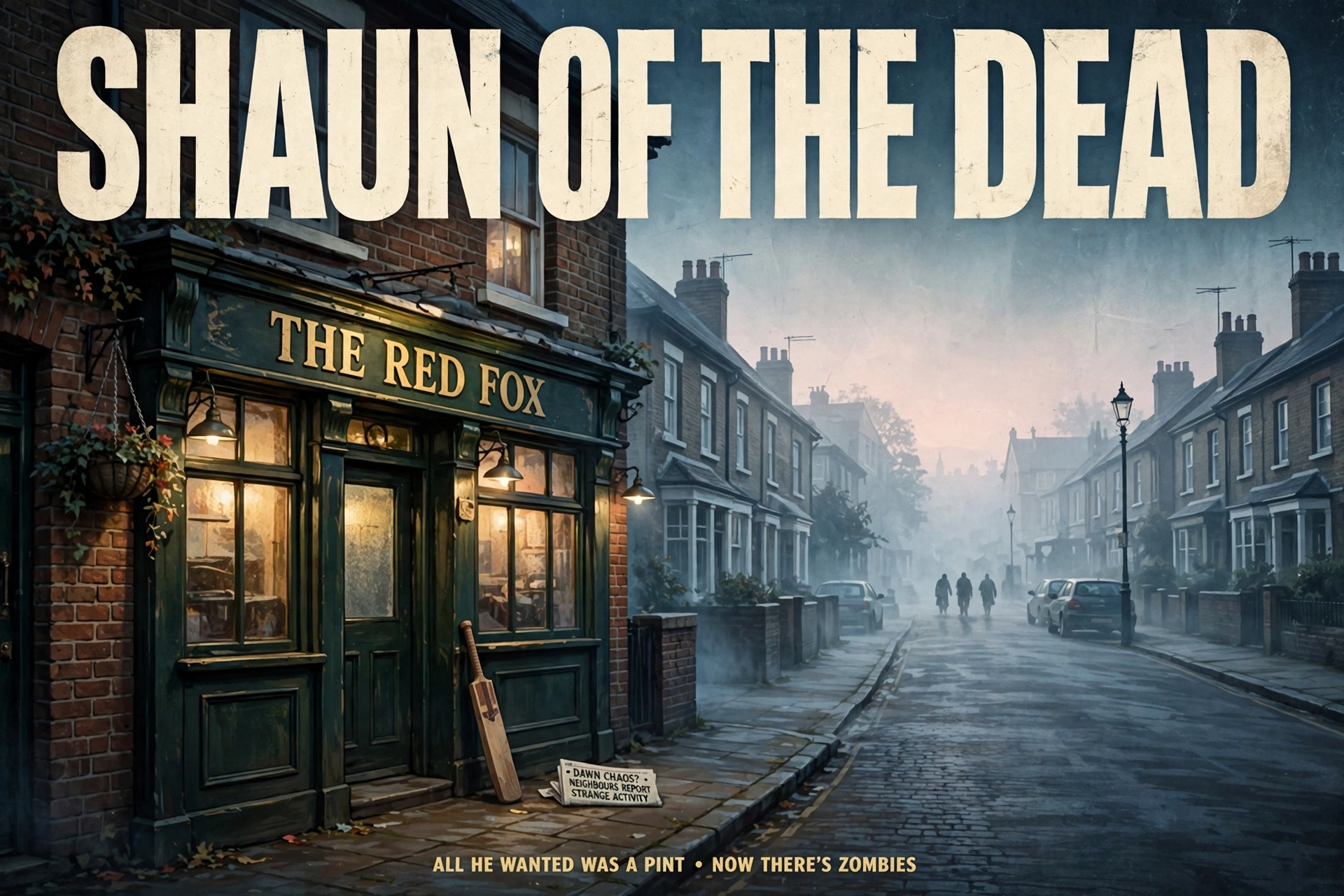
Every genre has a film that loves it so completely that the love itself becomes the film. Shaun of the Dead, released in the United Kingdom in April 2004, is that film for the zombie movie — a horror-comedy that is genuinely frightening, genuinely funny and, in its final act, genuinely heartbreaking, sometimes within the same minute. Written by director Edgar Wright and star Simon Pegg, growing directly out of their television series Spaced, it billed itself with cheerful honesty as “a romantic comedy. With zombies.” — and then delivered on all three elements so completely that it launched the Three Flavours Cornetto trilogy, made stars of its leads, and quietly redefined what a low-budget British genre film could do.
For this Shaun of the Dead review, the most important context is the film’s central joke, which turns out not to be a joke at all: Shaun’s London is already full of zombies before a single one rises. Commuters stare through each other on the bus. Shop workers shuffle through identical days. Shaun himself — twenty-nine, assistant manager at an electrical shop, girlfriend exasperated, evenings annexed by his best friend, the pub and a PlayStation — is sleepwalking through a life that has stalled, and the film’s genius is to make the apocalypse the first thing that ever asks him to wake up.
This review covers the spoiler-free story, the performances that turned a sitcom ensemble into cinema history, Wright’s ferociously precise direction, the film’s famous record-shop soundtrack and original score, its few genuine flaws, and the money — made, honestly and delightfully, on a budget smaller than the catering bill of the Hollywood zombie films it outclassed.
| Detail | Information |
|---|---|
| Release date | 9 April 2004 (United Kingdom) |
| Director | Edgar Wright |
| Writers | Simon Pegg, Edgar Wright |
| Genre | Horror, Comedy, Romance |
| Language | English |
| Runtime | 99 minutes |
| Budget | £4 million (approx. $6 million) |
| Lead cast | Simon Pegg, Nick Frost, Kate Ashfield, Lucy Davis, Dylan Moran, Bill Nighy, Penelope Wilton |
| Our rating | 9.2/10 |
Shaun is twenty-nine and going nowhere in the most comfortable way possible. He works a dead-end job at an electrical superstore where the teenage staff ignore him, lives in a North London house-share with his childhood best friend Ed — unemployed, unfiltered and permanently installed on the sofa — and spends every evening at the Winchester, the local pub he treats as a second living room. His girlfriend Liz has reached the end of this routine: she wants dinners that are not in the Winchester, evenings that do not include Ed, and a boyfriend with a plan. When Shaun fails, once too often, to deliver even a restaurant reservation, she ends it — and Shaun drowns the disaster in the usual place, in the usual way, with Ed.
The brilliance of the film’s first act is that the world begins ending in the background, and Shaun notices none of it: the headlines he flicks past, the shuffling stranger in the street, the news reports glimpsed between channels. Only when the dead arrive in his own garden does the plan finally form — Shaun’s plan, the first real one of his life. He will rescue Liz. He will rescue his mother, Barbara, and deal, somehow, with his stepfather Philip, with whom he has never made peace. He will bring everyone he loves to the safest place he knows. The Winchester. Have a nice cold pint, and wait for all of this to blow over.
What follows is a rescue mission across a collapsing suburb that plays, by turns, as farce, siege film, war film and tragedy. Wright and Pegg structure it as a dark mirror of the film’s opening: routes, faces and lines of dialogue return, transformed by catastrophe. Friends are picked up, arguments continue absurdly amid the horror, and the little group that finally barricades itself inside the pub must face what every zombie film is really about — what the living owe each other when the world stops forgiving them. We will not spoil who is left standing, or what it costs. We will say the last twenty minutes contain some of the most affecting acting in any British comedy, and that the film earns its tears the hard way: by making you laugh at these people until you love them, and then collecting the debt.
Simon Pegg as Shaun gives the defining performance of his career. Pegg plays Shaun not as a hero in waiting but as a genuinely ordinary man — decent, evasive, funny, weak — and lets competence arrive in inches, at cost. His comic timing is metronomic, but it is his final-act acting, grief and guilt breaking through the jokes, that lifts the film from parody to classic. Nick Frost as Ed creates comedy’s great man-child: lazy, foul-mouthed, loyal to the bone, and the source of half the film’s quotable lines. Frost makes Ed infuriating and beloved in the same breath, which is the whole character — and the film’s hardest emotional turn depends on the audience realising how much of Shaun’s stalled life Ed represents, and how much of his heart.
Kate Ashfield as Liz has the essential, thankless job — the girlfriend asking for more — and plays it with warmth and wit enough to make Shaun’s failure to grow up feel like a real loss rather than a plot device. Lucy Davis as Dianne and Dylan Moran as David, Liz’s flatmates, form the group’s friction: Davis all desperate theatrical brightness, Moran dry, jealous and quietly poisonous, giving the film its most disturbing human thread. And then there are the parents. Penelope Wilton as Barbara is the film’s gentle soul, fussing over tea and politeness while the world ends, and her scenes with Pegg carry a weight that sneaks up on you. Bill Nighy as Philip, the stepfather Shaun resents, achieves in a handful of scenes — culminating in a car journey of extraordinary economy — one of the great small performances in British film: a whole reconciliation, delivered almost entirely in restraint.
Edgar Wright directs comedy the way action directors are supposed to direct action: with total visual commitment. Every technique that became his signature is already here, fully formed — the crash-zooms and whip-pans, the rhythmic montages of ordinary life cut like heist sequences (the famous “getting ready” routine; the plan sequences in which Shaun explains each rescue in a perfect visual gag structure), the sound-synced edits, and above all the foreshadowing through editing: the film’s opening pub scene, in which Liz describes everything that will happen, and the mirrored camera moves that show Shaun’s daily zombified routine and then repeat it, shot for shot, after the apocalypse.
The horror craft is equally serious, and this is what separates the film from a hundred imitators. Wright shoots his zombies with a Romero disciple’s respect: slow, numerous, pitiless. The gore, supervised with gleefully practical effects, is substantial and unflinching, and the siege sequences are staged with clear geography and real dread — the comedy stops, cleanly and deliberately, whenever people are in true danger, which is precisely why the scares work. On £4 million, with David M. Dunlap’s cinematography giving suburban London a heightened, comic-book clarity, Wright made a film that looks and moves like it cost five times more.
Honest criticisms exist. The middle stretch, as the group holes up and argues, leans on the characters’ bickering slightly longer than its momentum needs. A couple of the era’s pop-culture gags are now period pieces. And viewers who come for wall-to-wall jokes should be warned: the final act consciously trades laughs for grief, a choice some first-time audiences find jarring. It is, in this reviewer’s judgement, exactly that choice that makes the film a classic rather than a sketch — but the tonal gear-change is real, and it is fair to name it.
The original score, by Pete Woodhead and Daniel Mudford, does the unglamorous, essential work: brooding, Romero-inflected dread that quotes the Italian prog-horror tradition — the film’s opening library cues consciously salute the Goblin-scored classics Wright adores — and then knows when to vanish under the comedy. It is the score’s seriousness that licenses the jokes: the film sounds like a horror movie, so it is one.
Around the score sits one of the great compiled soundtracks of its decade, used with a fan’s precision. Queen’s “Don’t Stop Me Now” scores the film’s most famous fight, choreographed so the pub brawl lands on the beat — a sequence that alone would justify the movie’s reputation. The Specials’ “Ghost Town” hangs over Shaun’s oblivious morning walk; Ash, The Smiths, Grandmaster Flash and I Monster thread the film in early-2000s Britain; and Zombie Nation and the film’s own record-shop scene — in which the heroes weaponise Shaun’s vinyl collection, sparing Batman and Prince, sacrificing the rest — turn the characters’ music taste into both comedy and plot. Few soundtracks have ever been this funny and this functional at once.
What we loved:
What could be better:
The numbers tell the Cornetto story in miniature. Shaun of the Dead was produced for about £4 million — roughly $6 million — a modest British budget even in 2004. Its original worldwide theatrical run finished at about $30 million, roughly $13.5 million of it from the United States, where Rogue Pictures’ September 2004 release turned it into a slow-burning cult phenomenon on word of mouth and ecstatic reviews, with horror’s elder statesmen — George A. Romero among them — publicly blessing it. That was already a handsome return of about five times the budget, before DVD, where the film became a genuine era-defining seller.
Current lifetime listings put the worldwide total higher — around $38.7 million — because the film has never really left cinemas: anniversary re-releases, including a 20th-anniversary return in 2024, Halloween seasons, quote-alongs and repertory runs keep adding to a gross that behaves less like a 2004 release and more like a permanent attraction. The deeper box-office truth, though, is leverage: this £4 million film’s success directly financed the careers and the trilogy that followed — Hot Fuzz and The World’s End — and helped reignite the zombie genre’s mainstream decade. Pound for pound, few films on this site have ever bought so much cinema with so little money.
Absolutely — with one warning and one promise. The warning: this is a real horror film, with real gore and a final act that will move you more than you expect from a movie with this poster. The promise: it is also one of the funniest, smartest and most rewatchable British films of the century, a movie whose every joke is load-bearing and whose heart is exactly where its title character finally finds his. If you have somehow never seen it, you have one of the great first-viewings in modern cinema ahead of you. You’ve got red on you.
Our rating: 9.2/10 — The rom-zom-com perfected at birth: Edgar Wright’s precision direction, Pegg and Frost’s defining double act, and a last act with the courage to break your heart.
Is Shaun of the Dead scary, or is it just a comedy?
Both, deliberately. The jokes are constant, but the zombies are played straight, the gore is graphic, and several sequences — and deaths — are genuinely upsetting. It is rated R in the United States and 15 in the UK. Horror fans will be satisfied; the squeamish should be warned.
Do I need to know zombie films to enjoy it?
No — it works completely as a standalone comedy-drama about a man growing up during the apocalypse. But it is layered with affectionate references to George A. Romero’s films and the wider genre, and fans will find dozens of planted details, from character names to the famous “We’re coming to get you, Barbara” line.
What is the Three Flavours Cornetto trilogy?
The informal trilogy linking this film with Hot Fuzz (2007) and The World’s End (2013) — three standalone Wright–Pegg–Frost films in three genres (horror, action, science fiction), connected by themes of friendship and stalled adulthood, a recurring fence-jumping gag, and, yes, Cornetto ice creams appearing in each.
Is Shaun of the Dead suitable for children?
No. Despite the comedy, it carries adult ratings for strong gore, language and horror. It is a film for older teenagers and adults, and its emotional final act lands hardest with viewers old enough to know a Shaun or an Ed of their own.
Where can I watch Shaun of the Dead?
It is widely available on major streaming services in most regions and in excellent Blu-ray editions, including special editions packed with Wright and Pegg’s commentaries — which are nearly as entertaining as the film. Check your local listings, as rights vary by country.