★ LATEST REVIEWS

★★★★☆ Our Rating: 8.5/10
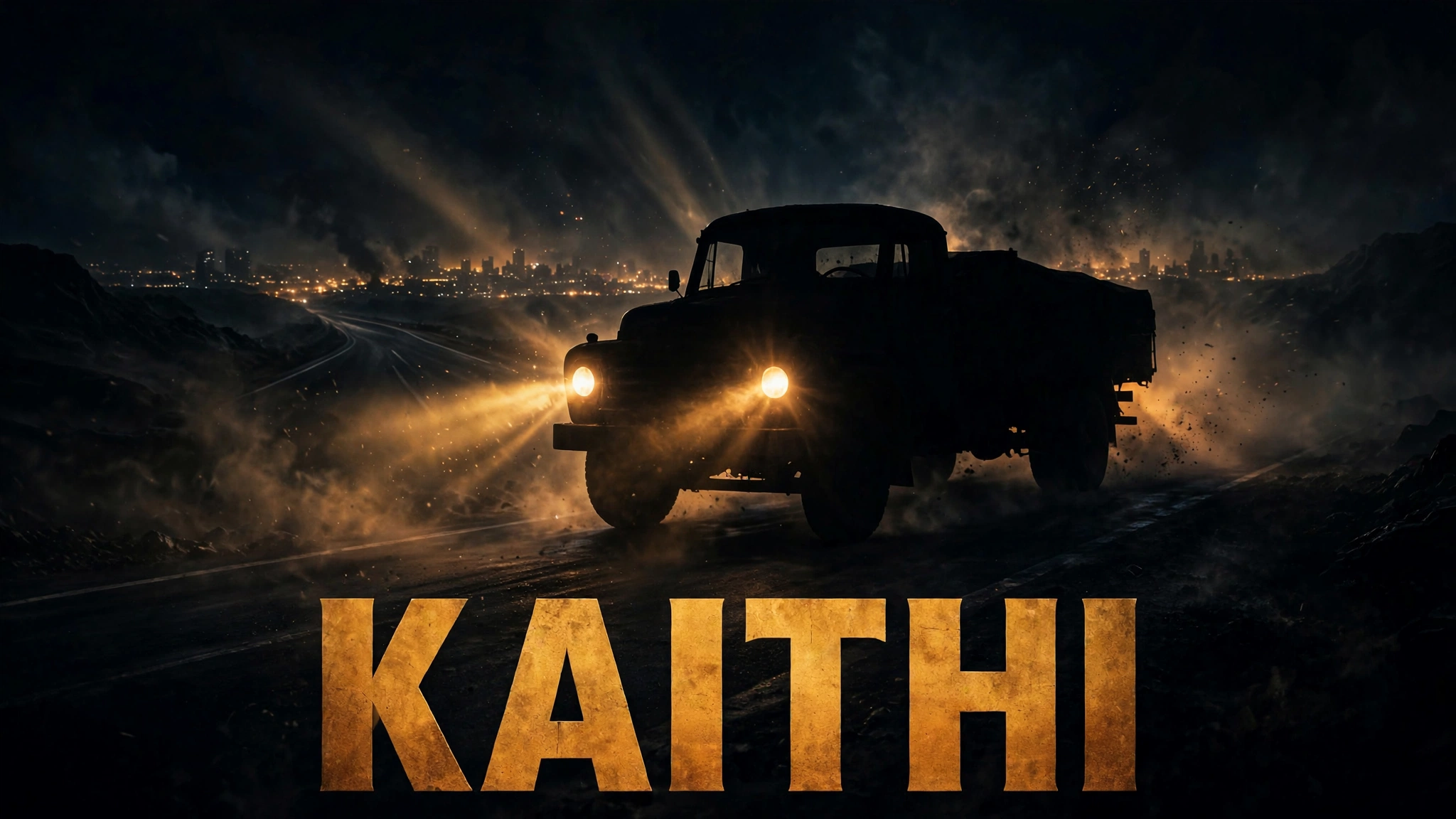
Most star-driven Indian thrillers make a promise and then keep wandering away from it — a song here, a comedy track there, a romance to soften the edges. Kaithi makes one promise and honours it for 146 minutes: a single night, a poisoned police convoy, a lorry that must not stop, and a man who has waited ten years to meet his daughter. Released on 25 October 2019, into the teeth of the Diwali season, Lokesh Kanagaraj’s second film had no heroine, no songs and no safety net. It became the sleeper triumph of its year, and the foundation stone of what audiences now call the Lokesh Cinematic Universe.
An honest Kaithi review should begin with that discipline, because discipline — not budget, not star power — is the film’s real special effect. Karthi plays a recently released prisoner with no backstory speeches and no slow-motion mythology; the film trusts action, geography and small human details to build him. It is not flawless. A strand involving college students is thinner than everything around it, and the villains are more functional than fascinating. But as a piece of sustained, popular thriller-making, Kaithi is close to exemplary — the rare commercial film that gets more intense, not less, the longer it runs.
This review covers the spoiler-free story, the performances, Lokesh’s direction and technical craft, Sam C. S.’s score in a famously songless film, what works and what does not, the box office in flagged figures, and why this lean 2019 thriller still feels like a turning point for Tamil mainstream cinema.
| Detail | Information |
|---|---|
| Release date | 25 October 2019 |
| Director | Lokesh Kanagaraj |
| Writers | Lokesh Kanagaraj (story); Lokesh Kanagaraj, Pon Parthiban (screenplay) |
| Genre | Action, Thriller |
| Language | Tamil |
| Runtime | 146 minutes |
| Budget | ₹25 crore (reported figure — see Box Office note) |
| Lead cast | Karthi, Narain, Arjun Das, Harish Uthaman, George Maryan, Dheena |
| Our rating | 8.5/10 |
The night begins with a victory that curdles instantly. Inspector Bejoy and his team have seized a huge consignment of drugs — the kind of haul that makes careers — and hidden it where the drug network cannot easily reach. Then, at a celebratory dinner, the officers are poisoned through their drinks. Dozens of unconscious policemen, one sober inspector too injured to drive, a hospital far away, and a city full of gangsters who know exactly what has happened and intend to take their seized consignment — and their captured leadership’s freedom — back before morning.
Bejoy’s only available driver is Dilli, a quiet ex-prisoner who happened to be nearby looking for food. Dilli has his own appointment with dawn: his daughter, whom he has never met, is waiting at an orphanage, and men who care for her have arranged for him to finally see her. Miss this night, and the chance may not come again. Bejoy offers a bargain — drive us, save these men, and I will make sure you meet her. Dilli agrees, and the film becomes a race in which a battered lorry is simultaneously an ambulance, a fortress and a target, while the gang network, led by the brothers Adaikalam and the volcanic Anbu, converges on it from every direction.
Lokesh braids this central chase with two supporting strands: a police headquarters holding the seized drugs, defended by a handful of stranded students and one elderly constable with more courage than firepower, and Bejoy’s shrinking circle of trustworthy people as the scale of the leak inside the system becomes clear. We will not spoil who survives the night or what Dilli’s past actually contains — the film guards both, and one mid-film stretch of storytelling, in which Dilli’s history is finally spoken aloud, is its emotional summit. What matters here is the clarity: every strand is about people with almost nothing left, protecting something that matters more than themselves.
Karthi as Dilli delivers an outstanding physical performance, and the key word is physical. Denied songs, romance and even much dialogue in the early stretches, he builds Dilli out of posture, breath and decisions: the way he checks a road before he speaks, the flinch of a man relearning freedom, the economy with which he fights — dirty, desperate, using whatever the frame offers. When the film finally gives him his long emotional moment, Karthi earns it completely, shifting from action figure to broken father without changing register. It stands among the finest work of his career, and it is a masterclass in how little a star needs when the writing trusts him.
Narain as Bejoy is the film’s unsung anchor. Bejoy is not a supercop; he is a frightened, injured man making impossible decisions in real time, and Narain plays the fear honestly rather than hiding it under uniformed swagger. The film’s moral tension — how much can you ask of a stranger, and on whose authority — lives in his face. Arjun Das as Anbu was the breakout: that gravel-heavy voice, the coiled unpredictability, the sense of a man whose violence is also a kind of grief for his imprisoned brother. In a film full of established actors, Das walks away with several scenes through presence alone, and his casting here reshaped his career.
George Maryan as Constable Napoleon provides the film’s warmest surprise — an ageing officer, written off by everyone including himself, who rises to the night with a dignity that gives the headquarters strand its heart. Harish Uthaman as Adaikalam, largely off-screen or imprisoned, projects menace through reputation and voice, and Dheena as Kamatchi, the caterer caught in the chaos, supplies the only humour — small, human and mercifully brief, which is exactly why it works. If there is a weak spot, it is that the student characters remain types rather than people; the actors do their best with material the film clearly considers secondary.
Lokesh Kanagaraj’s direction is a lesson in information control. The film tells you only what the night requires, plants its geography early — this road, this building, this distance — and then cashes that clarity in during the action, so you always know where the lorry is, what threatens it and what a mistake will cost. The action, choreographed by Anbariv, is staged for weight rather than balletic beauty: vehicles feel heavy, blows look improvised by exhausted people, and a late-film set piece involving an industrial machine gun works because the film has saved its loudest card for when Dilli has nothing left. Sathyan Sooryan’s cinematography makes a virtue of genuine darkness — headlights, fires, corridor bulbs — without ever losing the thread of who is where.
Philomin Raj’s editing deserves special credit. Cross-cutting between the lorry, the headquarters and the gang network could easily have dissolved into noise; instead each cut raises pressure on the other strands, and at 146 minutes the film feels shorter than many 120-minute thrillers. The structural honesty matters too: this is a film shot entirely around one night, with no daytime relief and no musical exits, and it maintains that contract to the final frame.
The criticisms are real but proportionate. The college-student strand is the film’s softest writing — its peril never quite matches the lorry’s — and the larger drug network remains abstract, more a pressure than a set of characterised opponents. A few coincidences are load-bearing. And viewers who dislike sustained violence, however purposeful, should know the film rarely looks away. None of this overturns the achievement: a second-time director made a mid-budget, songless, heroine-less action film the must-see event of a festival season, on craft alone.
Kaithi is famously a songless film, and that absence is not a gimmick — it is the film’s spine. Without songs to pause the night, the pressure never releases, and the film’s commitment to its single-night timeline feels absolute. Sam C. S.’s background score does not fill that silence with constant noise; instead it works in pulses, textures and silences, swelling under Dilli’s lorry runs and receding when a look or a small sound — a door, a breath, a distant siren — carries the moment. A softer, almost lullaby-like theme for Dilli’s daughter is used sparingly, so that when it returns near the end it lands with real emotional weight.
The restraint is the point. Where many action films score every punch, Kaithi trusts sound design — tyres, metal, night air — to do much of the work, and Sam C. S. knows when to let that sound design breathe. The result is a score you feel more than you notice, until its quietest motif becomes the film’s most memorable piece of music. It is one of the most disciplined scores in recent Tamil action cinema, precisely because it never tries to be a soundtrack.
What we loved:
What could be better:
Kaithi was made on a reported budget most commonly cited as ₹25 crore, and its worldwide gross is generally reported at approximately ₹105 crore — figures that should be read as trade estimates, since Indian box-office reporting does not use a single audited source. What is not in doubt is the shape of the success: a mid-budget, songless, heroine-less thriller released into the crowded Diwali season, without a conventional star vehicle, became a genuine theatrical hit and, over time, a reference point for what Tamil mainstream cinema could attempt. The film also earned international festival attention, including a screening at the International Indian Film Festival Toronto, and its world-building — the drug network, the police universe, Dilli’s unfinished story — set up Vikram (2022), in which Narain’s Bejoy returned and the shared universe acquired its name.
Yes — and set aside an uninterrupted evening for it. Kaithi is best watched the way its characters live it: in one sustained stretch, without checking your phone, because the film’s power is cumulative. The first half impresses with its control; the second half, once Dilli’s story is spoken aloud, turns that control into emotion. If you have seen Vikram or Leo, Kaithi is essential context; if you have not, it stands perfectly alone as a lean, propulsive thriller that proves how much mainstream cinema can do with almost nothing except a clear idea, a lorry and a night.
Our rating: 8.5/10 — a lean, relentless, beautifully controlled night-time thriller; minor thin strands, major achievement.
Is Kaithi connected to Vikram and Leo?
Yes. Kaithi is the first film in what is now called the Lokesh Cinematic Universe. Vikram (2022) continues the world — including the return of Narain’s Inspector Bejoy — and Leo (2023) expands it further. You can watch Kaithi on its own, but it gains resonance if you know where its characters and drug network lead.
Does Kaithi really have no songs?
Correct. Kaithi has no song-and-dance numbers and no heroine track. Sam C. S. provides a background score only, which is central to the film’s sustained tension: without musical breaks, the night never lets up.
Is Kaithi based on a true story?
No. Kaithi is a fictional story by Lokesh Kanagaraj, though its police, prison and drug-network details are drawn from recognisable real-world systems. Dilli, Bejoy and the night’s events are invented.
Was Kaithi remade in Hindi?
Yes. Kaithi was remade in Hindi as Bholaa (2023), directed by and starring Ajay Devgn. The remake follows the same one-night, lorry-and-police premise, though with its own changes in tone and scale.
Where can I watch Kaithi?
Kaithi (2019) is available on major streaming platforms in India and internationally, including its Telugu dubbed version Khaidi. Availability changes by region and by month, so check your local streaming listings before you settle in for its 146 minutes.