★ LATEST REVIEWS

★★★★★ Our Rating: 9.5/10
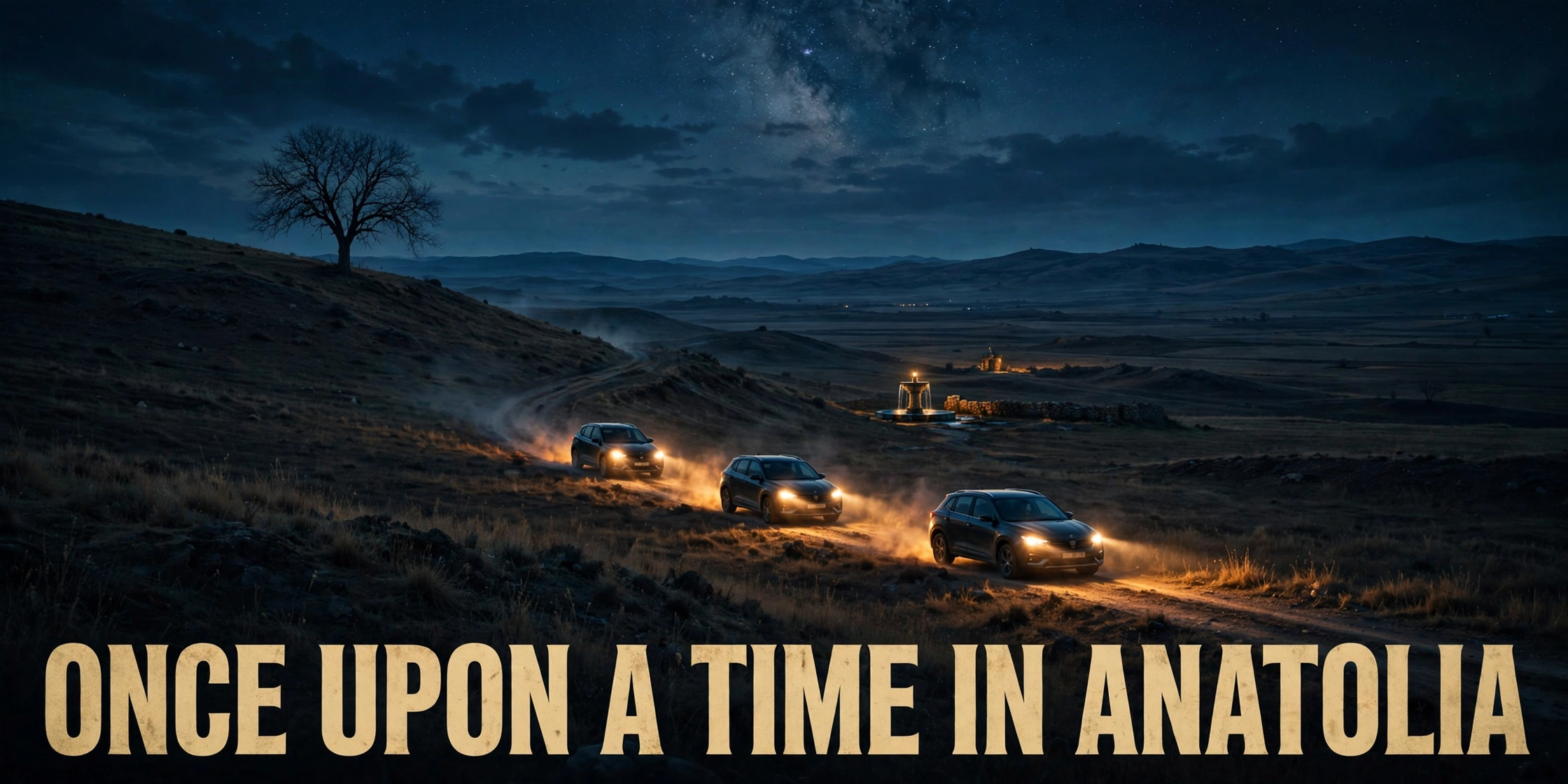
A police procedural usually begins with a body. Once Upon a Time in Anatolia begins with the search for one — and then, for more than ninety minutes of screen time, it refuses to find it. A small convoy of cars crawls through the dark hills of central Turkey carrying policemen, a prosecutor, a doctor, two handcuffed suspects and no certainty at all about where the dead man is buried. That is almost the whole plot. It is also, by near-universal critical agreement, one of the finest films of the twenty-first century.
Directed by Nuri Bilge Ceylan, Turkey’s most decorated modern filmmaker, the film premiered at the Cannes Film Festival on 21 May 2011 and shared the Grand Prix, the festival’s second-highest honour. It was later voted the 54th greatest film of the century so far in a BBC poll of 177 critics worldwide. Any honest Once Upon a Time in Anatolia review must warn you, though: this is a slow film, deliberately, defiantly slow, 157 minutes in which the loudest sounds are wind, engines and men avoiding the subjects that matter. This review explains why that slowness becomes hypnotic, what the film is really investigating, and who should — and should not — sit down with it.
| Detail | Information |
|---|---|
| Release date | 21 May 2011 (Cannes premiere); 23 September 2011 (Turkey) |
| Director | Nuri Bilge Ceylan |
| Writers | Nuri Bilge Ceylan, Ercan Kesal, Ebru Ceylan |
| Genre | Drama, Crime Procedural |
| Language | Turkish |
| Runtime | 157 minutes |
| Lead cast | Muhammet Uzuner, Yılmaz Erdoğan, Taner Birsel, Ahmet Mümtaz Taylan, Fırat Tanış, Ercan Kesal |
| Our rating | 9.5/10 |
A note on the missing budget row: no reliable production budget for this film has been published in any source we could verify. Ceylan’s films are made economically, with small crews, but a number would be a guess, and this site does not guess — so the row is omitted and the omission is explained here rather than hidden.
In the district of Keskin, in Kırıkkale Province, a man named Yaşar has been murdered. The suspect, Kenan (Fırat Tanış), has confessed, and claims he buried the body near a fountain on the steppe with the help of his brother Ramazan. There is only one problem: Kenan was drunk, it was dark, and on the Anatolian steppe every fountain, every hill and every bare tree looks exactly like the last one. So a convoy sets out at nightfall — Commissar Naci (Yılmaz Erdoğan) and his policemen, Prosecutor Nusret (Taner Birsel), Doctor Cemal (Muhammet Uzuner), drivers, diggers, suspects — stopping at fountain after fountain while the grave refuses to be found.
The search, based on a real experience of co-writer Ercan Kesal, who worked as a doctor in the region and plays the village mayor in the film, becomes the film’s true subject. Trapped together for a long night, the men talk — about food, prostates, bureaucracy, families, deaths they have known — and each conversation quietly opens a door onto guilt, compromise and the stories officials tell themselves to stay comfortable. A stop at a village mayor’s house, where the mayor’s young daughter serves tea by lamplight during a power cut, produces one of the most celebrated single scenes in modern cinema: a moment of beauty dropped into a night of squalor, which reduces a killer to tears. By dawn the search changes gear, the body is dealt with, forms are filled in — and the film ends on a professional decision, made quietly at an autopsy table, that we will not spoil here and that audiences have argued about ever since.
Muhammet Uzuner as Doctor Cemal is the film’s still centre and its moral instrument. Cemal says little, watches everything, and Uzuner acts almost entirely in reaction — a tightening around the eyes as a story stops adding up, a long silence where a challenge should be. It is a masterclass in screen minimalism, and it makes the doctor’s final choice land with the weight of a thriller twist. Taner Birsel as Prosecutor Nusret matches him with the opposite technique: Nusret talks, charmingly and at length, including a long anecdote about a woman who predicted the exact date of her own death. Birsel lets the anecdote curdle in real time — you can watch a man realise, mid-story, what he has actually been confessing.
Yılmaz Erdoğan as Commissar Naci brings the film’s earthiest energy: impatient, funny, rough with suspects, tender in odd moments, a working policeman ground down by procedure and by the night itself. Erdoğan was one of Turkey’s biggest popular stars, and his ordinary-man presence keeps the film anchored in the real world Ceylan’s artistry might otherwise float away from. Fırat Tanış as Kenan has the hardest role, a confessed killer who must stay human rather than monstrous, and his exhausted, evasive misery powers the film’s central scene. Around them, Ahmet Mümtaz Taylan as the driver Arap Ali and Ercan Kesal as the mayor fill small roles with complete lives — Kesal’s mayor, lobbying for a morgue over dinner while a murder party waits, is comic, sad and utterly believable at once.
Ceylan shoots the steppe the way other directors shoot oceans: as a beautiful, indifferent expanse that swallows human plans. Filmed over eleven weeks around Keskin in CinemaScope, with cinematography by his regular collaborator Gökhan Tiryaki, the film is built from long, patient takes — car headlights carving tunnels through total darkness, faces lit only by dashboards and lamps, dawn arriving in grey layers. Tiryaki’s work won cinematography honours at the Asia Pacific Screen Awards and in Dubai, and it is not hard to see why: few films have ever made night itself feel this tactile, this heavy with weather and fatigue.
The direction is as disciplined in the talk as in the landscapes. Ceylan, who co-edited with Bora Gökşingöl, lets conversations run past their plot function until they become the plot — a discussion about a morgue, a story about a death, a quarrel about a cigarette. The famous restraint has one honest cost: viewers raised on conventional procedurals may feel, around the hour mark, that the film is testing them, because it is. Ceylan compresses a real twelve-hour ordeal into 157 minutes and still wants you to feel its duration. Surrender, and the final act’s quiet procedures — a body forced into a car boot for want of a bag, paperwork, an autopsy — become almost unbearably tense. Resist, and no review can save the film for you.
There is, famously, virtually no score at all — and that absence is one of the film’s great artistic decisions. Once Upon a Time in Anatolia carries no credited composer in the usual sense, and its soundtrack is the world itself: wind worrying at the grass, tyres on gravel roads, tea glasses, distant dogs, the hum of generators, a folk song, “Allı Turnam,” that surfaces briefly as a diegetic exception and makes the surrounding silence feel even deeper. Academic writing on the film has described this as a dramaturgy of emptiness, and that is exactly how it plays. Without music to tell you what to feel, every face in the lamplight becomes an event, and every small sound at the autopsy — metal, paper, a splash — arrives with physical force. It is a lesson in how much of what we call a film score is really emotional instruction, and how powerful a film becomes when the instruction is withdrawn.
What we loved:
What could be better:
The commercial story here is a study in contrasts, and the honest numbers are modest. In Turkey, the Istanbul Foundation’s industry report for 2011 records that the film reached 153,669 admissions on 66 copies — a respectable figure for a 157-minute art film, but a fraction of the millions drawn that year by the local comedy hits that topped the Turkish chart. Box Office Mojo’s territory tracking tells the same story internationally: about $835,869 in Turkey, $399,331 in Italy and $152,408 in a long, slow limited run in the United States, adding up to a tracked worldwide total in the region of two million dollars. Those databases do not capture every territory, so treat that total as a floor rather than a final account.
But the box office was never this film’s ledger. Its returns were paid in prestige: the shared Grand Prix at Cannes, Turkey’s official submission for the Academy Award for Best Foreign Language Film (it was not shortlisted), best-director and cinematography prizes across the festival circuit, a 94% critics’ score on Rotten Tomatoes from the reviews aggregated there, and a permanent place on greatest-films lists — including the BBC’s critics’ poll of the century’s best, where it placed 54th. Measured as culture rather than commerce, few films of 2011 earned more.
If you have any appetite at all for slow cinema, yes — without hesitation, and under the right conditions: lights low, phone away, patience ready. Once Upon a Time in Anatolia is the rare film that changes what you think a crime movie can be, replacing revelation with accumulation and climax with conscience. If, however, your honest definition of a good night’s viewing is a mystery that moves, there is no shame in choosing differently — Ceylan made this film for viewers willing to ride in those cars all night, and he does not compromise for anyone else. For FlickZada, it stands as the pinnacle of the Turkish cinema covered in this bank so far: a murder story in which the most important evidence is found inside the men carrying the shovels.
Our rating: 9.5/10 — a meditative masterpiece; demanding, beautiful and quietly devastating, and one of the essential films of its century.
Is Once Upon a Time in Anatolia based on a true story? Yes, in its foundations. The screenplay draws on a real experience of co-writer Ercan Kesal, who worked as a doctor in the Keskin area and lived through a similar night-time search for a buried body. Characters and conversations were then shaped by Kesal, Ebru Ceylan and Nuri Bilge Ceylan, with echoes of Chekhov’s stories.
What did the film win at Cannes? It won the Grand Prix at the 2011 Cannes Film Festival, shared with the Dardenne brothers’ The Kid with a Bike. The Grand Prix is the festival’s second-highest honour after the Palme d’Or, which Ceylan later won outright for Winter Sleep in 2014.
Is Once Upon a Time in Anatolia a thriller? Not in the conventional sense. The killer is known and confesses early; there are no chases or twists of identity. Its tension is existential — about guilt, truth and what officials choose not to record — so go in expecting a slow-burning drama, not a whodunit.
Why is there no budget listed for the film? No reliable production budget has been published in verifiable sources. Ceylan’s productions are known to be economical and crew-light, but rather than repeat an unsourced figure from a database, we have left the budget out and said so openly.
Where can I watch Once Upon a Time in Anatolia? It is a staple of arthouse streaming services and curated platforms in many regions, and is widely available on Blu-ray from distributors such as Cinema Guild. Availability varies by country, so check your local services.