★ LATEST REVIEWS

Our Rating: ★★★☆☆ 6.5/10
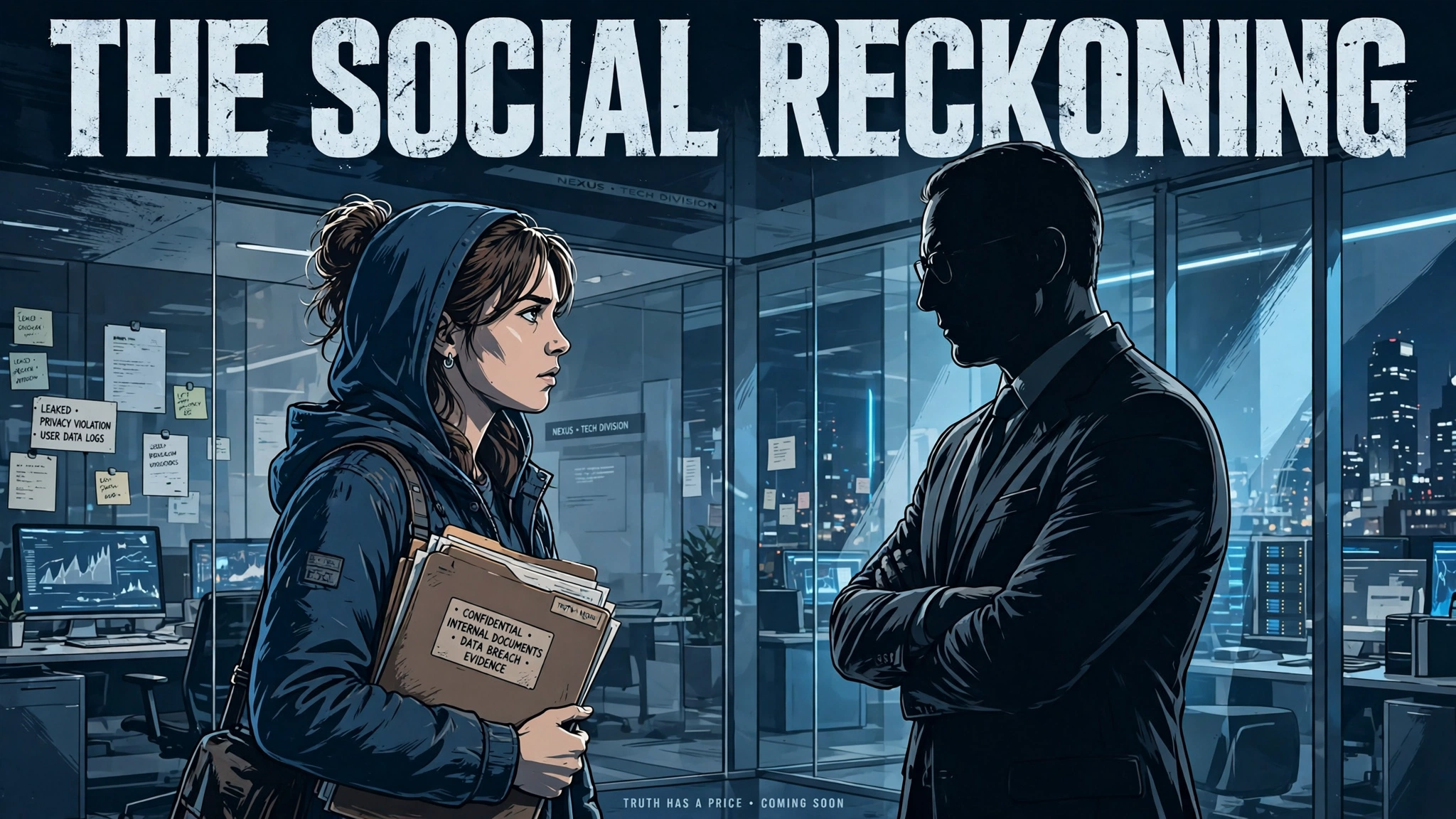
Sixteen years after The Social Network turned the founding of Facebook into one of the defining films of its era, Aaron Sorkin returns to the company — this time as both writer and director — for a story about what Facebook became. The Social Reckoning is not a conventional sequel. Sony Pictures officially describes it as a companion piece to the 2010 film: a new chapter, with new central characters, built around real events. It dramatizes the 2021 leak by Facebook whistleblower Frances Haugen and the Wall Street Journal reporting that became known as the Facebook Files, and it asks a question the first film never had to face: what happens when the truth about a company comes out, everyone sees it, and almost nothing changes?
That question is genuinely urgent, and Sorkin’s screenplay is often sharp. The problem is that the film built around it is a competent, talky prestige drama rather than the crackling thriller its subject deserves. It is worth watching for its performances and its ideas, and it is worth arguing about afterwards. But it never escapes the shadow of its predecessor, and its box-office failure suggests audiences noticed that before critics did.
This review is spoiler-free on the film’s structure and its closing argument. The real events behind it are public record; how Sorkin arranges them is the film’s own choice, and it deserves to be met fresh.
| Detail | Information |
| Release date | 9 October 2026 (United States); 8 October 2026 (Australia); 9 October 2026 (United Kingdom) |
| Director | Aaron Sorkin |
| Writer | Aaron Sorkin |
| Genre | Biographical legal thriller, drama |
| Language | English |
| Runtime | 112 minutes |
| Budget | $30–42 million (reported range; sources differ) |
| Lead cast | Mikey Madison, Jeremy Allen White, Jeremy Strong, Bill Burr, Wunmi Mosaku, Betty Gilpin, Billy Magnussen |
| Our rating | 6.5/10 |
Frances Haugen (Mikey Madison) is a Facebook product manager who has come to believe that her employer understands the harm its products can do and chooses growth anyway. Working in secret, she gathers internal documents and takes them to Jeff Horwitz (Jeremy Allen White), a Wall Street Journal reporter. Together, they prepare a series of stories about what the documents show: internal research on the platform’s effects on teenagers, on the spread of misinformation, and on the gap between what the company says in public and what it knows in private.
Hovering over both of them is Mark Zuckerberg (Jeremy Strong), no longer the brilliant, wounded college founder of the first film but the head of one of the most powerful companies on earth, preparing for the congressional scrutiny that will follow publication. The film moves between Haugen’s decision to speak, Horwitz’s reporting, and Zuckerberg’s world, building towards the moment the stories land and the reckoning of the title is supposed to begin. What gives the film its sting is the gap between that expectation and what actually follows: the hearings happen, the headlines fade, and the machine keeps running.
Sorkin structures the material as a journalistic procedural in the tradition of All the President’s Men, and the film’s best passages are its quietest ones: a source deciding how much to risk, a reporter testing whether a document means what it seems to mean, a conversation in which two people who want the same outcome disagree about how to get there. These scenes work because Sorkin writes argument better than almost anyone in mainstream film, and because Madison and White play them as a partnership of equals rather than as hero and helper.
Where the film falters is in its shape. The story it tells is, by nature, a story of documents, meetings and testimony, and Sorkin the director does not always find cinematic equivalents for Sorkin the writer’s ideas. Long stretches of the film feel like a well-made presentation of a case rather than a drama with its own momentum. The film tells the audience, repeatedly and persuasively, why it should be angry; it is less successful at making that anger felt as a dramatic experience. Critics noticed exactly this split, and it is visible in the film’s divided reception: many praised the screenplay’s intelligence while finding the direction serviceable rather than inspired.
Mikey Madison as Frances Haugen — Madison, coming off her breakout years, gives the film its moral centre and its most human performance. Haugen could easily have been written as a symbol — the brave whistleblower — but Madison plays her as a person making an irreversible decision in real time: careful, frightened, funny in flashes, and increasingly certain as the evidence mounts. Her scenes carry the film’s emotional weight, and she is the reason its argument lands at all. If the film is remembered for one thing, it should be this performance.
Jeremy Allen White as Jeff Horwitz — White plays Horwitz with the same watchful, unshowy intelligence he brings to his best work. The reporter is the film’s professional conscience: he must verify, not merely believe, and White lets the audience see the labour of that verification — the calls, the doubts, the care not to overclaim. His scenes with Madison have a relaxed, collegial chemistry that the film badly needs, because they are the only relationship in it built on trust rather than power.
Jeremy Strong as Mark Zuckerberg — Strong’s casting is the film’s most discussed decision, and the most divisive. Jesse Eisenberg, who played Zuckerberg in the original, declined to return, reportedly because he no longer wished to be publicly conflated with the founder. Strong replaces him with a very different interpretation: darker, more remote, more obviously villainous, a man whose charm has curdled into something joyless. Some viewers will find this a bracing update — this is, after all, a Zuckerberg of 2021, not 2004. Others will find it one-note beside Eisenberg’s wounded brilliance, and will feel that the film loses the ambiguity that made the original’s Zuckerberg so fascinating. Both responses are understandable, and the film’s critical split reflects them.
Bill Burr, Wunmi Mosaku, Betty Gilpin and Billy Magnussen — The supporting cast is strong across the board. Burr brings his familiar sceptical energy to a role that needs it, Mosaku gives the film a grounded, watchful presence, and Gilpin and Magnussen fill out the world of lawyers, colleagues and insiders with the kind of lived-in detail that keeps a procedural believable. No one is wasted, even if no one besides the central trio is given much room to grow.
Sorkin directs his own screenplay with the confidence of a writer who trusts his words — and that is both the film’s strength and its limitation. The dialogue is recognisably Sorkin’s: rapid, literate, funny in bursts, full of characters who argue in complete paragraphs. The Hollywood Reporter‘s review praised exactly this quality, noting that the screenplay’s signature rapid-fire dialogue avoids becoming a lecture. The Guardian‘s Peter Bradshaw, awarding three stars out of five, found the film entertaining but noted false notes, including the way Sorkin’s verbal tics blur the differences between characters.
What is missing is David Fincher. The original film’s cold, precise visual intelligence — its sense that every frame was a judgement — gave Sorkin’s words a counterweight, and Sorkin’s own direction, shot by returning cinematographer Jeff Cronenweth, is cooler and more neutral by comparison. The film looks handsome and professional, but it rarely finds an image as memorable as its arguments. Alexandre Desplat’s score, described by some reviewers as sweeping and occasionally too grand for the material, adds to the sense of a film reaching for importance rather than earning it scene by scene. Editor Alan Baumgarten keeps the procedural threads clear, but clarity is not the same as tension, and the film’s middle stretch sags as the reporting process repeats its own beats.
One honest caveat: viewers who arrive expecting The Social Network will be disappointed, and the film knows it. This is a quieter, sadder, more procedural film about a later, uglier chapter. Judged on its own terms — as a drama about whistleblowing and accountability — it is considerably better than its reputation suggests. Judged against its predecessor, as most viewers will judge it, it falls short. Both judgements are fair, and this review’s rating sits between them.
Desplat’s score is orchestral and earnest, leaning into strings and piano to underline the story’s moral stakes. At its best it gives the film a sense of scale; at its weakest it tells the audience how to feel about scenes that would be stronger left alone. The sound design is functional rather than showy — offices, hearing rooms, phones, keyboards — which suits a film about documents, but it also means the film never develops the sonic identity that made the original’s score and sound world so distinctive.
What we loved:
What could be better:
The Social Reckoning opened in the United States on 9 October 2026 to about $5.5 million from its opening weekend, finishing fifth — well below industry projections of $7–8 million, and a long way from The Social Network‘s $22 million opening in 2010. Its second weekend fell about 73% to roughly $1.4 million, dropping out of the top ten. Contemporary reporting put its worldwide total at around $17 million against a reported budget in the $30–42 million range, a result widely described as a flop. The Australian debut was similarly soft, at about $480,000 across its opening weekend.
Critically, the film split opinion in a pattern that mirrors its box office. Rotten Tomatoes recorded about 54% positive from more than 260 critics, with an average rating of 5.9/10, while Metacritic gave it 51 out of 100, indicating mixed or average reviews. Audiences were kinder: CinemaScore polled a B– (down from the original’s B+), while PostTrak reported about 75% positive. The consensus, in Rotten Tomatoes’ own summary, called it an urgent warning that arrives too late — a worthwhile critique that nonetheless pales beside its predecessor. That sentence is, in the end, a fair one-line review of the film itself.
Yes — with expectations set correctly. The Social Reckoning is not The Social Network, and it should not be watched as a contest between the two. Watched on its own terms, it is an intelligent, well-acted drama about a real act of courage and a real failure of accountability, anchored by Mikey Madison’s excellent performance. Its direction is flat, its middle drags, and its Zuckerberg divides opinion. But its subject matters, its best scenes crackle, and its refusal to pretend that exposure alone fixes anything is, quietly, the bravest choice in it.
Our rating: 6.5/10 — A smart, worthy companion piece that informs more than it electrifies.
Is The Social Reckoning a sequel to The Social Network?
Sony Pictures describes it as a companion piece rather than a direct sequel. It tells a new story — the 2021 Facebook Files leak — with new central characters, though Mark Zuckerberg returns, now played by Jeremy Strong.
Who directed The Social Reckoning?
Aaron Sorkin, who also wrote the screenplay. David Fincher, who directed the 2010 film, did not return.
Who stars in The Social Reckoning?
Mikey Madison as whistleblower Frances Haugen, Jeremy Allen White as Wall Street Journal reporter Jeff Horwitz, and Jeremy Strong as Mark Zuckerberg, with Bill Burr, Wunmi Mosaku, Betty Gilpin and Billy Magnussen in support.
Why didn’t Jesse Eisenberg return as Zuckerberg?
Eisenberg declined to reprise the role, reportedly because he no longer wished to be publicly conflated with the Facebook founder. Jeremy Strong replaced him.
How much did The Social Reckoning earn at the box office?
About $5.5 million in its US opening weekend and around $17 million worldwide, against a reported budget of $30–42 million — a disappointing result widely described as a flop.
Is The Social Reckoning based on a true story?
Yes. It dramatizes Frances Haugen’s 2021 leak of internal Facebook documents and the Wall Street Journal‘s Facebook Files reporting, though individual scenes and conversations are dramatized rather than documentary.