★ LATEST REVIEWS

Our Rating: ★★★☆☆ 6.5/10
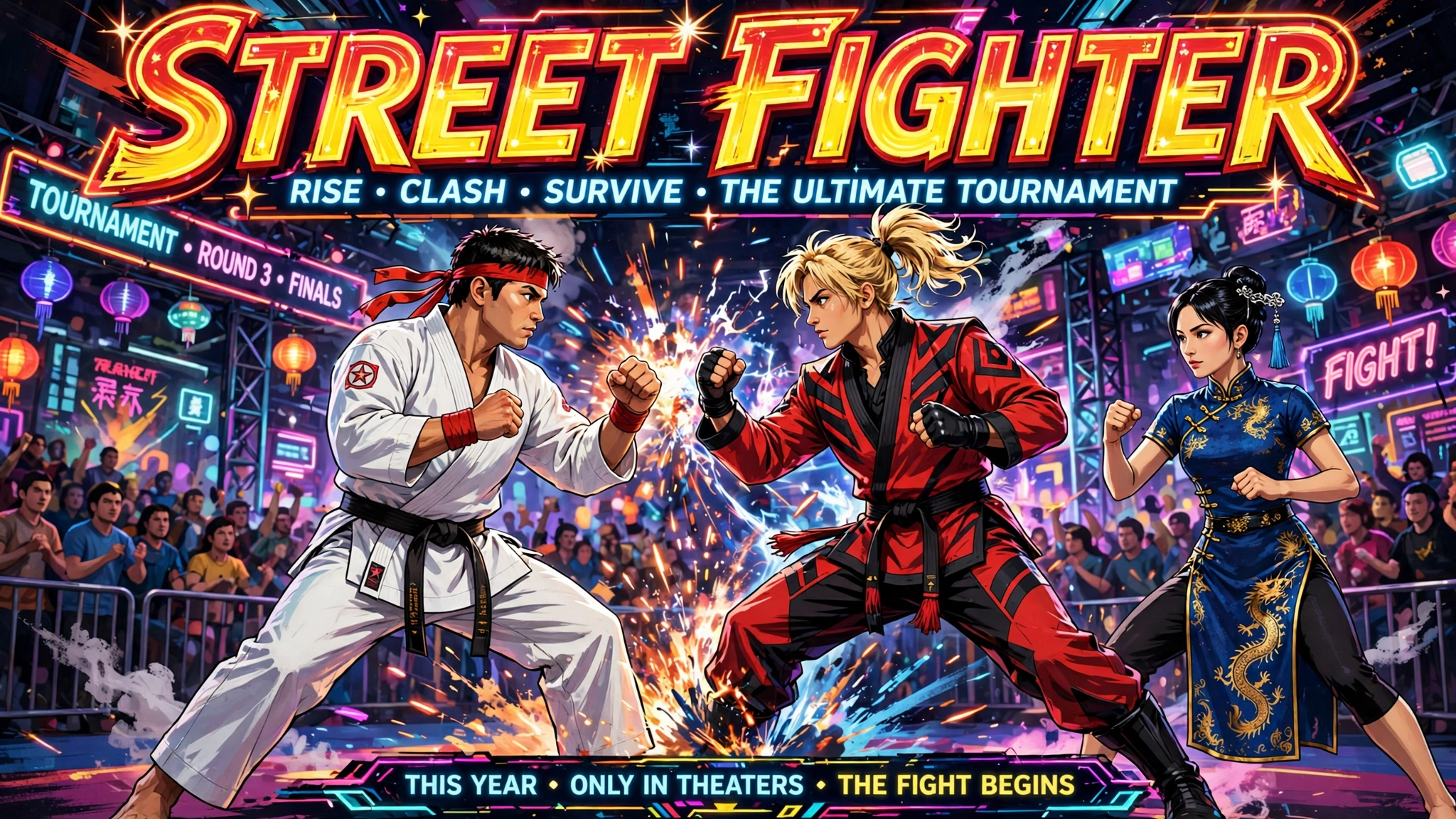
Video game adaptations have finally learned how to be good, and Street Fighter is the latest test of that lesson. Kitao Sakurai’s 2026 film is the third live-action attempt at Capcom’s fighting-game franchise, after the fondly remembered mess of 1994 and the largely forgotten 2009 effort, and it is comfortably the best of the three — which, as one reviewer noted, is a lower bar than it sounds. It is loud, garish, frequently funny and never boring, with two terrific leads and some gorgeous hand-drawn flashbacks. It is also overstuffed, muddled and constantly tripping over its own enormous cast list. For fans, it is a blast; for everyone else, it is a loud night out that could have been a much better film.
This review is spoiler-free on the film’s later turns. The premise and the roster are public knowledge; the plot’s turns are not spoiled here.
| Detail | Information |
| Release date | 16 October 2026 (United States and United Kingdom; premiered 12 October 2026 in Los Angeles; 15 October in some territories) |
| Director | Kitao Sakurai |
| Writers | Kitao Sakurai and T. J. Fixman (screenplay); Dalan Musson and Gary Dauberman (story) |
| Genre | Martial arts action comedy |
| Language | English |
| Runtime | 119 minutes (some listings give 120 minutes) |
| Budget | $82 million |
| Lead cast | Andrew Koji, Noah Centineo, Callina Liang, David Dastmalchian, Jason Momoa, Cody Rhodes, Joe “Roman Reigns” Anoa’i, Curtis “50 Cent” Jackson, Vidyut Jammwal, Orville Peck |
| Our rating | 6.5/10 |
Set in 1993, the film follows Ryu (Andrew Koji) and Ken Masters (Noah Centineo), two estranged street fighters whose friendship has fractured, and who are thrown back into combat when the mysterious Chun-Li (Callina Liang) recruits them for the next World Warrior Tournament. Behind the tournament lies a conspiracy: the dictator M. Bison (David Dastmalchian) is using it as a trap, and Ryu — whose past includes a devastating confrontation with Akuma (Roman Reigns), the man who killed his own brother and once trained both Ryu and Ken — is the prize Bison wants.
That is a workable spine, and the film’s best stretch is the relationship at its centre: Ryu’s discipline against Ken’s charisma, two former friends forced to fight side by side and, at times, against each other. The problem is everything piled on top of it. The roster is enormous — Guile, Blanka, Balrog, Vega, Dhalsim, E. Honda, Dan Hibiki, Cammy, Zangief, Juli and more — and the film keeps pausing its story to introduce, showcase and service each one. The result is a film that feels like a tournament bracket brought to life: exciting in bursts, exhausting in aggregate, and constantly resetting its own momentum.
Without spoiling the ending, it is fair to say the film closes with a clear eye on sequels. Some viewers will find that exciting; others, noting that the film spends much of its running time setting up pieces it does not resolve, will find it sequel-baiting. Both reactions are understandable.
Andrew Koji as Ryu — Koji, superb in the television series Warrior, is a natural Ryu: physically convincing, quietly intense, and able to carry the film’s emotional weight without saying much. His fight scenes are the film’s best, and his restraint gives the film a centre it desperately needs.
Noah Centineo as Ken Masters — Centineo is, by several reviewers’ accounts, the film’s real star. Ken becomes the story’s unlikely emotional hero, and Centineo plays him with a charm and vulnerability that makes the character’s journey — from reluctant participant to the film’s beating heart — genuinely affecting. It is the performance that holds the film together when the roster threatens to pull it apart.
Callina Liang as Chun-Li, and the enormous ensemble — Liang gives Chun-Li drive and mystery, and she handles the action with confidence, though the script gives her less interior life than the two leads. David Dastmalchian’s M. Bison is suitably menacing without becoming camp, and Jason Momoa’s Blanka, Cody Rhodes’s Guile, Roman Reigns’s Akuma, 50 Cent’s Balrog, Vidyut Jammwal’s Dhalsim and Orville Peck’s Vega all land their moments. The trouble is not talent but arithmetic: with this many characters, most get a showcase rather than an arc, and the film’s middle stretch becomes a parade of introductions.
Sakurai, who took over the project after Danny and Michael Philippou departed in 2024, directs with energy and a clear love of the source material. The film’s most praised technical choice is its hand-drawn, animated flashback sequences — created with Titmouse — which render the characters’ backstories in gorgeous, comic-book style, and which several reviewers singled out as the film’s visual highlight. Ken Seng’s cinematography keeps the tournament world colourful and legible, and the fight choreography, when the camera stays with it, is strong.
Where the film stumbles is in its structure. The script, credited to Sakurai and Fixman from a story by Musson and Dauberman, tries to serve two masters: a character story about Ryu and Ken, and a franchise-launching roster showcase. The two keep interrupting each other, and the pacing — excellent in the opening stretch, by one reviewer’s account — sags whenever the film stops to introduce another fighter. The tone, too, wobbles between earnest martial-arts drama and knowing comedy, and not every joke lands. None of this makes the film boring — it is rarely that — but it keeps a good film from becoming a great one.
One production note worth recording: Legendary Entertainment acquired the live-action film and television rights in April 2023, with Capcom co-producing, and principal photography ran from August to November 2025. The long road to the screen shows in the film’s polish, if not always in its focus.
The score, by Leo Birenberg and Zach Robinson, does exactly what a film like this needs: propulsive, percussive, and happy to lean into the arcade energy of the source material. The sound design of the fights — impacts, crowd noise, the arena atmosphere — is big and satisfying, and the film is at its best with the volume up. There is no breakout soundtrack moment here, but the music serves the spectacle well.
What we loved:
What could be better:
Street Fighter was made for a reported $82 million production budget, and early reporting put its worldwide gross at around $81.3 million — essentially level with its budget before marketing costs, which is a soft result for a franchise hopeful. That figure should be read as a reported total at the time of writing rather than a final audited number, since the film was still in release in some territories. Critically, the film received mixed reviews: some outlets praised its energy, leads and faithfulness to the games, while others scored it as low as 2.5 out of 5, citing the overstuffed roster and muddled script. The commercial picture, combined with that split reception, makes a sequel far from certain — which is ironic, given how hard the film works to set one up.
Yes, if you like fighting games, martial-arts spectacle, or Koji and Centineo — and especially if you grew up feeding coins into a Street Fighter arcade cabinet. This is a fun, loud, good-looking film with two excellent leads and some genuinely beautiful animated sequences. Just go in expecting a roster showcase that occasionally forgets its own story, rather than a tight martial-arts classic, and you will have a good time. Everyone else can wait for streaming.
Our rating: 6.5/10 — Loud, garish and frequently fun, carried by Koji and Centineo, but too crowded and too sequel-hungry for its own good.
Who directed Street Fighter (2026)?
Kitao Sakurai, from a screenplay by Sakurai and T. J. Fixman, based on a story by Dalan Musson and Gary Dauberman. It is produced by Legendary Pictures with Capcom and distributed by Paramount Pictures.
Who stars in Street Fighter (2026)?
Andrew Koji as Ryu, Noah Centineo as Ken Masters, Callina Liang as Chun-Li, David Dastmalchian as M. Bison, Jason Momoa as Blanka, Cody Rhodes as Guile, Roman Reigns as Akuma, 50 Cent as Balrog, Vidyut Jammwal as Dhalsim and Orville Peck as Vega.
What is Street Fighter (2026) about?
Set in 1993, estranged fighters Ryu and Ken are recruited by Chun-Li for the World Warrior Tournament, behind which dictator M. Bison is running a conspiracy to capture Ryu’s power.
How much did Street Fighter (2026) earn at the box office?
Around $81.3 million worldwide against a reported $82 million production budget, according to early reporting; treat this as a reported total, not a final audited figure.
Is Street Fighter (2026) connected to the earlier films?
No. It is a reboot and the third live-action feature based on Capcom’s games, unrelated to the 1994 and 2009 films.
Is Street Fighter (2026) suitable for family viewing?
It is rated PG-13 for martial-arts violence and action. It is best suited to teenagers and adults, and to fans of the games.