★ LATEST REVIEWS

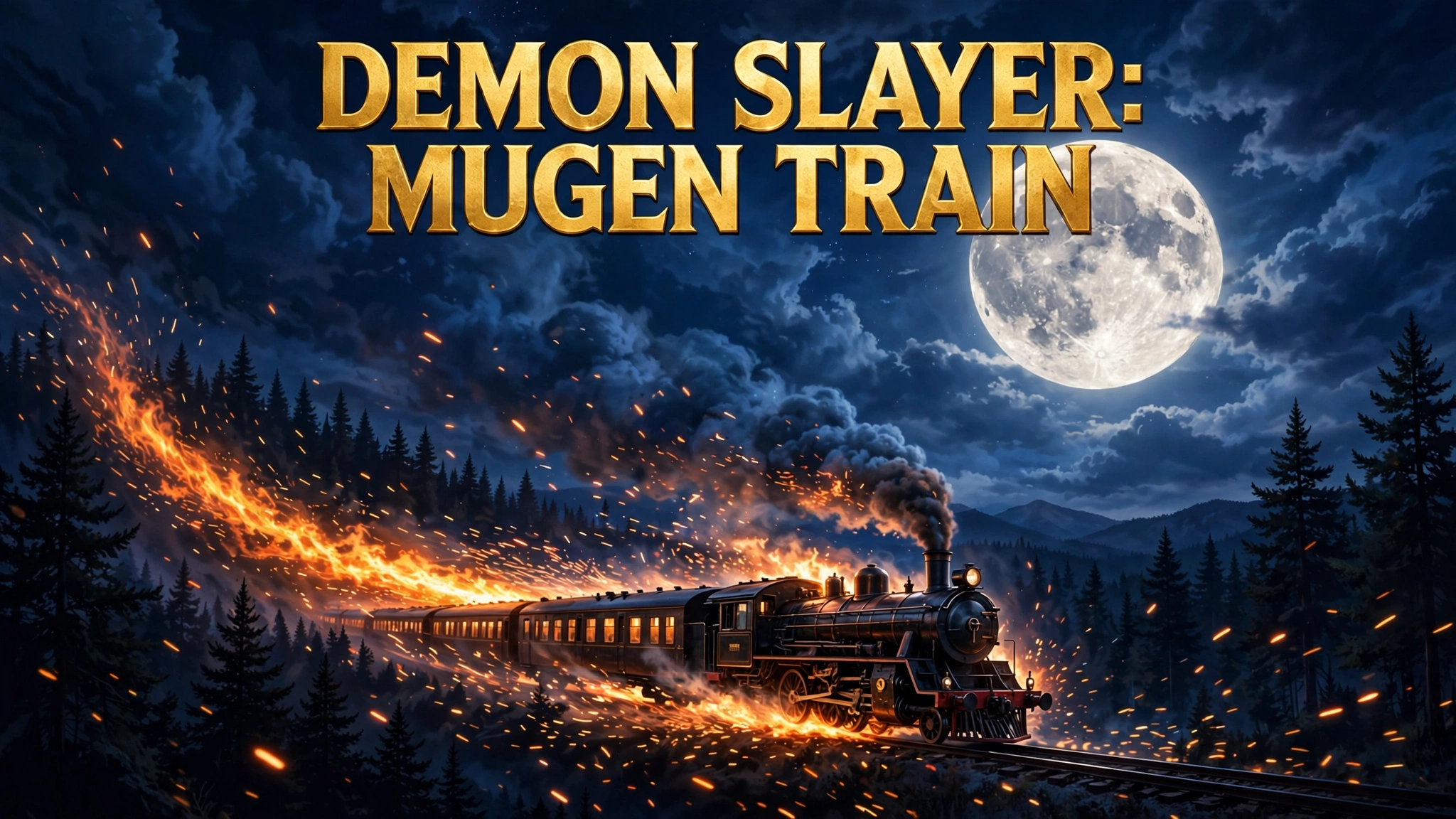
Our Rating: ★★★★★ 9/10
There is a moment, roughly two thirds into Demon Slayer: Kimetsu no Yaiba – The Movie: Mugen Train, when the film stops being a very good anime action movie and becomes something audiences carry with them for years. We will not describe it here — this is a spoiler-free review — but its emotional force explains a box-office story that still sounds impossible: released in October 2020, in the middle of a global pandemic that had emptied cinemas everywhere else, this single Japanese animated film became the highest-grossing film of the entire year worldwide, ahead of every Hollywood blockbuster and every other country’s biggest hit. No non-American production had ever topped the annual global chart before.
Context matters for any honest Demon Slayer Mugen Train review. The film is a direct sequel to the first season of the Demon Slayer television anime, adapted from Koyoharu Gotouge’s manga, and it assumes you know Tanjiro Kamado and why he carries his sister in a wooden box. Newcomers can follow the plot, but the payoffs are earned across twenty-six earlier episodes. Judged on its own terms — as a continuation, a piece of animation craft, and a story about duty and mortality — it is exceptional popular filmmaking, with a final act as moving as anything in modern anime. This review covers the story, the voice work, Ufotable’s technique, the music, and where the film falls short.
| Detail | Information |
|---|---|
| Release date | 16 October 2020 (Japan) |
| Director | Haruo Sotozaki |
| Writers | Ufotable (screenplay); based on the manga by Koyoharu Gotouge |
| Genre | Anime, Action, Dark Fantasy |
| Language | Japanese |
| Runtime | 117 minutes |
| Lead cast (voices) | Natsuki Hanae, Akari Kitō, Hiro Shimono, Yoshitsugu Matsuoka, Satoshi Hino, Daisuke Hirakawa, Akira Ishida |
| Our rating | 9/10 |
A note on the facts: Ufotable has never published an official production budget, so there is no budget row here. One database lists an estimate of about $15.75 million, but it is not a confirmed studio figure — see the Box Office section. Listings also differ on running time, some giving 119 minutes; 117 minutes is the figure in the North American release materials and major trackers, and it is the one we use.
The film picks up immediately after the television season ends. Young Demon Slayer Tanjiro Kamado, his demon-turned sister Nezuko, and his two gloriously ill-mannered companions — the terrified, sleep-fighting Zenitsu Agatsuma and the boar-masked, feral Inosuke Hashibira — are sent to join Kyojuro Rengoku, the Flame Hashira, one of the Corps’ nine elite swordsmen. More than forty passengers have vanished on the Mugen Train, and Rengoku is already aboard investigating.
What the demon responsible has planned is more interesting than a straightforward ambush. Enmu, the lowest-ranked of the demon lord Muzan Kibutsuji’s elite Twelve Kizuki, does not attack the swordsmen directly. He puts the entire train to sleep and sends human collaborators into their dreams to destroy the spiritual cores at the centre of each sleeper’s soul. It is a clever, cruel device, because the dreams are not nightmares — they are everything the dreamers have lost. Tanjiro’s dream, in particular, is the emotional core of the film’s first half: he wakes, in the dream, inside the happy mountain home that was taken from him, surrounded by the family he could not save. The film understands that the hardest fight is not against a monster. It is against the wish to stay.
Once the trap is sprung, the story becomes a race along a moving train that is itself part of the enemy, and the structure is admirably clear: escape the dream, find the demon’s real body, protect two hundred sleeping passengers, and survive what arrives after the train stops. That final arrival — which we will not spoil — reframes everything before it. The last movement is essentially a single extended duel built around a clash of philosophies: one character who believes eternal life is the only thing of value, and one who believes a short human life burns brighter precisely because it ends. It is shonen storytelling at its most sincere, and sincerity can carry a climax further than irony ever could.
Because this is animation, performance means voice performance first — and this cast, carried over intact from the television series, is superb across the board.
Satoshi Hino as Kyojuro Rengoku is the revelation. Rengoku appeared only briefly at the end of the TV season, mostly shouting with cheerful intensity, and there was a real risk he would play as a caricature — all volume and flame-coloured hair. Hino finds the man inside the mannerisms: the warmth is real, the discipline underneath it is real, and in the dream sequences, where we see the family that shaped him — a cold, broken father and a mother whose teaching became his creed — the performance quietly deepens. By the final act, when Rengoku must be funny, terrifying and heartbreaking within a few minutes of screen time, Hino delivers all three. It is one of the great single-film performances in anime.
Natsuki Hanae as Tanjiro Kamado has the hardest emotional assignment in the dream section, and it is a measure of his skill that Tanjiro’s goodness never curdles into blandness. Hanae plays kindness as a decision the character keeps making at cost to himself, and his work in the dream — joy curdling into grief as Tanjiro understands where he really is — is genuinely painful to listen to. Akari Kitō as Nezuko works with an unusual constraint: Nezuko barely speaks, communicating through muffled sounds, breath and physical comedy and fury, yet Kitō makes her fully present, and her scenes waking the others give the middle of the film its urgency. Hiro Shimono as Zenitsu and Yoshitsugu Matsuoka as Inosuke supply the comedy — broad, loud and expertly timed — without tipping the film off balance; both also get one showcase moment each, and both land. As the villains, Daisuke Hirakawa gives Enmu a soft, almost tender creepiness that is far more unsettling than shouting would be, and Akira Ishida, arriving late as the Upper Rank demon Akaza, brings a smiling, athlete’s enthusiasm to evil that makes the final duel feel like a perversion of a sporting contest — two masters recognising each other.
The English dub, for viewers who prefer it, is also strong, led by Zach Aguilar as Tanjiro and Mark Whitten as Rengoku, and it preserves the film’s emotional beats faithfully.
Director Haruo Sotozaki, continuing from the television series, and the studio Ufotable deliver what is, quite simply, some of the most polished 2D animation ever put into a commercial feature. Ufotable’s signature method — hand-drawn characters and effects blended with 3D camera movement and digital compositing, supervised here by director of photography Yuichi Terao — gives the action a sense of depth and speed that pure 2D rarely achieves, while the character animation itself remains expressive and, crucially, readable. You always know where everyone is on that train, even when the train itself becomes the battlefield.
The set pieces build beautifully. The dream worlds are lit and coloured differently from the waking world — softer, warmer, slightly too golden — so the audience feels the wrongness before the characters name it. The fight choreography uses the series’ Breathing techniques as visual signatures: water, lightning, beast and flame each move and sound different, and Rengoku’s flame forms in the climax are staged as waves of fire that fill the frame without ever hiding the swordsmen inside them. Editor Manabu Kamino keeps the cross-cutting between the sleeping passengers, the waking fighters and the train’s monstrous transformation clear and tense.
Honesty requires noting the craft is not flawless. The film inherits a television structure — its first act reintroduces characters and rules for cinema viewers who cannot rewind — and the middle section repeats its central problem once more than it needs to. Some fully digital effects sit less comfortably against the drawn work than others. But these are blemishes on a very high standard: shot for shot this is a beautiful film, and its final duel is a masterclass in staging animated action so technique serves character.
The score, shared by Yuki Kajiura and Go Shiina and carried over from their television work, is one of the film’s great strengths. Shiina’s contributions drive the action with pounding taiko-style percussion, choral surges and shamisen-inflected urgency, while Kajiura’s material handles the film’s heart — strings and piano themes that gather the whole Kamado family tragedy into a few recurring motifs. The division of labour mirrors the film itself: spectacle on the surface, grief underneath.
The closing theme, “Homura” (Flame), performed by LiSA and composed with Kajiura, deserves its own mention. Placed over the end of the story, it functions as the film’s final emotional release — a ballad about carrying a flame someone else lit for you. It became a major hit and won the Japan Record Award’s Grand Prix. Few franchise films use their theme song as storytelling. This one does, and it is a large part of why audiences left cinemas in tears.
What we loved:
What could be better:
The numbers need care, because trackers differ slightly — but the records themselves are not in doubt. Mugen Train grossed over $512 million worldwide; published lifetime totals range from about $507 million to about $515 million depending on the tracker and on how later reissue and reporting updates are counted (Wikipedia lists $512.7 million; The Numbers lists about $515.4 million). In Japan alone it earned more than ¥40 billion — the first film in Japanese cinema history to pass that mark — from roughly 29 million admissions, becoming the highest-grossing film of all time in Japan in just 73 days and ending the 19-year reign of Spirited Away.
Globally, it was the highest-grossing film released in 2020 — the first time a non-American production had ever topped a calendar year worldwide. It also became the highest-grossing Japanese and anime film of all time, and the highest-grossing R-rated animated film ever. In North America, released in April 2021, it grossed about $47–50 million depending on the tracker, the second-biggest anime result there at the time, with the biggest opening ever for a foreign-language film. One record has since changed hands: in 2025 the franchise’s own Infinity Castle – Part 1: Akaza Returns surpassed it as the highest-grossing Japanese film worldwide. That does not diminish 2020. No one expected an anime sequel film, released into a pandemic, to beat the entire planet. It did.
On budget: no official figure has been published. About $15.75 million circulates from a single database; it is an estimate, not a confirmed studio figure, and any profit calculation built on it should be treated as approximate.
Yes — with one condition. Watch the first television season first, because Mugen Train is a chapter, not a prologue, and its ending lands with the weight of everything before it. Do that, and you get one of the finest anime films ever released in cinemas: visually dazzling, superbly performed, and built around a stand in the final act that has already entered anime legend. Even viewers who bounce off shonen conventions tend to surrender to this one’s sincerity. It made half a billion dollars in the worst year in cinema history by making audiences feel something. That is not hype. That is the whole story.
Our rating: 9/10 — a spectacular, deeply moving anime epic, and the moment a television sequel became a piece of box-office history.
Do I need to watch the Demon Slayer TV series before Mugen Train?
Strongly recommended, yes. The film is a direct sequel to season one and adapts the manga’s Mugen Train arc without re-explaining the world. The plot is followable cold, but the characters, Tanjiro’s family tragedy and the ending’s impact all depend on the series.
Is Mugen Train the same as the start of season 2?
Largely, yes. The television version re-edited the film into episodes with one entirely new opening episode about Rengoku before the train journey. The film remains the original, tighter telling and the better first experience.
Was Mugen Train really the highest-grossing film of 2020?
Yes. With over $512 million worldwide it topped the 2020 global chart — the first non-American film ever to do so — and became the highest-grossing Japanese and anime film of all time, a worldwide record it held until the franchise’s own Infinity Castle film surpassed it in 2025.
Is Demon Slayer Mugen Train suitable for children?
It is rated R in the United States for violence and bloody images, and the violence, while stylised, is intense, with decapitations and a genuinely upsetting death. It suits teenagers and above better than young children, despite its colourful look.
Where can I watch Demon Slayer Mugen Train?
It streams on Crunchyroll and other major platforms in most regions, in Japanese with subtitles and in an English dub, and is widely available on Blu-ray. Availability varies by country, so check your local services.