★ LATEST REVIEWS

Our Rating: ★★★★★ 9/10
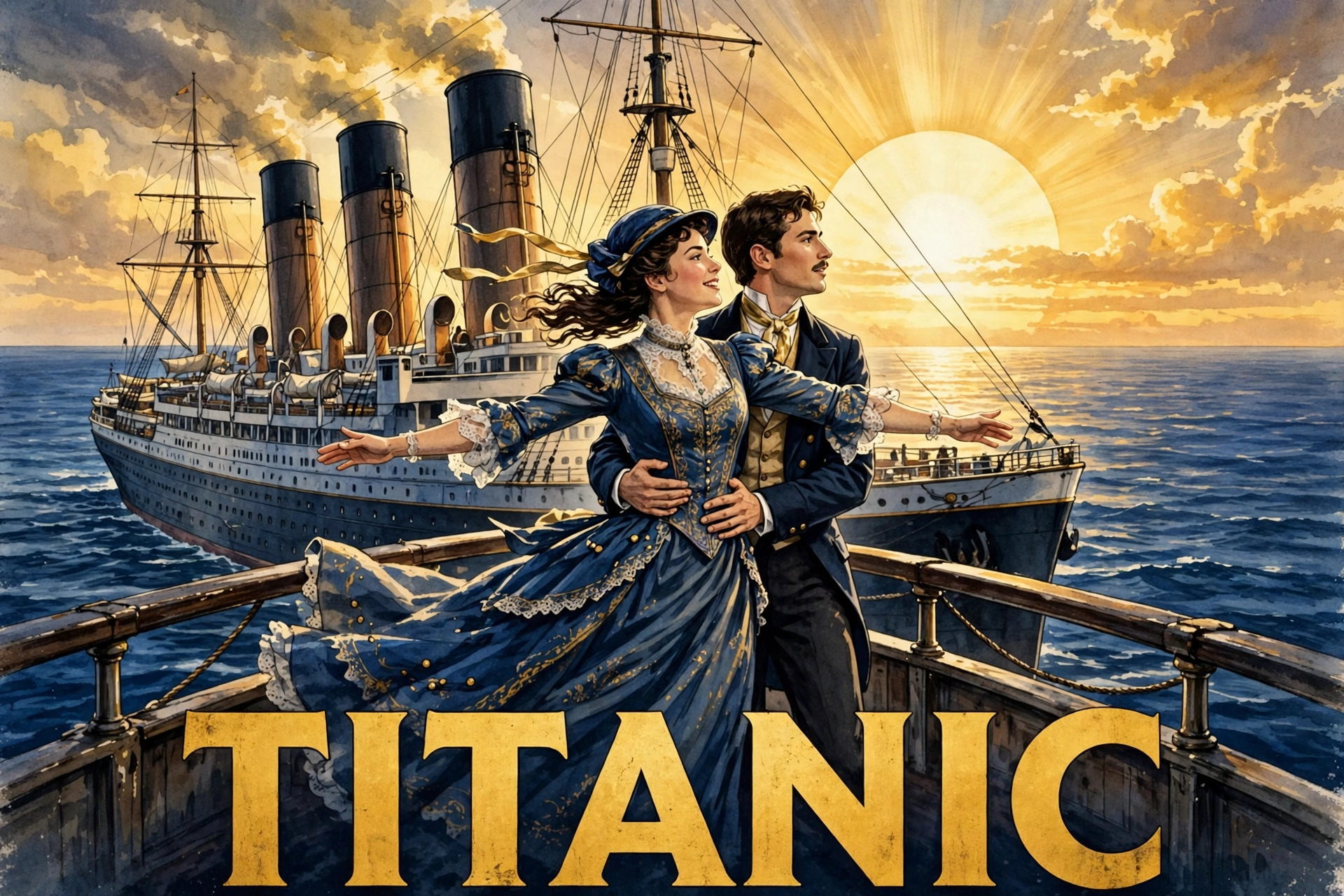
Some films become hits. A very small number become part of how a generation remembers falling in love with cinema itself. Titanic, released in December 1997, belongs firmly in that second group. James Cameron took one of the most documented disasters of the twentieth century and built around it a simple, sweeping love story, and the combination proved almost unstoppable: audiences returned again and again, the soundtrack played everywhere for a year, and the film stayed at the top of the box office for month after month in a way that feels impossible in today’s fast-moving release calendar.
It is easy, nearly three decades later, to be cynical about it. The dialogue has been quoted, parodied and turned into memes so often that the film can feel familiar even to people who have never sat through it. Watch it properly, though, on the biggest screen you can find, and the cynicism does not survive the second hour. Cameron earns his sentiment the hard way, by building a ship, filling it with recognisable human behaviour, and then showing, in patient and terrifying detail, what it costs when human arrogance meets the North Atlantic.
This Titanic review looks at the story without spoilers beyond what history itself already tells you, the two performances that carried it, the craft that still holds up, the extraordinary music, and the honest flaws that sit alongside its greatness — including a middle section that sags and a villain who belongs to an older, broader style of filmmaking.
| Detail | Information |
|---|---|
| Release date | 19 December 1997 (United States) |
| Director | James Cameron |
| Writers | James Cameron |
| Genre | Romance, Drama, Disaster |
| Language | English |
| Runtime | 195 minutes |
| Budget | $200 million |
| Lead cast | Leonardo DiCaprio, Kate Winslet, Billy Zane, Kathy Bates, Frances Fisher, Gloria Stuart, Bill Paxton |
| Our rating | 9/10 |
The film is framed in the present day. A treasure hunter, Brock Lovett, is searching the wreck of the RMS Titanic for a legendary blue diamond, the Heart of the Ocean. What his team recovers instead is a drawing, and that drawing brings an elderly woman, Rose, to his ship — a woman who was actually there in April 1912 and who agrees, at last, to tell what happened.
Her younger self is travelling in first class, engaged to a wealthy, controlling fiancé, Cal Hockley, and quietly suffocating inside a life chosen for her by her widowed mother and by debt. On the same crossing, in steerage, is Jack Dawson, a penniless young artist who won his ticket in a card game hours before sailing and who treats every day as an adventure because he has nothing to lose. Their meeting is unlikely, their attraction is immediate, and Cameron gives their relationship time to breathe: shared meals where Jack must borrow manners he does not own, walks on deck, dancing below decks, and conversations in which Rose begins to see a possible life beyond the one arranged for her.
That is the first half, and it is deliberately unhurried. The second half belongs to history. Anyone picking up this film knows the ship strikes an iceberg and sinks, and Cameron does not treat that as a twist. He treats it as an appointment the audience is dreading on behalf of people they have come to care about. The sinking itself unfolds close to real time, moving from disbelief to procedure to panic to impossible choices, with the love story threaded through it rather than pasted on top. How individual characters meet that night is the film’s real subject, and we will not spoil Rose and Jack’s particular path through it here.
Kate Winslet as Rose carries the film, and it is worth remembering how young she was when she did it. Her Rose is not a modern heroine dropped into 1912 fancy dress. She is intelligent and furious but also frightened, polite in public and desperate in private, and Winslet lets you watch her test the limits of her cage one scene at a time. The performance works because she never begs for sympathy: Rose’s awakening feels like a personality emerging rather than a script point being hit, and her scenes with her mother and with Cal have a bruised restraint that keeps the melodrama grounded.
Leonardo DiCaprio as Jack has the lighter role on paper — the free spirit who teaches the rich girl to live — and a lesser actor would have made him a collection of grins. DiCaprio gives Jack a watchfulness that complicates the charm. He reads rooms quickly, knows exactly what class costs him, and chooses generosity anyway. The famous chemistry between the two leads is real, but it is built from listening as much as flirting, and it is why the final act hurts in the way Cameron intends.
Around them, the ensemble does unusually strong work for a disaster film. Billy Zane as Cal is the weak link in conception — he is written as a near-pantomime villain — yet Zane’s clipped, entitled delivery makes him hateful in a specific, believable way rather than a cartoonish one. Kathy Bates as Molly Brown brings warmth and moral clarity without turning saintly, Frances Fisher as Ruth makes a snobbish mother understandable as a terrified widow doing grim arithmetic, and Gloria Stuart as the older Rose gives the framing device its soul; she was nominated for an Academy Award at 87, then the oldest acting nominee in Oscar history. Victor Garber as ship designer Thomas Andrews and Bernard Hill as Captain Smith embody the film’s other theme: decent, competent men confronting the consequences of a system that assured them this could not happen.
Cameron is often described as a technician, as if that were the opposite of a storyteller. Titanic is the clearest argument that, in his best work, the technique is the storytelling. He built a near-full-scale replica of the ship in a purpose-built tank in Mexico, shot real dives to the actual wreck for the opening, and blended models, sets and then-new digital effects so carefully that most viewers still cannot point to the joins. Russell Carpenter’s cinematography moves from golden, romantic warmth in the first half to cold blues and harsh working light in the second, a visual temperature drop that tells the story before the dialogue does.
The sinking sequence remains the benchmark against which screen disasters are judged, not because it is the loudest but because it is the clearest. Cameron keeps geography legible: you understand where the water is, where the boats are, who is trapped behind which gate and how much time is left. The ship breaking in two is spectacular, but the shots that linger are small — a couple in bed as water rises, an officer making a decision he cannot live with, a band playing on. If there is a criticism, it is editorial. At 195 minutes, the film can afford its length in the sinking, yet the framing device returns once too often, and a subplot involving Cal’s pursuit during the disaster tips from tension into action-movie excess. None of it sinks the film. All of it is noticeable on a rewatch.
James Horner’s score is inseparable from the film’s identity. Built around uilleann pipes, breathy vocals and long, aching string lines, it gives the ship a theme that feels both grand and mournful, as if the music already knows how the voyage ends. Horner won the Academy Award for Best Original Dramatic Score, and the score’s restraint in the disaster sequences — often pulling back to near-silence so that groaning metal, water and crowd noise do the work — is a lesson in when not to play.
Then there is the song. “My Heart Will Go On,” with music by Horner, lyrics by Will Jennings and performed by Celine Dion, became the best-selling single of 1998 and won the Academy Award for Best Original Song. Its omnipresence at the time provoked a backlash that has only recently softened. Heard in context now, placed over the closing credits after Horner’s score has done the emotional work, it functions as what it was designed to be: a pop distillation of the film’s central promise that love outlasts the person who embodied it. You may still find it sentimental. It is difficult to call it ineffective.
What we loved:
What could be better:
The numbers need context because Titanic rewrote what numbers were possible. Produced for $200 million — at the time the most expensive film ever made, a figure widely predicted to destroy careers — it instead became the first film in history to earn $1 billion worldwide. Its original run finished at roughly $1.84 billion, it remained the highest-grossing film of all time for more than a decade until Cameron’s own Avatar overtook it, and later reissues, including the 2012 centenary re-release and subsequent returns, have lifted its lifetime total to about $2.26 billion. Published lifetime totals vary slightly by tracker and by how reissue grosses are bundled, generally sitting in the $2.19–2.26 billion range, but no serious source disputes the shape of the achievement.
At the 70th Academy Awards it received 14 nominations, tying the record then held by All About Eve, and won 11 of them — including Best Picture and Best Director — tying Ben-Hur‘s record for wins. For a film the industry had openly expected to fail, that is not just success. That is a rout.
Yes — and if you have only ever seen it in clips, parodies and quoted lines, you have not really seen it. Titanic is melodrama, unashamedly, but it is melodrama executed with rare discipline: a love story that understands class, a disaster film that understands procedure, and a blockbuster that trusts an audience to sit with dread rather than cutting away from it. Its flaws — a broad villain, a few laboured lines, a frame story that outstays its welcome — are real, and they are also the flaws of a film reaching for the largest possible emotional canvas. Very few films attempt what this one attempts. Fewer still are wept over, argued about and rewatched a generation later.
Our rating: 9/10 — a monumental romance and disaster epic whose craft, performances and emotional force still justify every bit of its legend.
Is Titanic based on a true story?
The ship, the sinking on 15 April 1912 and many supporting figures — including Captain Smith, Molly Brown and Thomas Andrews — are real. Jack Dawson and Rose DeWitt Bukater are fictional characters created to carry the audience through the real event.
How long is Titanic, and is there an intermission?
The film runs 195 minutes, just over three hours and fifteen minutes. Some cinemas add an intermission for re-releases; home versions play straight through, and the natural pause point is the moment the ship strikes the iceberg.
Is Titanic suitable for children?
It is rated PG-13 for intense disaster sequences and peril, some sensuality and brief language. The second half is genuinely harrowing, so it suits older children and teenagers better than young viewers, ideally watched with an adult.
Did Leonardo DiCaprio and Kate Winslet win Oscars for Titanic?
No. Winslet was nominated for Best Actress and Gloria Stuart for Best Supporting Actress, but neither won. The film’s 11 wins from 14 nominations came in categories including Picture, Director, Score, Song, Cinematography and Visual Effects.
Where can I watch Titanic?
It is widely available on major streaming platforms and in restored Blu-ray and 4K editions. Streaming availability varies by region and changes over time, so check your local services for the current listing.