★ LATEST REVIEWS

Our Rating: ★★★★★ 9.5/10
There is a moment about twenty minutes into Mad Max: Fury Road when you realise the film is not going to stop. Not for exposition, not for a breather, not for the usual blockbuster rhythm of action, chat, action, chat. It just keeps moving, and it takes you with it. Any honest Mad Max: Fury Road review has to start there, because that refusal to slow down is both the film’s boldest gamble and the reason it is now routinely discussed among the greatest action films ever made.
Released in May 2015, thirty years after the previous film in the series, Fury Road was directed by George Miller, who created Max in 1979 and was in his late sixties when he returned to the wasteland. That fact matters. This does not feel like a veteran playing safe with a legacy property. It feels like a filmmaker who had been visualising one enormous chase for more than a decade and was finally given the money, the desert and the stunt team to build it for real. The result is a film that is simple in story, radical in execution and strangely moving underneath all the fire and chrome.
| Detail | Information |
|---|---|
| Release date | 14 May 2015 (Australia) |
| Director | George Miller |
| Writers | George Miller, Brendan McCarthy, Nico Lathouris |
| Genre | Action, Sci-Fi, Adventure |
| Language | English |
| Runtime | 120 minutes |
| Budget | Approx. $150–185 million (reported range) |
| Lead cast | Tom Hardy, Charlize Theron, Nicholas Hoult, Hugh Keays-Byrne |
| Our rating | 9.5/10 |
The world of Fury Road has collapsed into desert, scarcity and cults. Water and fuel are controlled by warlords, and the strongest of them in this stretch of wasteland is Immortan Joe, who rules the Citadel, a rock fortress where the desperate crowd below begs for brief, wasteful showers of water from above. Max Rockatansky, a former policeman haunted by people he could not save, is captured at the film’s opening and used in the most literal way the Citadel can imagine — as a living blood supply for its sickly, fanatical War Boys.
Into this setup drives Imperator Furiosa, one of Joe’s most trusted drivers. Sent out on what should be a routine run in her heavily armoured War Rig, she turns off the agreed route. Hidden inside the rig is Joe’s most prized possession, and once he understands what she has taken, he sends everything he owns after her: War Boys, allied gangs, and fleets of patched-together vehicles that look like they were designed by fever dreams and scrapyards.
Max, strapped first to the front of a pursuing car and then fighting his way loose, is dragged into Furiosa’s escape whether he wants to be or not. What follows is, in essence, one chase interrupted by brief, desperate pauses — a dash across the desert in search of a remembered homeland, and then a reckoning with the fact that running away may not be the same thing as finding redemption. To describe the plot in more detail would add surprisingly little, because Fury Road tells its story through faces, gestures and geography rather than dialogue. Where the characters want to go, what they are willing to lose to get there, and how their loyalties shift — all of it is readable in motion. We will not spoil the destination or who reaches it.
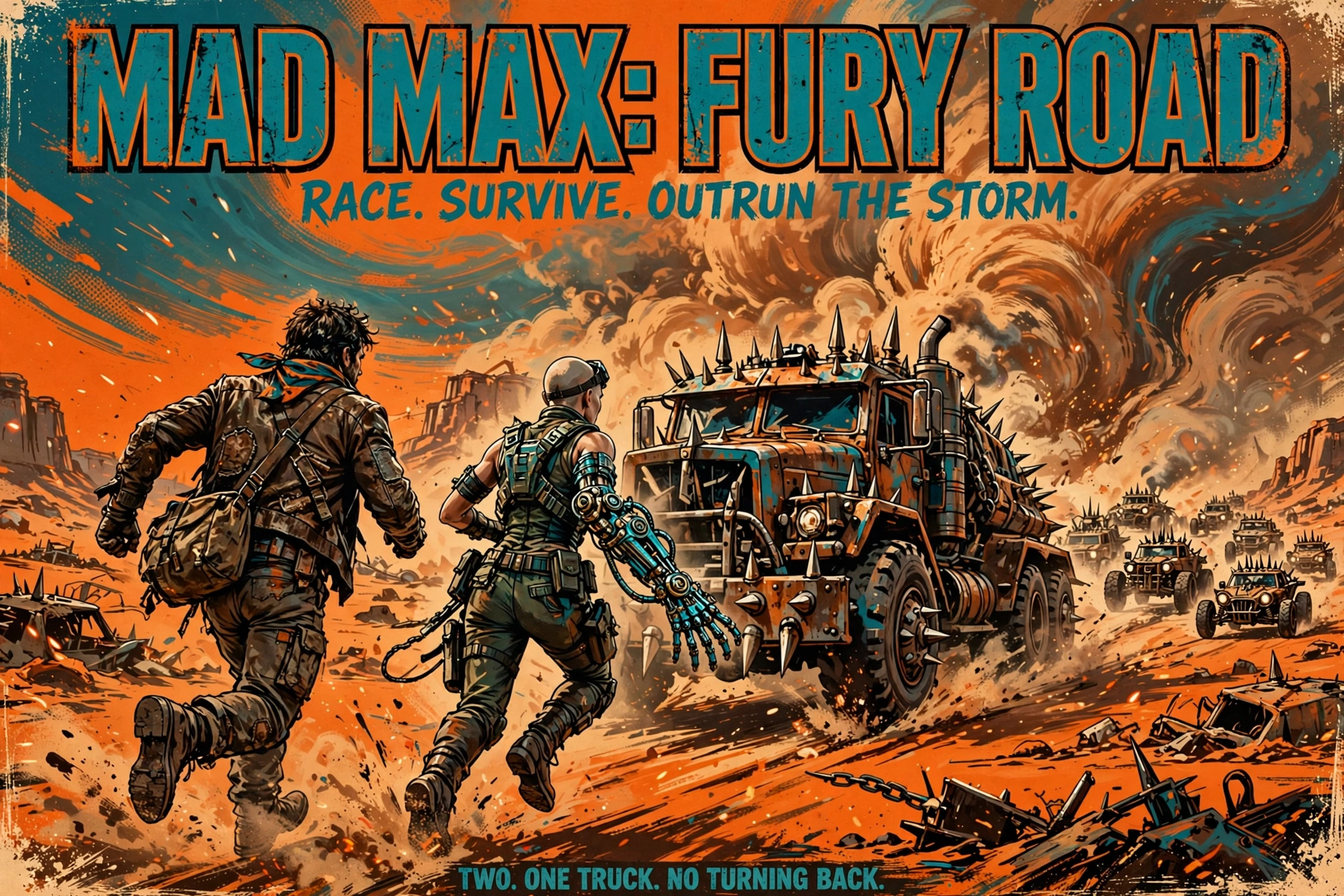
Tom Hardy as Max Rockatansky takes over a role defined by Mel Gibson and wisely refuses to imitate him. His Max is feral at first, grunting, twitching and scanning for exits like a trapped animal, and Hardy plays the character’s recovery of purpose as a gradual, physical thaw. He has very little dialogue, and long stretches where his most expressive tool is a look of disbelief at what is happening around him. Some viewers wanted a more verbal, central Max, and the film is honest enough to admit he is almost a supporting figure in his own franchise entry. But Hardy’s restraint is the point: this Max earns his heroism by choosing, again and again, to stay and help when every instinct tells him to run.
Charlize Theron as Imperator Furiosa gives the film its heart and its steel. With a shaved head, a mechanical arm and grease smeared across her forehead like war paint, Theron could have settled for iconic imagery. Instead she builds a complete person out of economy: command in her voice when she gives orders, buried guilt in the few moments she allows herself to explain why she is running, and a contained devastation in the film’s most famous quiet scene, when a hope she has carried for years collapses in front of her. It is one of the defining action performances of the century precisely because it never feels like posing. Furiosa is tired, capable and furious in the deep sense — angry at a world that made her complicit.
Nicholas Hoult as Nux provides the surprise emotional arc of the film. A War Boy raised to believe that a glorious death in Joe’s service will carry him to Valhalla, Nux begins as a wide-eyed fanatic chasing immortality through suicide attacks. Hoult plays his slow disillusionment without mocking the character’s faith, which makes his growing tenderness with one of the people he was sent to recapture genuinely affecting. Hugh Keays-Byrne as Immortan Joe — who, in a lovely piece of series history, also played the villain Toecutter in the original 1979 Mad Max — is terrifying behind a skeletal mask and breathing apparatus, a ruler whose voice turns theft into religion. Among the smaller roles, Rosie Huntington-Whiteley as Angharad, Riley Keough as Capable and Zoë Kravitz as Toast give the escapees distinct presences in very limited screen time, while Nathan Jones as Rictus Erectus embodies the Citadel’s brute force.
George Miller’s direction is the story here. Working from thousands of storyboard panels rather than a conventional dialogue-heavy script process, Miller stages the film as a continuous piece of visual reasoning. Every chase beat teaches you the geography — which vehicle is where, what weapon is at hand, what terrain is coming — so that when the action accelerates to a speed most directors could not keep coherent, you always know what is at stake. Cinematographer John Seale, lured out of semi-retirement, shoots the Namibian desert in scorched oranges and deep blues, then grades the night scenes into an almost monochrome blue that still feels baked by the same unforgiving world.
The stunt and practical-effects work is the film’s legend, and it deserves the reputation. Real vehicles were built in large numbers, real drivers and stunt performers performed jumps, pole-swinging attacks and crashes at speed, and the famous pole cats and flamethrower guitar rig are not digital inventions. Computer effects are present — for backgrounds, enhancements and safety removals — but the weight, dust and danger you feel comes from physical things colliding in a physical place. Editor Margaret Sixel, who had never cut an action film of this scale before, shapes hundreds of hours of material into a rhythm that somehow keeps rising without exhausting the viewer; her Oscar was richly earned, and her eye-line-centred cutting is a major reason the chaos remains readable.
If there is a craft criticism to make, it is that the sheer density can flatten individual set pieces on a first viewing — a few extraordinary stunts pass in seconds — and that the middle pause, welcome as it is, makes the structure’s simplicity very visible. These are small costs for a film whose production design, costume design and makeup all won Academy Awards alongside its editing and sound work: ten nominations, six wins, for a summer action sequel. That almost never happens, and it happened because the craft is the storytelling.
The score is by Dutch composer Tom Holkenborg, credited as Junkie XL, and it is built like the film itself: percussion first, everything else fighting to keep up. Taiko-style drums, pounding low strings and distorted guitar drive the chases, while a recurring, mournful theme for strings gives Furiosa’s quest an emotional weight that pure noise could not. The music rarely leaves the film in peace, which is a deliberate choice — the wasteland does not do quiet — but Holkenborg knows when to thin the arrangement for the human moments, particularly during the desert pauses and the final push.
Then there is the Doof Warrior: a blind musician strapped to a wall of speakers on a moving truck, playing a double-necked flamethrower guitar to spur Joe’s army forward. He is absurd, unforgettable and completely logical inside this world, where music is literally a weapon of morale. The score’s integration with sound design — engines pitched like instruments, wind and metal woven into the rhythm — is a large part of why Fury Road feels less watched than endured, in the best possible way.
What we loved:
What could be better:
Fury Road was expensive, and reports of its production budget vary — figures between roughly $150 million and $185 million circulate, which is why our Quick Facts table gives a range rather than a single neat number. Against that cost, its worldwide theatrical gross of about $380.4 million made it a clear commercial success and the highest-grossing film in the Mad Max series, though not the kind of billion-dollar phenomenon its critical reputation might suggest. Its real financial life has been long: strong home-video and streaming performance, and a permanent place on greatest-films lists that keeps new viewers arriving a decade later. It also performed a rarer trick for a fourth franchise instalment — it made the series more prestigious at age thirty-six than it had been at its start, and it set up the later prequel Furiosa: A Mad Max Saga (2024).
Yes — and on the biggest, loudest screen you can find. Mad Max: Fury Road is the rare blockbuster that trusts images over explanations, performers over speeches and physical craft over digital weightlessness. Action fans will get the genre at its peak; viewers who normally avoid action films may be surprised by how much feeling Miller, Theron and Hoult smuggle into a two-hour chase. If relentless intensity is not your taste, no review will convert you. For everyone else, this is essential viewing.
Our rating: 9.5/10 — a near-perfect action film, built by hand and driven like it was stolen.
Is Mad Max: Fury Road a sequel or a reboot?
It is the fourth film in George Miller’s Mad Max series, with Tom Hardy taking over the role of Max. It does not retell the earlier films and can be watched on its own, though small references reward series fans.
Do I need to watch the older Mad Max films first?
No. Fury Road explains its world through action and brief dialogue. The earlier films add context about Max’s past, but nothing in this story depends on them.
Why does Max have so little dialogue?
The film is designed as visual storytelling. Max begins as a traumatised survivor who has almost stopped believing in other people, and Hardy plays that withdrawal physically. Furiosa carries much of the mission and emotional weight by design.
Is Mad Max: Fury Road suitable for children?
No. It is rated for mature audiences in most regions for intense violence, disturbing images and its bleak setting, even though it avoids graphic gore for its own sake. It is best for older teens and adults.
Where was Mad Max: Fury Road filmed?
Principal photography took place mainly in Namibia, after unusually heavy rain turned the planned Australian desert locations green. Some studio and additional work was done in Australia and South Africa.