★ LATEST REVIEWS

★★★★☆ Our Rating: 8.5/10
Any honest Winter Sleep review has to begin with a warning that is also a compliment: this is a film of 196 minutes, built largely out of long conversations, in which almost nothing happens in the conventional sense — and it won the Palme d’Or at Cannes in 2014, the festival’s highest honour. Both facts are true, and your experience of the film will depend entirely on which one matters more to you.
Directed by Nuri Bilge Ceylan, Turkey’s most internationally celebrated filmmaker, Winter Sleep (Turkish title: Kış Uykusu) is a slow, dialogue-heavy portrait of a wealthy, self-satisfied man being dismantled, piece by piece, by the people closest to him. It is demanding, occasionally exasperating, and — if you surrender to its rhythm — quietly devastating. This review will praise it where praise is earned and be blunt about the patience it requires.
| Detail | Information |
| Release date | 16 May 2014 (Cannes premiere); 13 June 2014 (Turkey) |
| Director | Nuri Bilge Ceylan |
| Writers | Nuri Bilge Ceylan, Ebru Ceylan |
| Genre | Drama |
| Language | Turkish (with some English) |
| Runtime | 196 minutes |
| Lead cast | Haluk Bilginer, Melisa Sözen, Demet Akbağ, Ayberk Pekcan, Serhat Kılıç, Nejat İşler |
| Our rating | 8.5/10 |
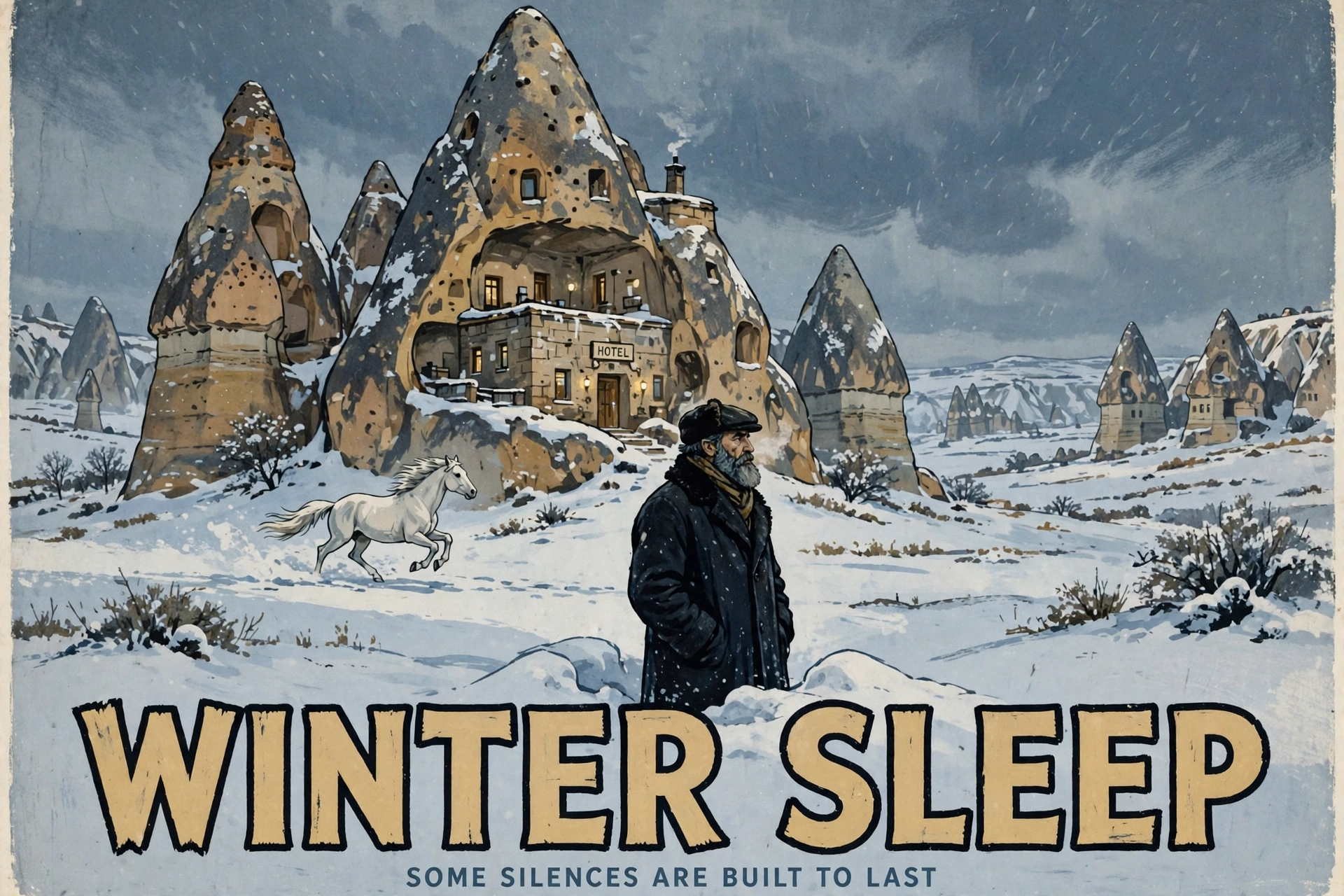
Aydın is a former actor who now runs a small hotel carved into the rock formations of Cappadocia, in central Anatolia. He owns property across the village, writes a column for a local newspaper, and is supposedly researching a grand history of Turkish theatre. Living with him in the hotel are his much younger wife Nihal, who throws herself into charity fundraising for village schools, and his recently divorced sister Necla, who spends her days on a sofa delivering elegant, poisonous judgements on everyone, starting with her brother.
As winter closes in and the tourists thin out, an ugly incident drags Aydın’s comfortable world into contact with the village below: his car window is smashed by a stone thrown by Ilyas, the young son of one of his tenants, a family that has fallen behind on rent and recently had bailiffs seize their belongings. Aydın prefers to let his loyal manager Hidayet handle such unpleasantness, but the tenant family’s humiliation, pride and anger keep returning to his door — literally, in the form of the boy’s uncle, a local imam who comes to apologise, and more dangerously in the form of the boy’s father Ismail, a proud, drinking man who does not forgive easily.
Very little of what follows is plot in the usual sense. Instead, the film unfolds as a series of extended verbal duels — Aydın against Necla, Aydın against Nihal, Nihal against the consequences of her own good intentions — in which years of resentment, class guilt, artistic failure and marital coldness are slowly brought into the open. The story draws loosely on Anton Chekhov’s short fiction, particularly “The Wife”, and on a strand of Dostoevsky’s The Brothers Karamazov, and it shares their central question: what does a man owe the people his comfort depends on? We will not reveal how the film answers it, except to say the final movement is earned, quiet and surprisingly moving.
Haluk Bilginer as Aydın gives one of the great performances of modern Turkish cinema, and he does it almost entirely with language and stillness. Aydın is pompous, evasive, cruel in the polite way of educated men, and yet Bilginer never lets you simply hate him. He plays Aydın’s intelligence as genuine and his blindness as genuine too — a man who can quote philosophy fluently but cannot hear a single sentence spoken to him in anger without converting it into a debating point. The longer the film runs, the more you see the fear underneath the performance of wisdom, and Bilginer lets that fear leak out in glances, pauses and small, ugly smiles.
Melisa Sözen as Nihal has the hardest task in the film, because her great confrontation with Aydın arrives late and must carry the emotional weight of everything before it. She succeeds completely. Her Nihal is not a simple victim: she is proud, sometimes naive in her charity work, and fully capable of wounding back. When she finally says, at length, what her marriage actually feels like from inside, Sözen makes the scene feel less like a scripted argument and more like a dam breaking. Demet Akbağ as Necla is superb in a different register — dry, funny, corrosive. Necla’s long early duel with Aydın, in which she dissects his newspaper column and his self-image piece by piece, is the film’s first great set piece, and Akbağ plays it like a woman who has rehearsed every line for years, because she has.
The supporting cast grounds the film’s class divide. Nejat İşler as Ismail, the disgraced tenant, brings a coiled, self-destructive pride that makes his few scenes genuinely frightening, while Serhat Kılıç as Hamdi, the imam brother who abases himself to keep the peace, embodies the humiliation the whole system runs on. Ayberk Pekcan as Hidayet, Aydın’s driver and fixer, says little and reveals much: his loyalty is the mechanism that keeps Aydın insulated from the world he owns.
Ceylan directs Winter Sleep like a man who believes conversation is action, and he shoots it like the photographer he also is. Working with cinematographer Gökhan Tiryaki, he frames Cappadocia’s cave dwellings, rock spires and approaching snow in compositions of painterly patience — wide shots in which human beings are small inside a landscape that does not care about them, intercut with warm, lamplit interiors where faces become the landscape instead. The contrast is the film’s visual argument: outside, indifference and cold; inside, people generating their own weather.
The editing, by Ceylan himself with Bora Göksingöl, is deliberately unhurried. Scenes are allowed to run far past the point where a conventional film would cut, and that duration is the point — you watch defences being built in real time and then, slowly, failing. Ceylan’s method will strike some viewers as indulgence, and it is fair to say the film could lose twenty minutes without losing meaning. But the long takes also produce effects no shorter cut could: the imam’s humiliating visit, the drunken late-night conversations, and Nihal’s climactic errand of conscience all depend on the discomfort of not being released from the room.
If there is a craft criticism to make, it is that the film’s literary architecture occasionally shows. A few exchanges feel written for the page — characters articulate their own psychology with a precision real people rarely manage — and Necla’s thread recedes in the second half more abruptly than it should. These are real flaws. They are also the flaws of a film aiming very high.
There is almost no conventional score in Winter Sleep, and what music exists is borrowed from the classical repertoire: passages from Franz Schubert’s Piano Sonata in A major, D.959 — specifically its melancholic Andantino movement, in a recording associated with Alfred Brendel — recur at intervals through the film. Ceylan uses the piece the way winter light is used in the photography: sparingly, and to change the temperature of a scene. The sonata’s quiet, circling sadness suits a story about people going round the same arguments for years.
Elsewhere, the film’s sound world is naturalistic — wind, fire, footsteps in snow, the clink of tea glasses — and that restraint matters. In the long dialogue scenes there is no score telling you who is winning, because nobody is. The silence is part of the judgement the film passes on its characters, and on us.
What we loved:
What could be better:
Winter Sleep was never built to be a blockbuster, and its numbers should be read in that light. Reported worldwide box-office totals sit at around $3.7 million — small in absolute terms, respectable for a three-and-a-quarter-hour Turkish-language art film with long subtitled conversations. Its real commercial story is prestige: it premiered in competition at Cannes on 16 May 2014, won both the Palme d’Or and the FIPRESCI Prize, became Turkey’s submission for the Best Foreign Language Film Oscar (it was not ultimately nominated), and travelled to festivals and arthouse cinemas worldwide on the strength of those honours. For Ceylan, whose previous film Once Upon a Time in Anatolia had also won major Cannes recognition, it confirmed a position few living directors hold: a filmmaker whose name alone opens films internationally. Box-office reporting for Turkish art cinema of this period is partial, so treat the $3.7 million figure as the commonly reported estimate rather than an audited total.
Yes — but choose your moment honestly. This is not a tired-evening film, and it is not background viewing. Watch Winter Sleep when you can give a long, wintry, talk-driven drama your full attention, ideally in one sitting, and it will reward you with performances and arguments that stay in your head for days. If the premise of two people dissecting a marriage for half an hour sounds like a punishment rather than a pleasure, believe your instincts and pick a different Ceylan film to start with. For patient viewers, this is one of the essential films of its decade: intelligent, beautifully made, and brave enough to make its hero almost impossible to like before it makes him impossible to forget.
Our rating: 8.5/10 — a masterful, demanding drama whose length and verbosity are both its signature and its price of admission.
How long is Winter Sleep, really? The film runs 196 minutes — three hours and sixteen minutes. It was the longest film in competition at Cannes in 2014 and is among the longest Palme d’Or winners ever.
Did Winter Sleep win the Palme d’Or? Yes. It won the Palme d’Or and the FIPRESCI Prize at the 2014 Cannes Film Festival, and it was Turkey’s official submission for the Best Foreign Language Film Academy Award, though it was not nominated.
Is Winter Sleep based on a book? It is loosely inspired by Anton Chekhov’s short story “The Wife” and by a subplot of Fyodor Dostoevsky’s The Brothers Karamazov, reshaped into an original screenplay by Nuri Bilge Ceylan and Ebru Ceylan.
Is Winter Sleep a slow film? By any honest measure, yes. It is built from extended conversations and long takes, with very little conventional action. Its slowness is deliberate, but viewers should go in expecting a dialogue-driven chamber drama, not a thriller.
Where can I watch Winter Sleep? It is available on arthouse streaming services and on disc in many regions, with English subtitles. Availability varies by country, so check your local platforms.