★ LATEST REVIEWS

★★★★☆ Our Rating: 8.5/10
Most science-fiction blockbusters ask you to take the future seriously. This The Fifth Element review is about the rare one that asks you to have fun with it instead — and then, almost sneakily, lands a sincere message about love saving the world underneath the flying taxis, opera-singing aliens and the most flamboyant costume design of the 1990s. Luc Besson’s 1997 French, English-language spectacle was, at the time, the most expensive European film ever made. Nearly three decades on, its reputation has only grown: divisive on release, it is now widely loved as a one-of-a-kind object that no studio system would produce in quite this form today.
Part of its charm is that it should not work. The plot is a deliberate patchwork of older adventure stories, the tone swings from slapstick to apocalypse within single scenes, and one major character exists largely to shout at maximum volume for twenty minutes. Yet the whole thing is held together by Besson’s absolute conviction, by design work of genuine genius, and by a central relationship that gives the noise a heartbeat. It is not a flawless film, and this review will name its flaws plainly. It is, however, an unforgettable one.
| Detail | Information |
|---|---|
| Release date | 7 May 1997 |
| Director | Luc Besson |
| Writers | Luc Besson, Robert Mark Kamen |
| Genre | Science Fiction, Action, Adventure |
| Language | English |
| Runtime | 126 minutes |
| Budget | $90 million |
| Lead cast | Bruce Willis, Milla Jovovich, Gary Oldman, Ian Holm, Chris Tucker |
| Our rating | 8.5/10 |
The film opens in Egypt in 1914, where a priestly order guards an ancient secret: every five thousand years, a great evil returns, and only a weapon built from four stones representing the classical elements, united with a fifth, supreme element, can stop it. The alien Mondoshawan, custodians of that weapon, promise to return when they are needed.
Cut to the 23rd century. New York is a vertical frenzy of flying traffic, and Korben Dallas (Bruce Willis) is a former special-forces major now driving one of those flying taxis and losing points off his licence in bulk. The great evil is approaching Earth as a living planet of darkness, and the Mondoshawan ship carrying the supreme being back to Earth is attacked by Mangalores, mercenary shapeshifters working for industrialist Jean-Baptiste Emanuel Zorg (Gary Oldman), who is himself serving the evil for profit.
From the wreckage, scientists reconstruct the supreme being: Leeloo (Milla Jovovich), who escapes the laboratory and quite literally falls into Korben’s cab. She is searching for Father Vito Cornelius (Ian Holm), the current guardian of the ancient knowledge. Korben, reluctantly at first, is pulled into a race that stretches from New York to a luxury space cruiser and an opera performance unlike any other, with the four stones, Zorg, the Mangalores and the fate of all life converging on the same deadline. We will stop there — the film’s routes to its finale, including one of the most famous intercut sequences in 1990s cinema, deserve to be discovered rather than summarised.
Bruce Willis as Korben Dallas is the film’s anchor, and his understatement is essential. Willis plays Korben as a man permanently unimpressed: the universe can be ending, and his first reaction is still that of a tired New Yorker whose day has been ruined. Coming straight after his run of 1990s action roles, Willis strips away the wisecracking and keeps only the dry core, which makes him the perfect straight man for the madness around him — and makes his gradual, genuine tenderness toward Leeloo land harder than any speech could.
Milla Jovovich as Leeloo carries the hardest assignment in the film. For long stretches she performs in a constructed “divine language” of Besson’s invention, communicating through expression, physicality and fragments of other languages, and she makes Leeloo feel simultaneously ancient, newborn and furiously capable. Her action work is convincing, her fish-out-of-water comedy is precise, and her despairing late-film question — what is the point of saving a species so devoted to destruction — gives the finale its moral weight. It is the performance that turned Jovovich into a star, and it holds up completely.
Gary Oldman as Jean-Baptiste Emanuel Zorg reunites with Besson after Léon and goes even broader: Southern drawl, asymmetrical hair, a plastic dome on half his skull, and a philosophy of cheerful nihilism delivered like a sales pitch. Zorg is a cartoon of corporate evil, and Oldman plays him as one, gleefully. Whether that registers as brilliant or exhausting depends on the viewer, but his set-piece demonstrations of his company’s weapons remain darkly hilarious.
Chris Tucker as Ruby Rhod is the film’s great divider. A hyperactive radio host in costumes that defy description, Tucker improvises at a pitch and speed that either electrifies the film’s second half or overwhelms it. Honest assessment: both reactions are understandable, sometimes within the same scene. Ian Holm as Cornelius brings warmth and flustered dignity as the priest who has waited his whole life for this moment, and Luke Perry, in an extended early cameo, helps ground the 1914 prologue.
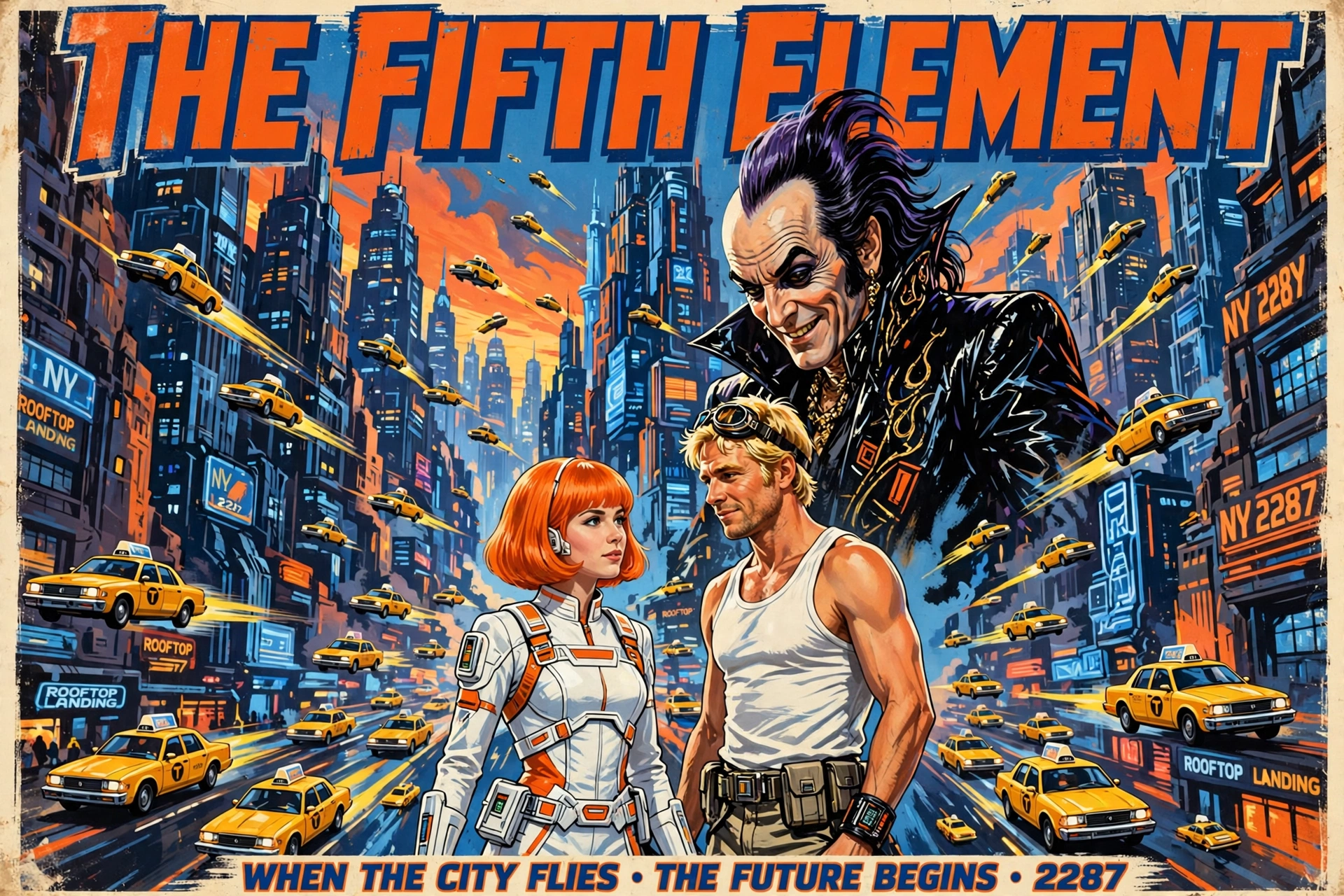
This is where The Fifth Element earns its immortality. Besson built the film’s world from the imaginations of French comics artists Jean Giraud — Moebius — and Jean-Claude Mézières, whose work on Valérian and Laureline had shaped Besson as a teenager. Their designs give the future a lived-in, European density that American sci-fi of the era rarely attempted: apartments the size of cupboards, noodle stalls flown to your window, traffic in stacked vertical lanes. Thierry Arbogast’s cinematography floods it all with colour — oranges, blues and golds pushed to pop-art intensity.
Jean-Paul Gaultier designed the costumes, reportedly over a thousand of them, and they remain the film’s signature: Leeloo’s thermal bandages and orange braces, Korben’s orange vest, Ruby Rhod’s leopard and rose ensembles, the Diva’s impossible gown. Every background extra looks designed. Nothing is generic, which is precisely why the film still looks like nothing else.
The effects, supervised through a mix of models, practical work and then-cutting-edge digital effects, have aged unevenly in resolution but superbly in design; the flying traffic sequences still thrill because the choreography is clear. Sylvie Landra’s editing peaks in the famous sequence that cross-cuts an operatic aria, a fight scene and a bomb countdown into one accelerating piece of pure cinema. If the craft falters anywhere, it is in pacing: the mid-section sags slightly between set pieces, and a few comedy beats are stretched past their natural life because Besson clearly adored them.
Éric Serra’s score is one of his finest, fusing orchestral writing with electronic textures, raï influences and playful in-world pop. The film moves through musical worlds the way it moves through visual ones, and Serra keeps them coherent — no small achievement in a film that contains both a reggae-tinged traffic jam and a full operatic performance.
That opera sequence deserves its own paragraph. The Diva Plavalaguna, played by Maïwenn and voiced by soprano Inva Mula, performs an aria that begins with Donizetti’s Lucia di Lammermoor and then mutates into a superhuman vocal display — Serra composed notes beyond normal human range and assembled the performance digitally, so that what you hear is deliberately impossible for an unaided human voice. Intercut with Leeloo’s fight, it became the film’s defining sequence and one of the most imitated ideas of its era. The score overall is not background decoration; it is half the film’s personality.
What we loved:
What could be better:
The numbers tell a remarkable story for a French production. The Fifth Element cost a reported $90 million — some industry estimates put the figure slightly higher, around $93 million — making it the most expensive European film ever produced at that time, a genuine gamble for Gaumont. It premiered as the opening film at Cannes on 7 May 1997 and went on to earn $263.9 million worldwide, of which about $63.8 million came from North America and the great majority from international markets, where it was a phenomenon.
That split mattered. The film proved a European studio could mount a spectacle on Hollywood’s scale, in English, and beat Hollywood in most of the world’s markets. Its afterlife has been just as strong: repeated television broadcasts, special-edition discs and anniversary reissues have kept it in circulation for nearly thirty years, and its imagery — the orange hair, the Multipass, the flying taxi — remains instantly recognisable far beyond film-buff circles. Few $90 million gambles in cinema history have aged this well.
Absolutely — especially if your diet of modern blockbusters has left you hungry for something handmade and strange. The Fifth Element is camp and sincere, derivative and utterly original, all at once, and its best sequences have never been matched for sheer joyful invention. New viewers should surrender to its tone rather than fight it: judged as hard science fiction it wobbles, but judged as a pop-art space opera with a heart, it is close to the peak of its kind.
Our rating: 8.5/10 — a visually unmatched, big-hearted sci-fi romp whose flaws are part of its flavour.
Is The Fifth Element a French film?
Yes. It was produced by the French studio Gaumont, directed by Luc Besson, and filmed in English with an international cast, largely at Pinewood Studios in England. It was the most expensive European production of its time.
Do I need to watch anything before The Fifth Element?
No. It is a completely standalone story with no prequels or sequels. It shares a director and several collaborators with Léon: The Professional, but the two films are unrelated in story.
What language does Leeloo speak?
Leeloo speaks the “divine language,” an invented language created by Besson with a vocabulary of only a few hundred words, which Milla Jovovich learned for the role. She famously held conversations in it with Besson on set.
Is The Fifth Element suitable for family viewing?
It is rated PG-13 in the United States for intense sci-fi violence, brief nudity and some sexuality. It suits teens and above; younger children will enjoy the visuals but some scenes are intense.
Where can I watch The Fifth Element?
It is available on streaming, digital rental and in restored 4K disc editions in most regions. Availability changes between services, so check your local platforms.