★ LATEST REVIEWS

★★★★☆ Our Rating: 8.5/10
Few films have travelled as strange a road as this one. A British production shot on the streets and in the slums of Mumbai, directed by Danny Boyle, performed largely by unknown or first-time actors, and at one point in danger of being sent straight to DVD by its own American studio — Slumdog Millionaire ended its journey holding eight Academy Awards, including Best Picture, and with more than $378 million earned around the world. This Slumdog Millionaire review looks back at the film away from that awards-season whirlwind: as a piece of storytelling, as a portrait of Mumbai, and as the controversy it has never quite shaken off.
A quick note on identity, because it confuses people: the film is filed here, correctly, under British Cinema. It is a United Kingdom production, from Celador Films and Film4, directed and written by British filmmakers and adapted from the novel Q & A by Indian diplomat and author Vikas Swarup — but its setting, much of its cast and crew, its Hindi dialogue and its co-director, Loveleen Tandan, are Indian, and American distributors were involved in bringing it to the world. It is a cross-border film in the fullest sense, and honestly, that hybrid energy is exactly what you see on screen.
| Detail | Information |
| Release date | 30 August 2008 (Telluride premiere); 9 January 2009 (United Kingdom) |
| Director | Danny Boyle (co-director, India: Loveleen Tandan) |
| Writers | Simon Beaufoy, based on Q & A by Vikas Swarup |
| Genre | Drama, Romance |
| Language | English, Hindi |
| Runtime | 120 minutes |
| Budget | $15 million |
| Lead cast | Dev Patel, Freida Pinto, Madhur Mittal, Anil Kapoor, Irrfan Khan |
| Our rating | 8.5/10 |
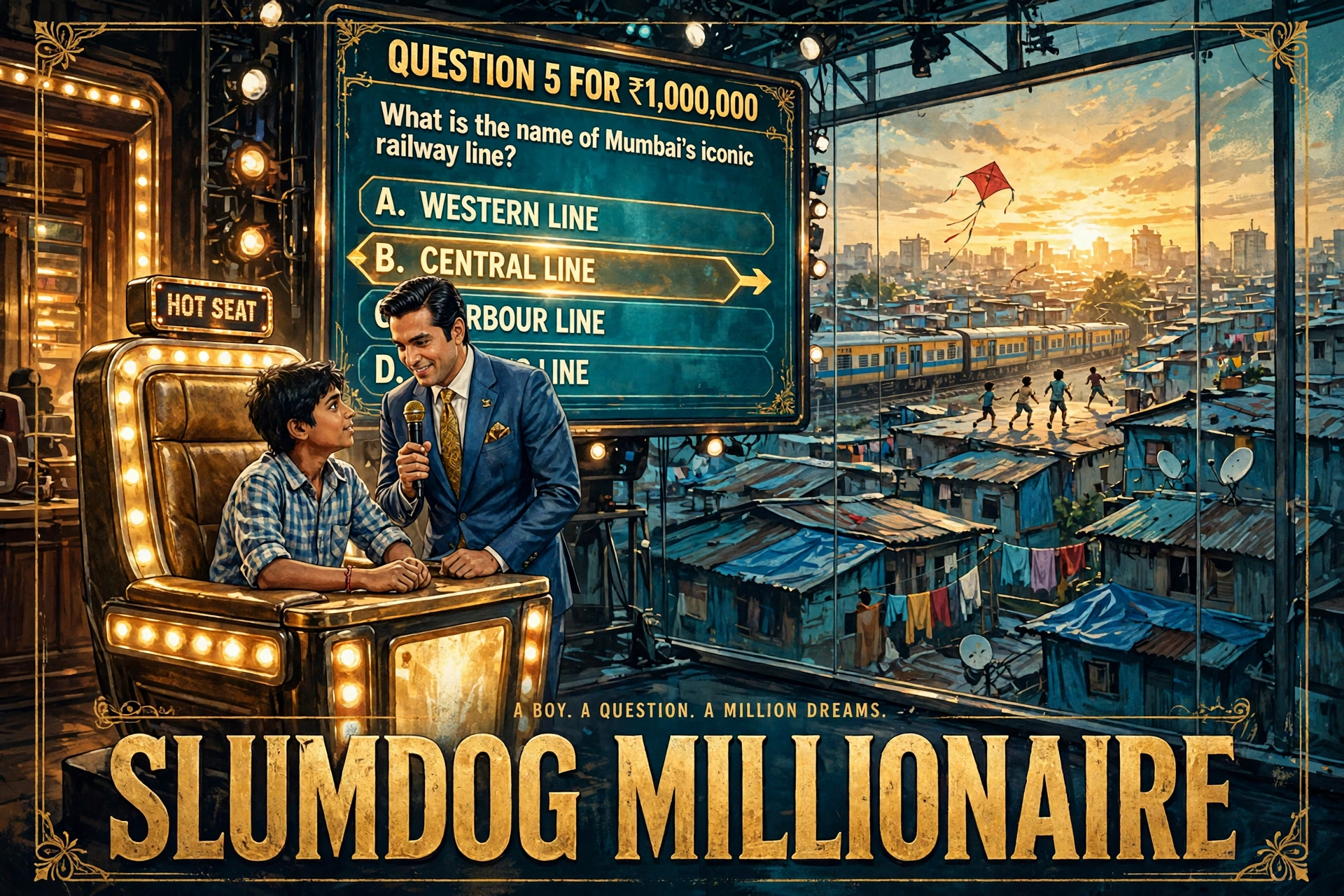
The film opens with a question of its own: Jamal Malik is one question away from winning 20 million rupees on the television quiz show Kaun Banega Crorepati, the Indian version of Who Wants to Be a Millionaire? How did a boy from the slums get there — by cheating, by luck, by genius, or because it is written?
Jamal (Dev Patel) is eighteen, works as a chai-wallah — a tea server — at a call centre, and has no formal education to speak of. When he answers question after question correctly, the show’s host, Prem Kumar (Anil Kapoor), grows first amused, then suspicious, then quietly hostile. During a break in filming, Jamal is arrested and interrogated by police who cannot believe that a “slumdog”, as they contemptuously call him, could know these things honestly. The bulk of the film is Jamal’s answer to that accusation: for every question, there is a memory. A childhood in the Juhu slums with his brother Salim and a girl named Latika. Communal violence that tears their world apart. Life as orphans on trains, in tourist towns and in the hands of people who exploit street children. Each episode of survival has, by accident or by wound, taught him exactly what the quiz asks.
Around those flashbacks, the other threads keep tightening. Salim (Madhur Mittal), the tougher brother, has taken a very different road out of the slums, one that runs through Mumbai’s criminal underworld, and the brothers’ bond has been tested nearly to breaking. Latika (Freida Pinto), the girl from the railway platform of Jamal’s childhood, has become the one thing he refuses to lose, and reaching her is the real prize underneath the money. And in the interrogation room, a police inspector (Irrfan Khan) who begins as Jamal’s tormentor is slowly becoming something else: his first true listener. Whether Jamal is believed, what the final question brings, and what all of it costs him — the film saves those answers for its last movement, and so will we.
Dev Patel as Jamal was a teenager with one British television credit when Boyle cast him, and the film rests on his openness. Patel plays Jamal neither as a genius nor as a saint — he is stubborn, lovesick and observant, a boy whose intelligence is made of attention rather than schooling. His stillness in the interrogation scenes, insisting on the simple truth of his story, gives the flashy structure an emotional anchor. Freida Pinto as Latika, in her first film role, has less dialogue than the plot’s importance would suggest — a fair criticism of the film — but she brings a guarded melancholy that sells Latika’s years of being passed from one form of captivity to another.
Madhur Mittal as Salim arguably has the hardest part and plays it brilliantly: the brother who chose power and money, who has done terrible things and done them partly for Jamal, and whose charm curdles as the film proceeds. Anil Kapoor as Prem Kumar is a delight and a menace in the same smile — a host who clawed his own way up from the streets and cannot stand the sight of a boy doing it faster, played by one of Bollywood’s biggest stars with total willingness to be disliked. And Irrfan Khan as the Police Inspector delivers the film’s most economical performance: suspicion, exhaustion and a dawning, unwilling respect, all in posture and pause. The child actors deserve their own sentence — Ayush Mahesh Khedekar as the youngest Jamal, Azharuddin Mohammad Ismail as the youngest Salim and Rubina Ali as the youngest Latika are natural, funny and heartbreaking, and the film’s first hour belongs to them as much as to anyone.
Danny Boyle directs Mumbai the way he once directed Edinburgh in Trainspotting — at a run. The camera plunges through alleyways, across rooftops and down the sides of the city’s enormous contrasts, and the editing, by Chris Dickens, matches the quiz show’s ticking pressure to the flashbacks’ forward tumble so the film feels like one long, accelerating breath. Anthony Dod Mantle’s cinematography, shot partly on small digital cameras that could move through real locations without a full studio circus, mixes the saturated colour and dust of the slums with the cold blue glass of the television studio — two Mumbais that barely speak to each other, which is the film’s whole subject.
The craft is not beyond criticism. Boyle’s energy sometimes aestheticises what it depicts: poverty photographed this vividly, cut this rhythmically, can start to look like an adventure playground, and that discomfort sits at the heart of the debate the film provoked in India, where some critics praised its craft and global success while others called its portrait of the slums a Western fantasy of Indian misery. Both readings engage with something real in the film. What is not in doubt is the control: the chase through the slum in the opening minutes, the train-top passages of the boys’ picaresque childhood, and the cross-cutting of the final show are bravura sequences that lesser directors would have made chaotic. Boyle also deserves credit for what he shares — Loveleen Tandan began as casting director, cast the children, directed Hindi portions on set and is credited as co-director (India), an acknowledgement that this film’s authenticity was a collaboration, not a visit.
A. R. Rahman’s score and songs are the film’s heartbeat, and they changed what the world thought an Indian film sound could be. Rahman fuses electronic beats, hip-hop textures, classical Indian instrumentation and full-throated melody into a sound that is simultaneously Mumbai street, Mumbai train and television-studio neon. “O… Saya”, created with M.I.A., powers the boys’ journey with pure propulsion; the score’s quieter passages, built on piano and strings, carry the romance. And “Jai Ho”, set to Gulzar’s lyrics, became a global phenomenon in its own right — the film’s closing celebration is inconceivable without it. Rahman won two Academy Awards for this film, for Best Original Score and Best Original Song for “Jai Ho”, becoming a household name far beyond India almost overnight. If the direction is the film’s engine, the music is its memory: years later, a few bars are enough to summon the whole story.
What we loved:
What could be better:
The commercial facts are well documented. Made for a reported $15 million, Slumdog Millionaire premiered at the Telluride Film Festival on 30 August 2008, won the People’s Choice Award at Toronto, and was then released in stages — limited release in the United States in November 2008, nationwide release in the United Kingdom on 9 January 2009, and India on 23 January 2009 — after a period when Warner Bros., which held rights through one of the distribution arrangements, had considered skipping American theatres altogether before Fox Searchlight took the film to cinemas. It went on to gross approximately $378 million worldwide (most tallies put it at around $378–383 million, depending on reissue counting) — roughly twenty-five times its budget — and became its distributor’s biggest film to that date.
The awards haul matched the money. From ten Academy Award nominations the film won eight, including Best Picture, Best Director for Boyle, Best Adapted Screenplay for Simon Beaufoy, Best Cinematography, Best Film Editing, Best Sound Mixing and Rahman’s two music prizes. It won seven BAFTA Awards and all four Golden Globes for which it was nominated. In the years since, debate about its portrait of India has matured rather than faded — but as an underdog production story, a British-Indian collaboration that conquered the world from a $15 million budget, its box office chapter needs no exaggeration.
If you have never seen it, yes: it remains one of the most propulsive, emotionally generous dramas of its decade, and its structure alone is worth studying. If you saw it during the Oscar storm, it rewards a calmer second viewing — the brothers’ story deepens, and the criticisms about coincidence and representation are easier to weigh fairly when the hype is gone. Either way, go in knowing it is a fairy tale wearing the clothes of social realism. Judged as realism, it strains; judged as a fable about a boy whose whole education was survival, it sings.
Our rating: 8.5/10 — exhilarating, heartfelt and beautifully scored; its coincidences and its contested portrait of poverty keep it just short of the very top tier.
Is Slumdog Millionaire a Bollywood film?
No. It is a British production — directed by Danny Boyle, written by Simon Beaufoy and produced by Celador Films and Film4 — filmed in India with Indian and British talent, Hindi and English dialogue, and Loveleen Tandan as co-director (India). It is a cross-border collaboration, not a Bollywood production.
Is Slumdog Millionaire based on a true story?
No. It is loosely adapted from Vikas Swarup’s 2005 novel Q & A. The quiz show in the film, Kaun Banega Crorepati, is the real Indian version of Who Wants to Be a Millionaire?, but Jamal’s story is fictional.
How many Oscars did Slumdog Millionaire win?
It won eight Academy Awards from ten nominations at the 2009 ceremony, including Best Picture, Best Director, Best Adapted Screenplay, and Best Original Score and Best Original Song (“Jai Ho”) for A. R. Rahman.
Why was Slumdog Millionaire controversial in India?
Reception was mixed. Many celebrated its craft and international success, while other critics and commentators objected to its depiction of slum poverty and of India more broadly, arguing it packaged hardship for Western audiences. The debate is part of the film’s legacy and is worth reading about alongside watching it.
Where can I watch Slumdog Millionaire?
It is widely available on streaming and home-video platforms in many regions. Availability changes over time, so check your local services.