★ LATEST REVIEWS

★★★★★ Our Rating: 9.5/10
Ask almost any serious list of the greatest films ever made to show its top ten, and this black-and-white Japanese epic from 1954 will be standing somewhere near the front of the queue. That reputation can intimidate a first-time viewer. Three and a half hours, subtitles, no colour, no stars most modern audiences recognise on sight — it sounds like homework. It is not. This Seven Samurai review exists to say the opposite as plainly as possible: once the story locks in, few modern blockbusters move with this much clarity, humour and heartbreak.
Released on 26 April 1954, Akira Kurosawa’s Seven Samurai was, at the time, the most expensive film ever produced in Japan, the product of a long, difficult shoot that kept growing in ambition. What that money and stubbornness bought was not spectacle for its own sake. It bought a complete world — a poor farming village, seven very different fighting men, and a battle that later action cinema has been learning from, and frankly borrowing from, for seventy years.
| Detail | Information |
| Release date | 26 April 1954 |
| Director | Akira Kurosawa |
| Writers | Akira Kurosawa, Shinobu Hashimoto, Hideo Oguni |
| Genre | Action, Drama, Samurai Epic (Jidaigeki) |
| Language | Japanese |
| Runtime | 207 minutes (with intermission) |
| Budget | Approx. ¥125–210 million (reports differ — see Box Office section) |
| Lead cast | Toshiro Mifune, Takashi Shimura, Keiko Tsushima, Isao Kimura, Daisuke Katō, Seiji Miyaguchi, Yoshio Inaba, Minoru Chiaki |
| Our rating | 9.5/10 |
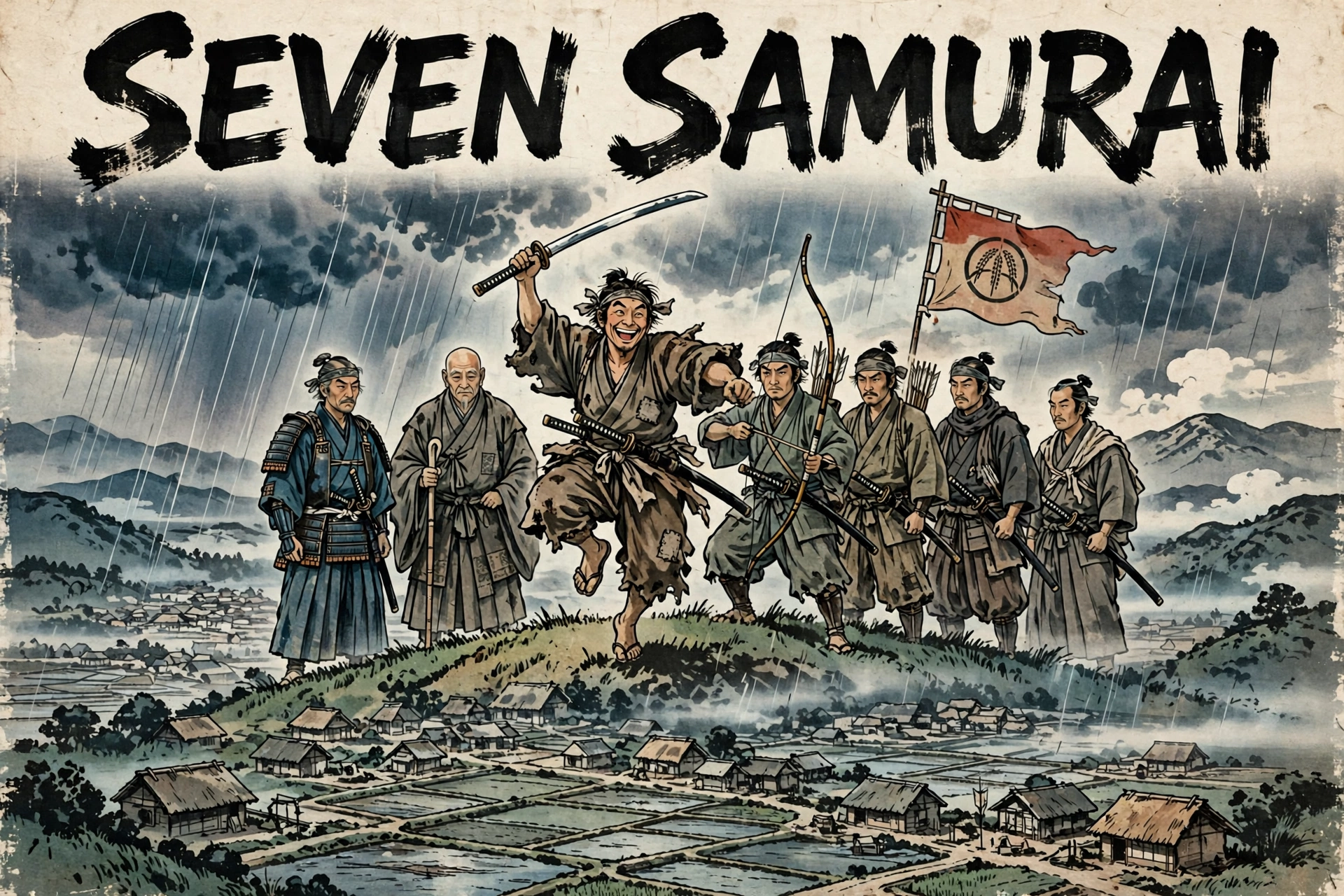
The film is set in 1586, during Japan’s Sengoku period, an age of civil war when armed men took what they wanted from people who grew food for a living. A bandit gang rides past a mountain farming village and decides, almost casually, to spare it for now — they already raided it once, so they will simply return after the harvest and take the new crop. A farmer overhears the plan, and the village is thrown into despair. Do they surrender their rice and starve, or resist men with horses, swords and guns when they themselves have neither?
The village elder, Gisaku, gives them an answer that sounds like a riddle: hire samurai. The farmers object that samurai are expensive and proud, and that they have nothing to pay with. Gisaku’s reply becomes the film’s moral starting point — find hungry samurai, men who will fight for three meals of rice a day because honour, for some, still matters more than comfort.
Finding such men is not easy, and the film wisely takes its time over it. In a nearby town the farmers witness an older warrior, Kambei Shimada, rescue a child from a thief with calm, selfless skill, shaving his head like a monk to get close enough to strike. Kambei agrees to help, not for glory but because the cause is just, and he begins assembling a team. He is joined by a loyal former lieutenant, a cheerful woodcutter-turned-warrior, a master swordsman of almost silent precision, a kind-hearted veteran who keeps the group’s spirits alive, and a young apprentice desperate to prove himself. The seventh man arrives by a very different route: a wild, loud, unpredictable figure who calls himself Kikuchiyo, follows the group uninvited, and forces his way into its ranks.
Once the seven reach the village, the real work begins, and it is mostly unglamorous work. Barriers must be built, fields flooded, spears made from bamboo, and frightened farmers — who distrust samurai almost as much as they fear bandits — must be trained to stand in a line and hold it. Old wounds between classes surface. Secrets the village has been hiding come out. A young farmer’s daughter and a young samurai are drawn towards each other in a society that forbids it. All of this is preparation for an attack the audience knows is coming. Exactly how that defence unfolds, who it costs, and what victory even means in a place like this — that is the film’s to reveal, and we will not take it from you here.
Takashi Shimura as Kambei Shimada is the film’s still centre. Shimura plays leadership without vanity: Kambei is tired, experienced and quietly aware of how many battles like this one he has already lost in his life. His authority comes from listening, from shaving away pride — literally, in his first great scene — and from treating farmers as people worth dying for. It is one of the most humane performances in all of cinema, and it sets the temperature for everyone around him.
Toshiro Mifune as Kikuchiyo is the opposite temperature, and the film needs both. Mifune erupts into scenes — swinging an oversized sword, mocking the samurai’s pretensions, clowning for the farmers, then suddenly exposing a wound so raw that the laughter stops in your throat. Kikuchiyo is not what he first claims to be, and as his real origins emerge, Mifune turns the character into the film’s beating argument: that worth is not decided by birth. His famous speech against the samurai class, delivered by a man desperate to belong to it, is devastating precisely because he implicates everyone, including himself.
The other five samurai could easily blur together in a lesser film; here each is etched in a few strokes. Seiji Miyaguchi as Kyuzo, the master swordsman, barely speaks and needs to — his stillness in a duel tells you everything about discipline. Minoru Chiaki as Heihachi supplies warmth and humour, the recruiter whose smile holds the group together. Daisuke Katō as Shichiroji, Kambei’s old comrade, embodies loyalty without a single showy moment. Yoshio Inaba as Gorobei is the tactician with a grin, and Isao Kimura as Katsushiro, the youngest, carries the audience’s own awe and inexperience into the village, where his romance with Keiko Tsushima as Shino tests the class line the whole film is quietly examining. Among the villagers, Kamatari Fujiwara as Manzo, Shino’s fearful father, and Bokuzen Hidari as Yohei, the timid farmer assigned to Kikuchiyo, give the “ordinary people” the same specificity as the warriors — which is the point of the film.
Kurosawa’s direction here became a textbook that filmmakers still study. He shot action with multiple cameras and long telephoto lenses, a method that was far from standard at the time, so that battles feel caught rather than choreographed — fighters collide, mud flies, horses wheel, and the cutting finds a fierce logic inside the chaos instead of tidying it away. Watch how he uses movement inside the frame: groups surge diagonally, rain drives sideways, banners and spears slice the composition into triangles. Then watch the quiet scenes, where the camera simply observes a room and lets shame, grief or affection do the work.
Asakazu Nakai’s black-and-white cinematography gives the village a material truth — wood, straw, earth, water — and turns the final stretch’s torrential rain into an adversary in its own right. Weather is never decoration in this film; wind bullies the bandits’ banner before a single blow is struck, and mud eventually decides how fast anyone, samurai or bandit, can move. Kurosawa also edited the film himself, and the structure he built is worth naming: a long, patient first half of recruitment and preparation, an intermission, and then a siege that unfolds in waves, with maps and tallies that keep the geography legible even as the situation deteriorates. Modern viewers raised on faster cutting should give the film its first half hour. The pace is deliberate, even stately at times — but every village argument and training scene is loading the final act with meaning, so that late losses land as losses of people, not of extras.
Fumio Hayasaka, Kurosawa’s close collaborator, composed a score that works in two distinct registers. For the samurai there is a proud, marching theme — bold brass and drums that announce men of purpose arriving in a place that has none. For the village and its fears, Hayasaka writes gentler, folk-inflected material that belongs to fields and households rather than battlefields. The tension between those two musical worlds is the film’s class divide rendered in sound. Just as importantly, Hayasaka and Kurosawa know when to withdraw music altogether and let rain, hooves, breathing and shouted orders carry a scene. The score never tells you a death is sad before the film has earned it; it arrives after the fact, like grief does.
What we loved:
What could be better:
Figures from 1954 Japan need a plain warning before any number is quoted. Japan’s industry then reported business largely in terms of distributor rentals — the share of ticket money returned to the distributor — rather than the worldwide gross totals modern readers expect, and sources do not agree on a single budget. Some references, including the British Film Institute, put the production cost at around ¥125 million; other accounts run as high as roughly ¥210 million, with the film’s long, expensive shoot and its need for Toho to keep funding it as the context. Either way, it was by far the most expensive Japanese film made to that date.
On the rentals measure, the film performed strongly: Japanese distributor rentals are commonly cited at about ¥268.2 million, making it one of the top domestic earners of 1954 and Toho’s biggest hit of the year. Its prestige travelled further than its money in the short term — a Silver Lion at the Venice Film Festival and two Academy Award nominations — and it built its worldwide reputation through revivals, re-releases and home video over decades rather than a single global opening weekend. We will not invent a combined worldwide total for a film whose economics were never reported that way. What the numbers do prove, combined with its influence, is that an unusually expensive, unusually long Japanese film found its audience at home and then, slowly, everywhere.
Yes — and set aside a proper evening for it. Watch the first half the way the film asks to be watched, as an investment in people you will come to care about, and the battle that follows will feel earned in a way few action films ever manage. It is not a museum piece to be admired from a distance; it is a gripping, funny, heartbreaking adventure that happens to have invented half the genre that followed it.
Our rating: 9.5/10 — a masterpiece with a long fuse; its length demands commitment, and everything after rewards it.
Is Seven Samurai based on a true story?
No. It is an original screenplay by Kurosawa, Shinobu Hashimoto and Hideo Oguni, set in the Sengoku era but not a dramatisation of a real event. Its village, samurai and bandits are fictional, though the social world they inhabit — armed men preying on farming communities — is historically real.
Why is Seven Samurai so influential?
Because it essentially invented the team-assembly action film: disparate specialists recruited for a mission, a training sequence, and a siege in which the plan is explained in advance so the audience can follow it falling apart. Its structure was remade directly as The Magnificent Seven (1960) and has been borrowed by westerns, war films, heist films and superhero films ever since. Its multi-camera, telephoto approach to action was equally influential.
Is it too slow for modern viewers?
The first half is patient by modern standards — recruitment, village arguments and training take real time. Most viewers who stick with it find that patience pays off in the second half, when every relationship and tactical choice suddenly matters. Treat the 207 minutes as a commitment, not a casual watch.
Does the film have an intermission?
Yes. It was designed with one, roughly at the point where the recruitment is complete and the village preparations begin in earnest. Restored cinema screenings and some home editions preserve the break; streaming versions generally play straight through.
Where can I watch Seven Samurai?
Restored versions stream on arthouse and general platforms in many regions, and restored home-video editions are widely available. Availability changes over time, so check your local services.