★ LATEST REVIEWS

★★★★★ Our Rating: 9.5/10
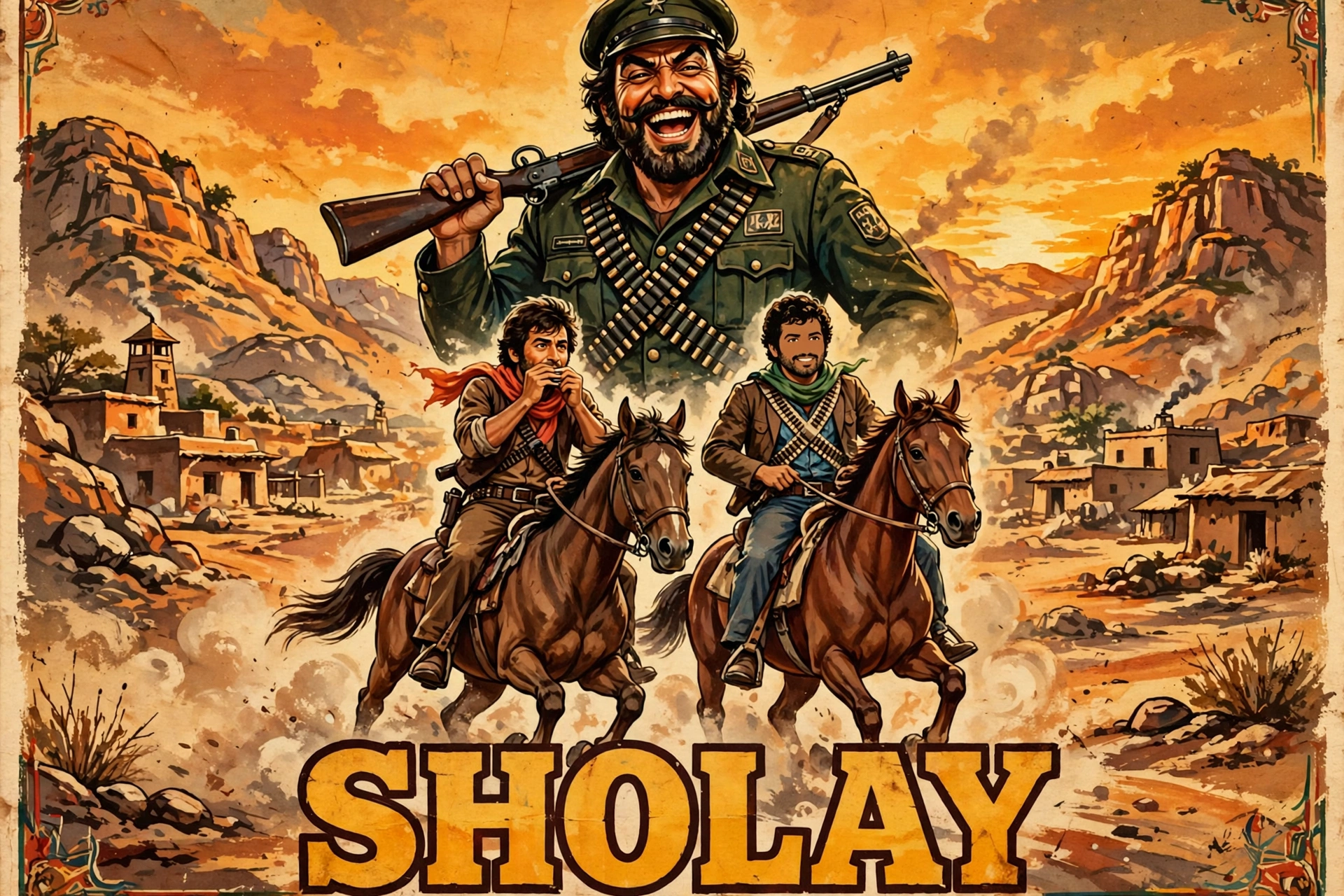
There are hits, there are classics, and then there is Sholay — a film so completely absorbed into Indian life that its dialogue is spoken daily by people who were not born when it released. Ramesh Sippy’s dacoit Western opened on 15 August 1975 to dismissive reviews and trade-paper predictions of failure. It then ran for five continuous years at Mumbai’s Minerva theatre, became the highest-grossing Indian film of its era, and in a 2002 British Film Institute poll was voted the greatest Indian film of all time. In 2005, the Filmfare Awards named it the Best Film of 50 Years.
A Sholay review written today has a strange duty: to look past the legend and ask whether the film itself — not the nostalgia, not the quotations — still works. The honest answer is yes, overwhelmingly, though not without caveats. At over three hours, built from borrowed Western bones and pure Bombay masala instinct, it is long, broad and violent in ways modern viewers should know about. It is also one of the most perfectly engineered popular films ever made. Here is the case.
| Detail | Information |
|---|---|
| Release date | 15 August 1975 |
| Director | Ramesh Sippy |
| Writers | Salim–Javed (Salim Khan and Javed Akhtar) |
| Genre | Action, Adventure, Drama (dacoit Western) |
| Language | Hindi |
| Runtime | 204 minutes (director’s cut); the original theatrical version ran approx. 198 minutes |
| Budget | Approx. ₹3 crore |
| Lead cast | Dharmendra, Amitabh Bachchan, Sanjeev Kumar, Hema Malini, Jaya Bhaduri, Amjad Khan |
| Our rating | 9.5/10 |
The village of Ramgarh lives in fear of Gabbar Singh (Amjad Khan), a dacoit chief whose gang loots, terrorises and murders with theatrical cruelty. Years earlier, police officer Thakur Baldev Singh (Sanjeev Kumar) captured Gabbar — and paid for it with a price this review will not describe, except to say that the Thakur, now retired and broken in a way the village only half understands, can no longer fight the bandit himself.
So he hires men who can. Jai (Amitabh Bachchan) and Veeru (Dharmendra) are small-time crooks — brave, loyal, chronically broke — who once saved the Thakur’s life and earned his strange respect. For a reward, they agree to do what the law no longer can: capture Gabbar Singh, alive. Settling into Ramgarh, the two outsiders find more than a job. Veeru falls for Basanti (Hema Malini), the village’s gloriously talkative tonga driver; Jai is drawn, silently and hopelessly, toward Radha (Jaya Bhaduri), the Thakur’s widowed daughter-in-law, whose grief fills the great house like dusk. As Gabbar’s attacks escalate — a festival ambush, a hostage horror, a bridge, a train, and a duel of coin-tosses with fate — the paid assignment turns into something Jai and Veeru never signed up for: a cause. The film’s ending was famously altered under censor pressure, and both versions circulate today; either way, its final cost is one Indian audiences have never forgotten.
Amjad Khan as Gabbar Singh delivers what may be the single most influential performance in Hindi cinema. A near-newcomer when cast, Khan built Gabbar from a drawling, paan-chewing menace — amused, almost bored, until the instant he is not. His menace lives in the silences: the slow walk, the boots on rock, the laugh that arrives a beat too late. Gabbar appears in surprisingly few scenes, yet he colonises the entire film; every other character’s courage is measured against him. Parents used his name to frighten children for a generation, and no Hindi-film villain since has escaped his shadow.
Amitabh Bachchan as Jai gives the film its still centre. Where Dharmendra blazes, Bachchan smoulders — dry, sardonic, wounded behind the wit. His Jai says little and means all of it, and the performance’s restraint is what makes the character’s famous coin, and the secret it carries, detonate the way it does. Dharmendra as Veeru is pure open-hearted exuberance: the brawler, the romantic, the drunk on the water tank threatening comic catastrophe. The Jai–Veeru friendship remains Hindi cinema’s defining male bond, and it works because both actors play it absolutely straight — two rogues whose loyalty to each other is the film’s real love story.
Sanjeev Kumar as Thakur Baldev Singh performs one of the hardest feats in the film: commanding every scene while playing a man defined by what he cannot do. His stillness is monumental — grief, pride and murderous patience held behind an officer’s discipline. Hema Malini as Basanti turns what could have been comic relief into the film’s sunshine; her motor-mouth courtship scenes with Dharmendra are beloved for good reason. Jaya Bhaduri as Radha has the fewest lines of any lead and some of the film’s most enduring images — a lamp, a window, a silence that says everything her character is forbidden to say. Around them, an unmatched supporting bench: Asrani as the Chaplin-moustached jailer, Jagdeep as Soorma Bhopali, A. K. Hangal as the blind imam whose one line — asking why there is such silence — has entered the language itself.
Ramesh Sippy was not yet thirty when he mounted Sholay, and he shot it like a man determined to give Indian audiences a Western that could stand beside Leone’s. Filmed around the rocky terrain of Ramanagara in Karnataka — hills still known today as the Sholay rocks — the film was shot in widescreen splendour with stereophonic sound, then novelties in Hindi cinema. Dwarka Divecha’s cinematography gives the landscape mythic scale, and the set pieces remain astonishing: the opening train robbery, staged with real locomotives and stunt riders, has a physical conviction modern CGI rarely matches.
M. S. Shinde’s editing — the film’s only Filmfare Award win at the time, a fact that now reads as an industry embarrassment — shapes over three hours of material into a rhythm of raid, respite and rising dread, cross-cutting Gabbar’s camp against the village with a hangman’s patience. The craft caveats are real. The film’s debt to Sergio Leone and to The Magnificent Seven is visible to anyone who knows those films; Sippy synthesised rather than invented his grammar. The comedy tracks occasionally halt the tension rather than seasoning it, and at 198–204 minutes depending on the version, first-time viewers will feel the length in the middle hour. But the construction — every character, song and subplot feeding the central siege — is a screenwriting lesson in itself. Salim–Javed’s script made stars of its writers, a first for Hindi cinema, and you can see why in every scene.
R. D. Burman’s score is woven into the film’s identity as tightly as its dialogue. The songs, with lyrics by Anand Bakshi, cover the film’s whole emotional register: “Yeh Dosti” remains the definitive anthem of screen friendship; “Mehbooba Mehbooba,” with Burman’s own gravelly vocal over Helen’s dance in Gabbar’s camp, is pure atmosphere; “Koi Haseena” and “Haa Jab Tak Hai Jaan” carry the romance and the menace respectively. But it is the background score that does the darkest work — the harmonica motif for Jai, the whistled emptiness around Gabbar’s entrances, and a use of silence before violence that taught a generation of Indian filmmakers how dread sounds. The soundtrack album, and even the film’s dialogue, were sold as records; audiences memorised both.
What we loved:
What could be better:
The numbers from 1970s India are estimates, and honest reporting requires saying so. The film was budgeted at roughly ₹3 crore — some accounts say production began nearer ₹2 crore and overran — making it the most expensive Hindi film of its time. Its Indian gross is commonly estimated at around ₹35 crore over its original run and re-releases, an unprecedented figure; it is also credited with selling over 100 million tickets in India across its lifetime and tens of millions more abroad, including an extraordinary run in the Soviet Union, though exact footfall figures vary by source and should be treated as informed estimates rather than audited fact.
Even the famous “slow start” story deserves a caveat: legend says the film was declared a flop in its first two weeks until word of mouth rescued it, but exhibitors from Mumbai’s Minerva theatre have publicly disputed that account, insisting the film played to packed houses from the start and blaming negative trade publicity. What is not disputed is the outcome: Sholay ran continuously for five years at Minerva, celebrated silver jubilees in over a hundred theatres, and remained India’s highest-grossing film for nearly two decades, until the 1990s blockbusters finally passed it. On ticket sales rather than rupees, many historians still consider it the most-watched Indian film ever made.
Yes — and on the biggest screen you can find, in the longest version available. If you are an Indian viewer who has somehow never seen it, you will discover you already know half of it by cultural osmosis. If you are new to Hindi cinema, there is no better single film to explain what the masala tradition can achieve at its peak: action, romance, comedy, music and tragedy, fused into one story and aimed, unapologetically, at the heart. It is not flawless — it is long, it is derivative in its bones, and this review has said so. But five decades of audiences have delivered their verdict already, and they were not wrong.
Our rating: 9.5/10 — not merely a great Hindi film, but one of the great popular films of world cinema.
Is Sholay based on a Western?
It is an original screenplay by Salim–Javed, but openly inspired by the Western genre — particularly Sergio Leone’s films and the “few defenders against a bandit” structure of The Magnificent Seven — transplanted into an Indian dacoit setting.
Why does Sholay have two different endings?
The original ending, in which the Thakur takes his revenge personally, was rejected by the Indian censor board of the Emergency era. Sippy reshot the climax so that the law intervenes. The restored director’s cut, running about 204 minutes, recovers the original ending.
Did Sholay win awards when it was released?
Barely — famously, its only Filmfare Award on release was for M. S. Shinde’s editing. History corrected the oversight: the BFI’s 2002 poll named it the greatest Indian film ever made, and Filmfare named it the Best Film of 50 Years in 2005.
Who was the first choice to play Gabbar Singh?
Amjad Khan was a relative newcomer and not the production’s initial consideration — the role was reportedly contemplated for other actors before Sippy cast Khan, whose voice and presence redefined screen villainy in India.
Where can I watch Sholay?
The film is widely available on streaming platforms and in restored home-video editions, including the longer director’s cut. Availability varies by region, so check your local services.