★ LATEST REVIEWS

★★★★★ Our Rating: 9/10
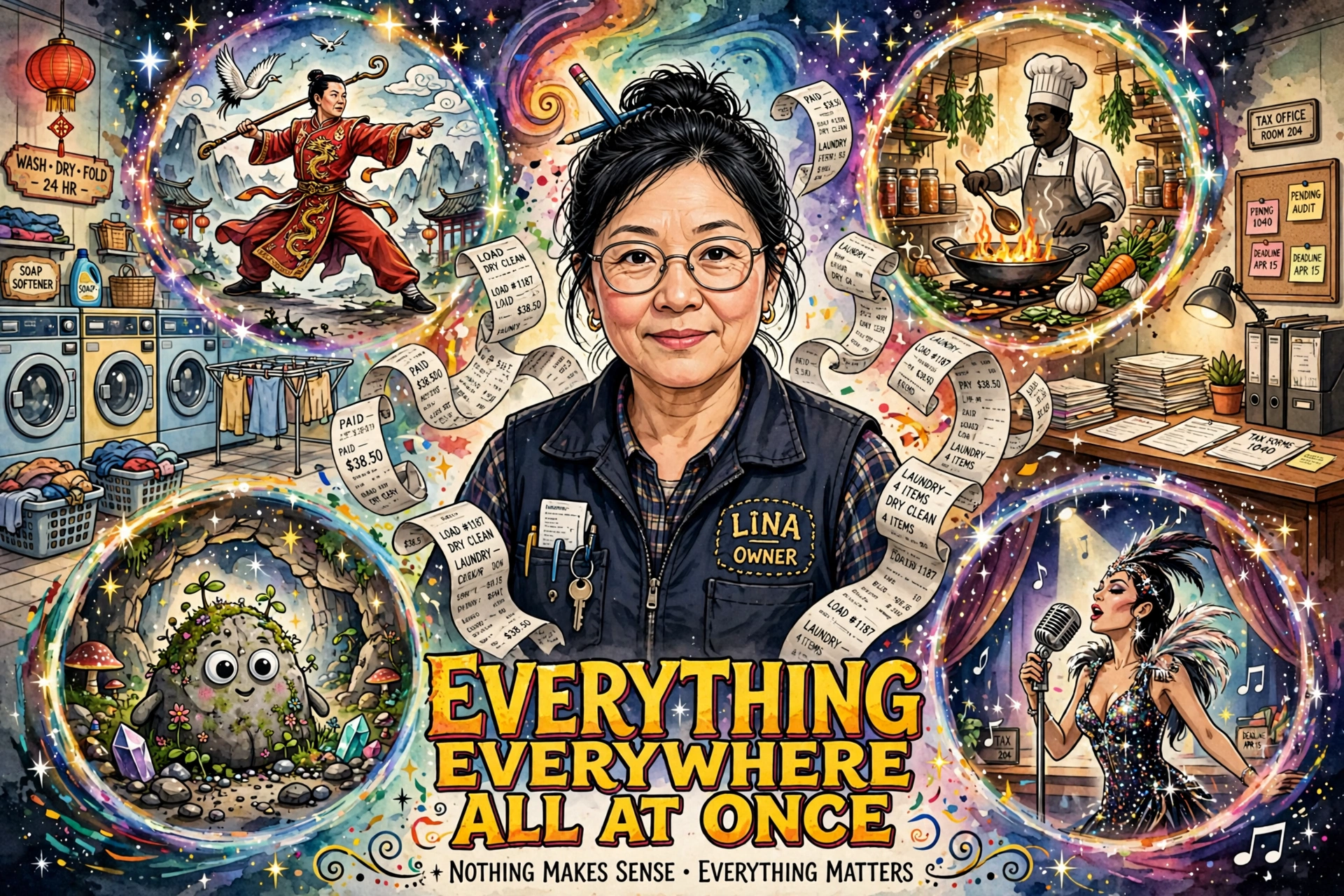
There are films you admire, films you enjoy, and then there are films that leave you sitting in silence as the credits roll because your brain and your heart are both still catching up. Everything Everywhere All at Once belongs firmly in that third category. It is a martial arts film, a science fiction epic, a family drama, an absurdist comedy and a story about doing your taxes, all at the same time, and somehow none of those parts cancel each other out.
Written and directed by Daniel Kwan and Daniel Scheinert, known together as Daniels, the film arrived in 2022 without a huge marketing machine behind it and built its reputation the old-fashioned way: people saw it, could not stop thinking about it, and dragged their friends back to see it again. Awards followed, including a remarkable sweep at the Academy Awards, but trophies are not the reason to watch it. The reason is simpler. Few modern films take this many risks and land this many of them.
At its centre is a tired, overwhelmed mother who feels she has failed at almost everything. Around her, the film builds a universe-hopping adventure involving googly eyes, hot dog fingers, a chef controlled by an animal under his hat, and two rocks having a conversation on a cliff edge. That those rocks produce one of the most moving scenes in recent cinema tells you everything about what this film can do.
It is not perfect. It is deliberately overwhelming, and some viewers will find the middle section exhausting. But its ambition and sincerity are extraordinary. Here is our honest breakdown of its story, performances and craft.
| Detail | Information |
|---|---|
| Release date | 25 March 2022 (United States) |
| Director | Daniel Kwan, Daniel Scheinert |
| Writers | Daniel Kwan, Daniel Scheinert |
| Genre | Sci-Fi, Action, Comedy-Drama |
| Language | English, Mandarin, Cantonese |
| Runtime | 139 minutes |
| Budget | $14–25 million |
| Lead cast | Michelle Yeoh, Stephanie Hsu, Ke Huy Quan, James Hong, Jamie Lee Curtis |
| Our rating | 9/10 |
Evelyn Wang is exhausted. She runs a laundromat with her husband Waymond, looks after her ageing father who has just arrived from China, worries constantly about money, and is preparing for an audit meeting she is dreading. Her relationship with her daughter Joy is strained to breaking point. Joy wants understanding and acceptance, particularly about her girlfriend Becky, while Evelyn keeps deflecting, criticising and changing the subject. Every room in Evelyn’s life feels too full: of washing, of paperwork, of unsaid things.
On the way into that audit meeting, something impossible happens. Waymond suddenly behaves like a different person and tells Evelyn that he is a version of her husband from another universe. Reality, he explains, is far larger than she knows. Countless parallel lives exist, branching from every choice she has ever made. In some she is a famous singer, in others a chef, in others something far stranger. And across those universes, a powerful and chaotic being is causing destruction that now threatens existence itself.
Evelyn, to her own disbelief, is told she is the one person who can stop it, precisely because her life looks like such a disappointment. By learning to connect with the skills and memories of her other selves, she can draw on talents she never developed in this life. The catch is that jumping between lives is disorienting, dangerous and emotionally brutal, because each alternate life shows her a version of happiness or success she did not choose.
That is the setup, and we will go no further with plot specifics. What matters is the shape of the journey: an ordinary woman, armed with receipts and regret, must fight across realities while confronting the question underneath all the spectacle. If she could have lived any life at all, why does this one, with these people, still matter? The film never loses sight of that question, even when it is at its most gloriously silly.
Michelle Yeoh as Evelyn Wang gives the performance her extraordinary career had been building towards. She has to be a frustrated mother, a kung fu hero, a glamorous star, a romantic lead and a broken woman, sometimes within the same scene, and she makes every version feel like the same soul seen from a different angle. Her comic timing is superb, her action work remains thrilling, and her quiet scenes with her family carry the film’s emotional weight. It is a role that demands everything, and she gives everything.
Ke Huy Quan as Waymond Wang is the film’s secret weapon. Returning to a major acting career after decades away, Quan plays Waymond as gentle, optimistic and seemingly feckless, until you realise his kindness is a deliberate philosophy, not a weakness. He also plays alternate versions of the character with completely different energy, shifting from goofy to commanding in a blink. One speech about choosing kindness as a way to survive becomes the moral centre of the entire film, and Quan delivers it beautifully.
Stephanie Hsu as Joy Wang has the hardest balancing act. Joy must feel like a real, hurt young woman and also embody something vast and terrifying when the multiverse story takes over. Hsu handles both registers with confidence. Her scenes with Yeoh crackle with years of unspoken frustration, and even under layers of costume and chaos, her pain remains recognisably human. That is essential, because the film only works if you never stop seeing the daughter inside the spectacle.
Jamie Lee Curtis as Deirdre Beaubeirdre, the tax auditor, leans fully into the absurdity and is clearly having a wonderful time. Beneath the comedy, she finds small flashes of loneliness that make the character more than a punchline. James Hong as Gong Gong, Evelyn’s father, brings authority, comedy and, late in the film, unexpected tenderness. At an age when most actors have long retired, Hong matches the younger cast beat for beat.
Daniels direct like inventors who refuse to accept that a modest budget should limit their imagination. The film’s central idea, jumping between universes, could have been an excuse for empty spectacle. Instead every universe has a distinct visual language, costume style and emotional purpose. One life is shot like a lush romantic drama. Another leans into classic martial arts cinema. Another is rendered in animation. The cutting between them, by editor Paul Rogers, is dizzyingly fast yet remarkably clear. You always understand where you are and why it matters, even when three fights are happening at once across different realities.
Cinematographer Larkin Seiple deserves huge credit for giving each world its own lighting and camera movement while keeping the laundromat and tax office, the film’s home base, grounded and drab in a deliberate way. The contrast makes the fantasy feel like an eruption inside ordinary life rather than an escape from it.
The action choreography, created with martial arts specialists, is inventive and funny without losing impact. Everyday objects become weapons, and fights double as jokes and character revelations. A sequence involving an unlikely trophy as a weapon is both shocking and hilarious, while a quieter fight built around a waist bag becomes a showcase for Quan’s character: defensive, resourceful and never cruel.
Visual effects were handled by a tiny team by blockbuster standards, and that constraint becomes a strength. The effects serve the ideas instead of swamping them. Nothing here looks expensive for its own sake; everything looks like it was imagined first and budgeted second, which is exactly the right order.
The score by Son Lux is as restless and shape-shifting as the film itself. The band, known for experimental work, builds themes that can sound playful one moment and devastating the next, using familiar melodies stretched, reversed and rebuilt as Evelyn moves between lives. Music becomes a kind of compass: when a theme returns in a new form, you feel the connection between universes before you fully understand it.
Alongside the score, the film uses existing music with great care. A famous piano ballad about unfulfilled dreams appears in a version that will likely change how you hear that song forever, tied to one of the film’s strangest and most beloved universes. Classical pieces underscore the romantic timelines, giving them grandeur without parody.
What impresses most is the use of silence. In a film this noisy, the quietest scenes, including one conducted almost entirely through on-screen text between two motionless characters, hit hardest because the music steps back and lets the emotion breathe. It is confident filmmaking: knowing when not to play anything at all.
What we loved:
What could be better:
The commercial story is almost as improbable as the plot. Produced for a reported $14–25 million, the film earned $143.4 million worldwide, becoming the highest-grossing release in the history of distributor A24 at the time. It did not open like a blockbuster. It grew, week after week, on word of mouth, repeat viewings and the kind of passionate recommendation money cannot buy.
Its second life during awards season sealed its legacy. The film won seven Academy Awards, including Best Picture, Best Director, Best Actress for Yeoh, and both supporting acting honours for Quan and Curtis. For a strange, subtitled-in-parts, R-rated independent film built around a laundromat, that is a historic achievement. More importantly, it proved there is a large audience hungry for original stories told with maximum imagination and minimum cynicism.
Yes, without hesitation, and ideally with as little prior knowledge as possible beyond this review. Everything Everywhere All at Once is the rare film that tries to do everything and somehow honours its title: it really does contain multitudes, and it brings them together into a story about a mother and daughter that will stay with you long after the googly eyes fade from memory. Give it your full attention, push through the deliberate chaos of its middle, and let its ending do its work.
If you have ever felt that your life took the wrong turns, this film has something to say to you, and it says it with fists, jokes and an open heart.
Our rating: 9/10 — A wildly inventive, deeply heartfelt masterpiece anchored by phenomenal performances.
Is Everything Everywhere All at Once based on a true story?
No. It is an original fictional screenplay by Daniel Kwan and Daniel Scheinert, though its family relationships and immigrant experience are drawn from real emotions and observations.
What languages is the film in? Are subtitles needed?
The film moves between English, Mandarin and Cantonese, reflecting how the family speaks at home. Subtitles are provided for non-English dialogue and are part of the intended experience.
Is there a sequel planned?
No sequel has been announced, and the story is complete in itself. The directors have treated it as a standalone film.
What is the age rating and runtime?
It is rated R for some violence, sexual material and language, and runs 139 minutes. It is best suited to older teens and adults.
Where can I watch it?
Availability varies by country and changes over time. Check major streaming, rental and purchase services in your region, as well as local disc releases, for current options.