★ LATEST REVIEWS

★★★★★ Our Rating: 9/10
Every generation of anime fans has a film they press on people who say they do not watch anime. For the last decade, that film has most often been Your Name. Released in Japan on 26 August 2016 after a premiere at Anime Expo in Los Angeles on 3 July 2016, Makoto Shinkai’s Kimi no Na wa starts as a cheeky body-swap comedy, turns without warning into something far more serious, and ends as one of the most openly emotional films of its era.
That ambition is also its risk. Your Name asks you to accept a supernatural premise, a complicated timeline, a small town in danger and two teenagers who may never properly meet — and to cry about all of it. For most viewers, it works overwhelmingly. For some, the machinery shows. In this review we break down the story without spoiling its central turn, the voice performances, the animation, the Radwimps soundtrack and the extraordinary box office, and give you an honest verdict.
| Detail | Information |
|---|---|
| Release date | 26 August 2016 (Japan); premiered 3 July 2016 (Anime Expo, Los Angeles) |
| Director | Makoto Shinkai |
| Writers | Makoto Shinkai |
| Genre | Romance, Fantasy, Drama, Animation |
| Language | Japanese |
| Runtime | 107 minutes |
| Budget | Approx. ¥750 million (around $7.5 million) |
| Lead cast | Ryunosuke Kamiki, Mone Kamishiraishi, Masami Nagasawa, Etsuko Ichihara |
| Our rating | 9/10 |
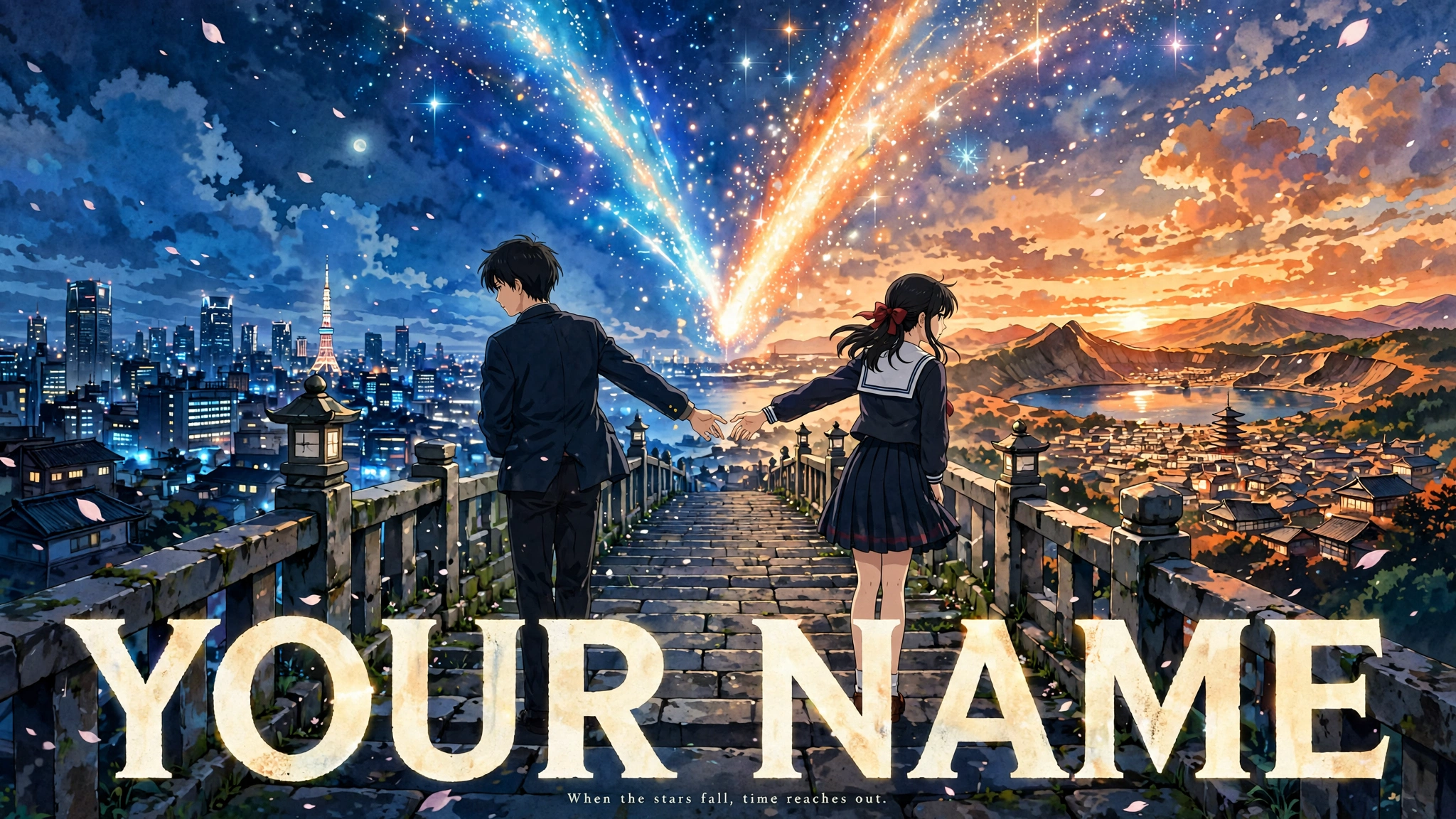
Mitsuha Miyamizu lives in Itomori, a pretty lakeside town where nothing happens, where her father is the mayor, where she helps at the family shrine, and where she is so bored and embarrassed by small-town life that she wishes aloud to be reborn as a handsome Tokyo boy. Taki Tachibana is exactly that, more or less — a Tokyo high-schooler juggling school, a part-time job in an Italian restaurant, and a crush he is too awkward to act on.
Then they start waking up in each other’s bodies.
At first it plays as comedy, and good comedy. A few days a week, unpredictably, Taki opens his eyes in Mitsuha’s life and Mitsuha opens hers in his. They leave each other furious notes on phones and notebooks. They set rules. They ruin each other’s reputations, improve each other’s love lives by accident, and slowly — through messages left for a person they have never met — build something that is part friendship, part diary, part falling in love.
Meanwhile, a comet is crossing the sky above Itomori, beautiful enough to draw the whole town out to look at it.
We will stop there, because Your Name has a genuine mid-film turn that reframes everything before it, and it deserves to land unspoiled. What can be said safely is this: the body-swap is not the point. It is the device Shinkai uses to talk about distance, memory, disaster and the peculiar grief of feeling that you have forgotten something — or someone — enormously important. The second half becomes a race, and the comedy gives way to urgency without the film ever losing sight of the two people at its centre.
Voice acting a body-swap story is a trap. Do too much impersonation and it becomes a gimmick; do too little and the audience loses track of who is who. The Japanese cast walks that line beautifully.
Ryunosuke Kamiki as Taki Tachibana has to play Taki, and also Mitsuha inside Taki — softer, more formal, bewildered by Tokyo and by suddenly having a body that does not match her habits. Kamiki shifts his rhythm and pitch just enough that you always know who is driving, without turning either version into a caricature. His real triumph comes later, when Taki’s cheerful competence collapses into desperation. The voice cracks in the right places. It sounds like a teenager, not an actor performing a teenager.
Mone Kamishiraishi as Mitsuha Miyamizu carries the film’s emotional weight. Mitsuha is the one with the shrine duties, the fractured family, the little sister, the grandmother who understands more than she says. Kamishiraishi makes her funny without making her a joke — her outrage when Taki-in-her-body misbehaves is perfectly judged — and then, in the film’s second half, lets a real ache into the performance. When Mitsuha tries to explain something she herself barely understands, you believe her completely.
Masami Nagasawa as Miki Okudera, Taki’s older co-worker and crush, brings a warmth that stops the love geometry from feeling schematic. She is perceptive in a way that makes a later sequence between her and Taki quietly devastating. Etsuko Ichihara as Hitoha Miyamizu, Mitsuha’s grandmother, is the film’s moral centre: dry, devout, unsentimental, and the keeper of traditions — braided cords, ritual sake, stories of the town — that turn out to matter far more than they first appear to.
The supporting friends on both sides, including Ryo Narita as Katsuhiko Teshigawara and Aoi Yuki as Sayaka Natori in Itomori, give the town a lived-in feel. Nobody here is a star vehicle. The casting serves the story, which is exactly why it works.
Shinkai has always been famous for backgrounds so detailed they look traced from photographs — skies, rain, train stations, vending-machine light — and Your Name, animated by CoMix Wave Films with character designs by Masayoshi Tanaka, is his most complete marriage of that visual obsession to an actual propulsive story. Earlier Shinkai films could feel like beautiful mood pieces in search of a plot. This one never stops moving.
Tokyo is rendered as teenagers actually experience it: station crowds, staircases, cram-school evenings, the glow of a phone in a dark room. Itomori is its mirror — a crater-lake town of shrine steps, power lines and festival stalls, gorgeous and stifling at once. The contrast is the argument of the film drawn in pictures. One life is too big to feel held by; the other is too small to breathe in.
The editing deserves special credit. Body-swap stories live or die on clarity, and Shinkai — who edited the film himself — uses a famous early montage, cut to music, to teach you the rules of the swap faster and more joyfully than any dialogue scene could. Later, when the film needs you to feel time itself slipping, the editing tightens and fragments in ways that mirror the characters’ panic.
Honesty requires one criticism. Shinkai’s perfectionism about skies and cityscapes occasionally overwhelms the human figures, who are drawn more simply than the world around them, and a couple of emotional peaks lean hard on the soundtrack to do work the scene has not quite done alone. Most viewers will not mind. Some will feel slightly managed. Both reactions are fair.
Pop band Radwimps did not just contribute songs to Your Name — they composed its score, and Shinkai cut the film around their music to an unusual degree. The result is the rare soundtrack that functions as narration. The songs arrive at structural moments: the swap montage, the turning of the story, the final movement. Their lyrics, about searching, dreaming and refusing to forget, say out loud what Taki and Mitsuha cannot.
Away from the songs, the score leans on piano and strings with a lightness that suits a story told between two school timetables. The risk of building a film this way is that it can feel like a very long, very beautiful music video, and in the first twenty minutes that risk is real. What saves it is that the big musical moments are genuinely earned by the plotting. When the music swells late in the film, it is releasing tension the story built, not manufacturing it from nothing.
What we loved:
What could be better:
Your Name was made for a reported ¥750 million, roughly $7.5 million, and nobody predicted what happened next. It spent weeks at the top of the Japanese box office, became the first animated film not made by Studio Ghibli or part of a major franchise to pass ¥10 billion in Japan, and kept going. Worldwide totals differ between sources — figures between roughly $355 million and $405 million are cited, depending on the territory count and the treatment of later re-releases — but every credible count makes it one of the highest-grossing anime films of all time and, for a period, the highest-grossing anime film ever worldwide. In China, South Korea and across Asia it played like a mainstream romance, not a niche import. It changed what distributors believed an original anime film could earn, and it made Shinkai, briefly, the most commercially powerful animation director on earth.
Yes, even if anime is not usually your thing — perhaps especially then. Your Name is a romance, a disaster film, a comedy and a story about memory wearing the clothes of a body-swap cartoon, and it is more disciplined than that description sounds. Its logic will not survive a spreadsheet, and once or twice it reaches for your tears a little obviously. But its best sequences achieve something rare: they make a supernatural story feel like an accurate description of being seventeen and certain that the most important thing in your life is something you cannot quite remember.
Our rating: 9/10 — a modern anime landmark: funny, beautiful and genuinely moving.
Is Your Name based on a novel?
Shinkai wrote a novel of the same name himself, published shortly before the film’s release in 2016. The film came first in production terms; the novel is his own companion version of the story, not a separate author’s work that he adapted.
Do I need to watch Your Name in Japanese?
An English dub exists and is well made, but the original performances by Ryunosuke Kamiki and Mone Kamishiraishi carry small shifts in speech and politeness that are part of how the body-swap is communicated. Subtitled Japanese is our recommendation for a first viewing.
Is Your Name suitable for children?
It is suitable for older children and ideal for teenagers. There is mild innuendo in the body-swap comedy and some intense, upsetting sequences in the second half connected to the town’s danger, but nothing graphic.
Is Your Name connected to Weathering with You or Suzume?
They are separate stories by the same director, Makoto Shinkai, with shared themes of weather, disaster, distance and young love. A small cameo connection exists for sharp-eyed fans, but you can watch each film completely on its own.
Will there be a live-action remake of Your Name?
A Hollywood live-action version has been announced and re-announced over the years with different filmmakers attached. As of now no live-action remake has been released, so treat any date you see as unconfirmed.