★ LATEST REVIEWS

★★★★☆ Our Rating: 7/10
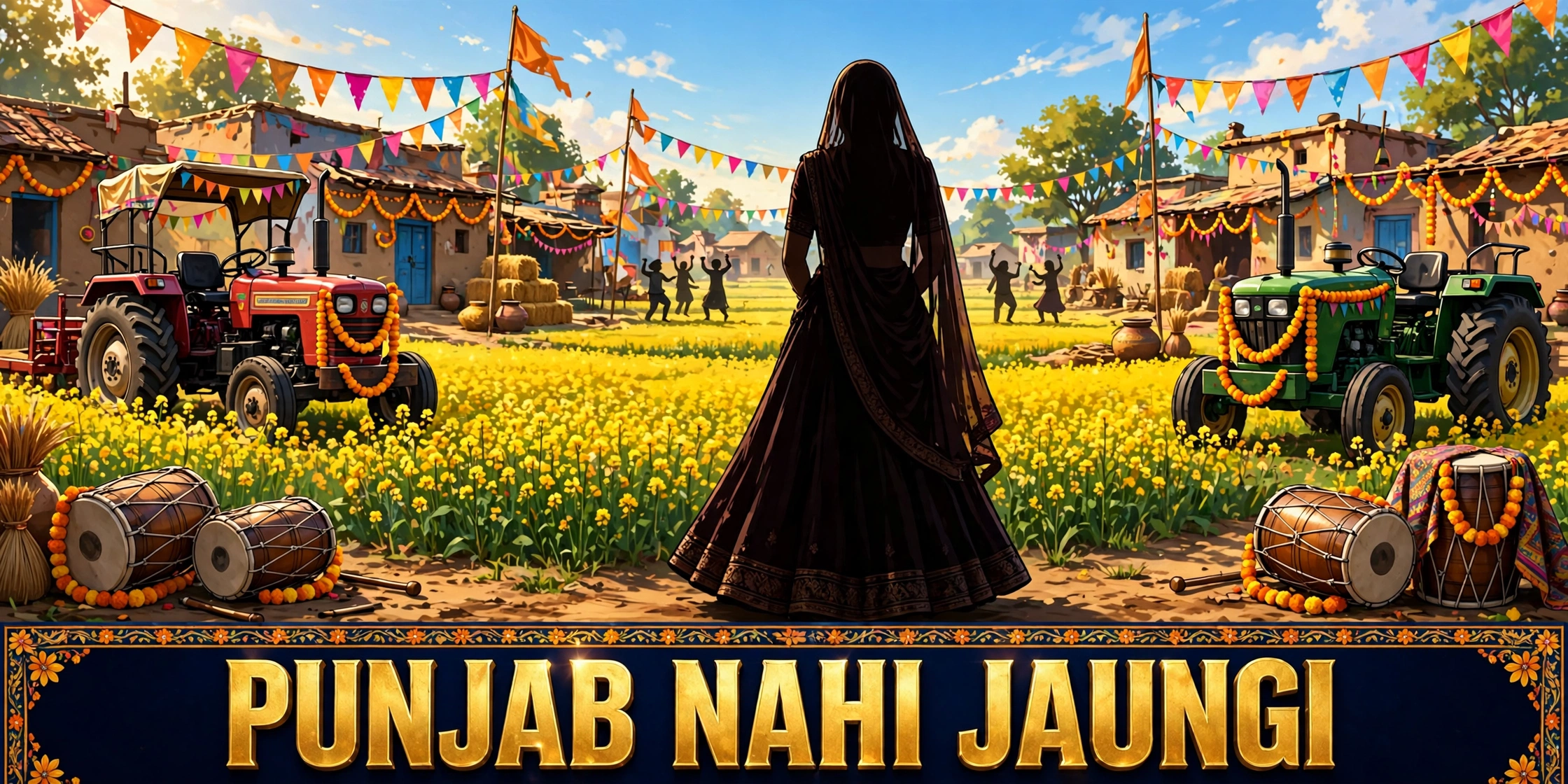
Few Pakistani films have been quoted, celebrated and argued about quite like Punjab Nahi Jaungi. Released on Eid-ul-Adha, 1 September 2017, this romantic comedy-drama from director Nadeem Baig and writer Khalil-ur-Rehman Qamar became a phenomenon: it ran for months, smashed records, and for a time stood as the highest-grossing Pakistani film ever made. Packed houses sang along, repeated its dialogues in daily life, and turned its title into a catchphrase.
Yet the same film also sparked serious criticism. Many viewers — then and now — have questioned its treatment of its heroine, its celebration of male ego, and a message that seems to belong to another era. Both reactions are real, and any honest review has to hold them together. This is a technically polished, hugely entertaining blockbuster built on star performances and memorable writing. It is also a film whose romance looks very different depending on where you sit.
In this review, we examine the story, the performances, the craft, the music and the record-breaking box office run, and we give you a straight verdict on what still works, what has aged badly, and who should watch it today.
| Detail | Information |
|---|---|
| Release date | 1 September 2017 |
| Director | Nadeem Baig |
| Writers | Khalil-ur-Rehman Qamar |
| Genre | Romance, Comedy, Drama |
| Language | Urdu, Punjabi |
| Runtime | 159 minutes |
| Lead cast | Humayun Saeed, Mehwish Hayat, Urwa Hocane, Sohail Ahmed, Saba Hameed |
| Our rating | 7/10 |
Fawad Khagga returns to Faisalabad after completing his master’s degree, the pride of a wealthy, deeply traditional Punjabi family. Fawad has one clear ambition for his future: a love marriage, on his terms, with a woman who matches the romantic ideal he has built in his head. His cousin Durdana loves him openly and hopefully, but Fawad’s heart is not in that direction at all.
That ideal appears to arrive in the form of Amal, a young woman from Karachi who has just returned from studying economics in London. The two families are bound by a friendship said to stretch back a hundred years, and Fawad’s family would love nothing more than for that bond to become a marriage. Fawad is smitten almost immediately. Amal, however, is modern, independent and clear-eyed about the life she wants — and that life does not involve leaving the city to become a traditional daughter-in-law on a Punjabi estate. She also has her own plans, including a college friend in London named Vasay, whom she intends to marry.
What follows is a pursuit. Fawad travels, pleads, performs grand gestures and uses every weapon in the traditional romantic arsenal — family honour, emotional pressure, wealth, persistence — to change Amal’s answer. Amal pushes back, gives ground, and pushes back again, while Durdana watches from the sidelines with her own hopes and schemes. The title tells you the central conflict: she will not go to Punjab. The film’s question is whether love, family and sheer determination can — or should — change her mind.
We will not spoil how that question is answered. What we will say is that the second half grows considerably more dramatic than the playful first, and the choices the film makes there are exactly where audiences divide. Watch the ending closely, and decide for yourself whether it feels like growth, surrender, or a bit of both.
Mehwish Hayat as Amal is the film’s strongest asset, and the reason much of it works at all. Hayat plays Amal as intelligent, funny and self-possessed, a woman who enjoys her independence and is not embarrassed about wanting more than tradition offers. She handles the comedy with lightness and the confrontations with steel, and she makes Amal’s resistance feel principled rather than stubborn. When the script later asks Amal to soften in ways that are harder to justify, Hayat’s performance still keeps the character human and sympathetic. It is easy to see why this role cemented her as the leading film actress of her generation.
Humayun Saeed as Fawad Khagga delivers the big, confident star turn the film is built around. Saeed is charismatic, funny and completely at ease with Khalil-ur-Rehman Qamar’s heightened dialogue, which he delivers like poetry even in ordinary conversation. His comic scenes sparkle, and his emotional breakdowns are played with full commitment. The honest criticism is that Fawad himself is written as a man whose ego the film keeps excusing. Saeed’s charm makes that easier to swallow in the moment, but charm is doing a lot of work that the writing should have done. It is a star performance in the classic sense — magnetic, and slightly too protected by the script.
Urwa Hocane as Durdana walks away with several of the film’s most memorable scenes. Durdana could have been a simple scheming cousin, but Hocane plays her with wit, longing and comic precision, turning lines into catchphrases and giving the character a bruised heart under the mischief. Audiences loved her, and rightly so; she gives the film energy whenever the central romance threatens to become repetitive.
The supporting cast is a roll call of Pakistani screen royalty. Sohail Ahmed brings effortless authority and humour, Saba Hameed is formidable as Fawad’s mother, and performers including Ahmed Ali Butt, Azfar Rehman, Behroze Sabzwari and Waseem Abbas fill the family world with texture. The ensemble is one of the film’s real luxuries: almost every scene has someone worth watching in it.
Nadeem Baig directs Punjab Nahi Jaungi with the confidence of a filmmaker who understands exactly what a festive Eid audience wants. The scale is impressive for its time: sprawling family homes, lush Punjabi locations around Faisalabad and Bahawalpur’s palatial architecture, wedding sequences staged with hundreds of details, and cinematography by Suleman Razzaq that bathes everything in warmth and colour. This was a film designed to prove that Pakistani productions could look as grand as anything across the border, and visually it makes that case convincingly.
Baig is also a skilled director of actors and dialogue scenes. The film’s many confrontations and comic set pieces are staged cleanly, and the camera knows when to simply let a performer hold a moment. The weaknesses are in pacing and proportion. At 159 minutes, the film is long, and the middle stretch circles the same conflict — will she agree, will she not — more times than it needs to. Some comic subplots exist purely to fill the festive-entertainer quota and could have been trimmed without any loss to the story.
Editing by Rizwan AQ keeps the set pieces lively, but the film’s emotional rhythm is uneven: the shift from breezy romance to heavy melodrama in the later portions is abrupt, and a couple of major turns rely on grand gestures rather than believable change. These are real flaws. They are also, for most of its original audience, flaws that the dialogue, music and performances comfortably outshone.
Music was central to this film’s success, with Shani Arshad leading a team of composers. The soundtrack mixes romantic ballads, folk-flavoured celebration and full-scale dance energy, drawing on voices including Shafqat Amanat Ali, Meesha Shafi and Sahir Ali Bagga. The wedding and festive numbers are staged as genuine spectacles, and the romantic tracks give the central relationship its most tender moments — often saying, in a few lines of melody, what the dialogue scenes strain to prove.
If the album is not flawless — one or two numbers feel included because a blockbuster of this size was expected to have them — it is undeniably effective. Several songs had a life far beyond the film, in weddings, shows and everyday playlists, which is the true test of a commercial soundtrack. In the cinema, the music does heavy emotional lifting, and it mostly succeeds.
What we loved:
What could be better:
The commercial story is historic. Punjab Nahi Jaungi grossed over Rs. 51.65 crore (Rs. 516.5 million) worldwide, becoming the highest-grossing Pakistani film of its time and holding that crown until Jawani Phir Nahi Ani 2 surpassed it the following year. It was the first Pakistani film to cross the Rs. 20 crore mark within its opening week, and its run stretched for months — still playing multiple daily shows in some cinemas fifteen weeks after release, a longevity almost unheard of in the modern multiplex era. For an industry still rebuilding, this film was proof that a local production, in local languages, could outdraw imported competition and keep audiences coming back.
Yes — with your eyes open. Punjab Nahi Jaungi is essential viewing for anyone who wants to understand modern Pakistani popular cinema: its craft, its star power, its music and its dialogue are all at blockbuster level, and Mehwish Hayat and Urwa Hocane are worth the price alone. At the same time, its gender politics deserve the criticism they receive, and younger viewers may find its idea of romance harder to accept than audiences did in 2017. Watch it as both things at once: a hugely enjoyable entertainer, and a time capsule of attitudes the industry is still arguing about.
Our rating: 7/10 — a polished, record-breaking blockbuster whose entertainment value is undeniable and whose message deserves debate.
Is Punjab Nahi Jaungi based on a true story?
No. It is an original fictional screenplay by Khalil-ur-Rehman Qamar, built around a long-standing family friendship and a clash between traditional Punjabi life and a modern, city-based outlook.
Is there a sequel to Punjab Nahi Jaungi?
A spiritual successor, London Nahi Jaunga, was released in 2022, reuniting Humayun Saeed and Mehwish Hayat with director Nadeem Baig in new roles and a new story rather than a direct continuation.
What languages is the film in, and are subtitles available?
The film mixes Urdu and Punjabi, reflecting its Faisalabad and Karachi settings. International and home releases have generally been presented with English subtitles.
Where can I watch Punjab Nahi Jaungi?
Availability varies by country and changes over time. The film has circulated widely on television and digital platforms since its record-breaking theatrical run, so check your local streaming services and digital stores.
How long is the film, and is it suitable for families?
It runs about 159 minutes. It is a festive family entertainer with comedy and romance, though parents should note some adult themes around relationships and alcohol in later scenes.