★ LATEST REVIEWS

★★★★★ Our Rating: 9/10
Some films feed you a story. Ustad Hotel feeds you something rarer: a feeling. Anwar Rasheed’s 2012 Malayalam drama, written by Anjali Menon, is about a young man who wants to cook for the world and an old man who believes cooking for people is itself a way of loving them. It is funny, tender and quietly wise, and more than a decade after its release it remains one of the most beloved films Malayalam cinema has produced. Dulquer Salmaan, in only his second film, announced himself as a star here; Thilakan, in one of his final screen roles, gave a performance that still makes audiences tear up.
This review is spoiler-free on the film’s later turns. The broad shape of the story is well known, but its pleasures deserve to be met fresh.
| Detail | Information |
|---|---|
| Release date | 29 June 2012 (Kerala; 20 July 2012 in other Indian cities and overseas) |
| Director | Anwar Rasheed |
| Writer | Anjali Menon |
| Genre | Drama, with comedy and romance |
| Language | Malayalam |
| Runtime | 150 minutes |
| Lead cast | Dulquer Salmaan, Thilakan, Nithya Menen, Siddique, Mamukkoya, Lena |
| Our rating | 9/10 |
Faizal, known to everyone as Faizi (Dulquer Salmaan), has grown up in Dubai with a dream his father cannot accept: he wants to be a chef. Trained in Switzerland, he is on the verge of a job in the United Kingdom when his father, Abdul Razak (Siddique), discovers the truth, confiscates his passport and brings him back to Kerala. Father and son barely speak the same language of ambition any more, and the rift between them is the film’s first engine.
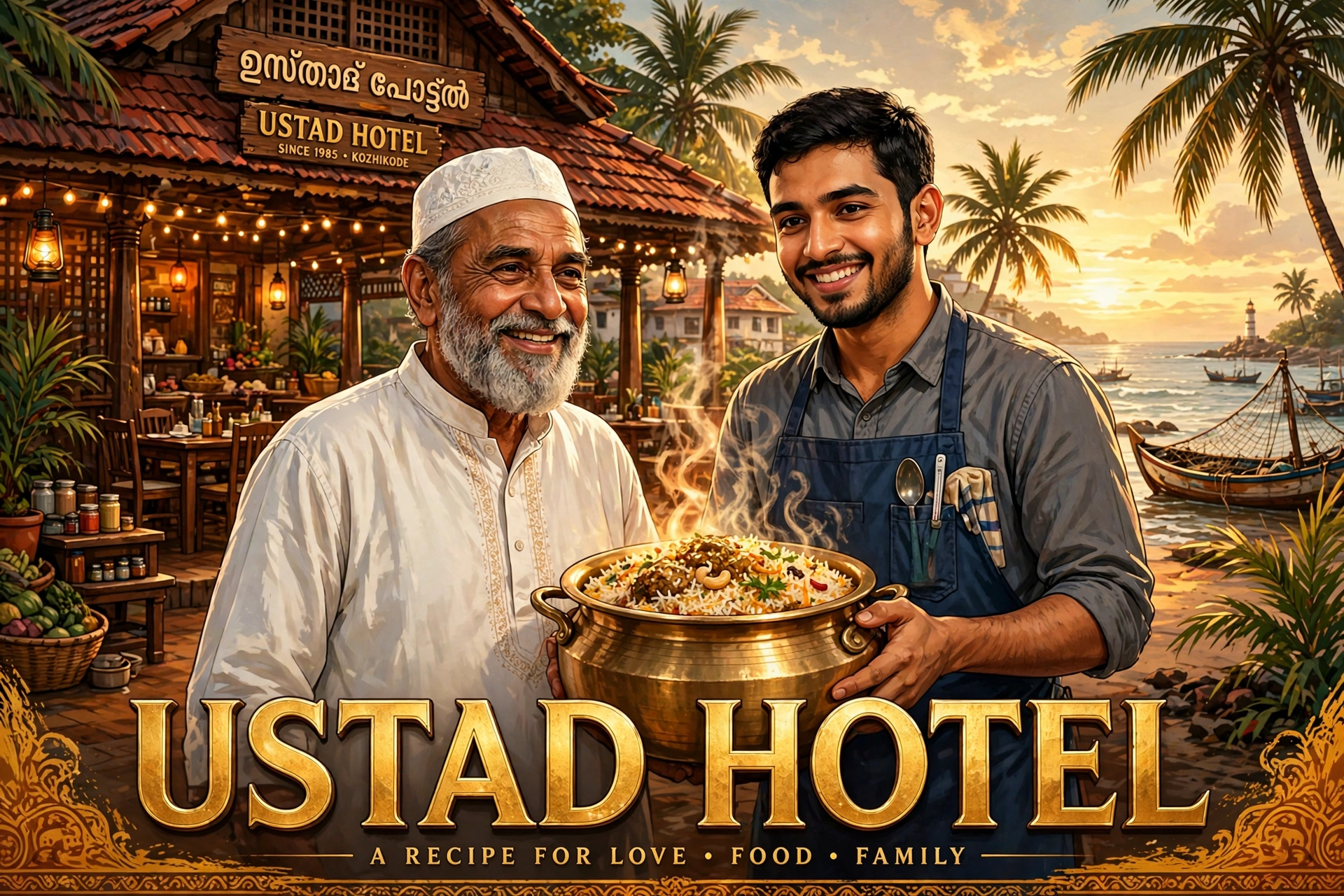
Faizi’s exile lands him in Kozhikode, at a modest beachside eatery run by his grandfather, Karim (Thilakan) — the “Ustad” of the title, a man who cooks biryani with the devotion of a craftsman and treats his restaurant as something closer to a community kitchen than a business. Faizi expects to wait out his time there, resentful and restless. Instead, slowly and without any single dramatic conversion scene, he begins to learn what his grandfather already knows: that food made with honesty, served without greed, carries a meaning no five-star kitchen can teach.
Around this spine, Anjali Menon’s screenplay weaves a gentle romance with Shahana (Nithya Menen), a young woman Faizi meets in Kozhikode, and a gallery of warm supporting characters — the restaurant’s staff, the regulars, the neighbourhood — who make the Ustad Hotel feel like a real place rather than a set. The film’s second half tests everything Faizi has learned, when the restaurant itself, and the values it stands for, come under threat. Without spoiling how that test resolves, it is fair to say the film earns its emotional climax rather than manufacturing it.
Thilakan as Karim, the Ustad — This is one of the great late-career performances in Indian cinema. Thilakan plays Karim not as a saint but as a stubborn, funny, deeply principled old man: a cook who refuses to cut corners, who feeds the poor from the same pot as the paying customers, and who treats his grandson with a patience that is itself a form of teaching. His scenes with Dulquer carry the whole film. Thilakan received a posthumous Special Mention at the National Film Awards for the role, and it is impossible to imagine the film without him. It was his last film released before his death, which gives the performance an added poignancy, but it needs no such context — it stands on its own.
Dulquer Salmaan as Faizi — Dulquer had debuted only months earlier, and here he already shows the qualities that would define his career: natural charm, an easy screen presence, and an ability to play vulnerability without self-pity. Faizi’s arc — from entitled, impatient young man to someone who understands what his grandfather was trying to tell him — is played in small gradations rather than big gestures, and Dulquer holds his own opposite a giant like Thilakan. It is the performance that made him a star in Kerala.
Nithya Menen as Shahana, and the supporting cast — Nithya Menen brings warmth and spark to Shahana, and crucially she is written as a person with her own mind rather than a mere romantic reward. Siddique is excellent as the father whose love expresses itself as control, a role that could easily have become a villain but instead remains painfully human. Mamukkoya, Lena and the rest of the ensemble give Kozhikode its texture, and the restaurant staff feel like people you might actually meet.
Anwar Rasheed directs with a lightness of touch that serves the material beautifully. The film never lectures, even when its themes — integrity in business, the dignity of honest work, the gap between generations — could easily have tipped into sermonising. Instead, Rasheed lets scenes breathe: long, unhurried sequences inside the restaurant, the rhythm of a kitchen at work, the sea air of Kozhikode. Loganathan Srinivasan’s cinematography makes the coastal city look lived-in and lovely rather than postcard-pretty, and the editing by Praveen Prabhakar keeps the 150-minute running time moving without hurry.
What is most impressive is the film’s tonal control. It is a comedy in its first stretch, a romance in its middle, and something close to a moral drama by the end, yet it never feels like three different films stitched together. The transitions are handled by character, not by plot machinery: Faizi changes, so the film changes around him.
One small caveat: a few of the comic side-tracks in the first half, enjoyable as they are, slow the film slightly, and viewers used to faster-paced commercial cinema may find the opening stretch leisurely. But that leisure is the point — the film is asking you to slow down and sit at the table for a while.
Gopi Sunder’s music is one of the film’s great strengths. The songs — including the much-loved “Appangal Embadum” and the soulful “Mel Mel Mel” — are woven into the story rather than pasted onto it, and the background score knows when to step forward and when to get out of the way. The celebrated sequence in which Faizi and Shahana run away, set to a sweeping score, is the film’s most famous musical moment, and it still works. The sound design of the kitchen — sizzling, chopping, the clatter of plates — gives the restaurant a sensory reality that makes the food theme feel earned rather than decorative.
What we loved:
What could be better:
Ustad Hotel was a major commercial success. Reported figures vary by source, as is common for regional releases of this period: contemporary trade reporting put its Kerala gross at around ₹10 crore after fifty days, with a worldwide total reported at around ₹15 crore, while other summaries cite roughly ₹9 crore. The exact figure matters less than the shape of the story — the film completed a 100-day theatrical run, was declared a blockbuster, and became one of the biggest Malayalam hits of 2012. Its success was later recognised at the highest level: the film won three National Film Awards, including Best Popular Film Providing Wholesome Entertainment, Best Dialogues for Anjali Menon, and the Special Mention for Thilakan. It was remade in Kannada as Gowdru Hotel (2017) and dubbed into Telugu, and it was re-released in theatres in January 2025, more than twelve years after its original run — a rare honour that says everything about its staying power.
Without hesitation, yes. Ustad Hotel is the rare film that is both deeply entertaining and quietly instructive, a crowd-pleaser that respects its audience. Watch it for Thilakan, stay for the food, the humour and the warmth, and expect to come out of it thinking about your own family — and about what honest work is actually worth. It is essential Malayalam cinema, and one of the finest Indian films of its decade.
Our rating: 9/10 — A warm, wise and beautifully acted classic about food, family and integrity, carried by Thilakan’s unforgettable performance.
Who directed Ustad Hotel?
Anwar Rasheed directed it, from a screenplay by Anjali Menon. It was produced by Listin Stephen under Magic Frames.
Who stars in Ustad Hotel?
Dulquer Salmaan as Faizi, Thilakan as his grandfather Karim, and Nithya Menen as Shahana, with Siddique, Mamukkoya and Lena in supporting roles.
What is Ustad Hotel about?
A young aspiring chef, blocked by his father from working abroad, is sent to work in his grandfather’s beachside restaurant in Kozhikode, where he learns what honest cooking — and honest living — really mean.
Did Ustad Hotel win any awards?
Yes, three National Film Awards: Best Popular Film, Best Dialogues for Anjali Menon, and a posthumous Special Mention for Thilakan.
How much did Ustad Hotel earn at the box office?
Reported totals vary between roughly ₹10 crore in Kerala and around ₹15 crore worldwide; it completed a 100-day run and was one of the biggest Malayalam hits of 2012.
Is Ustad Hotel suitable for family viewing?
Yes. It is a warm, clean family drama with humour, romance and strong values, suitable for viewers of all ages.
