★ LATEST REVIEWS

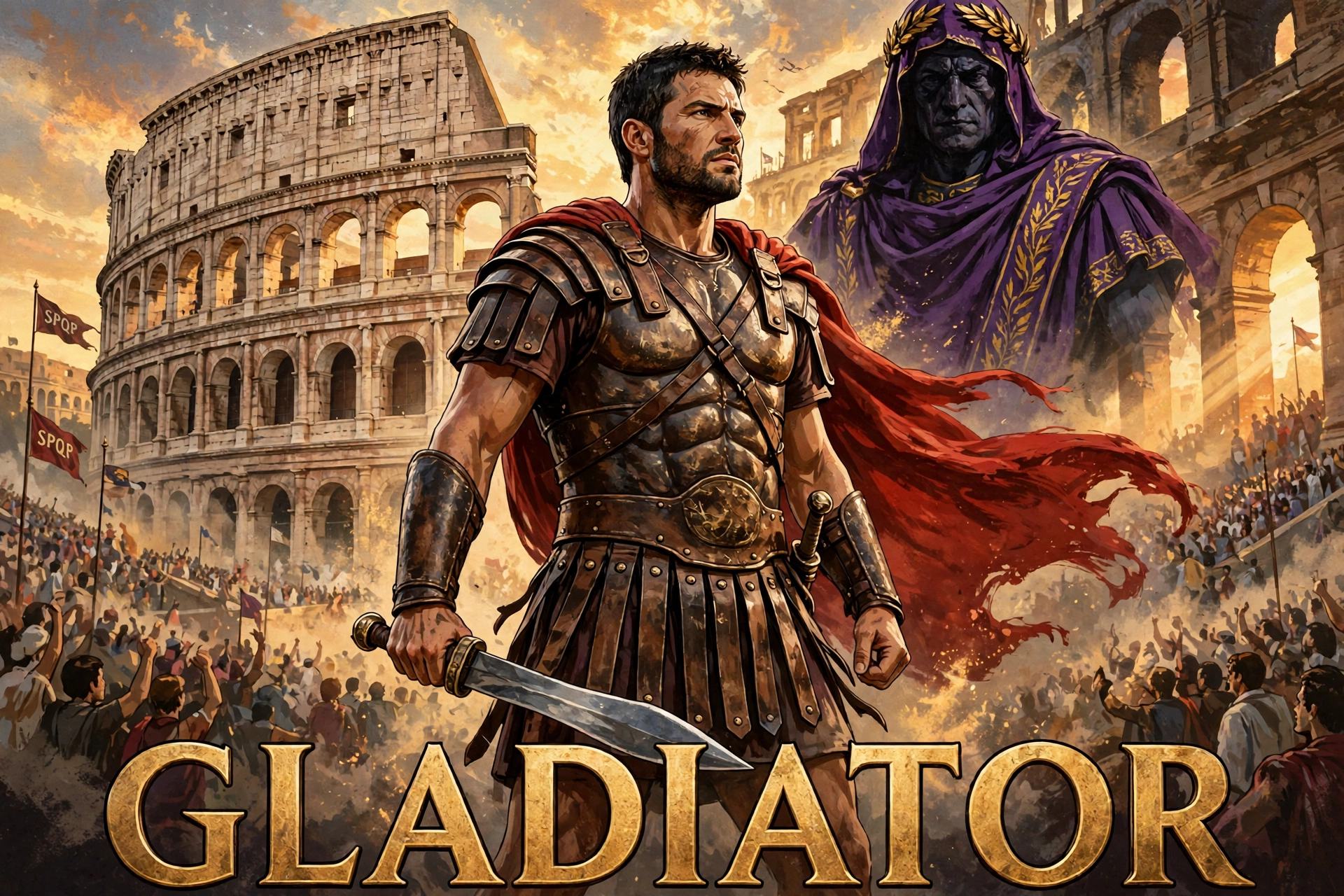
★★★★★ Our Rating: 9/10
Some films age into monuments. Gladiator is one of them. When Ridley Scott’s historical epic arrived in May 2000, the swords-and-sandals genre had been dormant for decades, dismissed as a relic of an older Hollywood. Scott revived it in a single stroke: a brutal, emotional blockbuster about a betrayed general who loses everything, is sold into slavery, and fights his way back through the blood of the arena to confront the emperor who destroyed his life. It won five Academy Awards, including Best Picture, made Russell Crowe a global star, and set the template for the historical epics that followed, from Troy to 300. A quarter of a century on, its power has barely faded.
This review is spoiler-free on the film’s final confrontation. The broad arc of Maximus’s journey is famous, but the details of how it ends are best met on screen.
| Detail | Information |
|---|---|
| Release date | 5 May 2000 (United States) |
| Director | Ridley Scott |
| Writers | David Franzoni, John Logan, William Nicholson |
| Genre | Historical action drama |
| Language | English |
| Runtime | 155 minutes |
| Budget | $103 million |
| Box office | Around $460 million worldwide (reported totals vary between roughly $457 million and $465 million depending on re-releases) |
| Lead cast | Russell Crowe, Joaquin Phoenix, Connie Nielsen, Oliver Reed, Derek Jacobi, Djimon Hounsou, Richard Harris |
| Our rating | 9/10 |
Maximus Decimus Meridius (Russell Crowe) is the Roman Empire’s most trusted general, a soldier who dreams only of going home to his wife and son in Spain. The dying emperor Marcus Aurelius (Richard Harris) plans to pass power not to his corrupt son Commodus (Joaquin Phoenix) but to Maximus, hoping he will restore Rome to the people. Commodus murders his father, seizes the throne, and orders Maximus executed. Maximus escapes, but too late: his family is murdered, his home burned, and he collapses into slavery, sold to a gladiator school run by the former gladiator Proximo (Oliver Reed).
What follows is one of cinema’s great revenge structures. Maximus rises through the arena, fight by fight, until his fame reaches Rome itself and the Colosseum, where Commodus stages grand spectacles to win the love of the crowd. Maximus’s goal is never merely survival: he wants to stand before the emperor who ruined him, in front of all Rome, and expose him. The film’s genius is that it makes this personal revenge inseparable from a political question — who does Rome belong to, the emperor or the people? — and lets the arena become the courtroom where that question is settled.
Scott tells the story with a soldier’s eye for detail and a romantic’s heart. The opening battle in Germania, shot in driving rain and mud, remains one of the great war sequences ever filmed: chaotic, terrifying, and strangely beautiful. The arena fights that follow are staged as brutal theatre, each with its own character, from the desperate scramble of Maximus’s first bout to the grand re-enactment of the Battle of Carthage. Between the battles, the film slows down for grief, loyalty and quiet conversation, and it is those scenes that give the action its weight.
Russell Crowe as Maximus — This is the performance that made Crowe a star, and it deservedly won him the Academy Award for Best Actor. Maximus is a man of few words, and Crowe plays him with a physical, restrained intensity: the way he holds a sword, the way he looks at the sky before a fight, the grief that never leaves his eyes. His famous declaration of identity in the arena — soldier, husband, father — works because Crowe has spent the whole film earning every word of it. It is a star performance built on stillness rather than showmanship.
Joaquin Phoenix as Commodus — Phoenix is magnificent as one of cinema’s great villains: needy, cruel, pathetic and terrifying by turns. Commodus is not a cartoon tyrant; he is a son desperate for a father’s love he never received, and that desperation curdles into murderous insecurity. Phoenix makes the emperor’s vanity and fear feel human, which makes him far more disturbing than a simple monster would be. The scenes between Commodus and his sister Lucilla crackle with a queasy, dangerous intimacy.
Connie Nielsen, Oliver Reed and the supporting cast — Nielsen gives Lucilla intelligence and steel; she is a political player in her own right, not a decorative love interest. Oliver Reed, in his final role, brings weary warmth to Proximo, the showman who understands the arena better than anyone. Derek Jacobi lends senatorial dignity as Gracchus, Djimon Hounsou gives the film its moral conscience as the fellow gladiator Juba, and Richard Harris, in only a few scenes, makes Marcus Aurelius’s weary wisdom unforgettable. The depth of this ensemble is a large part of why the film still feels rich rather than merely spectacular.
Ridley Scott directs with total command. The film’s visual language — John Mathieson’s cinematography, all golden wheat fields, grey German forests and the sun-bleached stone of Rome — gives the epic a painterly quality, while the handheld chaos of the battle scenes keeps it visceral. Hans Zimmer and Lisa Gerrard’s score is now iconic in its own right: the soaring vocals and mournful strings turn Maximus’s longing for home into the film’s emotional spine, and the music alone can reduce audiences to tears decades later.
The production itself was famously troubled — the script was being rewritten during shooting, and Oliver Reed died during production, requiring pioneering digital work to complete his remaining scenes — yet none of that strain shows on screen. The Colosseum, partly built full-scale in Malta and partly extended digitally, remains convincing, and the film’s sense of a lived-in, dirty, crowded Rome is one of its great achievements. If there is a flaw, it is that the film occasionally leans on historical invention for drama — the real Commodus’s story was stranger and messier — but as drama, the choices are sound, and the film never pretends to be a documentary.
Zimmer and Gerrard’s score deserves its own paragraph. It does not merely accompany the film; it articulates what Maximus cannot say. The recurring theme that plays over the wheat fields and the film’s final scenes has become shorthand for grief and homecoming in popular culture, quoted and reused endlessly. The sound design of the arena — roaring crowds, clashing steel, the thud of chariots — is equally accomplished, making the Colosseum feel like a living, breathing beast.
What we loved:
What could be better:
Made for a reported $103 million — an enormous sum for a historical drama in 2000 — Gladiator earned around $460 million worldwide, with reported totals varying slightly between roughly $457 million and $465 million depending on how re-releases are counted. It was one of the year’s biggest hits, won five Academy Awards from twelve nominations, and, just as importantly, it reopened the door for the historical epic. Without Gladiator, there is no Troy, no Kingdom of Heaven, no 300, and no modern appetite for sword-and-sandal spectacle. Its commercial success was also a creative one: it proved that adult, serious blockbusters could still conquer the box office.
Without hesitation, yes. Gladiator is one of the defining blockbusters of its era and one of the finest historical epics ever made. It works as pure spectacle, as a revenge story, and as a meditation on honour, grief and power. If you have somehow never seen it, clear an evening. If you have, it rewards a return visit — the wheat fields, the arena and that final walk are as moving now as they were in 2000.
Our rating: 9/10 — A towering epic: Crowe at his peak, Phoenix at his most chilling, and a story of revenge and honour that earned its place in cinema history.
Is Gladiator based on a true story?
Loosely. Marcus Aurelius, Commodus and Lucilla were real historical figures, and Commodus did fight as a gladiator, but Maximus is fictional and the film’s plot heavily invents and rearranges history for dramatic effect.
Who won Oscars for Gladiator?
The film won five Academy Awards, including Best Picture and Best Actor for Russell Crowe, along with costume design, sound and visual effects.
How much did Gladiator earn at the box office?
Around $460 million worldwide against a $103 million budget, with reported totals varying slightly between about $457 million and $465 million.
Is there a sequel to Gladiator?
Yes, Gladiator II (2024), also directed by Ridley Scott, follows Lucius, the son of Lucilla, years after the events of the first film.
Is Gladiator suitable for family viewing?
No. It is a violent, intense historical epic with graphic battle and arena violence, best suited to older teenagers and adults.
