★ LATEST REVIEWS

★★★★☆ Our Rating: 8.5/10
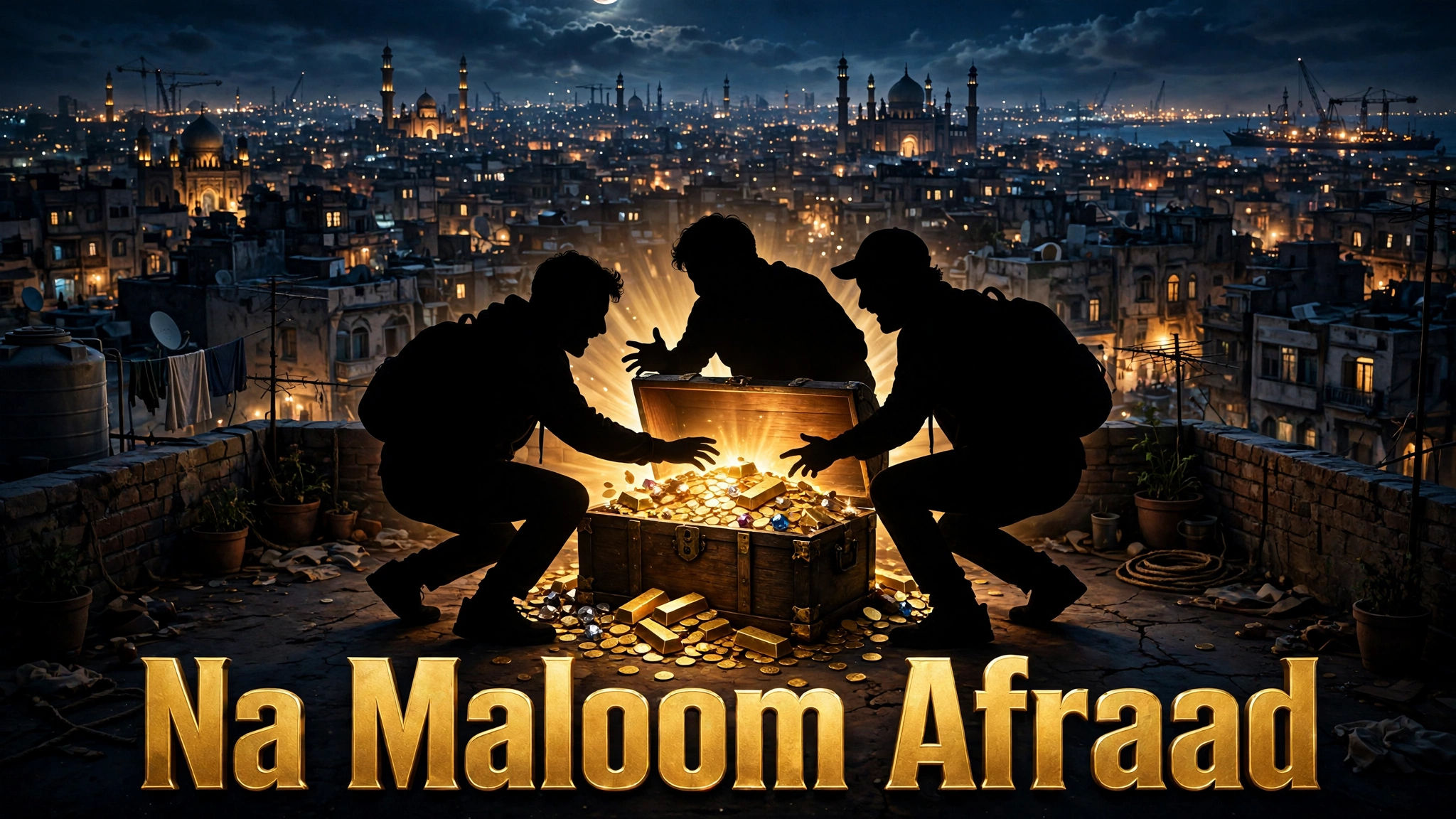
Every revival has a starting gun, and for modern Pakistani cinema one of the loudest was fired on Eid-ul-Adha 2014. Na Maloom Afraad — the title means “unidentified persons”, the phrase used in police reports for unknown suspects — arrived as the directorial debut of Nabeel Qureshi, a television director with no feature track record, fronted by a cast drawn mostly from TV. On paper it looked like a gamble. On screen it played like a revelation: a fast, funny, street-smart comedy thriller that understood Karachi the way few films before it had bothered to, and trusted that audiences would follow a story about three broke men and one terrible plan.
The film’s importance is easy to state and hard to overstate. It proved that a contemporary Pakistani story, told in the local idiom, shot on real streets, without borrowed glamour from across the border, could fill cinemas and keep them full for weeks. It launched film careers, established the Filmwala Pictures partnership of Qureshi and producer-writer Fizza Ali Meerza, and set a template — social reality wrapped in entertainment — that Pakistani commercial cinema is still following.
But importance alone does not make a film worth watching a decade later. What keeps Na Maloom Afraad alive is that it remains genuinely entertaining: the jokes are rooted in character, the city is a participant rather than a backdrop, and underneath the caper mechanics sits a recognisable portrait of people for whom the system has no honest route to a better life. In this review we give you an honest breakdown of the story, the performances, the craft, the music and the box office, and tell you plainly whether this modern classic still earns the label.
| Fact | Detail |
|---|---|
| Release date | 6 October 2014 |
| Director | Nabeel Qureshi |
| Writers | Nabeel Qureshi, Fizza Ali Meerza |
| Genre | Comedy, Thriller |
| Language | Urdu |
| Runtime | 137 minutes |
| Budget | Rs. 90 million |
| Lead cast | Fahad Mustafa, Javed Sheikh, Mohsin Abbas Haider, Urwa Hocane, Kubra Khan, Salman Shahid |
| Our rating | 8.5/10 |
Karachi is a city that runs on hustle, and our three central characters are running out of it. Shakeel is a decent, worn-down man whose small insurance business is collapsing around him; years of honesty have left him with little to show for it. Farhan is a smooth-talking salesman of burial plots — yes, really — whose charm consistently outruns his income, and whose love life is heading towards a marriage he cannot possibly afford. Moon is the youngest of the three, a restless dreamer working at a mobile phone shop, nursing ambitions far larger than his circumstances and a soft spot that keeps dragging him into other people’s problems.
Each man is drowning quietly in his own way: debts, family pressure, a city where strikes, extortion and shutdowns can erase a month’s earnings in a day. What brings them together is a scheme — reckless, illegal and, in their telling, the only rational response to an irrational system. The plan is meant to solve all their problems at once. Naturally, this being Karachi and this being a comedy, it solves none of them and manufactures several new ones, involving dangerous people who are considerably better at crime than our heroes are.
We will not describe the scheme or its twists, because the film’s pleasure lies in watching the plan unravel in stages, each complication funnier and more perilous than the last. What can be said is that the story keeps one foot in laughter and one in genuine anxiety: these are likeable men, and the film never lets you forget that the city around them punishes mistakes without sentiment.
Javed Sheikh as Shakeel delivers the performance of the film and, arguably, one of the finest of his long career. Shakeel could have been a figure of pity; Sheikh makes him a figure of dignity under pressure. His comic timing is immaculate — a raised eyebrow or a weary pause lands harder than most actors’ punchlines — but it is the sadness underneath that stays with you. When the character’s desperation finally cracks through his respectability, the scene hurts in the best way, because Sheikh has spent the whole film earning it. He deservedly won major acting honours for this role.
Fahad Mustafa as Farhan announced himself as a film star with this debut lead. Farhan is the trio’s engine: fast-talking, resourceful, romantic and permanently one step ahead in conversation while two steps behind in life. Mustafa plays him with a looseness that feels improvised even when it is not, and his chemistry with both Sheikh and Haider gives the film its rhythm. The cemetery-salesman premise could have been a one-joke character; Mustafa turns it into a running commentary on a city where even death is a business.
Mohsin Abbas Haider as Moon is the discovery of the film. Moon’s energy is different — twitchier, more naive, more volatile — and Haider throws himself into it completely. He gets some of the film’s broadest comedy and handles its most manic sequences without losing the character’s essential sweetness. It is the kind of debut that immediately marks an actor as one to watch.
Urwa Hocane as Naina and Kubra Khan as Hina give the romantic tracks warmth, though the script is honest about its priorities: this is the men’s story, and the women are written more as motivations and emotional anchors than as fully independent arcs. Salman Shahid as Gogi is superb value in support, playing menace and absurdity in the same breath, and a famous item appearance by Mehwish Hayat provides the film’s most talked-about musical moment.
For a debut feature, Na Maloom Afraad is strikingly assured. Qureshi directs Karachi as he found it: much of the film was shot in real locations around Saddar and other working neighbourhoods, and that decision pays off in every frame. The traffic, the shop shutters, the cramped interiors — none of it is dressed up, and the authenticity gives the comedy a texture that studio sets could never have supplied. When a citywide shutdown becomes a plot device, it lands because the film has already shown you exactly how this city breathes.
Cinematographer Rana Kamran shoots the city with affection but no gloss, keeping the camera mobile during the caper sequences and steady for the emotional ones. The editing, by Asif Mumtaz, deserves special praise: at 137 minutes the film is not short, yet it rarely drags, because scenes are cut on the laugh or the turn rather than after it. The chase and confrontation passages in the later half are staged with a clarity that more experienced directors often fumble — you always know where everyone is, what they want, and why it is about to go wrong.
If there are technical limitations, they belong to the era and the budget: an occasional rough sound mix in location scenes, and a climax that leans on coincidence a little harder than the rest of the film does. Neither flaw seriously dents the experience.
Shani Arshad’s music captures the film’s split personality — streetwise and sentimental in equal measure. The songs range from the raucous to the romantic, and the soundtrack became a genuine popular success in its own right, with the dance number featuring Mehwish Hayat turning into a cultural talking point that pulled additional audiences towards the film. Importantly, most numbers are stitched into the narrative’s mood rather than stopping it dead.
The background score does heavy lifting in the thriller stretches, tightening scenes that are played for laughs on the surface but danger underneath. It is a good example of scoring in service of tone: the music reminds you the stakes are real even while the characters are being ridiculous, which is precisely the balance the whole film depends on.
What we loved:
What could be better:
Released on 6 October 2014, in the Eid-ul-Adha frame, Na Maloom Afraad went head to head with the bigger-budgeted spy thriller O21 — and beat it decisively. Made on a reported budget of Rs. 90 million, the film crossed Rs. 51 million within roughly its first nine days and went on to a reported worldwide total of around Rs. 140 million, an excellent return that understates its impact: its real achievement was longevity, holding screens for weeks on word of mouth at both multiplexes and single-screen cinemas.
The honours followed. At the 14th Lux Style Awards the film became the most nominated title of the year in the film categories, winning Best Film, Best Director for Qureshi and Best Actor for Javed Sheikh. A sequel, Na Maloom Afraad 2, followed in 2017. But the truest measure of the film’s box office story is what it enabled: it convinced producers, exhibitors and audiences that original, locally rooted Pakistani stories were not a risk but an opportunity, and the modern industry’s slate still bears its fingerprints.
Absolutely. Na Maloom Afraad is not merely a historically important Pakistani film; it is a thoroughly enjoyable one, and those two things do not always travel together. The comedy has aged well because it was built on character and place rather than topical gags, the thriller mechanics still grip, and Javed Sheikh’s performance alone justifies the watch. New viewers discovering Pakistani cinema often ask where to start with the modern era. This is one of the two or three best answers anyone can give.
Our rating: 8.5/10 — A street-smart Karachi caper with heart, humour and a career-best Javed Sheikh.
Is Na Maloom Afraad based on a true story?
No. It is an original fictional story, though its setting draws heavily on the everyday realities of life in Karachi, which is why so much of it feels recognisable.
Does Na Maloom Afraad have a sequel?
Yes. Na Maloom Afraad 2 was released in 2017, reuniting the central trio for a new adventure set largely in South Africa. The first film stands complete on its own, so the sequel is optional viewing.
What language is Na Maloom Afraad in?
The film is in Urdu, with the natural sprinkling of English and local slang used in Karachi. Subtitled versions have been available on home releases, so non-Urdu speakers can follow it comfortably.
Where can I watch Na Maloom Afraad?
The film has been widely available over the years on television, official video uploads and rotating streaming catalogues. Availability differs by country, so check your local streaming services for the current listing.
How long is Na Maloom Afraad, and is it family friendly?
It runs about 137 minutes. The humour is broad and the themes are adult in the sense of money, crime and desperation, but the treatment is mainstream and suitable for most family viewing with older children.