
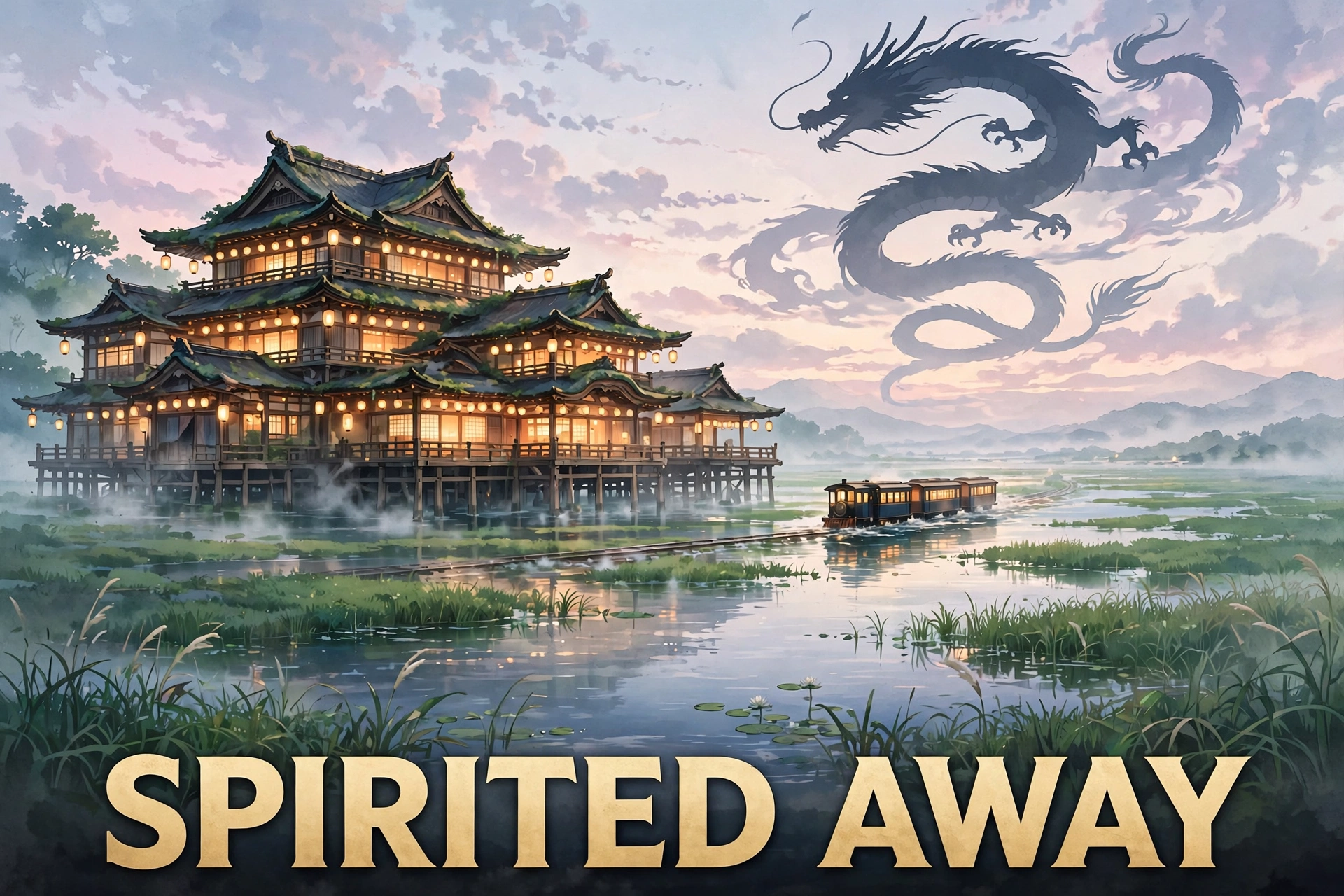

Spirited Away (2001) Review – The Animated Wonder That Still Feels Like a Dream
There are animated films you admire, and then there is Spirited Away. More than two decades after it first appeared in Japanese cinemas on 20 July 2001, Hayao Miyazaki’s fantasy remains the film other animators quietly measure themselves against — not because it is loud or clever, but because it trusts a child, and the audience, to feel their way through a strange world without having everything explained.
It also carries a weight of history that could easily crush a lesser film. It won the Academy Award for Best Animated Feature, shared the Golden Bear at Berlin, and for years stood as Japan’s highest-grossing film of all time. Strip all of that away, though, and what is left is simpler and stronger: a sullen ten-year-old girl, lost in a place that does not want her, who has to learn how to work, how to remember her own name, and how to be brave without becoming hard. In this review we look at the story, the voice work, the craft, the music and the box office, and ask whether it still deserves the reverence it receives. Short answer: mostly, yes — with a few honest caveats.
Quick Facts: Spirited Away at a Glance
| Detail | Information |
|---|---|
| Release date | 20 July 2001 (Japan) |
| Director | Hayao Miyazaki |
| Writers | Hayao Miyazaki |
| Genre | Fantasy, Adventure, Animation, Family |
| Language | Japanese |
| Runtime | 124 minutes |
| Budget | Approx. $19.2 million (¥1.9 billion) |
| Lead cast | Rumi Hiiragi, Miyu Irino, Mari Natsuki, Takashi Naito, Yasuko Sawaguchi |
| Our rating | 9.5/10 |
The Story: A Girl Who Must Not Forget Her Name (Spoiler-Free)
Chihiro Ogino is moving house, and she hates it. Sulking in the back seat while her parents take a wrong turn down a wooded track, she follows them — reluctantly, complaining the whole way — through a tunnel into what looks like a deserted theme park. There are restaurants with no staff and counters piled high with steaming food. Her parents sit down and help themselves. Chihiro refuses, wanders off, and finds a vast, glowing bathhouse across a bridge.
A boy named Haku warns her to leave before dark. She runs back too late. Night has fallen, the empty streets are filling with shadowy spirits, the river that was dry is now a sea, and her parents — who ate food meant for gods — have changed in a way that makes escape impossible in the way she imagined.
Alone, transparent and terrified, Chihiro has only one route to survival: get a job. The bathhouse is run by Yubaba, a formidable witch who steals the names of everyone who works for her. Chihiro signs a contract, is renamed Sen, and is put to work scrubbing floors and tending to an endless procession of river gods, radish spirits and masked guests. If she forgets her real name, she can never leave. If she remembers who she is — and learns why Haku seems to know her — she might find a way to free them all.
That is all you need going in. The film deliberately withholds exposition. Rules are learned the way a new employee learns them: by making mistakes, by watching others, by being helped by people whose kindness has a price.
Performances: Voices That Never Show Off
Because this is animation, performance means two things at once — the voice, and the body the animators give that voice. Both are exceptional here.
Rumi Hiiragi as Chihiro (Sen) carries the entire film, and the smartest choice Miyazaki makes is to let her sound like an actual child. She whines, she mumbles, she cries without prettiness. Early Chihiro is genuinely a bit annoying, which is the point. As Sen, Hiiragi does not suddenly become a plucky heroine; she becomes quieter, steadier, more observant. The growth is in small things — how she says thank you, how she stops flinching — and it feels earned rather than scripted.
Miyu Irino as Haku has the harder, less showy job. Haku is kind and distant in the same breath, a boy who has already lost the thing Chihiro is fighting to keep. Irino plays him with a flat calm that occasionally cracks, and those cracks matter more than any big speech would. You believe Haku is both protector and prisoner.
Mari Natsuki as Yubaba is magnificent and terrifying in equal measure. Yubaba is not a cackling villain. She is a businesswoman — greedy, exhausted, devoted in a twisted way to her oversized baby, and absolutely bound by the contracts and courtesies of her own house. Natsuki gives her a voice that can swing from cooing politeness to explosive rage in a sentence, and the animators match it with a character whose head, jewellery and temper all seem too large for the room. Her twin sister, also voiced by Natsuki in a warmer register, becomes a quiet masterclass in how much a voice actor can change with temperature rather than trickery.
Around them, the ensemble builds a working community rather than a gallery of mascots. Takashi Naito and Yasuko Sawaguchi as Chihiro’s parents are brief but crucial — ordinary, a little thoughtless, never demonised. Bunta Sugawara as Kamaji, the many-armed boiler man, grumbles his way into becoming a grandfather figure, and Yumi Tamai as Lin gives Sen the older-sister toughness the bathhouse sections need. Nobody is doing a star turn. Everyone sounds like they work there.
Direction and Technical Brilliance
Miyazaki directed from his own screenplay, and the most distinctive thing about his direction is its patience. Most family films of this era cut quickly and explain constantly. Spirited Away lingers. A train ride across a flooded plain, with almost no dialogue, becomes the emotional centre of the film. Chihiro folds clothes, eats a rice ball and weeps, washes a floor properly. Miyazaki has often spoken about valuing those in-between moments — the Japanese concept of ma — and here they are not decoration. They are where Chihiro changes.
The animation, produced by Studio Ghibli with cinematography credited to Atsushi Okui and editing by Takeshi Seyama, is hand-drawn in a way that still embarrasses much modern digital work. Water is the test, and the film passes it constantly: bathwater, river water, rain, a flooded landscape that turns a railway into a line drawn across the sky. The bathhouse itself is an impossible building — part ryokan, part factory, part temple — crammed with pipes, elevators, trapdoors and boiler rooms, yet it always feels navigable because the film teaches you its geography through Chihiro’s labour.
Character design does similar work. The spirits are drawn from folklore without ever becoming a bestiary lesson. Some are beautiful, some are faintly disgusting, most are simply going about their evening. No-Face, the masked figure who drifts from silent loneliness into dangerous excess, is the film’s most famous creation precisely because the design is so empty — a white mask and a black shape into which everyone, including the audience, projects something different.
If there is a technical criticism, it is that the final act moves faster than the film has trained you to expect. Threads that were allowed to breathe for two hours are tied up briskly, and viewers who love the film’s dream logic may still feel the ending arrives with a small jolt of plot mechanics. It does not spoil the film, but it is noticeable on rewatch.
Music and Background Score
Joe Hisaishi’s score is inseparable from the film’s effect. Rather than wall-to-wall fantasy swelling, Hisaishi leans on piano — simple, repeating figures that sound like memory trying to form. The main themes carry a waltz-like melancholy that suits a story about work, water and forgetting. When the orchestra does open up, for arrivals at the bathhouse or moments of flight, it feels like weather changing rather than a cue telling you to feel something.
Just as important is what the music does not do. Miyazaki leaves long stretches to sound alone: cicadas, train wheels, the creak of wood, water sloshing in a tub. Hisaishi respects those silences. The result is a soundtrack people listen to on its own for a reason — it recreates the film’s emotional weather without needing the pictures — but in the film itself, its restraint is the real achievement.
What Works and What Doesn’t
What we loved:
- A heroine who grows through work, courtesy and courage rather than chosen-one powers
- World-building learned by doing, with almost no clumsy exposition
- Hand-drawn animation of water, food, weather and architecture that has barely aged
- Yubaba and No-Face — two of the most memorable figures in any animated film
- Joe Hisaishi’s piano-led score and Miyazaki’s brave use of quiet
What could be better:
- The final stretch resolves several threads more quickly than the film’s earlier pacing promises
- Some younger children may find certain spirit designs and transformations genuinely frightening
- Viewers who need clear rules for a fantasy world may be frustrated — the film deliberately withholds them
Box Office: The Film That Outran Every Expectation
Made for a reported $19.2 million — modest even by the standards of major animation at the time — Spirited Away became a phenomenon in Japan first, where it held the record as the country’s highest-grossing film for nearly two decades. Worldwide, totals vary slightly by source and by how later re-releases are counted, but the figure most commonly cited today is around $395–396 million, a remarkable return for a subtitled, hand-drawn film with no franchise behind it. Its Oscar win in 2003 introduced it to a second, enormous audience in North America and Europe, and it has continued to earn through reissues ever since. Few films have ever converted so small a production budget into so long a commercial — and cultural — life.
Verdict: Should You Watch It?
Yes — and if you have only ever seen it dubbed, distracted, or as a child, watch it again properly. Spirited Away is not perfect. Its ending hurries, its logic is intentionally slippery, and its middle section asks for patience that not every viewer will want to give. But its flaws are the flaws of ambition and temperament, not of carelessness. This is a film made by people who believed children could handle mystery, sadness and beauty without having them softened first. That belief is why it lasts.
Our rating: 9.5/10 — a genuine masterpiece of animation, and essential viewing for anyone who cares about film, not just anime.
Frequently Asked Questions
Is Spirited Away suitable for children?
Mostly, yes, but with a note of caution. It is a family film with no cynicism in it, yet some transformations, spirits and moments of peril can unsettle younger children. Older children and adults tend to get the most from it.
Should I watch Spirited Away dubbed or subtitled?
Both versions are respected, and the English dub is unusually careful. That said, Rumi Hiiragi’s original performance as Chihiro has a rawness worth hearing at least once, so the subtitled Japanese version is our recommendation for a first viewing.
Is Spirited Away connected to other Studio Ghibli films?
No. It is a standalone story. You do not need to have seen any other Ghibli film to follow it, though fans enjoy spotting the studio’s recurring love of flight, food, work and strong-willed girls.
What does the title Spirited Away mean?
The Japanese title refers to kamikakushi — the folklore idea of a person being hidden away by the gods. Chihiro is not just lost; in the eyes of the spirit world, she has been taken, and her stolen name is part of that taking.
Will there be a sequel to Spirited Away?
There is no sequel, and Miyazaki has never made one. The story ends where it needs to. Any sequel news you see circulating online should be treated as rumour unless Studio Ghibli itself announces it.