

John Wick: Chapter 4 (2023) Review – Bigger, Longer, and Brutally Beautiful
By the fourth chapter of any action series, the usual pattern is exhaustion. The hero has less to say, the villains are thinner copies of earlier villains, and the set pieces repeat old tricks at higher cost. John Wick: Chapter 4 mostly escapes that trap by leaning hard into the things this series does uniquely well: clean fight geography, committed physical performance, absurdly detailed underworld etiquette, and a visual style that treats neon, rain, glass, and tailored suits as seriously as weapons. It is the biggest film in the series in length, locations, and ambition, and for long stretches it is also the most beautiful.
It is also, honestly, too long and too thin in story for its running time. The plot can be summarised in a sentence, and the film knows it, filling the space with duels, chases, stair falls, and new characters who mostly exist to test John Wick in a different style. Whether that is a flaw depends on why you bought a ticket. If you want a tight crime story, this will feel padded. If you want to watch some of the finest action choreography in modern Hollywood, staged by people who clearly love the craft, this is close to essential viewing.
Keanu Reeves continues to do a remarkable share of the physical work, and director Chad Stahelski, a former stunt performer, photographs that work with respect. In this review, we give you an honest breakdown of the story, performances, craft, music, and box office, without spoiling the final outcome.
Quick Facts: John Wick: Chapter 4 at a Glance
| Detail | Information |
|---|---|
| Release date | 24 March 2023 (United States) |
| Director | Chad Stahelski |
| Writers | Shay Hatten, Michael Finch, based on characters created by Derek Kolstad |
| Genre | Action, Thriller, Crime |
| Language | English |
| Runtime | 169 minutes |
| Budget | $100 million |
| Lead cast | Keanu Reeves, Donnie Yen, Bill Skarsgård, Laurence Fishburne, Hiroyuki Sanada |
| Our rating | 8/10 |
The Story: One Path to Freedom, Paved With Old Debts (Spoiler-Free)
John Wick is still living under a death sentence from the High Table, the council that governs the assassin underworld, and still carrying the consequences of being declared excommunicated in the previous film. Chapter 4 opens with John preparing in the desert and quickly establishes the only offer that matters: there may be a formal, old-fashioned way to challenge the Table’s authority and win his freedom, if he can survive long enough to claim it and if the family and alliance politics around him line up exactly right.
Standing in his way is the Marquis Vincent de Gramont, a young, wealthy, and ruthless representative of the High Table who has been given wide powers and a large budget to end the Wick problem permanently. The Marquis does not need to fight John himself. He can raise bounties, punish John’s allies, close safe houses, and force old friends into service against him. One of those friends is Caine, a blind assassin who is coerced into hunting John to protect his own family. Another pressure point is the Osaka Continental, run by John’s old friend Shimazu Koji, whose hotel becomes an early battleground when the Marquis decides that neutrality will no longer be tolerated.
The story moves from Osaka to Berlin to Paris, introducing a tracker known as Mr Nobody, who works with a dog and keeps raising his price as he studies his target, and returning faces including Winston, Charon, and the Bowery King. The structure is simple by design. John must complete a series of obligations, survive escalating attacks, and arrive at a formal duel at sunrise in Paris, with conditions that this review will not spoil. Everything else, the duels, debts, markers, and challenges, is ritual around that single question: can a man who has lived by these rules ever use those same rules to leave?
Performances: Quiet Men, Loud Physicality
Keanu Reeves as John Wick — Reeves has never played John as a chatty hero, and here he speaks less than ever. The performance is physical and mournful. John is tired, injured, and visibly ageing inside his own legend, yet he keeps getting up with a stubbornness that is both impressive and a little sad. Reeves’s stunt work, driving, and fight execution remain remarkable, and his limited dialogue makes the moments when John asks for, or offers, loyalty land harder.
Donnie Yen as Caine — Yen is the film’s standout addition. Playing a blind swordsman and gunfighter, he creates a style that is precise, witty, and completely distinct from John’s heavier brawling. Caine uses sound, placement, and economy of movement, and Yen brings humour to scenes that could have been one-note, tapping a cane, adjusting a posture, waiting a beat too long before striking. Beneath that, he gives Caine real sorrow. This is a man who does not want the job he has been forced to take, and Yen makes that conflict clear without speeches.
Bill Skarsgård as the Marquis de Gramont — Skarsgård leans into arrogance, playing the Marquis as a man who treats murder as administration and other people’s lives as budget lines. His accent and flamboyant tailoring divided audiences, and at times the character tips towards caricature. Still, he works as a contrast. John and Caine have earned their skills through pain. The Marquis has inherited his power and spends other people to protect it.
Hiroyuki Sanada as Shimazu Koji and Rina Sawayama as Akira — Sanada brings dignity and old-school samurai gravity to the Osaka section, making a relatively brief role feel like the moral centre of the first hour. Sawayama, in her film acting debut, holds her own as his daughter and concierge, handling both action and grief with confidence.
Ian McShane as Winston, Laurence Fishburne as the Bowery King, and Lance Reddick as Charon — The returning players provide continuity and dry wit. McShane can make a warning sound like a toast. Fishburne enjoys every operatic line. Reddick, who died shortly before the film’s release, gives Charon his usual calm loyalty, and his presence adds an unintended poignancy for long-time viewers. Shamier Anderson as Mr Nobody also makes a strong impression, creating a character who could easily support more screen time in this world.
Direction and Technical Craft
Stahelski directs action the way good dance is directed. You see bodies, distances, and decisions. Dan Laustsen’s cinematography gives each city its own palette. Osaka is sleek and warm, full of wood, glass, and cherry blossom contrasted with tactical violence. Berlin becomes a rain-slick, industrial rave of a nightclub where a waterfall runs through a fight. Paris is photographed as a golden, monumental maze of traffic circles, museums, and endless steps.
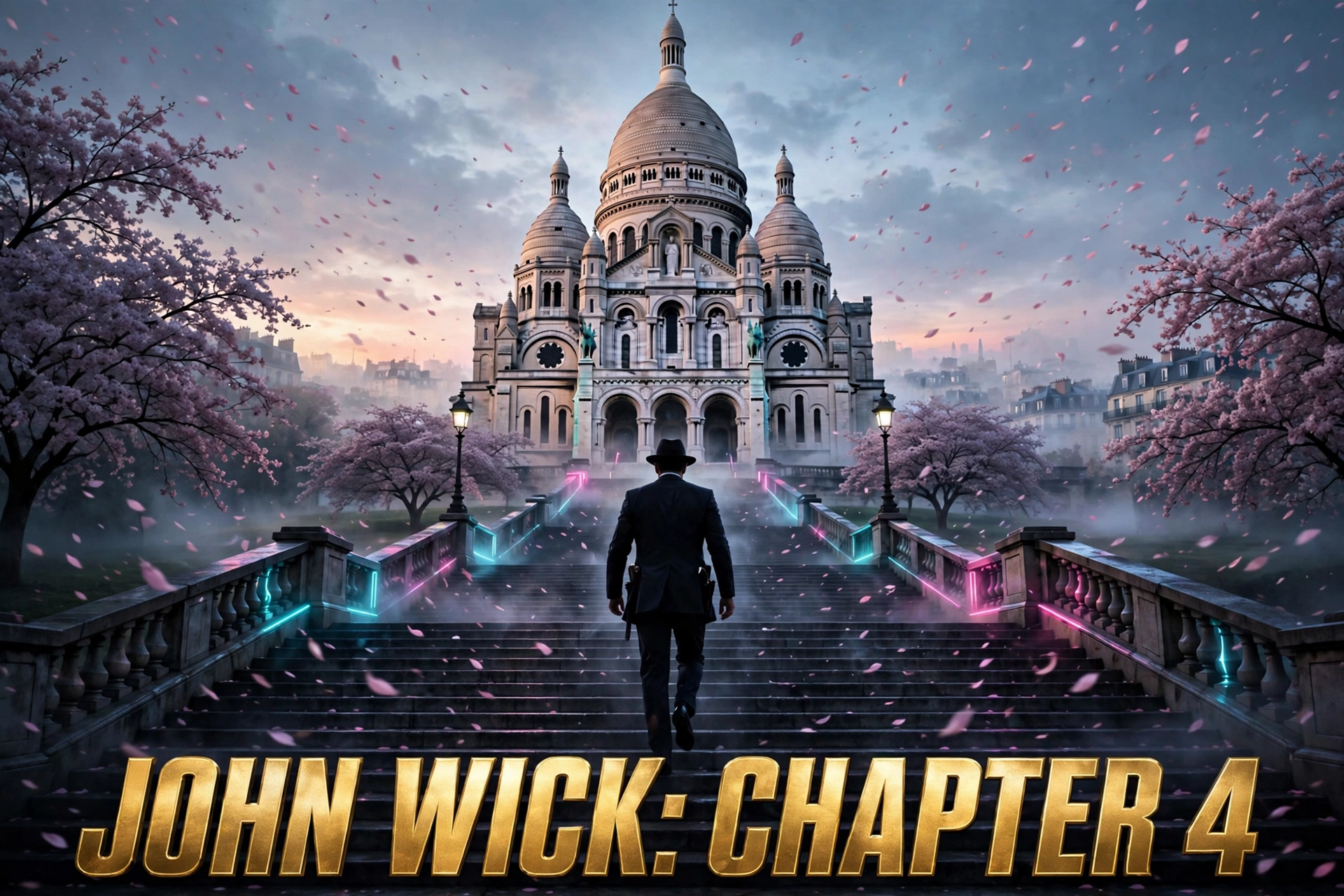
Three set pieces define the film. The Osaka Continental siege mixes swordplay, gun work, and armour-plated enemies in long, readable takes. The Berlin club fight uses water, crowds, and pounding music without losing track of its fighters. In Paris, a top-down apartment sequence, shot to resemble a living floor plan while John uses incendiary rounds, is a genuine technical showpiece, and the extended fight up the steps towards Sacré-Cœur turns exhaustion itself into comedy, suspense, and character. Editor Nathan Orloff mostly preserves clarity, resisting the shaky, over-cut style that ruins many studio action films.
The cost of this ambition is length. At 169 minutes, the film has sequences that are thrilling individually but repetitive in accumulation. A subplot or two could have been trimmed, and the middle section in Berlin, while beautiful, delays the Paris endgame without adding much new information. Visual effects support the stunts rather than replacing them, which is the right choice, though a few digital extensions and falls look noticeably less convincing than the practical work around them.
Music and Background Score
Tyler Bates and Joel J. Richard return to score the film, blending electronic pulse, strings, and western touches that suit a story increasingly framed as a duel between ageing gunfighters. Their music rarely tells you exactly what to feel in the crude way some action scores do. Instead, it sets a tempo for movement, drops away for a blade exchange, then surges when a fight changes gear.
Licensed tracks are used sparingly and with personality, from club music in Berlin to a stylish montage in Paris where radio warnings and a classic French-flavoured cover create a strange, elegant calm before the final stretch. Sound design deserves equal credit. Gunshots have distinct weight by weapon and space, blades scrape, bodies hit furniture with ugly thuds, and Caine’s world is partly expressed through small sounds, clicks, bells, and shifting feet, that other characters might miss. In a series built on physical storytelling, that attention to audio detail is not decoration. It is part of the choreography.
What Works and What Doesn’t
What we loved:
- Donnie Yen’s Caine, a funny, sorrowful, and completely original addition to the series
- Action choreography and cinematography that stay clear, inventive, and physically impressive across multiple cities
- A visual identity for each location, from Osaka’s warmth to Paris at dawn
- Reeves’s weary, committed performance, selling both skill and exhaustion
What could be better:
- At 169 minutes, the film is overlong, with a middle section that repeats beats
- The plot is very thin for the running time, and the Marquis sometimes feels more like a costume than a character
- A few digital effects stand out against otherwise strong practical stunt work
Box Office: The Biggest Chapter Yet
John Wick: Chapter 4 cost a reported $100 million to produce, the largest budget in the series to that point, and grossed about $447.3 million worldwide, with roughly $187 million from North America and about $260 million from international markets. It opened in the United States with about $73.8 million, the best opening of the franchise, and finished as the highest-grossing John Wick film.
This series began in 2014 as a modest revenge thriller. By Chapter 4, it had become a global franchise built on craft, word of mouth, and Reeves’s reputation for doing the work, and it kept interest alive for spin-offs including Ballerina.
Verdict: Should You Watch It?
If you enjoy action cinema at all, yes. John Wick: Chapter 4 is overlong, narratively slight, and occasionally in love with its own mythology, but at its best it offers sequences you simply will not see executed this well elsewhere. It respects stunt performers, choreographers, and the audience’s ability to follow a fight without a cut every second. That respect is rarer than it should be.
Newcomers should start with the first film, which is shorter, cleaner, and more emotionally direct. Fans of the series will find this a satisfying, often stunning escalation that also feels like a natural place for John’s personal story to pause. It does not reinvent the series, and it does not need to. It refines its strengths to a high shine, then asks its hero, and its audience, how much more punishment either really needs.
Our rating: 8/10 — A visually gorgeous, exhaustingly inventive action epic held back only by its length and thin story.
Frequently Asked Questions
Is John Wick: Chapter 4 a sequel, and should I watch the earlier films first?
Yes, it directly follows Chapter 3 – Parabellum and assumes you know John, Winston, the High Table, and why John is being hunted. Watch the first three films first for the full effect.
Is John Wick: Chapter 4 based on a true story?
No. It is an original fictional story using characters created by Derek Kolstad, though its underworld rules, duels, and codes are inspired by crime films, westerns, and samurai cinema.
What language is the film in, and are subtitles available?
The main language is English, with some Japanese, French, German, and other languages in specific scenes. Subtitles are widely available on home and streaming releases, depending on your region.
Where can I watch John Wick: Chapter 4?
Availability changes by country. Check major streaming services, digital purchase and rental platforms, and local listings rather than relying on an old announcement, as rights move between services.
How long is the film, and what is its age rating?
It runs 169 minutes and is rated R in the United States for pervasive strong violence and some language. It is considerably more violent and longer than a typical action film, so plan an intermission for a home viewing if you need one.