
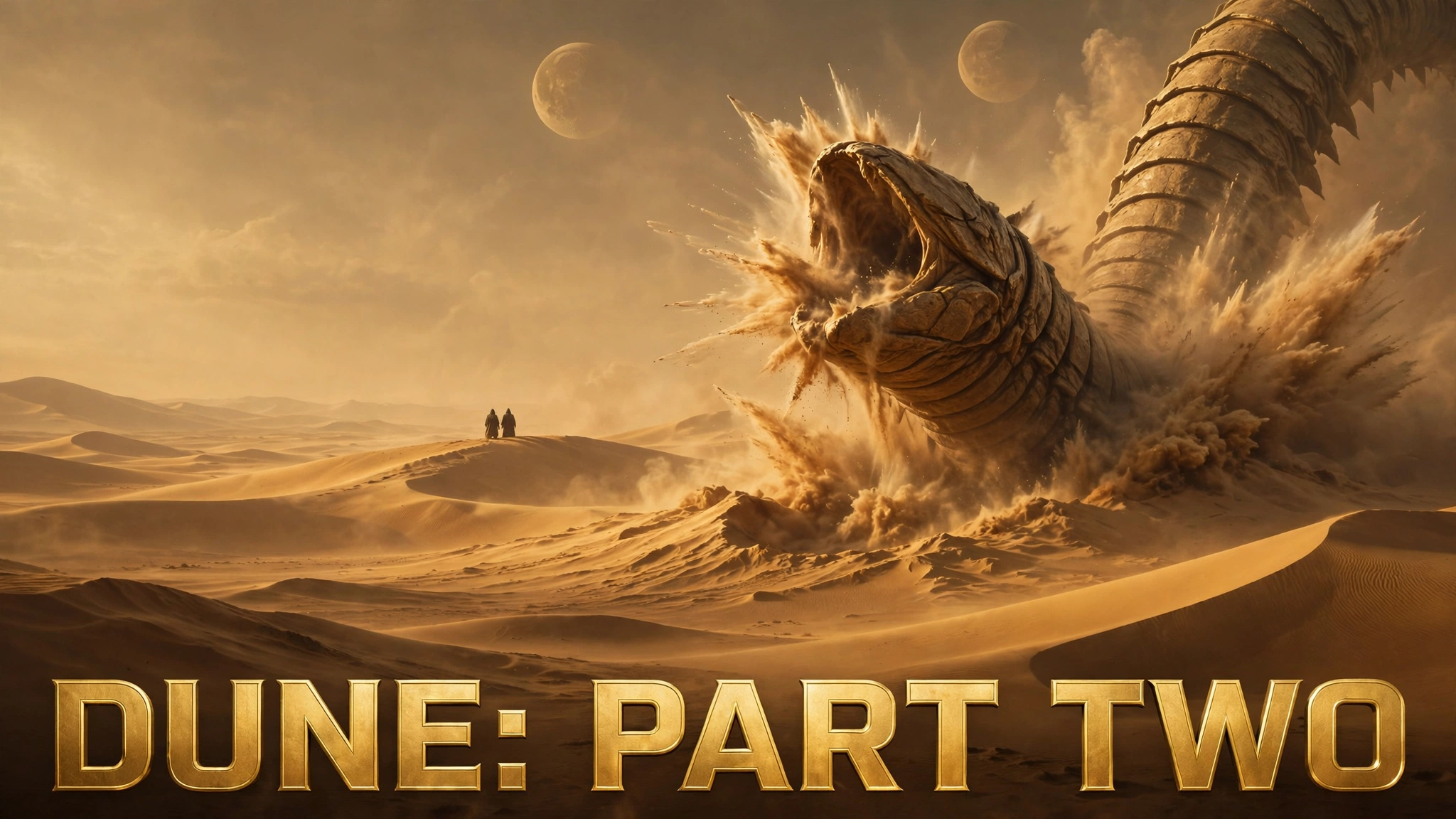

Dune: Part Two (2024) Review – A Desert Epic That Actually Earns Its Scale
Some sequels simply repeat what worked before, only louder. Dune: Part Two does something rarer. It takes the careful, sometimes distant world-building of the first film and turns it into a story with a pulse, a warning, and a genuine sense of danger. Where Part One often felt like an elegant introduction, this chapter feels like the argument itself, about power, belief, revenge, and how easily a liberator can start to resemble a tyrant.
That shift matters, because the film could easily have collapsed under its own reputation. It arrives with enormous expectations, a beloved source novel, and visuals that were praised long before anyone discussed its ideas. Yet for most of its running time, it stays focused on people making choices they cannot take back. Paul Atreides is not presented as a clean hero riding towards a happy ending. He is a young man learning a harsh culture, falling in love, and hearing a version of his own future that should frighten him as much as it tempts him.
Its final stretch moves very fast, but its ambition is matched by discipline. In this review, we give you an honest breakdown of the story, performances, craft, music, and box office, without spoiling the ending.
Quick Facts: Dune: Part Two at a Glance
| Detail | Information |
|---|---|
| Release date | 1 March 2024 (United States) |
| Director | Denis Villeneuve |
| Writers | Denis Villeneuve, Jon Spaihts, based on the novel by Frank Herbert |
| Genre | Sci-Fi, Adventure |
| Language | English |
| Runtime | 166 minutes |
| Budget | $190 million |
| Lead cast | Timothée Chalamet, Zendaya, Rebecca Ferguson, Austin Butler, Florence Pugh |
| Our rating | 9/10 |
The Story: Revenge, Faith and a Future Paul Fears (Spoiler-Free)
The film picks up after House Atreides has been shattered and Paul and his mother Jessica are surviving among the Fremen, the desert people of Arrakis. Paul is learning their ways, from moving across sand without attracting a worm to understanding why water is treated as more precious than gold. With Chani, a Fremen fighter who does not automatically buy into prophecy, he takes part in attacks on spice harvesting operations run by the Harkonnens, the brutal family now controlling the planet for the Emperor.
In ordinary sequel language, that would be the whole pitch: the exiled heir trains, fights back, and claims his destiny. Villeneuve and co-writer Jon Spaihts keep pulling that simple revenge story in a more troubling direction. Religious stories about Paul have been seeded among the Fremen for generations, and Jessica, a member of the Bene Gesserit sisterhood, understands exactly how belief can be used as a political weapon. Some Fremen see Paul as a saviour. Others, including Chani, see a person who should be judged by what he does, not by what old prophecies claim.
Meanwhile, the Harkonnen response grows more vicious. Baron Vladimir Harkonnen turns to his nephew Feyd-Rautha, a celebrated and terrifying fighter on the Harkonnen home world, to restore control of Arrakis. On the imperial side, Princess Irulan watches events with a colder, more strategic eye, aware that control of spice means control of travel, trade, and the empire itself.
The premise is therefore both intimate and vast. Paul must decide what kind of leader he is willing to become, knowing that the path that gives him revenge may also unleash violence far beyond Arrakis. The film does not spoil its own tension by making that choice feel easy, and this section will not reveal how it resolves.
Performances: Chalamet Grows Up On Screen
Timothée Chalamet as Paul Atreides — This is the performance that answers the main question left by the first film: can Chalamet carry not just grief and sensitivity, but authority? He can, though the film wisely makes that authority unsettling rather than simply heroic. Early on, he listens, watches, and learns. Later, when his voice hardens in public scenes, the change feels earned because we have seen how much doubt sits underneath it.
Zendaya as Chani — Zendaya is the film’s emotional conscience, and she gives its most important performance after Chalamet. Chani is not written as a reward for the hero. She is a soldier with her own loyalties, humour, and deep suspicion of outsiders who arrive carrying myths. Her love for Paul is believable precisely because it is not blind, and her reactions in the later scenes give the spectacle a human cost that the dialogue alone could not supply.
Austin Butler as Feyd-Rautha Harkonnen — Butler disappears into a role that could have been a cartoon. Pale, hairless, and almost reptilian in movement, Feyd-Rautha enjoys cruelty as performance. What makes him effective is not just menace but vanity. He wants to be admired while he frightens people, and that need makes his arena scenes and his political scenes equally revealing.
Rebecca Ferguson as Lady Jessica — Ferguson becomes more frightening here than she was in the first film, in a quieter way. Jessica’s transformation is handled through posture, voice, and certainty. She is a mother protecting her children and a political operator spreading a faith she knows has been engineered. Ferguson lets both truths exist at once.
Florence Pugh as Princess Irulan and Christopher Walken as Emperor Shaddam IV — Pugh brings intelligence and restraint to a small but pivotal role; you sense a mind constantly calculating the next decade, not just the next scene. Walken is more muted, playing power as tired entitlement rather than theatrical evil, though his limited screen time means the Emperor feels slightly less vivid than the other major players. Javier Bardem, as Stilgar, provides warmth and fervent belief in equal measure, and is often the bridge between the audience and Fremen culture.
Direction and Technical Craft
Villeneuve directs scale better than almost any working filmmaker, but his real strength is patience. He allows a desert crossing, a ritual, or a worm ride to develop its own rhythm instead of cutting it into noise. When action does arrive, it tends to be clear in geography and heavy in consequence. You understand where fighters are, what they are trying to reach, and why a mistake matters.
Greig Fraser’s cinematography gives each world a distinct moral temperature. Arrakis is not simply orange. It shifts from blinding white heat to bruised dusk tones, making the desert feel beautiful and hostile at the same time. The Harkonnen world of Giedi Prime is shot in stark black and white under its black sun, a bold choice that makes its arena sequence feel like a nightmare newsreel from another species. Costumes and production design support the same idea: Fremen gear looks repaired, practical, and lived in, while imperial and Harkonnen spaces feel designed to intimidate.
Editing keeps a long film moving, though not always evenly. The middle section, where Paul is absorbed into Fremen life, is the film’s richest stretch. The final act compresses several major developments into a short space, and a couple of transitions feel abrupt. Visual effects, overseen with unusual restraint, blend with real desert locations in Abu Dhabi and Jordan. The sandworms have weight. Machines kick up dust. Nothing floats in that weightless digital way that weakens so many modern blockbusters. The film later won Academy Awards for Best Sound and Best Visual Effects, and neither honour feels surprising when you experience how fully the world presses in around the characters.
Music and Background Score
Hans Zimmer’s score is not background decoration. It is a pressure system. He builds on themes from the first film with voices, drums, bagpipe-like textures, and electronic pulses that feel ancient and futuristic at once. The love theme associated with Paul and Chani is more tender than you might expect from Zimmer at full scale, and that tenderness becomes sadder as the story darkens.
Crucially, Zimmer and the sound team know when to pull back. Desert scenes sometimes play with wind, fabric, breathing, and the rhythmic thump of a thumper device calling a worm. When the full score returns, it lands harder. The arena sequence on Giedi Prime uses sound to create dread rather than excitement alone, and the worm-riding set piece is thrilling partly because the music grows with Paul’s confidence instead of overwhelming it from the start.
What Works and What Doesn’t
What we loved:
- A central performance from Chalamet that turns doubt into dangerous authority without losing Paul’s vulnerability
- World-building that feels physical and cultural, not just explained in dialogue
- Stunning cinematography and sound design that make Arrakis feel real, hostile, and awe-inspiring
- A love story that challenges the hero myth instead of simply decorating it
What could be better:
- The final act is rushed, with major political and military turns arriving very quickly
- Some newcomers and returning viewers may struggle with dense names, factions, and prophecy terms early on
- A few important figures, particularly the Emperor, get less development than their importance suggests
Box Office: A Major Hit That Outran the First Film
Dune: Part Two was made on a reported budget of $190 million and grossed about $714.8 million worldwide. That was a clear step up from the first film, which had to contend with pandemic conditions and a simultaneous streaming release in the United States. The sequel opened at number one in North America on 1 March 2024, with a domestic opening reported at around $82.5 million, and it showed strong legs in premium formats such as IMAX.
Context matters here. This was not a superhero film or a family animation title with built-in four-quadrant merchandise appeal. It was a long, serious science-fiction epic adapted from a dense 1960s novel, with a downbeat warning about charismatic leaders at its centre. Grossing over $714 million showed that Villeneuve had turned a book once considered difficult to film into a genuine mainstream event, and it made a third film, based on Dune Messiah, a realistic prospect rather than a fan hope.
Verdict: Should You Watch It?
Yes, especially on the biggest screen you can still find, or at home with the best sound setup available to you. Dune: Part Two is blockbuster filmmaking with a brain, a heart, and a willingness to make its hero’s victory feel complicated. It works as spectacle, as a love story, and as a cautionary tale about how revenge and religion can fuse into something no one can control.
It asks more of the audience than a typical franchise sequel, and its hurried ending stops it just short of perfection. But very few films of this size feel this carefully made, this well acted across the ensemble, or this confident in silence as well as noise. If you bounced off the first film for being too slow, this one is more propulsive. If you loved the first, this is the payoff, darker and richer than you may expect.
Our rating: 9/10 — A towering, troubling sci-fi epic that delivers spectacle with real moral weight.
Frequently Asked Questions
Is Dune: Part Two a direct sequel, and do I need to watch Part One first?
Yes, it continues the same adaptation and assumes knowledge of the first film. A quick recap will help, but watching Part One first is strongly recommended.
Is Dune: Part Two based on a book?
Yes. Together, the two films adapt Frank Herbert’s 1965 novel Dune. Villeneuve splits the book across both films rather than covering a separate sequel novel.
Will there be a Dune: Part Three?
A third film based on Dune Messiah, Herbert’s follow-up novel, has been in development. It is not part of this film’s story, so Part Two still gives you a complete chapter ending.
What language is the film in, and are subtitles available?
The film is primarily in English, with invented languages used for Fremen and other cultures. Home and streaming releases typically offer subtitles in multiple languages, depending on your region and provider.
Where can I watch Dune: Part Two, and what is its age rating?
Availability changes by country and over time, so check your local cinema listings, digital purchase stores, and major streaming services. It is rated PG-13 for sequences of strong violence, brief strong language, and some suggestive material, and runs 166 minutes.