
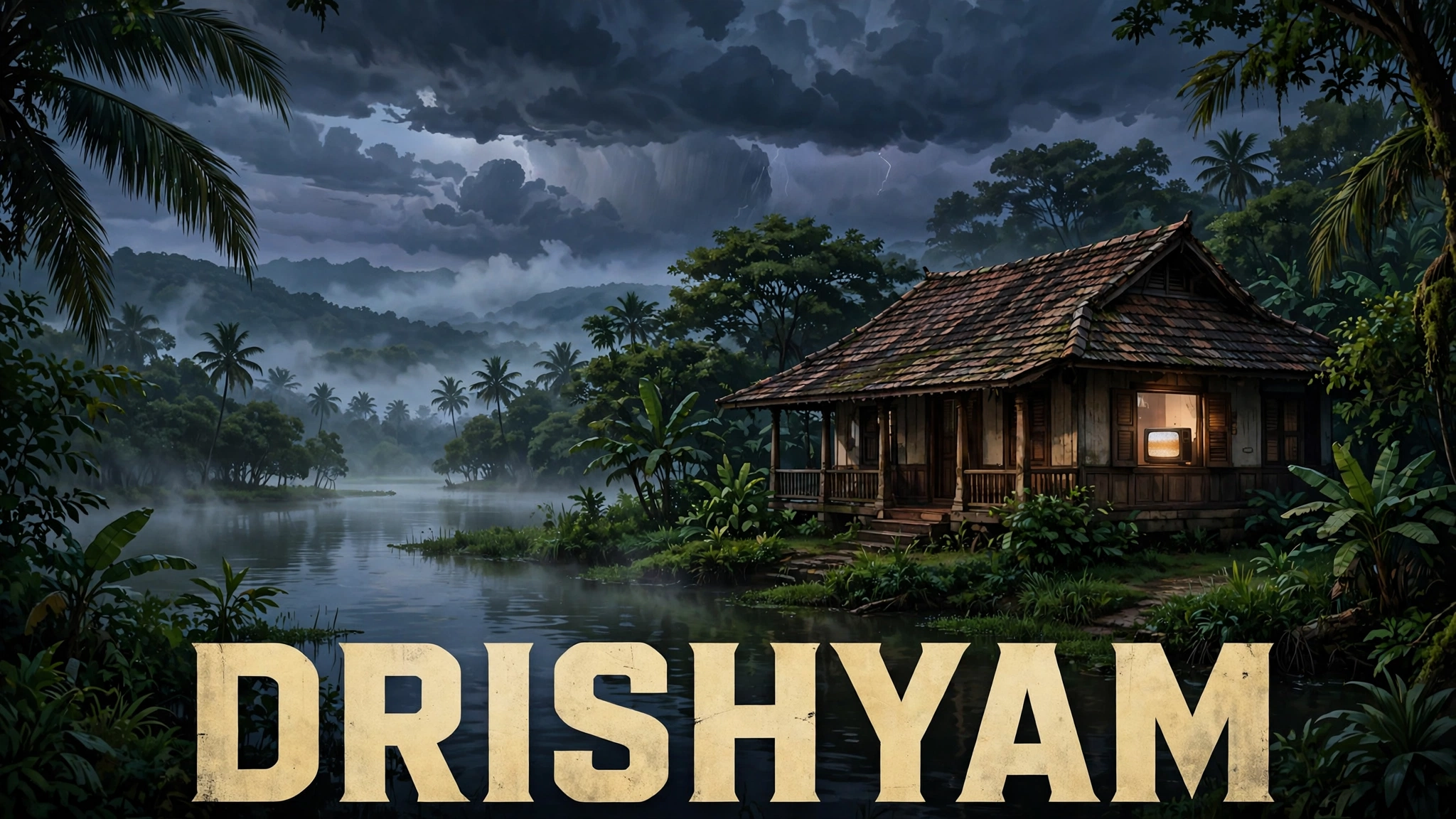

Drishyam (2013) Review – How Far Can a Father Go to Protect His Family?
The most dangerous man in Drishyam has no gun, no political power and no formal education worth mentioning. He runs a small cable-TV business in a sleepy Kerala town, failed the fourth standard at school, and has one qualification nobody can match: he has watched thousands of films, and he remembers every trick they ever taught him. Released on 19 December 2013, Jeethu Joseph’s Malayalam crime thriller built a phenomenon out of that simple idea — and became, at the time, the highest-grossing Malayalam film ever made.
This is a review of the original 2013 Malayalam film with Mohanlal — not the Hindi remake or any of its other versions. The remakes are fine films in places, but the original has a texture, a patience and a lead performance that none of them fully reproduced. Here is why it still stands as one of the finest Indian thrillers ever made, and where, honestly, it shows its age.
Quick Facts: Drishyam at a Glance
| Detail | Information |
|---|---|
| Release date | 19 December 2013 |
| Director | Jeethu Joseph |
| Writers | Jeethu Joseph |
| Genre | Crime, Thriller, Drama |
| Language | Malayalam |
| Runtime | 164 minutes |
| Budget | Approx. ₹3.5–5 crore |
| Lead cast | Mohanlal, Meena, Ansiba Hassan, Esther Anil, Asha Sharath |
| Our rating | 9/10 |
The Story: An Ordinary Family, an Unthinkable Night (Spoiler-Free)
Georgekutty (Mohanlal) is a self-made man in the high ranges of Kerala: an orphan who built a modest cable network business, married Rani (Meena), and raised two daughters, the teenage Anju (Ansiba Hassan) and little Anumol (Esther Anil). He is frugal to the point of comedy, obsessed with cinema to the point of eccentricity, and utterly devoted to the small, happy world he has built.
That world cracks when Anju returns from a school nature camp and is confronted by Varun (Roshan Basheer), a fellow student who secretly filmed her in a bathroom at the camp and now tries to blackmail her with the video. One terrible night at the Georgekutty home, the confrontation ends in an accident that leaves an ordinary family staring at a catastrophe — made infinitely worse by who Varun is: the only son of Geetha Prabhakar (Asha Sharath), the Inspector General of Police.
What follows is not a chase film but a chess match. Georgekutty, drawing on a lifetime of movie plots, constructs an alibi for his family out of bus tickets, restaurant bills, phone records and the fallible memories of everyone who saw them — then has to defend that construction against a police force that includes both a principled, formidable IG and a corrupt local constable, Sahadevan (Kalabhavan Shajohn), who hates him. To say more would be theft: Drishyam‘s pleasures are in watching ordinary details become weapons, and in a final movement that recontextualises everything you have seen. We will not spoil it here.
Performances: Mohanlal at His Quiet, Devastating Best
Mohanlal as Georgekutty delivers one of the defining performances of his career — and he does it by doing almost nothing, loudly. There are no star mannerisms for long stretches: this is a soft-spoken, slightly henpecked husband who counts every rupee. But watch his eyes during the interrogation scenes, the way calm and calculation coexist, and you understand why this role could only belong to him. The performance’s masterstroke is that Georgekutty’s genius never stops being a father’s fear; Mohanlal plays the love first and the cleverness second, which is exactly why the audience stays loyal to a man obstructing a murder investigation.
Meena as Rani is the film’s conscience and its ache. Rani cannot perform the way her husband can, and Meena makes that fragility painfully real — her breakdown points are where the film’s tension peaks, because the alibi’s weakest link is a mother’s nerves. Ansiba Hassan as Anju and Esther Anil as Anumol are both natural; Esther, in particular, has a crucial interrogation scene that is unbearable in the best way.
Asha Sharath as IG Geetha Prabhakar is the film’s secret weapon — a grieving mother and a brilliant investigator in the same body, whose professional brilliance and personal helplessness tear at each other. Kalabhavan Shajohn as Sahadevan is loathsomely effective as the corrupt constable whose petty grudge drives the investigation’s cruellest turns, and Siddique as Prabhakar, the boy’s father, brings quiet dignity to a role that could easily have been one-note.
Direction and Technical Craft
Jeethu Joseph’s direction is a lesson in patience. The first hour deliberately moves at the speed of small-town life — Georgekutty’s office banter, family teasing, the local tea shop filmed like a second home. Critics at the time noted the slow start; defenders argue, correctly, that the slowness is the strategy. Every shopkeeper, every bus route, every casual routine established in that gentle first act becomes load-bearing in the second, and the audience, having lived in this world, can feel the investigation tightening like a hand around a throat.
Sujith Vaassudev’s cinematography keeps the high-range greenery beautiful and the interiors ordinary — the film’s realism is its special effect. Ayoob Khan’s editing deserves special praise for the parallel construction of the investigation sequences, where the same events are rebuilt from police logic and family memory until you can no longer be sure which version you believe. The film’s craft is not flawless: a subplot involving Georgekutty’s father-in-law feels underdeveloped, and a few scenes in the mid-section restate tension the audience already feels. But as an exercise in screenplay engineering, Drishyam is close to perfect — its structure has since been studied, copied and remade across India and beyond.
Music and Background Score
With only two songs — composed by Vinu Thomas and Anil Johnson — Drishyam lives and dies by its background score, and Anil Johnson’s work is exactly right: sparse, string-led, and willing to go quiet at the moments other thrillers would shout. The score’s restraint mirrors Georgekutty himself; it lets the performances and the ticking-clock editing generate the dread, swelling only in the final movement, where it lands with accumulated force. The songs themselves are pleasant and brief, serving the family-warmth passages of the first act rather than interrupting the thriller machinery.
What Works and What Doesn’t
What we loved:
- A screenplay of clockwork precision in which almost every detail pays off
- Mohanlal’s career-defining understatement, matched by Meena and Asha Sharath
- An investigation-versus-alibi structure that keeps outsmarting the audience fairly
- An ending that is both shocking and, on reflection, inevitable
What could be better:
- The first act’s leisurely pace will test impatient viewers, even if it pays off
- A couple of supporting subplots are thinner than the main thread deserves
- Some dialogue scenes run long once the film’s machinery is already clear
Box Office: The Little Film That Rewrote Malayalam Cinema’s Ceiling
Numbers must be handled carefully here, because Drishyam was made in an industry that did not then publish figures the way it does now. Sources agree on the shape of the story: produced on a modest budget reported between roughly ₹3.5 crore and ₹5 crore, the film became the first Malayalam release to cross ₹50 crore at the box office, with most reports placing its worldwide total around ₹62 crore (some estimates run higher). It ran for over 150 days in theatres, remained the highest-grossing Malayalam film of all time until Pulimurugan passed it in 2016, and — perhaps its most astonishing legacy — was remade in Telugu, Tamil, Kannada and Hindi within a few years, with versions in other languages following. A film this small does not change an industry’s sense of the possible by accident.
Why the Remakes Keep Coming Back to This Film
The clearest measure of Drishyam‘s quality is how often Indian cinema has returned to it. Within a few years the same story had been retold in Telugu, Tamil, Kannada and Hindi, each time with that industry’s biggest star in the Georgekutty role, and the remakes were hits in their own right. Yet even strong versions tend to sand down what makes the original distinctive: the unhurried portrait of a specific Kerala town, the lived-in ordinariness of the family home, and Mohanlal’s refusal to signal cleverness before the story requires it. Watching the original after the remakes is an instructive experience — the plot beats are familiar, but the patience is not, and it is the patience that makes the final act feel less like a twist and more like a trap closing that was built, quietly, in the film’s very first scenes.
Verdict: Should You Watch It?
If you have only seen a remake, you owe yourself the original: the performances are finer-grained, the small-town Kerala texture is irreplaceable, and the final reveal lands hardest here. If you have never seen any version, clear an evening, avoid every spoiler, and let Georgekutty teach you what a lifetime of watching movies can do. The opening hour asks for patience; the remaining hundred minutes repay it many times over.
Our rating: 9/10 — a near-perfect thriller, and the gold standard for Indian cover-up dramas.
Frequently Asked Questions
Is Drishyam based on a true story?
No. It is an original fictional screenplay by Jeethu Joseph. Its realism — the procedures, the alibi construction, the small-town setting — is crafted, not documentary.
Is Drishyam (2013) the original, or is the Hindi film the original?
The Malayalam film of 2013, starring Mohanlal, is the original. The Hindi Drishyam (2015) with Ajay Devgn is a remake, as are the Telugu, Tamil and Kannada versions.
Does Drishyam have a sequel?
Yes — Drishyam 2 (2021), again directed by Jeethu Joseph with Mohanlal, continues Georgekutty’s story several years later and was widely praised as a worthy successor.
Is Drishyam suitable for family viewing?
It contains no graphic content, but its themes — blackmail, a death, police brutality in interrogation scenes — are adult and intense. It is best suited to teens and above.
Where can I watch Drishyam (2013)?
The Malayalam original streams on major platforms in many regions, with subtitles. Availability changes over time, so check your local services.