★ LATEST REVIEWS

Our Rating: ★★☆☆☆ 3/10
There is a special kind of fame that only a 0% Rotten Tomatoes score can buy. Christmas at the Kringles arrived on Halloween weekend 2026 as the season’s only major horror release, boasting a cast of beloved comedy performers, a premise with genuine cult potential, and a director coming off the cult success of Willy’s Wonderland. It left the weekend with 19 negative reviews out of 19, an average rating of 3.1 out of 10, one of the worst per-screen averages of any wide horror release of the year, and — paradoxically — more people talking about it than about most of the films that beat it. This review will be honest about both halves of that story: the film is, by most measures, bad. It is also, in places, the kind of bad that has a future.
This review is spoiler-free on the film’s later reveals. The premise gives away most of the fun anyway.
| Release date | 30 October 2026 (United States); premiered at Screamfest on 15 October 2026. |
| Director | Kevin Lewis |
| Writer | Zack Imbrogno |
| Genre | Action comedy horror |
| Language | English |
| Runtime | 98 minutes |
| Lead cast | Ron Livingston, Rachel Bilson, Rob Riggle, Thomas Lennon, Arden Myrin, Beverly D’Angelo, David Wain, Donald Faison |
| Our rating | 3/10 |
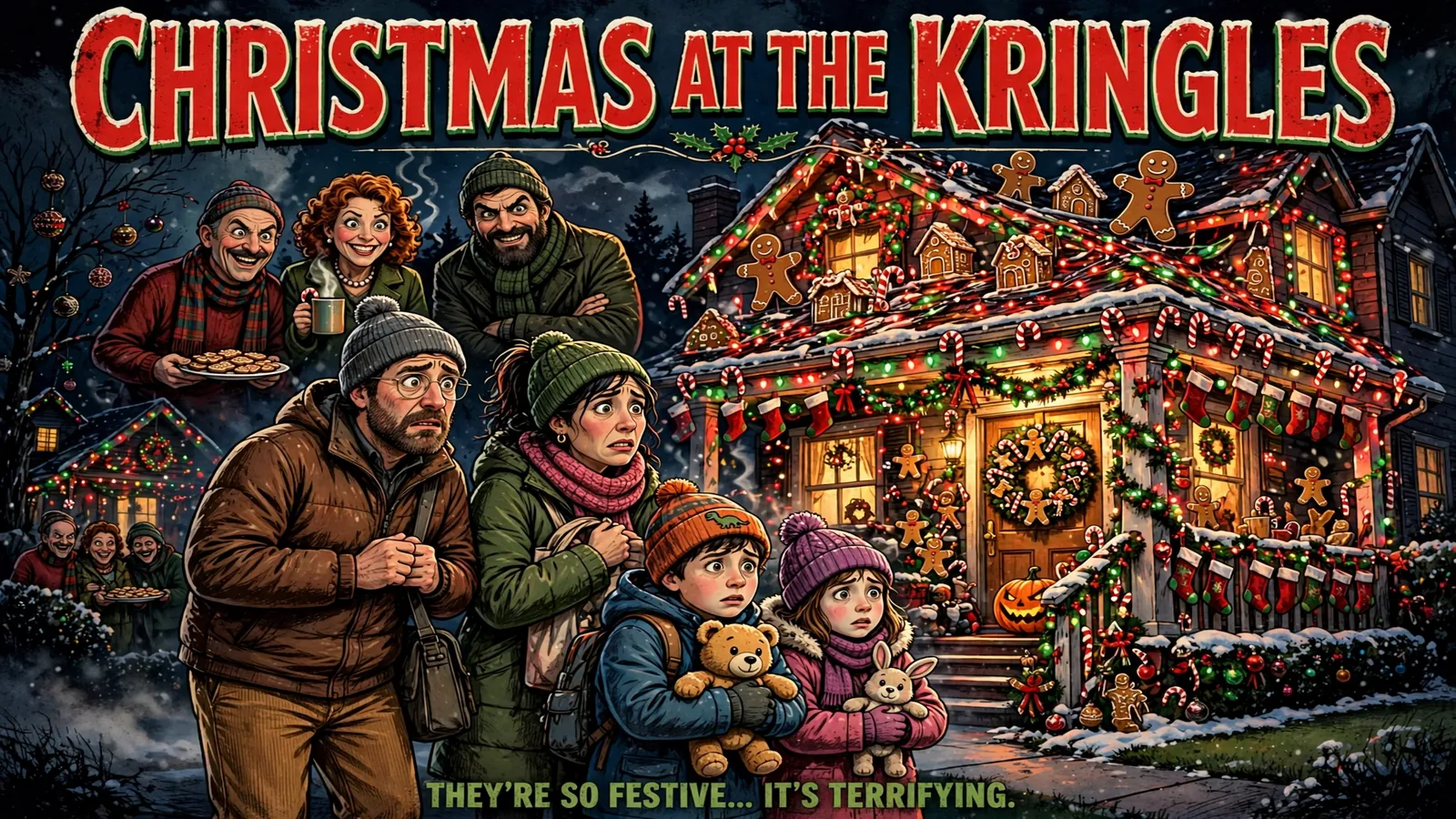
Mark Severson (Ron Livingston) and his wife Julie (Rachel Bilson) move with their young son Bobby to a quiet suburb, hoping the fresh start will help a strained marriage. Their new next-door neighbours, Nick and Carol Kringle (Thomas Lennon and Arden Myrin), are warm, welcoming and completely obsessed with Christmas — not just in December, but every single day, all year, with a fervour that starts as a joke and curdles into something stranger. The Kringle house is a monument to the season: stockings, towering gingerbread constructions, a sprawling tree draped in lights, all in saturated reds and greens that look inviting at first glance and gradually acquire a claustrophobic edge. Behind the cheer, the film suggests, is a suburban carnage cult with a recruitment video, a leader played by David Wain, and a doctrine of perpetual joy that its members enforce with enthusiasm. Mark, meanwhile, joins forces with an alcoholic mall Santa to fight back.
That is a genuinely good premise — Get Out meets National Lampoon’s Christmas Vacation by way of Willy’s Wonderland — and the film’s first act has real promise. Lennon and Myrin, as the Kringles, are the film’s best asset: funny, creepy and committed, selling both the joke and the threat. Livingston grounds the film with weary pragmatism, and Bilson brings a restrained urgency to Julie’s growing doubt that something is deeply wrong next door. The production design is a delight in itself: the Kringle house is the rare horror location you remember after the film ends.
Where the film collapses is in everything after the premise. Critics were unusually united: the comedy of the first act is painful rather than funny, the tension the film tries to build later is dialled up so far that it stops functioning, and the worldbuilding is haphazard — Riggle’s character in particular was called nonsensical by multiple reviewers. The script gives away its full picture early and then has nowhere to go, so the middle sags into repetitive displays of Kringle excess while the emotional stakes dilute. By the time the action climax arrives, the film has spent its best ideas and is running on noise.
Ron Livingston as Mark — Livingston does what he has always done: play an ordinary man ground down by work and worry, and make it believable. His frustration is palpable, his marriage strain feels real, and he holds the film’s centre even when the script abandons him.
Rachel Bilson as Julie — Bilson is restrained and effective, conveying both Julie’s longing for stability and her creeping certainty that the neighbours are dangerous. She deserves a better film, and she nearly wills this one into being one in her scenes.
Thomas Lennon and Arden Myrin as the Kringles — The film’s real stars. Lennon and Myrin steal every scene they are in, balancing sitcom cheer with cult menace, and their performances are the main reason the film may find a second life as a cult curio.
Rob Riggle, Beverly D’Angelo, Donald Faison and David Wain — Rob Riggle, Beverly D’Angelo, Donald Faison and David Wain round out an ensemble of seasoned comic performers who are all, visibly, trying hard — which makes the film’s failure feel more like a script problem than a talent problem.
Kevin Lewis directs with a keen eye for visual contrast — the film looks good, with saturated holiday colours against suburban drabness — but the tone never settles. The film wants to be a comedy, a horror film and an action film at once, and it ends up being none of them convincingly. The first act’s jokes land flat, the horror never builds dread because the film shows its hand too early, and the action climax feels grafted on from a different movie. Lewis’s Willy’s Wonderland worked because its premise was simple and its execution was deadpan; Christmas at the Kringles has a premise that needs careful escalation, and the film escalates everything except the story.
The score leans on Christmas music warped just enough to be unsettling — carols that sour, jingles that repeat one time too many — and in the film’s best moments that warping does real work. But the sound design, like the script, eventually mistakes volume for menace, and the later scenes become loud without becoming scary.
What we loved:
What could be better:
The numbers tell the story plainly. Christmas at the Kringles opened in 1,825 US theatres over Halloween weekend to just $675,000 — a per-screen average of $369, the 132nd lowest wide debut per-screen average of all time, and a record low for a 2026 horror film opening on more than 1,000 screens. Halloween falling on a Saturday hurt, as did competition from the second weekend of Clayface and the surging Resident Evil, but no calendar excuse covers a $369 average. Audiences were slightly kinder than critics — the Popcornmeter later settled around 40% against the critics’ 0% — but only slightly. The film’s total reported gross stood around $710,000 shortly after opening weekend. Its commercial future, if it has one, is as a cult streaming curiosity, not a theatrical success.
Only if you enjoy glorious failures. Christmas at the Kringles is not a good film, and this review will not pretend otherwise — the script is weak, the comedy misfires, and the scares never land. But it has a great premise, two wonderful performances from Lennon and Myrin, and a 0% score that makes it a genuine piece of film history. Watch it with friends, with low expectations and a willingness to laugh at it rather than with it, and you may have a better time than its opening-weekend audiences did. Just do not expect a hidden masterpiece. The critics, for once, were right.
Our rating: 3/10 — A failed horror-comedy with a cult premise and two scene-stealing performances, sunk by a script that shows its hand early and jokes that never land.
What is Christmas at the Kringles about?
A suburban family moves next door to neighbours who celebrate Christmas every single day, and discovers their relentless cheer hides a violent cult-like devotion to perpetual joy.
Who stars in Christmas at the Kringles?
Ron Livingston and Rachel Bilson as the Seversons, with Thomas Lennon and Arden Myrin as Nick and Carol Kringle, plus Rob Riggle, Beverly D’Angelo, David Wain and Donald Faison.
Who directed Christmas at the Kringles?
Kevin Lewis, director of Willy’s Wonderland, from a screenplay by Zack Imbrogno.
When was Christmas at the Kringles released?
It premiered at Screamfest on 15 October 2026 and opened in US theatres on 30 October 2026.
How long is Christmas at the Kringles?
98 minutes, rated R for horror violence and language.
Why does Christmas at the Kringles have 0% on Rotten Tomatoes?
All 19 critics’ reviews counted at launch were negative, averaging 3.1 out of 10, with individual scores as low as a D- and 0 out of 5; the audience Popcornmeter was higher, around 40%.
How much did Christmas at the Kringles earn?
About $675,000 in its opening weekend from 1,825 US theatres, a per-screen average of $369.