★ LATEST REVIEWS

★★★★★ Our Rating: 9.5/10
Every few years a sequel arrives that does not merely repeat its predecessor but understands it — takes everything the first film promised and delivers it with more confidence, more heart and more craft. Paddington 2, directed by Paul King and released in the United Kingdom in November 2017, is the modern gold standard for that achievement. Picking up Michael Bond’s marmalade-loving bear where the delightful 2014 film left him, it tells a story of a stolen pop-up book, a framed bear and a prison transformed by kindness, and it does so with a precision of filmmaking — visual, musical, emotional — that most dramas for adults never approach. For a period it held a perfect 100% approval rating on Rotten Tomatoes across hundreds of reviews, and the honest surprise, watching it, is how completely it earns that reputation.
A Paddington 2 review also has to reckon with its strange public afterlife: the “Citizen Kane of family films” headlines when it briefly topped review rankings, the single late negative review that ended its perfect score in 2021 and was treated internationally as news, and its coronation in poll after poll as one of the greatest sequels ever made. Hype like that usually crushes a gentle film. This one survives it because the hype, unusually, is accurate — with one or two small qualifications we will note, as any fair review should.
This review covers the spoiler-free story, a cast operating at the very top of its game — including a career-best Hugh Grant — King’s extraordinarily inventive direction, Dario Marianelli’s score, what works and what does not, and the box office, where the figures need untangling because two different worldwide totals are both in circulation and both, in their own way, are true.
| Detail | Information |
|---|---|
| Release date | 10 November 2017 (United Kingdom) |
| Director | Paul King |
| Writers | Paul King, Simon Farnaby, based on the stories by Michael Bond |
| Genre | Family, Comedy, Adventure |
| Language | English |
| Runtime | 103 minutes |
| Budget | $40 million |
| Lead cast | Ben Whishaw (voice), Hugh Bonneville, Sally Hawkins, Hugh Grant, Brendan Gleeson, Julie Walters, Jim Broadbent, Peter Capaldi, Imelda Staunton (voice) |
| Our rating | 9.5/10 |
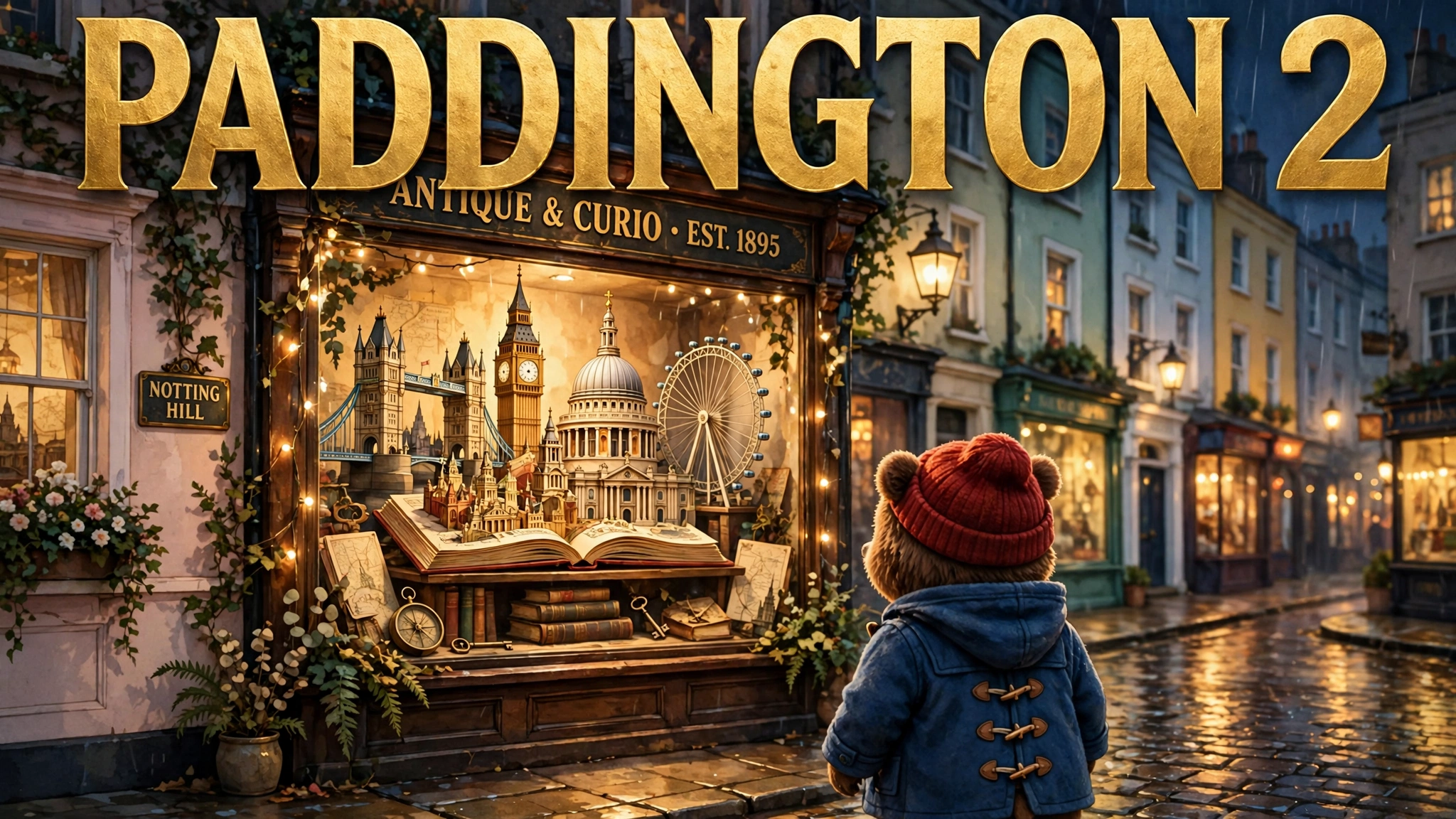
Paddington Brown, the young bear from Darkest Peru, is now happily settled with the Brown family in Windsor Gardens, Notting Hill, and has become the beloved eccentric of his neighbourhood — cheering the lonely, helping the forgetful, and conducting his life by his Aunt Lucy’s maxim that if you are kind and polite, the world will be right. With Aunt Lucy’s 100th birthday approaching, Paddington finds the perfect present in Samuel Gruber’s antique shop: a rare, beautiful pop-up book of London, the city she always dreamed of visiting. It costs more than a bear can quickly earn, so Paddington takes a series of odd jobs — with results that range from a disastrous hairdressing turn to a window-cleaning round that shows King’s gift for silent-comedy staging at its purest.
Before Paddington can buy it, the book is stolen in the night, and the evidence — a bear-shaped silhouette, a trail of marmalade logic — points squarely at the neighbourhood’s most polite resident. Wrongly convicted, Paddington is sent to prison, where his cellmates include the terrifying kitchen hard-man “Knuckles” McGinty. What happens inside those walls is the film’s warm, funny, quietly radical core: Paddington does not toughen up to survive prison; prison softens to survive Paddington. Meanwhile the Browns, who never doubt him for a moment, work to unmask the real thief — a culprit hiding in plain sight behind a career of disguises. We will spoil nothing of the chase that follows, except to say it involves a steam train, a great deal of ingenuity, and an ending that pays off the film’s themes so completely that grown adults routinely weep at it. This reviewer did.
Ben Whishaw as the voice of Paddington gives one of the great voice performances in family cinema. His Paddington is gentle without being weak, courteous without being servile, and funny through timing and sincerity rather than jokes at his own expense. Whishaw understands the character’s secret: Paddington’s politeness is a discipline, chosen daily, and the film’s emotional climax depends on the audience feeling what it costs him to keep choosing it.
Hugh Grant as Phoenix Buchanan delivers the performance of his career — a vain, faded actor living opposite the Browns in a house full of his own costumes and past glories, delivering every line as if to a balcony that no longer exists. Grant plays Buchanan’s narcissism with total commitment and zero winking, sings and dances in the film’s joyous musical set piece, and somehow keeps a pantomime villain human enough to pity. Sally Hawkins as Mary Brown brings warmth, mischief and a illustrator’s romantic streak; Hugh Bonneville as Henry Brown, now embracing midlife risk with an insurance man’s horror, is quietly hilarious; and Julie Walters as Mrs Bird steals every scene she is permitted, which is all of them.
The supporting bench is absurdly deep. Brendan Gleeson as Knuckles McGinty plays the prison hard-man with a slow-blooming tenderness that anchors the film’s second act. Jim Broadbent is all avuncular delight as Mr Gruber, Peter Capaldi milks the neighbourhood-watch curtain-twitcher Mr Curry for every suspicious squint, Imelda Staunton voices Aunt Lucy with the warmth of a whole philosophy of life, and Michael Gambon lends the late Uncle Pastuzo a single, perfectly weighted flashback. There is not a lazy performance in the film.
Paul King’s direction is the film’s invisible headline: this is one of the most formally inventive mainstream family films ever made, and it hides its brilliance inside charm. King thinks in pictures and transitions — a pop-up book that literally unfolds into the London the characters then walk through; a prison that shifts from grey to pink as Paddington’s influence spreads, in a colour story told without a word of dialogue; a fantasy sequence in which Paddington finally walks through the book with Aunt Lucy that uses the pop-up aesthetic as pure emotion. His camera glides, his editing has musical timing, and his sight gags are constructed like clockwork, in the tradition of Keaton, Chaplin and Jacques Tati, all of whom King openly admires.
The technical execution matches the ideas. Paddington himself, animated by Framestore, is a seamless blend of performance and fur, light and weight — the marmalade, the rain, the prison laundry all interact with him convincingly, and crucially, the animation serves Whishaw’s restraint rather than upstaging it. Erik Wilson’s cinematography bathes London in the storybook glow the Browns’ street requires, then finds a colder palette for the courtroom and prison before the colour literally returns with hope. The film is dedicated to Michael Bond, who died in 2017, the year of release; it is impossible to imagine a finer monument.
Two small criticisms, honestly offered. First, the middle act’s prison section, delightful as it is, slightly delays the detective plot the Browns are pursuing, and very young children may feel the pace dip before the spectacular final act. Second, the film’s perfection of tone can feel, to determined cynics, almost engineered — every beat lands, every theme rhymes. That is less a flaw than a temperament: this is a film that believes goodness is a craft, and practises it. But viewers who prefer their family films rougher-edged should know what they are getting.
Dario Marianelli, an Oscar winner for Atonement, composed a score of wit and sweep that matches King beat for beat: bustling, clockwork themes for Paddington’s jobs and capers; a sly, theatrical swagger for Buchanan; and strings that open up, without sentimentality tricks, for the Aunt Lucy material. Marianelli, who also scored the first film, deepens its musical world rather than replacing it, and his music for the final train sequence is a masterclass in building excitement and emotion simultaneously.
King also uses songs with a curator’s joy. The calypso flavours that recall the first film’s London return, and the film’s set-piece delight is a full musical number — Grant’s Buchanan performing “Rain on the Roof” from Follies, in costume, in prison, in one of the decade’s great comic sequences, staged as both a plot point and a curtain call. Few family films understand that music is structure; this one builds some of its best scenes out of it.
What we loved:
What could be better:
Paddington 2 cost a reported $40 million to produce. Its original theatrical run is most often summarised at about $227–228 million worldwide — roughly $41 million in North America and $186 million internationally — including a superb £42.8 million in the United Kingdom, where it was a genuine phenomenon. That was already a clear commercial success: more than five times its production budget, before home entertainment.
So why do current listings, including Box Office Mojo, show about $290.1 million? Because the film has been re-released repeatedly — anniversary screenings, family seasons and franchise revivals around the third film’s arrival — and modern databases fold that re-release revenue into the lifetime total. Both numbers are therefore “true,” but they describe different things: roughly $228 million for the original run, roughly $290 million lifetime. The honest disappointment in the story is North America, where a distributor change during the Weinstein Company’s collapse disrupted its release and it earned a fraction of what its reviews promised; everywhere else, audiences found it. Add a long, lucrative home-video and streaming life, and Paddington 2 stands as that rare thing: a sequel that out-performed its predecessor in love, and comfortably in money too — just not in the one market that writes the headlines.
Yes — whoever you are. If you have children, this is close to the perfect film to watch with them: funny at four, funny at forty, and built on values — politeness, loyalty, seeing the best in people — that it demonstrates rather than lectures. If you do not have children, watch it anyway, for Grant, for Gleeson, for King’s direction, and for the reminder that craftsmanship this complete is its own kind of joy. The first Paddington is very good. This one is a masterpiece of its kind.
Our rating: 9.5/10 — The perfect sequel and a benchmark for family filmmaking: Hugh Grant’s career-best turn, Paul King’s clockwork visual wit, and a heart that never once cheats.
Do I need to watch the first Paddington film before Paddington 2?
It helps but is not essential. The sequel re-establishes everything you need within minutes — who the Browns are, where Paddington came from, why Aunt Lucy matters — though the first film is well worth seeing in its own right, and the two make a perfect double bill.
Is Paddington 2 suitable for young children?
Yes. It is rated PG for mild peril and rude humour. The prison scenes are played for warmth and comedy, the villain is theatrical rather than frightening, and there is nothing rougher than a chase, a splash and a few hard stares. It is a model of family filmmaking for roughly ages four and up.
Why did Paddington 2 famously have a 100% Rotten Tomatoes score?
Because for over three years every one of its hundreds of registered critic reviews was positive — the longest such run for a widely reviewed film on the site — until a single negative review registered in 2021 dropped it to 99%, where it remains among the highest-rated films of all time. The score became a news story in itself, but the film’s quality underneath it is real.
Is Hugh Grant really that good in this film?
Yes — by near-universal agreement it is the performance of his career, earning him a BAFTA nomination for Best Supporting Actor and a shelf of critics’ awards. He plays Phoenix Buchanan with total sincerity inside total absurdity, and his musical number alone justifies the ticket.
Where can I watch Paddington 2?
It is available on major streaming services in most regions and in excellent Blu-ray editions, often bundled with the first film. Check your local listings, as rights vary by country.