★ LATEST REVIEWS

★★★★☆ Our Rating: 7/10
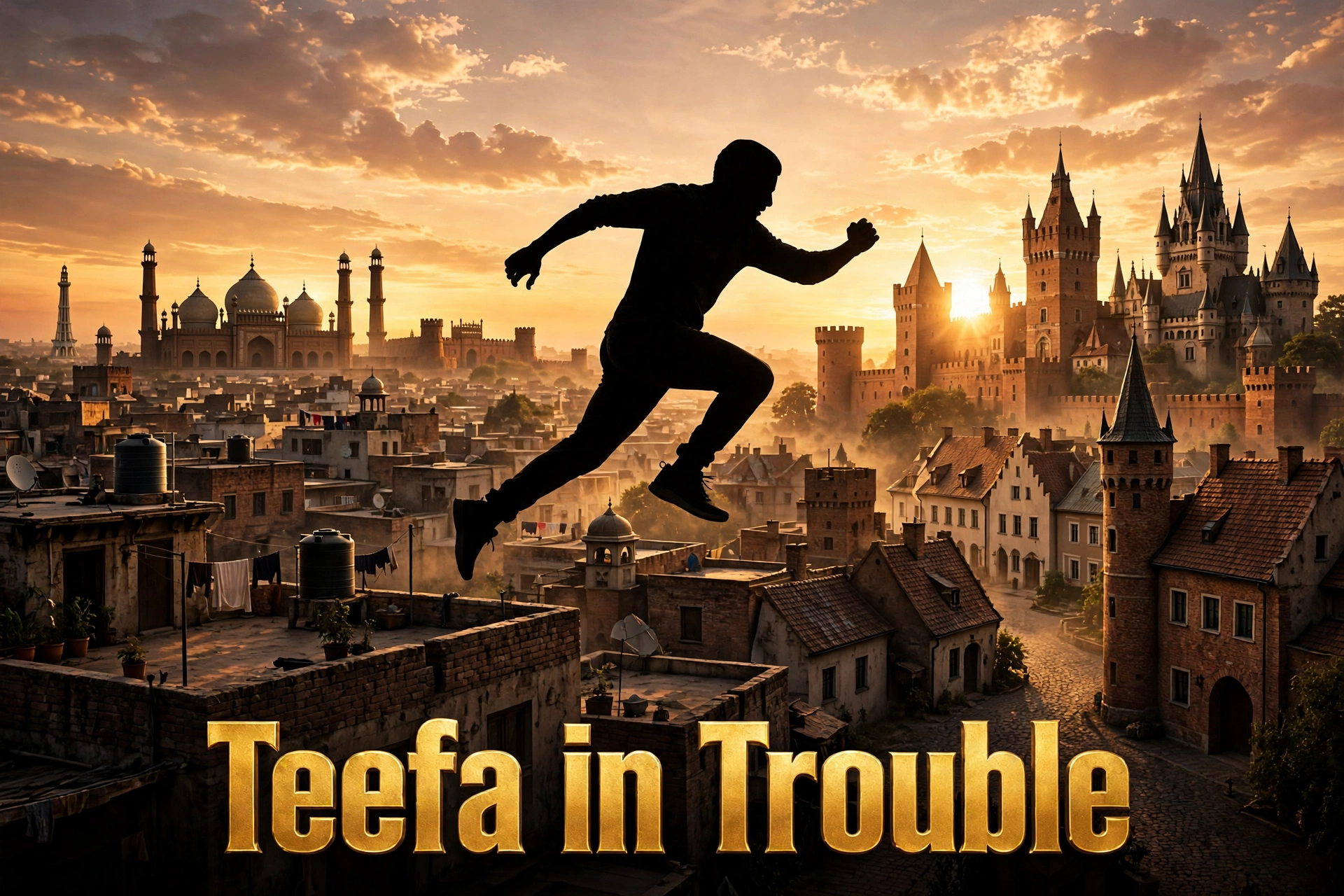
Most Pakistani films of the 2010s revival were built on conversation: comedies of manners, family dramas, social satires. Teefa in Trouble wanted something else — velocity. Released on 20 July 2018 as the feature debut of music-video and commercials director Ahsan Rahim, and as the Pakistani cinema debut of singer-star Ali Zafar under his own Lightingale Productions banner, the film set out to prove that a local production could mount action, chase choreography and international locations with genuine polish. It is a kidnapping caper played as a romantic action comedy, a Lahori fixer sent to Poland to fetch a gangster’s prospective daughter-in-law, and it moves like it has somewhere to be.
The ambition alone made it an event. It was among the most expensive Pakistani films of its time, it was distributed internationally by Yash Raj Films — a first for a non-Indian production — and it arrived on a non-holiday weekend, refusing the protection of an Eid release. Confidence like that invites scrutiny. Does the film beneath the gloss actually hold together, or is it a very expensive trailer for itself?
The honest answer is somewhere interesting in between. Teefa in Trouble delivers the slickest action Pakistani cinema had produced up to that point, carried by a star performance of real charm. Its script, however, is thinner than its stunts, and its attitude towards its own central premise — a kidnapping treated as a meet-cute — deserves a harder look than the film gives it. In this review we break down the story, the performances, the action craft, the music and the remarkable box office run, honestly and without spoilers.
| Fact | Detail |
|---|---|
| Release date | 20 July 2018 |
| Director | Ahsan Rahim |
| Writers | Ali Zafar, Ahsan Rahim, Danyal Zafar |
| Genre | Action, Comedy, Romance |
| Language | Urdu, Punjabi |
| Runtime | 155 minutes |
| Budget | US$1.5 million |
| Lead cast | Ali Zafar, Maya Ali, Javed Sheikh, Mehmood Aslam, Faisal Qureshi, Nayyar Ejaz |
| Our rating | 7/10 |
Teefa — real name Lateef — is a fixer from Lahore’s old city, the man local strongman Butt Sahab calls when a problem needs solving quietly, quickly and preferably with a joke on the way out. Teefa is good with his fists, better with his tongue, and devoted to his widowed mother, whom he calls Baybae and treats like royalty. When Butt Sahab decides his son Billu will marry Anya, the daughter of his old associate Bashira, known as Bonzo, there is one small complication: Anya lives in Warsaw, wants nothing to do with the arrangement, and her father has no intention of forcing her. Butt Sahab’s solution is Teefa. Go to Poland, bring the girl back, collect the money.
Teefa accepts, recruits his loyal friend Tony Shah, and lands in Warsaw with a plan built on deception: get close to Anya, win her trust, and deliver her to Lahore before she understands what has happened. What he has not budgeted for is Anya herself — sharp, independent and entirely unwilling to be managed — or Bonzo, who turns out to be a formidable figure in his own right, or the Polish police, or the small matter of his own conscience, which starts filing objections at the worst possible moments.
From there the film becomes a chase in two countries, mixing fights, escapes, double-crosses and reluctant romance. We will leave the turns unspoiled. The spine of the story is a familiar question dressed in new clothes: can a man hired to treat a person as cargo become someone worthy of her as a person? The film’s success depends on how willing you are to go along with that transformation, and we will return to it in the verdict.
Ali Zafar as Teefa is the film’s engine and its biggest asset. Zafar, making his Pakistani film debut after a successful run in Indian cinema, understands that Teefa works only if the audience likes him faster than they can judge him. He plays the role with a grin, a swagger and a distinctly Lahori verbal wit, tossing off insults and endearments in the same breath. His physical commitment is real, too: the fights are built around his agility rather than a stunt double’s anonymity, and it shows. Where he is less convincing is in the film’s heaviest emotional beats, where the performance stays at the level of charm when the scene asks for reckoning.
Maya Ali as Anya, also making her film debut, is asked to do the story’s hardest work: make a character written as a prize behave like a person. She largely succeeds. Her Anya is funny, prickly and quick, and her scenes with Zafar have an easy friction that sells the romance better than the script does. The limitation is the writing, not the actress — the film keeps needing Anya to not ask obvious questions, and no performance can fully hide that.
Javed Sheikh as Bonzo brings the same relaxed authority he brings to everything, turning a potentially stock gangster father into the film’s most grounded adult. Mehmood Aslam as Butt Sahab leans into pomposity with evident enjoyment, while Faisal Qureshi as Tony Shah provides loyal-sidekick comedy and some of the warmest scenes in the film. Nayyar Ejaz as Sheikh Sahab and Asma Abbas as Khalida Butt add colour in smaller roles, and Simi Raheal as Baybae gives the mother-son thread a tenderness the film could have used more of.
This is where Teefa in Trouble earns its reputation. Ahsan Rahim comes from music videos and advertising, and he directs action like a man who has spent years learning where to put a camera for maximum impact in minimum time. The fight choreography is the best Pakistani cinema had offered to that date: punches have weight, geography stays readable, and the sequences escalate inventively, using locations — rooftops, streets, interiors — as props rather than backdrops. The Warsaw material, shot in Poland with cinematographer Zain Haleem, is genuinely handsome, giving the film a cold European sheen that contrasts nicely with the warmth and clutter of Lahore.
The editing, by Rahim himself with Taha Ali, keeps the first half zipping along. Sound design is punchy, production design is rich without looking airless, and the costume work — Teefa’s jackets became a minor fashion moment — understands exactly what a star vehicle needs.
Against that, the film is too long. At 155 minutes it outstays its plot by a good twenty, with the middle stretch circling scenes that advance charm rather than story. Rahim’s visual confidence also sometimes substitutes for dramatic confidence: when the film reaches the moments where Teefa should face what he has done, the camera keeps moving, as if style alone could carry the moral weight. It cannot, quite.
Ali Zafar composed the film’s music, with Shani Arshad providing the background score, and the soundtrack is built like a star album: upbeat, polished, designed to live on playlists beyond the film. The romantic numbers give the Zafar–Maya Ali pairing its softness, and the title energy of the score keeps the chase sequences buoyant. Zafar the singer is fully integrated into Zafar the actor here — few performers in the region can supply their own playback this naturally.
Shani Arshad’s score is the quieter achievement, knitting Lahore and Warsaw into one soundscape and giving the action a propulsive, modern pulse. If a complaint is needed, it is that the songs, like the film itself, privilege mood over momentum: a couple of numbers arrive at moments when the story should be tightening, not relaxing. As an album, though, this is one of the stronger Pakistani soundtracks of its year.
What we loved:
What could be better:
Teefa in Trouble opened on 20 July 2018, in ordinary season, days before a general election — close to the worst commercial window a big film could choose — and proceeded to smash records anyway. It posted the strongest opening of its era for a non-holiday Pakistani release, powered through its first weeks with unusual staying power, and was widely reported to have crossed the Rs. 50 crore worldwide mark, becoming only the third Pakistani film to reach that milestone at the time.
Precise lifetime figures vary between trade sources — Pakistani reporting of the period commonly places the worldwide total in the region of Rs. 47 to 50 crore, with a domestic haul of roughly Rs. 33 crore — but every account agrees on the conclusion: this was one of the biggest Pakistani hits of 2018 and the highest-grossing non-holiday release the industry had seen. For a debut director and a star’s homecoming vehicle, that is a formidable result, and it permanently changed producer expectations about what an action film could earn outside the Eid corridor.
If you want to see modern Pakistani cinema at its most polished and propulsive, yes. Teefa in Trouble is a proper big-screen entertainer: funny, fast, handsome and carried by a leading man having the time of his life. Go in ready to forgive a script that mistakes momentum for depth, and an ethical blind spot at the story’s centre, and you will have a very good time. Viewers who need their romances built on firmer ground may find the charm offensive rather than disarming — and that reaction is fair, which is why this lands as a strong seven rather than something higher.
Our rating: 7/10 — Dazzling action and star charisma in a package whose script never quite catches up with its stunts.
Is Teefa in Trouble Ali Zafar’s first Pakistani film?
Yes. Although Ali Zafar had acted in Indian films before, this was his debut in Pakistani cinema, as well as his first film as a producer under Lightingale Productions. It was also Maya Ali’s film debut and director Ahsan Rahim’s first feature.
Is Teefa in Trouble based on a true story?
No. It is an original fictional story written by Ali Zafar, Ahsan Rahim and Danyal Zafar.
What languages is Teefa in Trouble in?
The film moves between Urdu and Punjabi, reflecting its Lahori hero and its Polish setting; English appears naturally in the Warsaw scenes. Subtitled versions have been released for international audiences.
Where can I watch Teefa in Trouble?
The film received a wide international theatrical release through Yash Raj Films and later moved to streaming, including a well-publicised run on Netflix in many territories. Current availability depends on your country, so check your local streaming platforms.
How long is Teefa in Trouble and is it suitable for children?
It runs about 155 minutes. It is a mainstream action comedy with frequent stylised violence and romantic themes; most families treat it as suitable for older children and teenagers rather than very young viewers.