
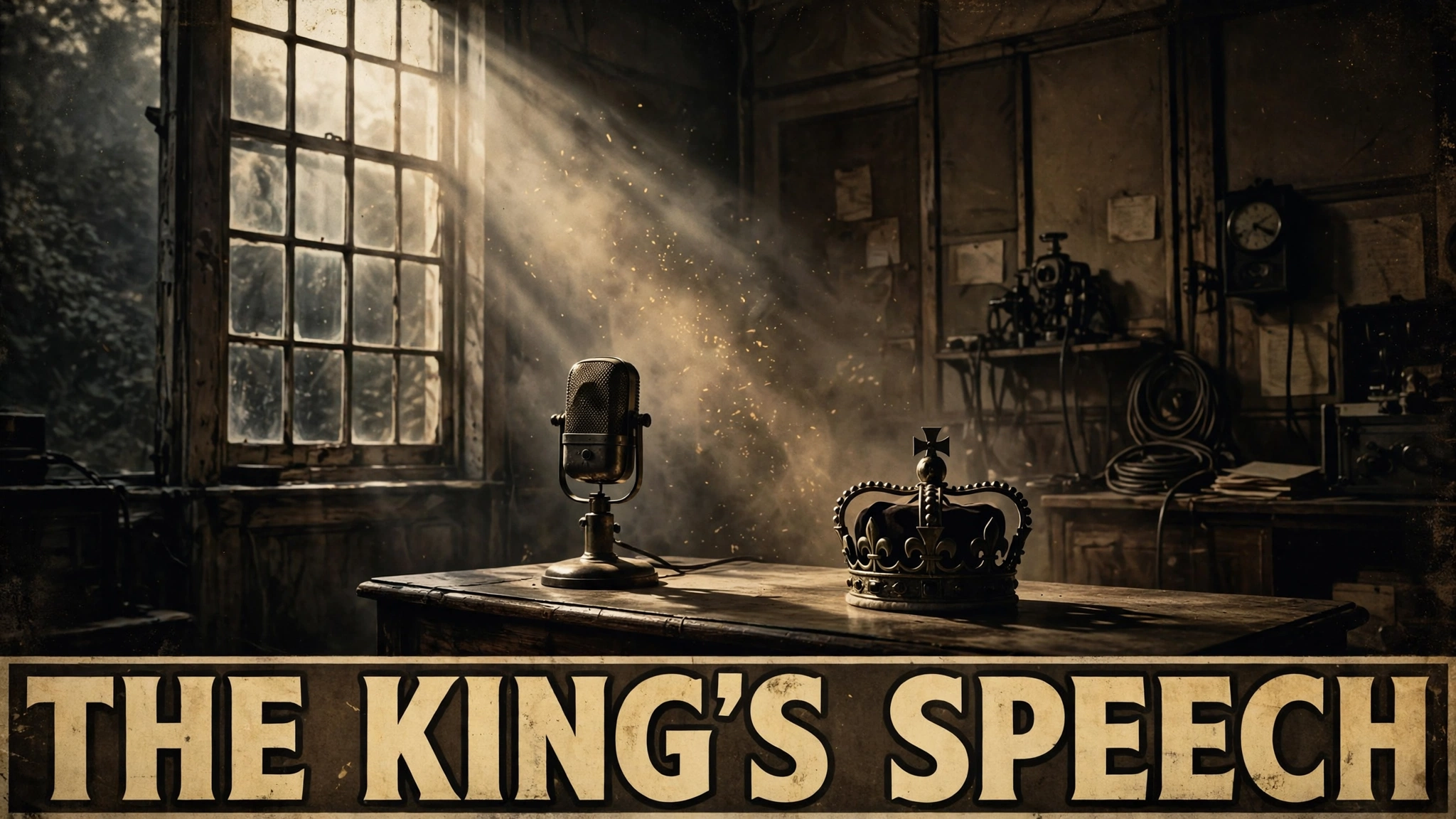

The King’s Speech (2010) Review – A Quiet Film About Finding a Voice
On paper, The King’s Speech sounds like the driest film imaginable: a prince with a stammer takes elocution lessons in 1930s London. In practice, Tom Hooper’s drama — premiered at Telluride on 6 September 2010 and released in the United Kingdom on 7 January 2011 — became one of the most beloved British films of its decade, sweeping the Academy Awards with wins for Best Picture, Best Director, Best Actor and Best Original Screenplay.
Its triumph was not an accident of awards-season politeness. The film works because it understands something basic: public speaking is terrifying for almost everyone, and for a man whose entire job is becoming being heard — in the new age of radio, by an empire drifting towards war — a stammer is not an embarrassment. It is an existential crisis. In this review we examine the story, the two central performances, Hooper’s direction, Alexandre Desplat’s music and the film’s remarkable box office, and we will be honest about the places where it plays history a little too neatly.
Quick Facts: The King’s Speech at a Glance
| Detail | Information |
|---|---|
| Release date | 6 September 2010 (Telluride premiere); 7 January 2011 (United Kingdom) |
| Director | Tom Hooper |
| Writers | David Seidler |
| Genre | Drama, History, Biography |
| Language | English |
| Runtime | 119 minutes |
| Budget | $15 million |
| Lead cast | Colin Firth, Geoffrey Rush, Helena Bonham Carter, Guy Pearce, Timothy Spall |
| Our rating | 8.5/10 |
The Story: The Reluctant King and the Unlikely Teacher (Spoiler-Free)
Prince Albert, Duke of York — “Bertie” to his family — is the second son of George V, and he is perfectly content to remain second. He has a devoted wife, two young daughters, and a severe stammer that turns every public address into a public humiliation. The film opens with the evidence: Wembley Stadium, 1925, a microphone, a crowd, and a man freezing on syllables while the sound echoes back at him.
His wife Elizabeth, having quietly exhausted the respectable Harley Street specialists and their marbles-in-the-mouth nonsense, finds Lionel Logue — an Australian speech therapist working out of shabby rooms in London, with no formal medical qualifications, a sideline coaching nervous actors and shell-shocked veterans, and a complete refusal to be impressed by royalty. Logue insists on first names, on equality inside his consulting room, and on treating the problem as something tangled up with fear, upbringing and habit — not just a faulty tongue.
Bertie storms out. Then, slowly, because radio is making a king’s voice a matter of state and because his father is ageing and his elder brother David — the Prince of Wales, later Edward VIII — is plainly more interested in the twice-divorced Wallis Simpson than in duty, Bertie comes back.
What follows is part therapy, part friendship, part countdown. History is well known here, so the shape is not a spoiler: the old king dies, the brother takes the throne and gives it up, and the man who cannot finish a sentence must lead a country into the Second World War with a broadcast the whole nation will hear live. Whether he can do it — and what it costs him, and what Logue’s unconventional loyalty really rests on — is the film.
Performances: Two Actors at Their Very Best
Colin Firth as King George VI gives the performance that defines his career. Playing a stammer is a technical minefield: do it too well and the audience suffers through every scene; do it too lightly and the stakes vanish. Firth threads it. His Bertie does not stammer randomly — he blocks, on particular sounds, under particular pressures, worst of all when he feels judged or rushed by people who outrank him. You can watch the panic arrive in his face a half-second before the word fails. Around that central difficulty Firth builds a complete man: funny in dry flashes, devoted to his family, quick to a frightening temper that is clearly shame wearing armour, and terrified in a way no king is supposed to admit. He won the Oscar, the BAFTA and the Golden Globe for this. He deserved all of them.
Geoffrey Rush as Lionel Logue is the perfect counterweight, and arguably has the more enjoyable part. Rush plays Logue as a man performing confidence as a therapeutic technique — brisk, cheeky, theatrical, quoting Shakespeare at his sons around the kitchen table — while keeping his own precarious position mostly hidden. The joy of the film is watching the class positions invert: inside Logue’s room, the Australian commoner is the authority and the future king is the patient who must swear, sing, roll on the floor and tell the truth. Rush never lets Logue become a mere eccentric. There is steel in him, and one late confrontation between the two men, where professional and personal betrayal blur, is the best scene in the film.
Helena Bonham Carter as Queen Elizabeth does a great deal with a supporting role that could have been pure decoration. Her Elizabeth is the engine of the whole story — she finds Logue, she manages her husband’s despair, she assesses everyone in a room in seconds — and Bonham Carter plays her with wit and a flinty sweetness that suggests the famous public smile without ever impersonating it. Guy Pearce as Edward VIII is excellent and slightly underused: vain, charming, cruel in the casual way of a man who has never been told no, and a full decade of resentment compressed into a few scenes. Timothy Spall as Winston Churchill has the impossible job of playing the most impersonated man in British history; he wisely goes for the growl and the watchfulness rather than the full tribute act. Michael Gambon as George V and Derek Jacobi as the Archbishop of Canterbury add gravitas in brief turns.
Direction and Technical Craft
Tom Hooper directs with a visual idea that sounds like a gimmick and works like a thesis. Working with cinematographer Danny Cohen, he shoots Bertie in wide, off-balance compositions — the prince small in one corner of the frame, dwarfed by fog, peeling wallpaper and enormous empty rooms, with lenses that slightly distort the space around him. The world literally does not fit this man comfortably. Logue’s consulting room, by contrast, is shabby, warm and textured, and the camera relaxes there. As Bertie’s confidence grows, the framing steadies with him.
It is a handsome film without being a pretty one. London is brown, green and damp. The production design finds a Britain of Bakelite radios, sandbagged studios and palaces that look more like offices than fairy tales, which suits a story about monarchy becoming a broadcasting job.
Hooper’s weaknesses are the ones his critics always cite, and they are present. The wide-angle close-ups can feel mannered when the scene does not need them. The historical background — the abdication crisis, the rise of Hitler, Churchill’s manoeuvring — is simplified into signposts, and some real complexities of Logue’s methods and timeline are tidied away for dramatic shape. Screenwriter David Seidler, who stammered himself as a boy and waited decades, out of respect for the Queen Mother, to tell this story, writes dialogue that is sometimes almost too perfectly shaped. People speak in exchanges a real therapist’s room would rarely produce. But the emotional architecture is sound, and Seidler’s personal stake in the material keeps it from ever feeling like a cynical awards exercise.
Music and Background Score
Alexandre Desplat’s score is a model of restraint, built largely on piano and strings playing figures that hesitate, repeat and resolve — a musical echo of the film’s subject that never becomes a cheap joke about it. Desplat keeps the music small because the film’s real sound design is the voice itself: breath, silence, the terrifying amplified openness of a live microphone. Period recordings and classical pieces are woven through the climactic broadcast sequence to powerful effect, the music finally swelling only when Bertie has earned it. Desplat won the BAFTA for this score; it is one of the most intelligently judged of his career.
What Works and What Doesn’t
What we loved:
- Colin Firth and Geoffrey Rush — a double act for the ages, funny and painful in equal measure
- A screenplay that turns speech therapy into genuine suspense without inventing villains
- Hooper and Danny Cohen’s off-kilter framing, which makes you feel Bertie’s discomfort visually
- Helena Bonham Carter quietly running the entire film from the supporting cast
- An ending built on a real broadcast that earns every bit of its emotion
What could be better:
- The surrounding history is simplified — Edward VIII, Churchill and the politics of abdication are sketches, not portraits
- Some of Logue’s story and methods are neatened for the screen; the real record is messier
- Hooper’s lens choices occasionally call attention to themselves in quiet scenes
Box Office: The Little British Film That Conquered the World
The King’s Speech was made for just $15 million, backed in part by the UK Film Council, and its commercial life embarrassed films costing twenty times as much. It grossed $414.2 million worldwide, became at the time the most successful independent British film ever at the UK box office, and did it almost entirely on word of mouth — audiences recommending a film about elocution lessons the way they usually recommend thrillers. Its twelve Oscar nominations and four wins, including the night’s biggest prizes, crowned a run that proved there was still a global mass audience for a well-acted, adult, dialogue-driven drama. The British industry has been chasing its example ever since.
Verdict: Should You Watch It?
Yes. The King’s Speech is not a radical film, and it does not pretend to be — its history is tidied, its structure is classical, and it knows exactly which emotions it is aiming at. But it aims with rare precision. Firth and Rush together are reason enough, and beneath the period polish sits something universal and true: the fear of being heard, and the friend who refuses to let you hide from your own voice.
Our rating: 8.5/10 — a beautifully acted, deeply satisfying drama that earns its crown.
Frequently Asked Questions
Is The King’s Speech based on a true story?
Yes. George VI really did work with Australian speech therapist Lionel Logue for years, and Logue really was present for the king’s wartime broadcasts. The film compresses timelines and shapes some events for drama, but the friendship and the therapy were real, and Logue’s diaries helped inform the screenplay.
Did Colin Firth really stammer in the film?
Firth developed the stammer for the role with coaching and studied recordings of George VI. He has said the speech patterns were hard to shake off after filming. It is a performance, not an impersonation — he does not attempt an exact copy of the king’s voice.
What awards did The King’s Speech win?
It won four Academy Awards — Best Picture, Best Director for Tom Hooper, Best Actor for Colin Firth and Best Original Screenplay for David Seidler — from twelve nominations, and seven BAFTAs including Best Film and Outstanding British Film.
Is The King’s Speech suitable for children?
It is broadly suitable for older children and teenagers. There is one famous sequence of strong language used as a therapy technique, which earned the film a stricter rating in some countries than its otherwise gentle content would suggest.
Where does the final speech come from?
The climax is built around the king’s real radio broadcast of 3 September 1939, announcing that Britain was at war with Germany. The words you hear are based on that actual address, which Logue helped him prepare and deliver.