
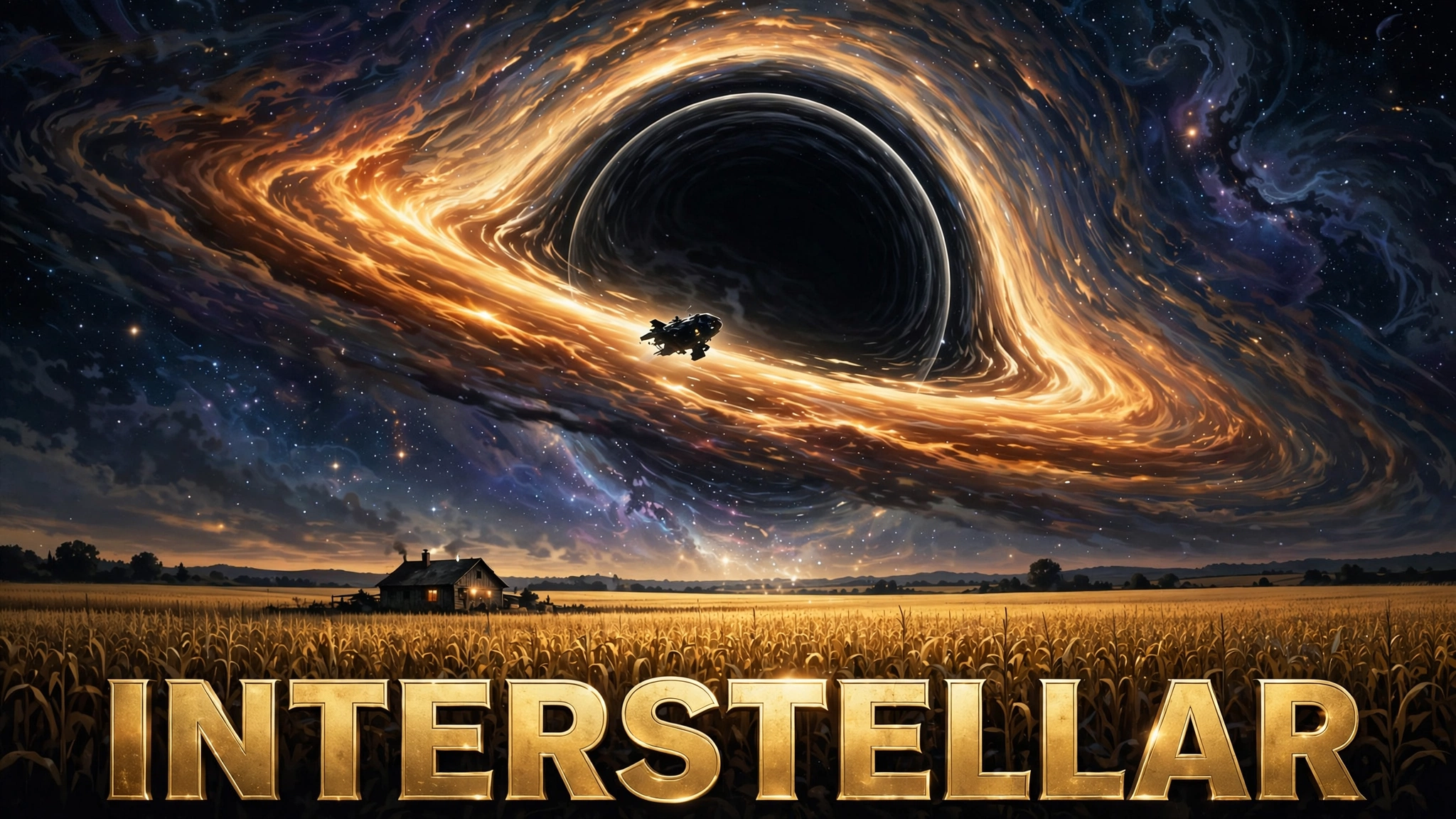

Interstellar (2014) Review – A Heartfelt Journey Beyond the Stars
Some science fiction films impress you with ideas. Interstellar tries to do that and break your heart at the same time. Released in 2014, Christopher Nolan’s space epic arrived with enormous expectations, a reputation for scientific ambition, and a promise to take audiences further from Earth than almost any mainstream film had attempted. More than a decade later, it remains one of the most argued-about blockbusters of its era — admired for its scale and sincerity, questioned for its dialogue and its big emotional swings.
What makes the film endure is not just its wormholes and black holes. It is the simple, painful story underneath all that physics: a father who leaves his children to try to save humanity, knowing that time itself may steal the years he hoped to share with them. That idea gives the spectacle a human cost, and it is why scenes set in quiet farmhouses can hit as hard as scenes set on alien oceans.
Interstellar is long, dense, and occasionally over-explains itself. It is also moving, visually extraordinary, and made with a conviction that is rare at this budget level. In this review, we give you an honest breakdown of where its ambition pays off and where it strains, so you can judge this modern sci-fi landmark for yourself.
Quick Facts: Interstellar at a Glance
| Detail | Information |
|---|---|
| Release date | November 5, 2014 (United States) |
| Director | Christopher Nolan |
| Writers | Jonathan Nolan, Christopher Nolan |
| Genre | Sci-Fi, Adventure, Drama |
| Language | English |
| Runtime | 169 minutes |
| Budget | $165 million |
| Lead cast | Matthew McConaughey, Anne Hathaway, Jessica Chastain, Michael Caine |
| Our rating | 9/10 |
The Story: Leaving Earth to Save It (Spoiler-Free)
The film opens on a near-future Earth that is slowly becoming uninhabitable. Crops are failing one by one, dust storms sweep through farming communities, and society has retreated from ambition. Space exploration is treated as a wasteful luxury from a more hopeful age. In this world lives Joseph Cooper, a former test pilot and engineer who now farms with his father-in-law and his two children, Tom and Murphy. Cooper is capable and restless, frustrated that his skills are being used to coax food from dying soil while his daughter grows up in a world that seems to be closing down.
Murphy, bright and curious, believes something strange is happening in her bedroom, where dust patterns and falling objects seem to carry a message. Following that mystery leads Cooper to a hidden facility and to an offer he cannot easily refuse: a secret mission through a wormhole near Saturn to search for a new home for humanity among distant stars. A previous expedition has already sent explorers ahead to assess candidate planets, and now a follow-up crew must decide where, if anywhere, people could survive.
Cooper joins a small team aboard the Endurance, knowing the cruel catch at the heart of the mission. Because of relativity, hours spent near massive gravitational forces could mean years passing back on Earth. Every choice about where to land becomes a choice about how much of his children’s lives he will miss. That tension — between saving the species and being present for his own family — drives the entire film, and it gives even the most technical discussions a personal urgency. The rest of the journey, and what the crew finds out there, is best discovered without spoilers.
Performances: Emotion Anchors the Spectacle
Matthew McConaughey as Joseph Cooper: McConaughey gives the film its emotional centre. His Cooper is practical, stubborn, and deeply loving, and the actor plays him without vanity. His most famous scene, watching years of family messages in a single sitting, works because he lets grief arrive in waves rather than performing it all at once. It is the kind of work that keeps a huge, concept-heavy film feeling personal.
Anne Hathaway as Dr Amelia Brand: Hathaway plays a scientist who must weigh evidence against instinct, and she gives Brand a quiet determination that balances Cooper’s rougher edges. A speech she gives about love as a force worth trusting divided audiences on release — some found it sincere, others found it too on the nose — but Hathaway commits to it fully, and her later scenes carry real weight.
Jessica Chastain as adult Murphy Cooper: Chastain takes over the Earthbound heart of the film, playing Murphy as an adult scientist still shaped by anger at her father’s departure and by hope that his promise meant something. She brings intelligence and contained hurt to a role that could easily have been purely functional, and her storyline becomes just as gripping as the mission in space.
Michael Caine as Professor John Brand: Caine, a regular Nolan collaborator, brings warmth and authority as the scientist leading the rescue effort. He also recites poetry at key moments, a choice that underlines the film’s belief that science and human feeling belong in the same conversation. Mackenzie Foy as young Murphy and Casey Affleck as adult Tom also deserve mention for grounding the family drama before and during Cooper’s absence.
The ensemble is strong throughout, and notably, the robot characters TARS and CASE, voiced by Bill Irwin and Josh Stewart, provide both practical help and dry humour without ever becoming comic relief in the cheap sense.
Direction and Technical Brilliance
Christopher Nolan directs Interstellar with his trademark preference for practical effects, real locations, and large-format film photography. Working with cinematographer Hoyte van Hoytema, he shot significant portions on IMAX cameras, and the difference is visible. The spacecraft feel solid and mechanical, Earth looks dusty and tired, and the alien worlds — one covered in shallow water, another in ice — feel like places a camera actually visited rather than images assembled entirely in a computer.
The visual effects, which won the Academy Award for Best Visual Effects, remain impressive years later. The depiction of the black hole Gargantua was developed with input from physicist Kip Thorne, and its glowing accretion disc bending around the darkness became one of the defining images of modern science fiction. Just as effective is what the film does with silence and scale. Space is often quiet in this film, and that quiet makes the docking sequences, set to pounding music, feel genuinely perilous.
Editing by Lee Smith handles multiple timelines and locations with clarity for most of the running time, cutting between the Endurance and Earth in a way that sharpens the emotional stakes rather than confusing them. The main technical complaint is the sound mix, a recurring Nolan issue. Dialogue is sometimes buried beneath music and effects, and while the director has defended this as an intentional choice, viewers at home may find themselves reaching for subtitles during key conversations. It is a real flaw in an otherwise meticulously crafted film.
Music and Background Score
Hans Zimmer’s score for Interstellar is widely regarded as one of the finest of his career, and it is hard to imagine the film without it. Built around a church organ, piano, and strings, the music gives the space sequences a spiritual, almost reverent quality. Nolan famously gave Zimmer only a short piece of writing about a parent leaving a child as his starting point, without explaining the plot, and the score’s emotional directness seems to come from that brief.
The docking sequence, driven by the cue often known as “No Time for Caution”, is a masterclass in how music can create tension. The organ swells as the stakes rise, and the scene becomes almost unbearable without a single explosion. Quieter passages, used over farm life and family goodbyes, are just as effective. If anything, the score occasionally overwhelms the drama rather than supporting it, telling the audience very loudly how to feel. But when it works — which is most of the time — it elevates the film from impressive to unforgettable.
What Works and What Doesn’t
What we loved:
- A powerful father-daughter story gives the huge science fiction concepts genuine emotional weight.
- Stunning large-format cinematography and Oscar-winning visual effects that still hold up today.
- Hans Zimmer’s organ-led score is moving, distinctive, and perfectly matched to the film’s themes.
- The film treats its audience as intelligent, taking relativity and time dilation seriously rather than hand-waving them away.
What could be better:
- Dialogue is sometimes hard to hear in the sound mix, and some exposition is delivered clumsily through conversation.
- At 169 minutes, the pacing sags in places, particularly for viewers less invested in the scientific detail.
- The final act asks for a large leap of faith that will feel profound to some and sentimental to others.
Box Office: A Slow-Burning Success
Produced for a reported budget of $165 million, Interstellar premiered on October 26, 2014, and opened in the United States on November 5, 2014. It went on to gross $782.9 million worldwide, according to current totals that include later re-releases. That figure is especially notable because the film was not a franchise sequel and relied on original storytelling, word of mouth, and repeat IMAX viewings rather than an existing fan base.
Its reputation has only grown since release. Regular re-releases in IMAX have drawn strong audiences, and the film consistently places near the top of audience polls of the best science fiction films ever made. Commercially and culturally, it proved that an original, demanding blockbuster could still become an event.
Verdict: Should You Watch It?
Yes — particularly if you can see it on the largest screen available to you. Interstellar is not flawless. Its dialogue can be muffled and over-explanatory, and its ending divides people to this day. But its ambition, craft, and emotional honesty set it apart from almost every other studio science fiction film of the last decade. McConaughey, Chastain, and Hathaway ensure the human story never gets lost among the stars, and Zimmer’s score ties the whole experience together.
This is a film about time, distance, and the promises parents make to children. Few blockbusters aim that high, and fewer still come this close to reaching it.
Our rating: 9/10 — An ambitious, deeply moving space epic whose heart is as big as its universe.
Frequently Asked Questions
Is Interstellar based on a true story?
No. The story is fictional, written by Jonathan Nolan and Christopher Nolan. However, physicist Kip Thorne advised on the science, and the film’s depiction of black holes and time dilation is grounded in real relativity theory.
Do I need to understand physics to enjoy Interstellar?
No. The film explains its key ideas — wormholes, relativity, and time moving differently in different places — as it goes. A basic interest in space helps, but the family story carries viewers who are not science specialists.
How long is Interstellar and what is its age rating?
The runtime is 169 minutes, just under three hours. It is rated PG-13 in the United States for intense perilous action and brief strong language, making it broadly suitable for older children and teenagers with parental guidance.
Is there a sequel to Interstellar?
No sequel has been made or officially announced. The film was designed as a standalone story, and Christopher Nolan has not indicated plans to continue it.
Where can I watch Interstellar?
The film is widely available through streaming services, digital purchase and rental stores, and on Blu-ray, including IMAX-enhanced editions. Availability varies by country, so check the services available in your region.