
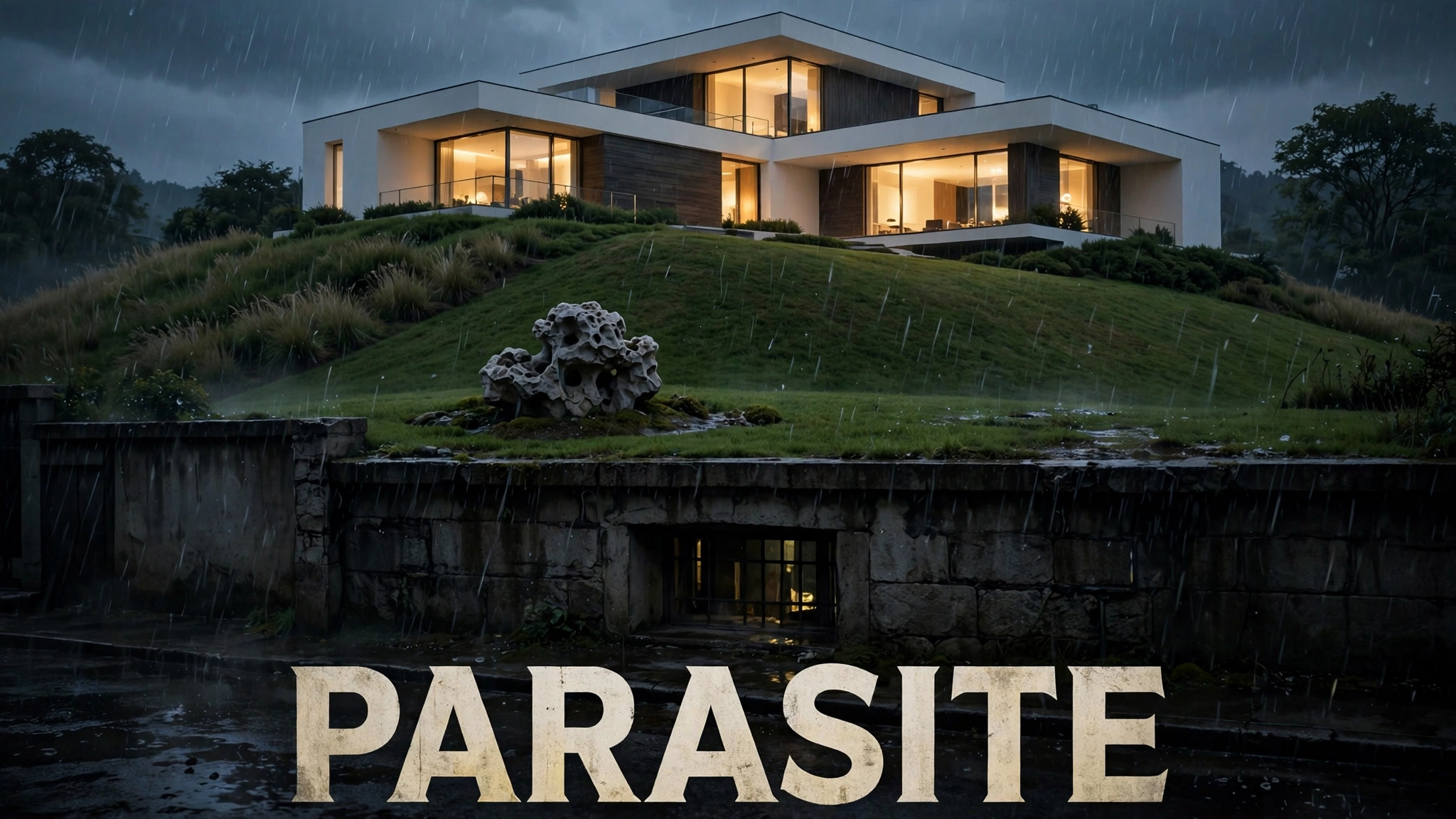

Parasite (2019) Review – A Rich House, a Poor Family, and the Staircase Between Them
Every few years a film arrives that reminds the whole world what cinema can do. Parasite, released in South Korea on 30 May 2019 after premiering at Cannes on 21 May, is one of those films. Bong Joon Ho’s darkly funny, quietly furious thriller about wealth and poverty went on to win the Palme d’Or at Cannes and then, at the 92nd Academy Awards, became the first non-English-language film ever to win Best Picture. Those prizes matter, but they are not the reason to watch it.
The reason to watch it is simpler: for 132 minutes, Parasite never takes the predictable path. Just when you think you know whether you are watching a comedy, a con film, a home-invasion thriller or a tragedy, it changes shape — without ever cheating. This review is spoiler-free about its famous twists, but honest about both its brilliance and its small imperfections.
Quick Facts: Parasite at a Glance
| Detail | Information |
|---|---|
| Release date | 21 May 2019 (Cannes premiere); 30 May 2019 (South Korea) |
| Director | Bong Joon Ho |
| Writers | Bong Joon Ho, Han Jin-won |
| Genre | Thriller, Drama, Dark Comedy |
| Language | Korean |
| Runtime | 132 minutes |
| Budget | ₩13.5 billion (approx. $11.4 million) |
| Lead cast | Song Kang-ho, Lee Sun-kyun, Cho Yeo-jeong, Choi Woo-shik, Park So-dam, Jang Hye-jin |
| Our rating | 9.5/10 |
The Story: One Job Becomes Four (Spoiler-Free)
In a cramped semi-basement flat in Seoul, the Kim family folds pizza boxes for a living, leeches Wi-Fi from neighbours, and leaves the window open when the street is fumigated because at least the insects indoors will die for free. The father, Ki-taek, the mother, Chung-sook, the son, Ki-woo and the daughter, Ki-jung are clever, loyal and completely stuck. Talent is not their problem. Opportunity is.
Opportunity arrives when a friend offers Ki-woo his tutoring job with a wealthy family. The Parks live in a stunning modernist house on a hill — all glass, lawn and calm — with a gentle, trusting mother, a successful father, a teenage daughter and a young son obsessed with playing at being an explorer. With a forged credential and a confident manner, Ki-woo steps into that world, and quickly sees openings for the rest of his family. One by one, under invented names and invented relationships, the Kims take service jobs inside the Park house, carefully removing the people who held those jobs before them.
For a while it plays like a satisfying caper: the poor outsmarting the rich with skill the rich never bothered to value. Then, on a stormy night when the Parks are away camping, a visitor arrives at the door with a secret about the house that the Kims never imagined — and the film pivots into something stranger, tenser and sadder. To say more would be theft. Go in knowing as little as possible.
Performances: Two Families, No Weak Links
Song Kang-ho as Kim Ki-taek anchors the film with one of the great performances of his career. His Ki-taek is charming, resourceful and quietly humiliated by the world, often in the same scene. Song never begs for pity. He lets small reactions — a smile held a second too long after a rich man’s careless remark — carry the character’s whole history. By the final act you understand this man completely, which makes where the story takes him genuinely painful.
Choi Woo-shik as Ki-woo is the audience’s way in, and he plays the son with bright, eager intelligence. Ki-woo believes, at first, that the family’s scheme is a ladder. Choi lets you see both the hope and the self-deception in that belief. Park So-dam as Ki-jung is arguably the film’s coolest presence: precise, funny and ruthlessly competent, she steals nearly every scene she enters, and her improvised confidence in front of the Parks is a joy to watch.
Lee Sun-kyun as Park Dong-ik and Cho Yeo-jeong as Choi Yeon-kyo, the wealthy parents, avoid the easy trap of villainy. Lee plays a man whose politeness is real but whose comfort depends on never looking down. Cho is superb as a mother who is trusting to the point of danger, yet not stupid — just insulated. Jang Hye-jin as Chung-sook gives the Kim mother a dry, practical strength, while Lee Jung-eun in a pivotal supporting role delivers work so good it shifts the entire film’s centre of gravity when she appears. There is not a false note in the ensemble.
Direction and Technical Brilliance
Bong Joon Ho directs Parasite like a man in total control of geometry. The film is built on vertical space: the Parks live up a hill, in sunlight; the Kims live half underground; and the city’s rain, in the film’s most famous sequence, flows downhill from one world into the other with devastating logic. Production design turns the Park house — built entirely for the film — into a character: beautiful, serene, and full of lines its owners insist must never be crossed.
Cinematographer Hong Kyung-pyo frames the two homes with opposite grammars, warm openness above and cramped angles below, without ever making the contrast feel like a lecture. Editor Yang Jin-mo deserves special credit for the film’s celebrated montage passages, where music, image and action compress the family’s takeover into a sequence so smooth you almost applaud the con before remembering its victims. Bong’s tonal control is the real marvel: a scene can be hilarious and dreadful within a single shot, and he never signals which feeling you are supposed to have.
A fair criticism: the final act asks for a degree of symbolic reading that some viewers may find neater than the messy realism that came before it, and one late device involving a letter divides audiences. We think it works as emotional truth rather than literal plotting, but it is the one place the film’s spell thins slightly.
Music and Background Score
Jung Jae-il’s score is elegant and sly. Baroque-flavoured piano and strings give the Park world a polished veneer, while the music under the Kim family’s schemes has a playful, ticking energy that makes their competence feel like a heist. The score also knows the value of absence: in the film’s tensest night-time passages, ambient sound, rain and silence do the work, and the effect is gripping. A classical aria used at a key moment adds grandeur that the scene then quietly undercuts — a perfect musical expression of the film’s whole method.
What Works and What Doesn’t
What we loved:
- A screenplay that changes genre without ever breaking its own rules
- Flawless ensemble acting, led by Song Kang-ho and Park So-dam
- Production design and direction that make class visible in architecture
- Humour and dread blended with rare confidence
What could be better:
- The closing movement leans on symbolism some viewers may find tidy
- A couple of coincidences in the middle act are convenient, even if deliberately so
- Its chilliness may keep emotionally distant viewers at arm’s length
Box Office: The Little Film That Conquered the World
Parasite was made for about $11.4 million and earned roughly $258 million worldwide in its original accounting — later tallies including re-releases push the figure slightly higher, toward $263 million — a return almost unheard of for a subtitled film. In South Korea it drew more than ten million admissions. In North America it became a word-of-mouth phenomenon, expanding week after week instead of fading, and its awards run only accelerated it. It remains the highest-grossing film of Bong Joon Ho’s career and a permanent proof that subtitles are no barrier when a story is this well told. Its trophy shelf — Palme d’Or, four Academy Awards including Best Picture, Best Director, Best Original Screenplay and Best International Feature Film, plus the Golden Globe for Best Foreign Language Film — simply confirmed what audiences had already decided.
Verdict: Should You Watch It?
Yes, without reservation. Parasite is that rare thing: a film that entertains scene by scene while building, almost invisibly, into a statement about how the rich and poor live inside the same city and entirely different worlds. It is funny until it is not, thrilling until it turns tragic, and it trusts you to keep up. If you have avoided it because of subtitles, this is the film that will cure that hesitation forever.
Our rating: 9.5/10 — a modern masterpiece, and essential viewing for anyone who loves cinema.
Frequently Asked Questions
Is Parasite a horror film?
No, though it becomes very tense. It is best described as a dark comedy thriller and social drama, with moments of violence and dread rather than supernatural horror.
Is Parasite based on a true story?
No. The story is fictional, though Bong Joon Ho drew on real features of Seoul life, including semi-basement housing and the tutoring culture among wealthy families.
What language is Parasite in, and are subtitles available?
The film is in Korean, with brief English dialogue. Subtitled versions are available worldwide, and Bong himself famously urged viewers to overcome the one-inch barrier of subtitles.
Did Parasite really win Best Picture at the Oscars?
Yes. At the 92nd Academy Awards it won Best Picture, Best Director, Best Original Screenplay and Best International Feature Film — the first non-English-language Best Picture winner in Oscar history.
Where can I watch Parasite?
Streaming and digital availability varies by country and changes over time. Check your local platforms and stores; the film is widely available in most regions.