
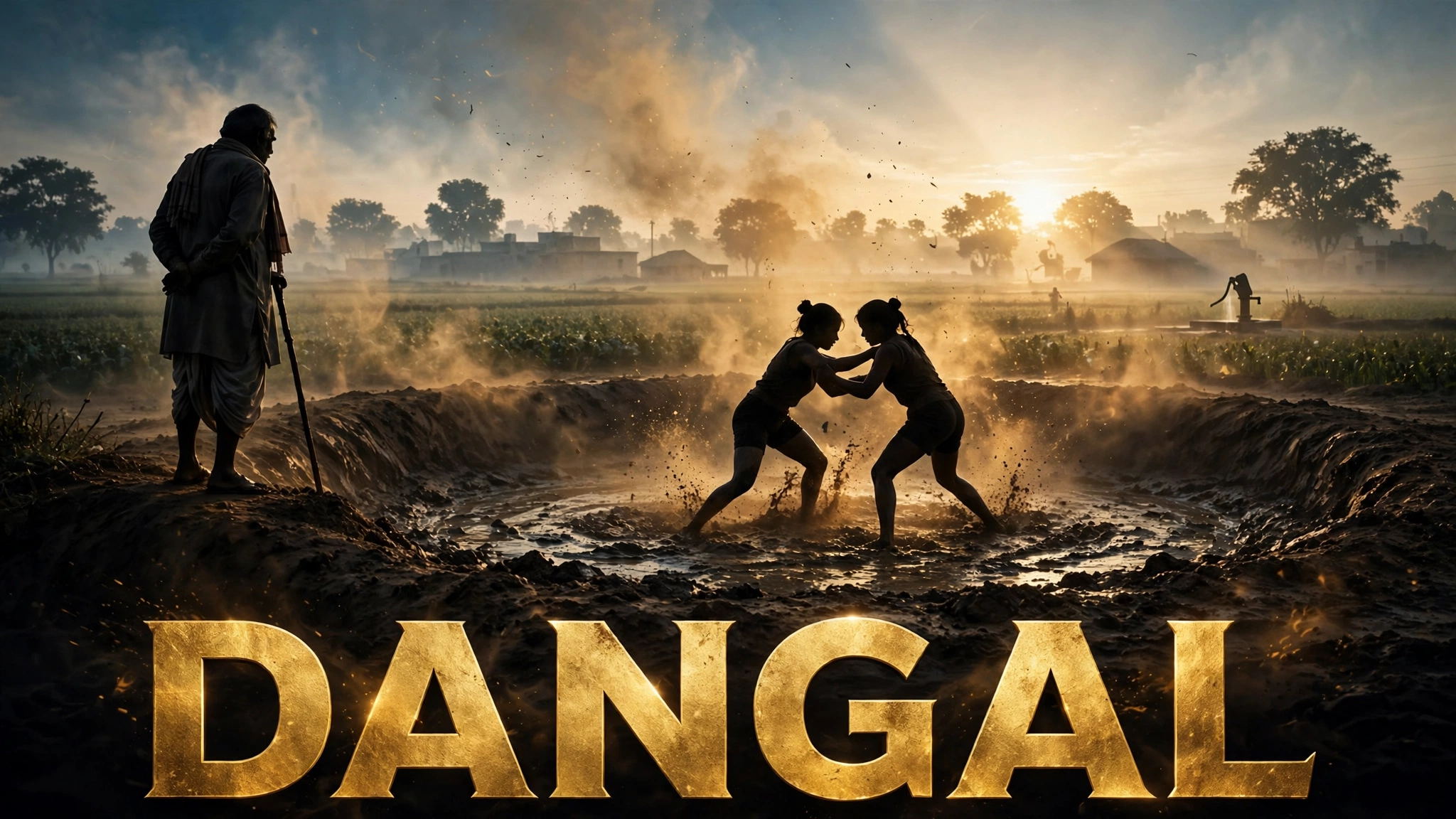

Dangal (2016) Review – Fathers, Daughters and a Gold Medal Dream
Every few years, a Hindi film comes along that manages to be a crowd-pleaser, a critical favourite, and a genuine conversation-starter at the same time. Dangal is that rare film. On the surface it is a sports biopic about wrestling. Underneath, it is about a father’s unfinished dream, two daughters who never asked for it, and a society that had decided long ago what girls were supposed to do with their lives. The friction between those three forces is where the film lives, and it is why the final bout leaves audiences on their feet.
Sports films follow a familiar shape: training, setbacks, a big contest at the end. Dangal does not escape that shape, and it does not pretend to. What it does instead is fill the shape with such specific detail — the mud pits of Haryana, the politics of sports federations, the price of chicken on a wrestler’s diet — that the familiar stops feeling predictable. You know roughly where the story must go. You still find yourself gripping the armrest.
There is also the question the film keeps quietly asking: when does a parent’s ambition for a child become a cage, and when does it become a door? The movie is honest enough to let that question stay uncomfortable for a long time before it offers any answer. That honesty, more than the medals, is its real achievement.
In this review, we will break down the story, the performances, the wrestling itself, the music, and the record-breaking box office run — honestly, including the places where the film plays it safe.
Quick Facts: Dangal at a Glance
| Detail | Information |
|---|---|
| Release date | 23 December 2016 (India) |
| Director | Nitesh Tiwari |
| Writers | Nitesh Tiwari, Piyush Gupta, Shreyas Jain, Nikhil Mehrotra |
| Genre | Biographical sports drama |
| Language | Hindi |
| Runtime | 161 minutes |
| Budget | ₹70 crore |
| Lead cast | Aamir Khan, Sakshi Tanwar, Fatima Sana Shaikh, Sanya Malhotra, Zaira Wasim, Suhani Bhatnagar, Aparshakti Khurana |
| Our rating | 9.0/10 |
The Story: A Dream Handed Down, Whether They Wanted It or Not (Spoiler-Free)
Mahavir Singh Phogat was once a promising wrestler who gave up the sport under family and financial pressure, carrying one regret into middle age: he never won a gold medal for India. He consoles himself with a plan — his son will do it one day. Life, however, gives him four daughters and no son, and the dream appears to die in a house full of girls in a conservative Haryana village.
The turning point arrives when his two eldest daughters, Geeta and Babita, come home having beaten up two boys who troubled them. Mahavir sees what everyone around him refuses to see: the fighting instinct he had been waiting for was in his house all along, just not in the body he expected. Against the mockery of the village, he begins training the girls himself — early mornings, cropped hair, a strict diet, and bouts in a home-dug mud pit.
The story then follows the sisters from local contests against boys, through state and national levels, and into the difficult world of professional coaching and federation politics, where Mahavir’s old-school methods clash with the official system. Geeta, the elder sister, becomes the film’s central sporting figure as she pushes towards international competition, while her relationship with her father strains under the weight of everything he demands.
We will not spoil the results of the final tournaments or how the family rift resolves. It is enough to say the climax is staged as both a sporting contest and an emotional reckoning, and it works on both levels.
Performances: A Family You Believe In
Aamir Khan as Mahavir Singh Phogat: Khan’s physical transformation for this role — gaining substantial weight to play the older Mahavir, then appearing as the fit younger wrestler — is well known, but the acting underneath deserves more attention than the body. His Mahavir is stubborn, proud, sometimes unfair, and completely incapable of expressing love in words. Everything he feels comes out as instruction, criticism, or silence. Khan lets you dislike the man in several scenes, which is a brave choice for a superstar, and it makes the later emotional payoffs honest rather than automatic.
Fatima Sana Shaikh as adult Geeta Phogat: Shaikh carries the film’s hardest assignment: she must be convincing as an international-level wrestler and as a daughter quietly rebelling against the man who made her. She succeeds at both. Her Geeta is not a symbol; she is a young athlete who enjoys her freedom at the national camp, makes mistakes, and has to find her own reasons to fight. The wrestling, crucially, looks real — because the training behind it clearly was.
Sanya Malhotra as adult Babita Kumari: Babita is the quieter sister, the one who mediates between Geeta and their father, and Malhotra plays her with warmth and steel in equal measure. She gets fewer showcase scenes than Shaikh but makes her presence count, especially in the family sequences where her loyalty is torn.
Zaira Wasim and Suhani Bhatnagar as young Geeta and Babita: The child actors are superb. Wasim in particular captures the resentment and slow acceptance of a girl whose childhood is being rewritten by her father’s whistle. Their portions of the film, full of small humiliations and small victories, are arguably its heart.
Sakshi Tanwar as Daya, the mother: Tanwar does a great deal with a role that could have been decorative. Her Daya is the household’s emotional realist — worried, funny, occasionally defiant — and her scenes with Khan ground the film in an ordinary, believable marriage.
Direction and Technical Craft
Nitesh Tiwari directs with patience and a strong feel for place. He lets village life breathe: the gossip, the weddings, the well-meaning relatives who think Mahavir has lost his mind. That groundwork matters, because the audience needs to feel the social pressure the family is defying for the victories to mean anything.
The wrestling sequences are the film’s technical triumph. Shot by Satyajit Pande and staged with real grappling rather than wire-assisted spectacle, the bouts are edited for clarity — you always understand who is winning, who is tiring, and why a particular throw matters. Ballu Saluja’s editing deserves real credit here; sports editing often hides weak action with fast cuts, while Dangal frequently does the opposite, holding shots long enough for the effort to register. The sound design in the arenas — breathing, bodies on the mat, a crowd rising — adds a physicality that no background score could manufacture.
Where the film is less adventurous is in its second-half structure. The conflict between Mahavir and the national coach follows a fairly predictable good-coach, bad-coach pattern, and the federation official is written as a straightforward obstacle rather than a person. It is effective drama, but it is the one stretch where a true story starts to feel arranged for the screen.
At 161 minutes the film is long, yet it rarely drags, because the training material keeps finding new variations and the family scenes keep deepening the stakes. The decision to shoot much of the film in real locations, with dialect coached into the performances, pays off in authenticity throughout.
Music and Soundtrack
Pritam’s soundtrack for Dangal works on two levels: as an album people still play, and as fuel inside the film. The title track is a full-throated training anthem that the film deploys exactly when it should — under effort, not under speeches. “Haanikaarak Bapu,” sung from the children’s point of view about their terrifying father, is a clever piece of writing: it is funny, it is catchy, and it tells you more about the household’s power balance than any dialogue scene could.
The gentler numbers carry the emotional thread. “Naina” aches in the right places during the father-daughter estrangement, and “Idiot Banna” adds a flash of village colour. Amitabh Bhattacharya’s lyrics throughout deserve mention for staying rooted in the film’s world — the words sound like they belong to these people, in this state, in this sport.
The background score supports the wrestling without overwhelming it. In the final bout, the film wisely lets crowd noise and silence do much of the work, reserving the music for the moments where emotion, not information, is the point. It is a well-judged balance that many louder sports films fail to find.
What Works and What Doesn’t
What we loved:
- Wrestling sequences that look, sound, and feel genuinely physical — among the best staged in Hindi cinema
- Performances across four generations of the family, with the young Geeta and Babita stealing the first hour
- A father-daughter conflict the film refuses to simplify, letting Mahavir be wrong as often as he is right
- Music and lyrics that grow out of the story’s world instead of interrupting it
What could be better:
- The national coach is written as a near-villain, which flattens a real institutional debate into a personal duel
- The second half follows the sports-biopic template closely, so a few beats arrive exactly when you expect them
- Babita’s own sporting journey gets less screen time than Geeta’s, leaving her arc slightly underfed
Box Office: The Bout That Conquered Two Countries
Released in India on 23 December 2016 on a budget of about ₹70 crore, Dangal was a major hit at home, but its real box office story became historic overseas — above all in China, where it released in May 2017 and connected with audiences in a way no Indian film had before. Chinese viewers responded to the father-daughter theme and the underdog sports story, and the film kept expanding week after week.
Worldwide, reported totals vary by source and by how later re-releases are counted, but the commonly cited figures place the film in the range of roughly ₹1,968 crore to over ₹2,000 crore, making it the highest-grossing Indian film of its era and, for years, the benchmark every big release was measured against. Even the lower end of that range is extraordinary for a film about women’s wrestling from a Haryana village, with no conventional romance and a middle-aged, overweight hero for much of its running time.
The lesson the industry took — that strong, rooted stories can travel across languages and borders — is one of Dangal‘s most important legacies, alongside the boost it gave to interest in women’s wrestling in India itself.
Verdict: Should You Watch It?
Absolutely. Dangal is popular cinema operating at its highest level: emotionally direct without being dishonest, technically polished without losing its soil, and carried by performances that respect both the real people and the audience. Its flaws — a templated second half and a one-note antagonist — are real but small next to what it achieves. If you have somehow never seen it, clear an evening. If you have, it rewards a rewatch; the early training scenes play even better when you know what they are building towards.
Our rating: 9.0/10 — A rousing, heartfelt sports drama that earns every cheer it gets.
Frequently Asked Questions
Is Dangal based on a true story?
Yes. It is based on the lives of wrestler Mahavir Singh Phogat and his daughters Geeta and Babita Phogat of Haryana. Some events and characters have been dramatised and compressed for the screen, as is standard in biopics.
Is there a sequel to Dangal?
No. Dangal is a standalone film and no sequel has been made or announced.
What language is Dangal in, and are subtitles available?
The film is in Hindi, with a strong Haryanvi flavour in the dialogue. Subtitled versions are widely available for international viewers.
Where can I watch Dangal?
Streaming and rental availability varies by country and changes over time. Check the leading streaming platforms and digital rental stores in your region for the current listing.
What is the runtime and age rating of Dangal?
The film runs for 161 minutes and was certified U in India, making it suitable for family viewing, though younger children may need patience for its length.