
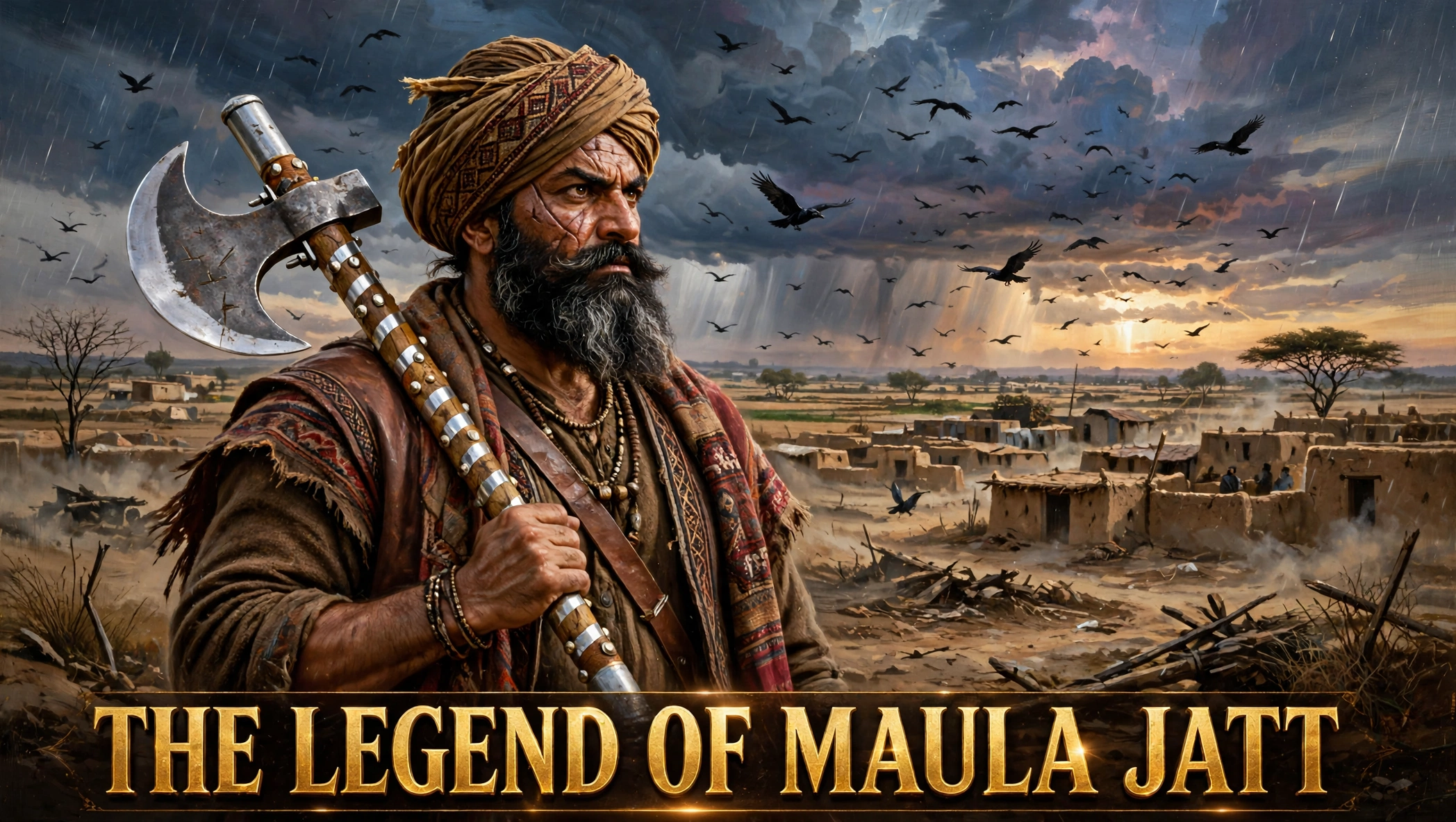

The Legend of Maula Jatt (2022) Review – The Punjabi Epic That Changed Pakistani Cinema Forever
Some films entertain you. A rare few change what an entire industry believes is possible. The Legend of Maula Jatt is firmly in the second category. Released on 13 October 2022 after years of delays, legal battles and a pandemic, Bilal Lashari’s Punjabi action drama did not just revive a 43-year-old cult classic — it became the highest-grossing Pakistani film of all time and proved that a regional-language film from Pakistan could conquer the global box office.
But records alone do not make a great film. Is The Legend of Maula Jatt actually worth watching, or is it all hype and history? In this detailed review, we break down the story, performances, direction, music and box office performance of the film, and give you our honest verdict — the good, the bad, and everything in between.
Quick Facts: The Legend of Maula Jatt at a Glance
| Detail | Information |
|---|---|
| Release date | 13 October 2022 (premiered 12 October 2022, Lahore) |
| Director | Bilal Lashari |
| Writers | Bilal Lashari, Nasir Adeeb |
| Genre | Action, Drama |
| Language | Punjabi |
| Runtime | 153 minutes |
| Budget | Approx. $4.6 million (Pakistan’s most expensive film at the time) |
| Lead cast | Fawad Khan, Hamza Ali Abbasi, Mahira Khan, Humaima Malick |
| Based on | Characters from the 1979 classic Maula Jatt by Nasir Adeeb |
| Our rating | 8.5/10 |
The Story: A Folk Hero Rises (Spoiler-Free)
The film is set in a harsh, feudal Punjab ruled by warring clans, where honour is defended with blood and the weapon of choice is the gandasa — the traditional axe that has become the symbol of this franchise. Maula Jatt (Fawad Khan) is a fierce, prize-winning fighter raised by a foster family, haunted by fragments of a violent childhood he cannot fully remember. He lives for the fight ring and for his loyalty to the Jatt clan that raised him.
Across the divide stands the brutal Natt clan, led by the feared Jeeva Natt and his ruthless son Noori Natt (Hamza Ali Abbasi) — a man so dangerous that even his own family keeps him locked away. When the paths of the two clans collide, Maula is pulled into a war that is far more personal than he realises. At his side is Mukkhoo (Mahira Khan), a sharp-tongued, fearless woman who fights her own battles, while on the other side, Daaro (Humaima Malick) schemes with cold intelligence.
Without giving anything away: this is a revenge saga about identity, blood feuds and the price of honour. The screenplay keeps the soul of the 1979 original — the legendary rivalry of Maula Jatt and Noori Natt — but rebuilds it as a darker, more layered origin story, with flashbacks slowly revealing why these two men were always destined to meet.
Performances: A Career-Best Cast
Fawad Khan as Maula Jatt delivers what many consider the performance of his career. Known mostly for romantic roles before this film, he disappears completely into Maula — bulked up, brooding and quietly volcanic. He does not speak much, but he does not need to: his silence carries threat, grief and honour in equal measure. When he finally explodes, the theatre erupts with him.
Hamza Ali Abbasi as Noori Natt is the perfect storm opposite him. Noori is unhinged, theatrical and terrifying, yet Abbasi finds the wounded pride inside the monster. His entry scene alone is worth the ticket price, and his Punjabi delivery — growling, poetic, unpredictable — gives the film its most quoted dialogues. A great hero needs a great villain, and Noori Natt is now the benchmark for Pakistani cinema.
Mahira Khan as Mukkhoo is far more than a love interest. She is witty, brave and handy in a fight, and her chemistry with Fawad Khan gives the film its emotional softness between battles. Humaima Malick as Daaro is equally impressive — cold, intelligent and dangerous, she plays the Natt clan’s strategist with real menace. The supporting cast adds depth too: Mirza Gohar Rasheed brings a tragic edge as Maakha, Faris Shafi is a revelation as the loyal Mooda, and veterans like Shafqat Cheema and Nayyer Ejaz ground the world in authenticity.
Direction and Technical Brilliance
Bilal Lashari, who announced this project back in 2013 and spent years fighting to finish it, directs with the confidence of a filmmaker who knows exactly what he wants. The world-building is extraordinary for South Asian cinema: mud-brick villages, torch-lit fight pits and sweeping Punjab landscapes create a folk universe that feels ancient and alive.
The action choreography is the film’s biggest technical triumph. The gandasa fights are brutal, weighty and shot with clarity — you see every swing land. Lashari favours long takes and practical stunt work over quick cuts, which makes the violence feel real and dangerous. The cinematography bathes everything in dust, fire and shadow, and the sound design — roaring crowds, clashing steel, pounding drums — turns every duel into an event.
Music and Background Score
Instead of a typical song-and-dance soundtrack, the film leans on a thunderous background score that fuses Punjabi folk instruments with modern orchestral power. The dhol-driven themes that announce Maula and Noori have become iconic in their own right, and the music never lets the tension drop during the clan-war sequences. It is a score designed for the big screen, and it shows.
What Works and What Doesn’t
What we loved:
- Two powerhouse lead performances and a villain for the ages
- World-class action choreography and production design
- A gripping revenge story rooted in Punjabi folk culture
- Dialogues by Nasir Adeeb that honour the 1979 original while feeling fresh
What could be better:
- At 153 minutes, the second half sags in places; a tighter edit would have helped
- Some supporting characters deserved more screen time and clearer arcs
- If you do not understand Punjabi, you will depend heavily on subtitles (though the visuals carry much of the story)
Box Office: Records That May Never Be Broken
The numbers tell their own story. Made on a reported budget of about $4.6 million — the most expensive Pakistani production of its time — The Legend of Maula Jatt crossed $10 million (over Rs. 220 crore) worldwide within seven weeks, became the first Pakistani film to earn Rs. 100 crore domestically, and eventually surpassed Rs. 200 crore globally, finishing as the highest-grossing Pakistani film and the highest-grossing Punjabi-language film of all time. In the UK it was the second-highest-grossing South Asian film of 2022, and in Norway it became the most-watched South Asian film ever. Years later, no Pakistani film has come close to these figures.
Verdict: Should You Watch It?
Absolutely — whether you love action cinema, Punjabi culture, or simply want to see the film that redefined an industry. The Legend of Maula Jatt is not a perfect film: it is long, and its middle stretch tests your patience. But its ambition, performances and sheer scale overwhelm its flaws. This is Pakistani cinema operating at a level nobody believed it could reach.
Our rating: 8.5/10 — a landmark action epic, and essential viewing.
Frequently Asked Questions
Is The Legend of Maula Jatt a remake?
It is a hard reboot of the 1979 cult classic Maula Jatt. It uses Nasir Adeeb’s original characters and rivalry but tells a rebuilt, expanded origin story rather than copying the old film scene by scene.
Is The Legend of Maula Jatt based on a true story?
No. Maula Jatt is a folk character from Punjabi popular culture. The story is fictional, rooted in the clan-feud traditions of rural Punjab.
What language is the film in, and are subtitles available?
The film is in Punjabi. International releases and streaming versions carry English subtitles, and dubbed versions have circulated in some markets.
Where can I watch The Legend of Maula Jatt?
Availability changes by country and over time. The film has appeared on major streaming platforms in various regions after its record-breaking theatrical run, so check your local streaming services and digital stores.
Will there be a sequel to The Legend of Maula Jatt?
The ending leaves the door open, and the makers have spoken about expanding this universe given the film’s historic success. However, no sequel has been officially released or dated as of now — treat any circulating date as rumour until the producers announce it.