
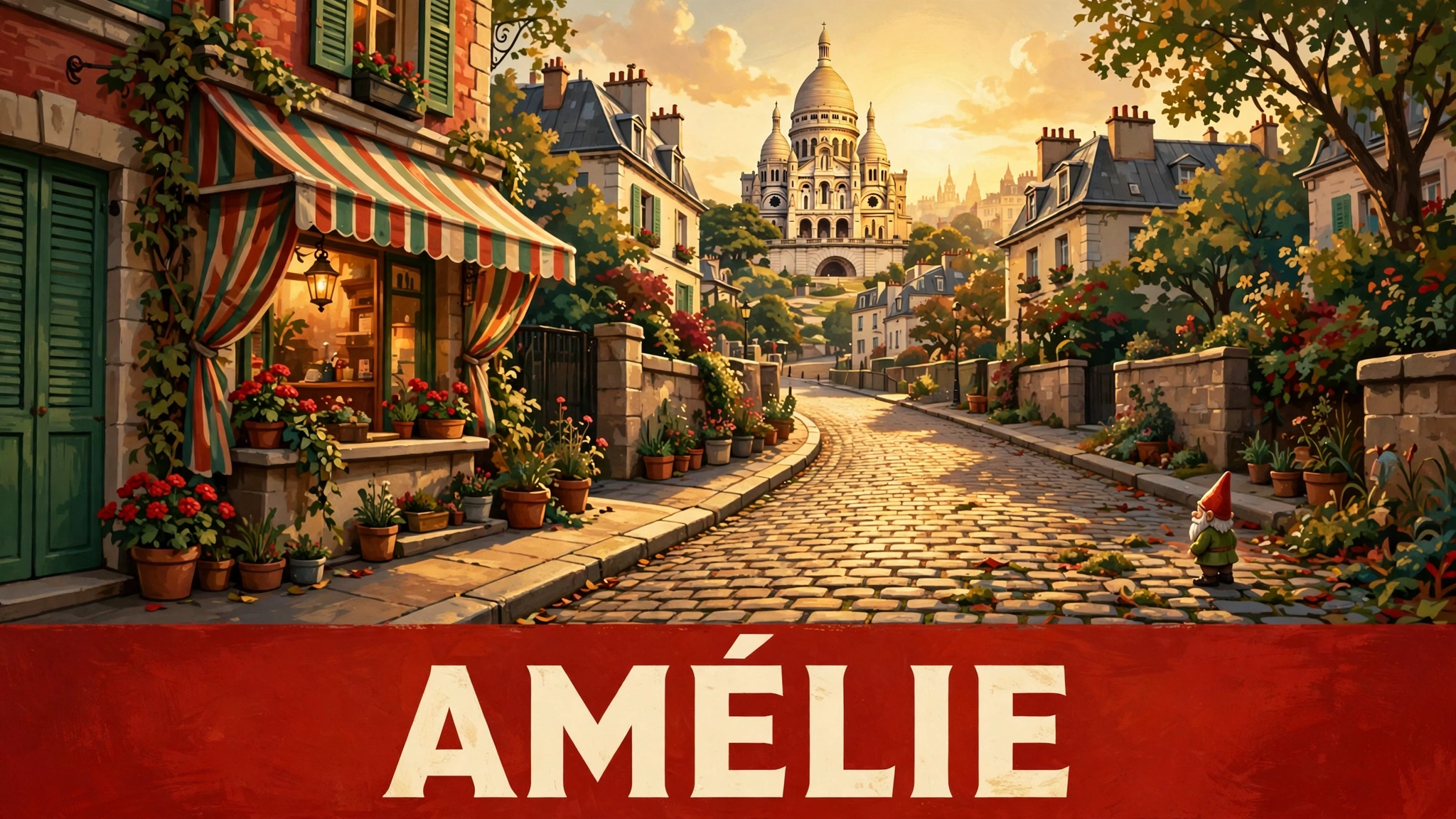

Amélie (2001) Review – A Little Film About Kindness That Took Over the World
Some films you watch. Amélie you fall into. Released in France on 25 April 2001 under its full title Le Fabuleux Destin d’Amélie Poulain — the fabulous destiny of Amélie Poulain — Jean-Pierre Jeunet’s romantic fable took a shy café waitress, a box of childhood treasures, a travelling garden gnome and the streets of Montmartre, and turned them into one of the most beloved European films ever made.
It was an unlikely conquest. Jeunet’s previous films, Delicatessen and The City of Lost Children, were dark, damp and strange, and his Hollywood detour with Alien: Resurrection had satisfied nobody. Amélie was him coming home — to Paris, to French, to warmth — without giving up any of his visual inventiveness. The result charmed critics, packed cinemas for months and introduced the world to Audrey Tautou. In this review we explore the story spoiler-free, the performances, the film’s extraordinary look, Yann Tiersen’s famous music and its box office — and we will be honest about the criticisms, French and otherwise, that have followed it ever since.
Quick Facts: Amélie at a Glance
| Detail | Information |
|---|---|
| Release date | 25 April 2001 (France) |
| Director | Jean-Pierre Jeunet |
| Writers | Guillaume Laurant (screenplay); story by Guillaume Laurant and Jean-Pierre Jeunet |
| Genre | Romance, Comedy, Fantasy |
| Language | French |
| Runtime | 123 minutes |
| Budget | $10 million |
| Lead cast | Audrey Tautou, Mathieu Kassovitz, Rufus, Serge Merlin, Jamel Debbouze, Dominique Pinon |
| Our rating | 9/10 |
The Story: The Secret Life of Amélie Poulain (Spoiler-Free)
An omniscient narrator — dry, amused, listing likes and dislikes at high speed — introduces Amélie Poulain from the moment of her conception, and the childhood that follows explains the adult. Her father, a reserved former army doctor, wrongly concludes from a racing heartbeat during her rare physical check-ups that she has a heart condition. She is kept home from school. Her mother, a tightly wound teacher, dies in a freak accident outside Notre Dame when Amélie is still small. The girl grows up the way such children do: alone, observant, and with an imagination that rushes in to fill every silence.
Adult Amélie works in a Montmartre café full of eccentrics, lives alone in a small flat, and takes her pleasures in miniature — dipping her hand into sacks of grain, cracking the top of a crème brûlée with a spoon, skipping stones on the Canal Saint-Martin. She is not unhappy, exactly. She is unbegun.
Then, on the night of a famous royal car crash in a Paris tunnel — the film dates itself precisely — a shock knocks a bottle from her hand, she finds a loose tile in her bathroom wall, and behind it a small metal box: a boy’s treasure hoard, hidden some forty years earlier. Amélie decides to find the boy, now a middle-aged man, and return it anonymously. If it moves him, she resolves, she will devote herself to doing good turns for the people around her. If it does not, never mind.
It moves him. And so begins her secret career: matchmaking the café’s lovelorn regulars, tormenting a bullying grocer with exquisite, invisible precision, guiding a blind man across a street in a breathless burst of description, sending her widowed father’s garden gnome on a world tour by post. And all the while, a strange young man who collects the torn-up photographs strangers abandon in photo booths keeps crossing her path — Nino Quincampoix — and for once, the person Amélie cannot work out how to help, at a safe and anonymous distance, is herself.
Performances: Tautou’s Star-Making Turn
Audrey Tautou as Amélie Poulain gives one of the great star-making performances in French cinema. Jeunet had written the part with another actress in mind and rewrote his plans the moment he saw Tautou, and it is impossible now to imagine anyone else. Her Amélie is built from glances — sideways, mischievous, wounded, sly — and from stillness. Tautou understands that Amélie is not a manic pixie; she is a lonely, watchful woman whose schemes are how she touches a life she is too frightened to enter directly. The performance is funny throughout and sad underneath throughout, and the final movement of the film works entirely because Tautou has made you feel both at once.
Mathieu Kassovitz as Nino Quincampoix has the harder, quieter job. Nino could be merely a male mirror of Amélie — a fellow collector of other people’s discarded moments — and Kassovitz, better known internationally as the director of La Haine, plays him with a gentle, slightly haunted oddness that makes the pairing feel inevitable rather than cute. Their courtship, conducted through clues, notes and near-misses, only works because both actors play the fear underneath the games.
The supporting company is a Jeunet repertory troupe operating at full charm. Rufus as Raphaël Poulain, Amélie’s father, achieves a whole character arc with barely a handful of lines — his scenes with the gnome’s postcards are among the film’s most moving. Serge Merlin as Raymond Dufayel, the elderly painter with brittle bones who copies the same Renoir every year, becomes Amélie’s unlikely confessor, and Merlin gives the film its wisdom and its spine. Jamel Debbouze as Lucien, the sweet-natured grocery assistant, provides warmth and some of the film’s biggest laughs, while Dominique Pinon as Joseph, the café’s jealous, tape-recording regular, supplies the vinegar. André Dussollier’s narration deserves billing of its own: his crisp, droll delivery is the film’s storytelling engine, and the movie would be half itself without him.
Direction and Technical Brilliance
Amélie is one of the most visually distinctive films of its era, and its look was engineered, not found. Jeunet and cinematographer Bruno Delbonnel saturated the film in greens, reds and golds, cleaned the streets of Montmartre of graffiti, modern clutter and — controversially — much of modern Paris itself, and shot the city as a storybook version of its own best memories. Delbonnel’s camera tilts, dives, races along streets and peers through keyholes; special effects, still relatively new as an everyday tool in French cinema, are used for daydreams, melting hearts and talking portraits rather than spectacle.
The editing, by Hervé Schneid, matches the narration’s pace in the famous opening sequences — a childhood summarised in minutes through dozens of tiny, perfectly timed vignettes — and then, importantly, slows down. Jeunet knows the whimsy would curdle if the film never breathed. The quiet scenes between Amélie and Dufayel, conducted across balconies and through a video camera, are shot simply, and they anchor everything.
The criticism of this style is real and worth stating plainly. In France, some critics attacked the film’s Paris as a scrubbed, nostalgic postcard — a Montmartre emptied of the diversity and difficulty of the real neighbourhood — and the charge has never entirely gone away. Jeunet’s defence, that he was making a fable rather than a documentary, is fair; but a fable still chooses what to show, and viewers who know the real Paris may feel the film’s tidiness as an exclusion rather than a dream. It does not diminish the craft. It does complicate the love letter.
Music and Background Score
Yann Tiersen’s music is now so famous that many people know the soundtrack better than the film. Remarkably, much of it was not written for Amélie at all — Jeunet discovered Tiersen’s earlier albums during production and built the film’s musical world from them, with Tiersen composing additional material to complete it. The sound is unmistakable: piano, accordion, toy piano, music box and waltzing strings, circling simple melodies that feel like memories of a France that may never have existed.
Pieces like the famous piano waltz that follows Amélie through her schemes have taken on a life in adverts, weddings and a thousand internet videos, but in the film itself the music is used with discipline. It carries the montages, threads the separated characters together, and falls away for the dialogue scenes that matter. Few scores have ever been so completely fused with a film’s identity — for better and, occasionally, for a touch of over-familiarity on rewatch.
What Works and What Doesn’t
What we loved:
- Audrey Tautou’s luminous, career-defining performance
- Bruno Delbonnel’s saturated green-and-gold Paris — a visual signature copied ever since
- A script that builds real emotion out of tiny acts of kindness and cruelty
- Yann Tiersen’s score, inseparable from the film’s identity
- The Dufayel scenes, which give the whimsy a wise, melancholy heart
What could be better:
- The film’s Paris is a deliberate fantasy — beautiful, but scrubbed of the real city’s diversity and edge, a criticism raised in France from the start
- Viewers allergic to whimsy will find the narration and vignettes relentless in the first half hour
- Some subplots among the café regulars resolve a little too neatly, even by fable standards
Box Office: France’s Global Fairytale
Made for just $10 million, Amélie grossed about $174.4 million worldwide — one of the greatest returns in French cinema history. It ran for months in French cinemas, became one of the most successful non-English-language films ever released in the United States, and picked up five Academy Award nominations, including Best Foreign Language Film and Best Original Screenplay, alongside a sweep of César Awards at home. Perhaps more telling than any figure: Montmartre tourism surged, the café where Amélie works became a pilgrimage site, and the film’s visual language — the colours, the narration, the lists of likes and dislikes — was imitated by advertisers and filmmakers for a decade. Few $10 million films have ever cast so long a shadow.
Verdict: Should You Watch It?
Yes — Amélie remains the definitive feel-good film for grown-ups, and its craft has barely dated. Go in knowing what it is: a fable, told in a heightened style, about a woman who must learn to accept for herself the happiness she engineers for everyone else. If its whimsy is not for you, you will know within twenty minutes. If it is, the film’s final ten minutes deliver one of the most purely joyful payoffs in modern cinema.
Our rating: 9/10 — enchanting, beautifully made and quietly wise beneath the sugar.
Frequently Asked Questions
What does the full French title of Amélie mean?
Le Fabuleux Destin d’Amélie Poulain translates as “The Fabulous Destiny of Amélie Poulain”. International releases shortened it to simply Amélie.
Is Amélie based on a true story?
No. Amélie is an original character created by Jean-Pierre Jeunet and screenwriter Guillaume Laurant. The film’s Paris is a deliberately heightened, storybook version of the real Montmartre.
Should I watch Amélie with subtitles or dubbed?
Subtitles, strongly recommended. André Dussollier’s narration and the cast’s delivery are central to the film’s rhythm and humour, and much of that is lost in dubbing.
Is Amélie suitable for children?
It is a gentle film in spirit, but it was made for adults — there are brief sexual references and frank moments among the café regulars. It suits teenagers and adults best, though older children who cope well with subtitles often love it.
Where was Amélie filmed?
In real Paris locations, heavily art-directed — principally Montmartre, including the Café des Deux Moulins, which still operates and still draws fans of the film from around the world.